

Got dreams to achieve? Hop on as we take you on your journey to success!


Services
Contact Info

Noida office
+91 7428715522Bangalore office
+91 8861432223 support [at] vidysea.com
Copyright@Vidysea
Got dreams to achieve? Hop on as we take you on your journey to success!
Noida office
+91 7428715522Bangalore office
+91 8861432223support [at] vidysea.comCopyright@Vidysea
Studying in Singapore is a major aspiration for countless international students. As Asia’s premier education hub, boasting world-renowned universities like NUS and NTU, rich cultural diversity, and a booming fintech and business sector, the "Lion City" offers a world-class educational experience. However, fully grasping the Cost of Study in Singapore is vital before you pack your bags. Without a solid financial plan, students may encounter unexpected budgetary pressure in one of the world's most expensive cities. In this detailed guide, we will break down the Cost of Study in Singapore, explain major expenses, provide university and course-wise estimates, and offer tips to manage your finances effectively.

Team Vidysea
Published Updated
The Cost of Study in Singapore extends far beyond just paying your university tuition. It comprises a mix of several key elements:
On average, international students must budget approximately SGD $1,500 to SGD $3,000 per month for living costs alone. However, your actual Cost of Study in Singapore will vary based on your lifestyle. Understanding these totals ahead of time helps you plan better.
When calculating the Cost of Study in Singapore, tuition is your biggest expense. Fees vary significantly between public autonomous universities (like NUS, NTU, SMU) and private educational institutions (PEIs like SIM, PSB).
International undergraduate fees depend heavily on the course type and whether you opt for the MOE Tuition Grant (a subsidy in exchange for a 3-year work bond).
Postgraduate (Master’s, MBA) fees are a major factor in the Cost of Study in Singapore:
Living expenses constitute a massive chunk of the total Cost of Study in Singapore. Costs are usually calculated on a monthly basis.
Unlike larger countries, Singapore is a city-state. Rent is high everywhere, but choosing shared HDB flats over private condominiums is the single best way to lower the Cost of Study in Singapore.
To accurately estimate the Cost of Study in Singapore, you must add these essentials:
Here is a rough breakdown to help you visualize the annual Cost of Study in Singapore (Tuition + Living):
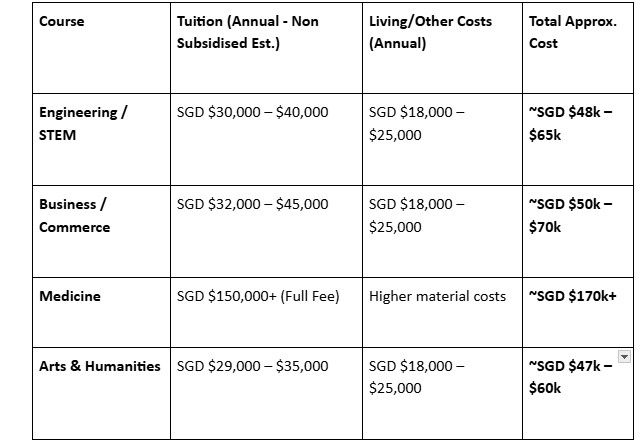
Note: Securing the MOE Tuition Grant can reduce tuition by approx 40-50%, significantly lowering the Cost of Study in Singapore.
Here are practical tips to lower the Cost of Study in Singapore:
What is the average Cost of Study in Singapore for international students?
On average, living expenses are around SGD $20,000-$30,000 per year, while tuition ranges from SGD $30,000 to $50,000 (without grant), making the total Cost of Study in Singapore range between SGD $50k-$80k annually.
How much do undergraduate programmes cost in Singapore?
International undergraduate tuition typically ranges from SGD $30,000 to $40,000 per year (non-subsidised). With the Tuition Grant, this drops significantly, impacting the total Cost of Study in Singapore.
What are the living expenses for students in Singapore?
Living expenses generally range between SGD $1,500 and SGD $2,500 per month depending on whether you rent a shared HDB room or a private condo.
Can scholarships reduce the Cost of Study in Singapore?
Yes. Singapore offers generous scholarships like the Singapore International Graduate Award (SINGA) and university-specific awards that can fully cover the Cost of Study in Singapore.
Are there hidden costs students should know about?
Yes. Rental deposits (usually 1-2 months' rent), air conditioning servicing fees (for rentals), and high alcohol/entertainment costs are "hidden" additions to the Cost of Study in Singapore.
Is it possible to work part-time to offset the Cost of Study in Singapore?
Only if you study at a designated government-approved institution (like NUS, NTU, SMU, polytechnics). Students at private institutions (PEIs) are generally strictly forbidden from working, so you cannot rely on jobs to lower the Cost of Study in Singapore.
Planning ahead is essential to manage the Cost of Study in Singapore effectively. Tuition fees, high rent, and lifestyle costs all add up—and careful budgeting is key. However, through the MOE Tuition Grant, scholarships, and smart living choices (like HDB renting and hawker food), you can offset these expenses.
With proper guidance and preparation, international students can achieve their dream of an Asian Ivy-league education without the Cost of Study in Singapore causing overwhelming financial stress.