

Got dreams to achieve? Hop on as we take you on your journey to success!


Services
Contact Info

Noida office
+91 7428715522Bangalore office
+91 8861432223 support [at] vidysea.com
Copyright@Vidysea
Got dreams to achieve? Hop on as we take you on your journey to success!
Noida office
+91 7428715522Bangalore office
+91 8861432223support [at] vidysea.comCopyright@Vidysea
Every year, thousands of Indian students who have been admitted to top universities abroad have their visas refused. Not because they were not qualified. Not because their university was not legitimate. But because of specific, preventable documentation errors that an experienced student visa assistance review would have caught before the application was submitted. The pattern of rejections is remarkably consistent. The same ten issues appear in the refusal letters year after year: insufficient financial proof, one IELTS band score below the visa minimum, missing TB test, undisclosed previous refusals, inconsistent Statements of Purpose. These are not obscure edge cases. They are the majority of all student visa refusals across the UK, USA, Australia, and Canada.

Team Vidysea
Published Updated

This guide documents every common rejection reason for Indian student visa applications in 2026, across all major study destinations. For each reason, it tells you exactly why it causes a refusal, how to prevent it, and whether it can be fixed after the fact. The guidance for study abroad that follows a refusal is valuable — but the guidance that prevents the refusal in the first place is worth ten times more.
🔴 The most important insight in this guide
85–90% of student visa refusals for Indian students are caused by one of the ten reasons in the table below. None of them require exceptional circumstances. All of them are preventable with a structured pre-application review. The students who receive refusals are not unlucky — they are applicants who either were not given the right student visa assistance, or did not seek it. A 45-minute document review before submission prevents the most expensive mistake in study abroad planning.
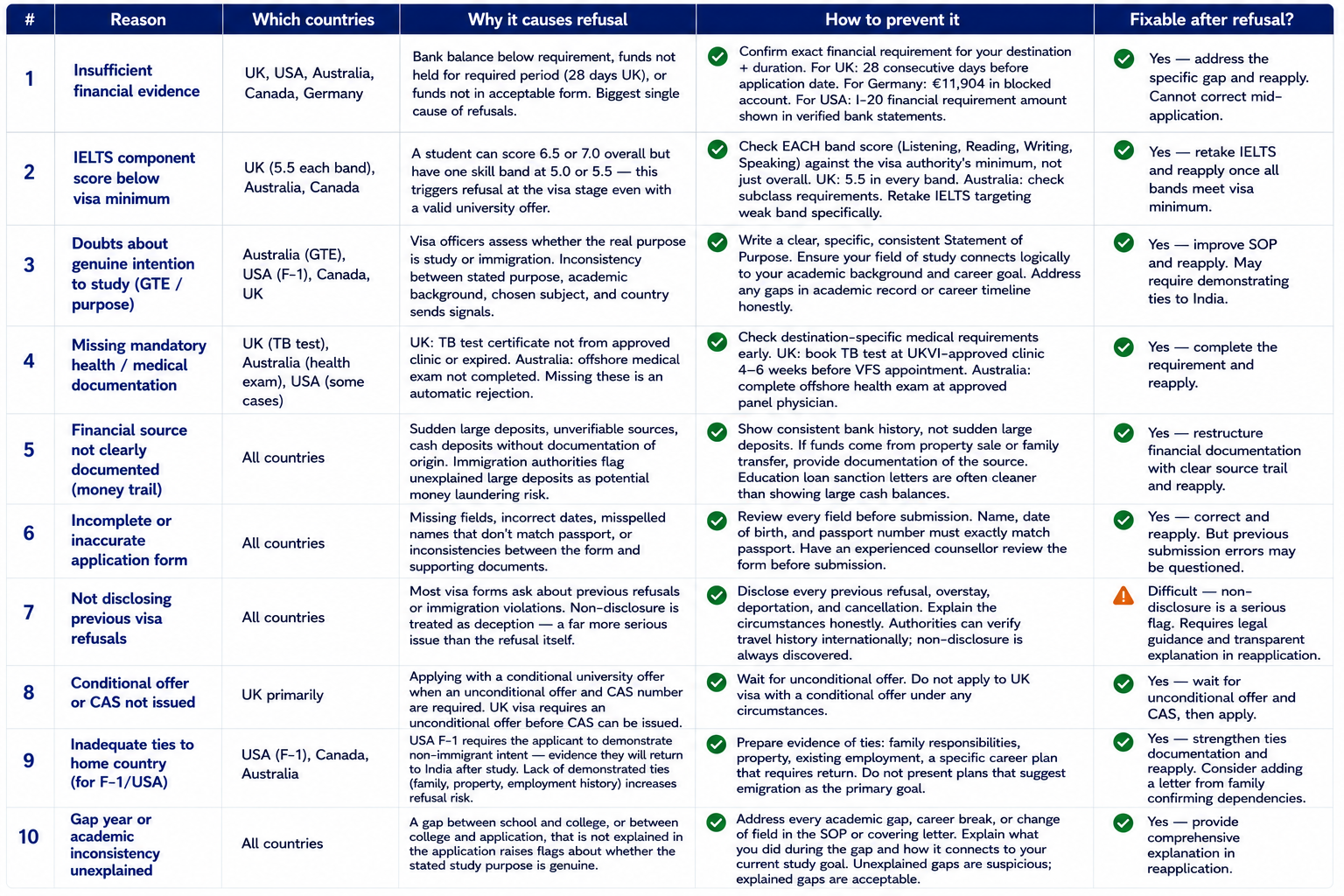
10 Common Student Visa Rejection Reasons — Prevention and Recovery
This table covers the ten most frequent causes of student visa application refusals for Indian students across all major study destinations in 2026. The 'Fixable after refusal?' column uses: Yes (straightforward reapplication), Difficult (complex situation), Very Difficult (may require legal guidance):
✅ The one check that prevents the most refusals
Before submitting any student visa application, review your IELTS score certificate and verify every individual band score — Listening, Reading, Writing, and Speaking — against the visa authority's minimum for each skill. Not just the overall score. For UK: every band must be 5.5+. A score of 6.5 overall with Writing at 5.0 = visa refusal. This 3-minute check prevents the single most common cause of UK student visa refusals for Indian students.
Deep Dive: The Three Most Common Rejection Reasons for Indian Students
Three of the ten reasons above account for more than 60% of all Indian student visa refusals. They deserve specific attention.
1. Financial Proof — The 28-Day Rule and Source Documentation
Every major study destination has a financial maintenance requirement — you must show you can afford to study and live there. The refusal does not come from having insufficient money. It comes from not demonstrating it correctly in the required format
UK (28-day rule): Your bank balance must be at or above the required amount (£9,338 for studies outside London, £11,385 in London) for 28 consecutive days ending no more than 31 days before your visa application date. A balance that dips even for one day within the 28-day window can be flagged. Sudden large deposits within the window — especially loan disbursements — can be questioned if their source is not clear.
Germany (blocked account): You must deposit exactly €11,904 into a blocked account (Sperrkonto) with Fintiba or Expatrio before your visa appointment. The blocked account statement — not a regular bank statement — is what German consulates accept as financial proof. Showing a regular bank balance of €12,000 instead of a blocked account is not equivalent.
USA (F-1): Your financial proof must match or exceed the total amount shown on your I-20 (Form I-20 from the university, which specifies tuition + living estimate). Bringing bank statements showing less than the I-20 amount, or bank statements for accounts that are not yours, is the most common F-1 refusal cause.
Australia: Funds must be 'readily accessible' and show a pattern of availability — not a one-day peak balance. Bank statements for the last 3 months showing the required amount consistently held are stronger than a single recent statement showing a sudden large balance.
2. IELTS Component Score Below Visa Minimum
This is the most under-checked and most fixable cause of UK student visa refusals. The UK Student visa requires IELTS 5.5 in each individual skill band — not just 5.5 overall. A student who scores 7.0 overall but has Writing at 5.0 will have their UK Student visa refused. This happens because:
The fix: check your band scores now. If any individual band is below 5.5, book a targeted retake focusing on that section. The IELTS 30-day improvement guide on Vidysea's blog covers exactly this scenario — a targeted retake for one weak band.
3. Non-Disclosure of Previous Visa Refusals
This is the one rejection reason that cannot simply be fixed by reapplication. If a student does not disclose a previous refusal and the immigration authority discovers it — either through their own systems or through inconsistencies in the application — the applicant is flagged for deception, which is a far more serious matter than the original refusal.
The correct approach: Disclose every refusal, overstay, cancellation, and deportation across every country, no matter how old or apparently minor. Most visa forms have a question asking about this explicitly. The form asks for a reason why the previous application was refused — provide it honestly and explain what has changed since.
A previous refusal, honestly disclosed with an explanation of the change in circumstances, is much less likely to cause a second refusal than a non-disclosure discovered by the immigration authority. Immigration databases are international. Non-disclosure is almost always discovered.
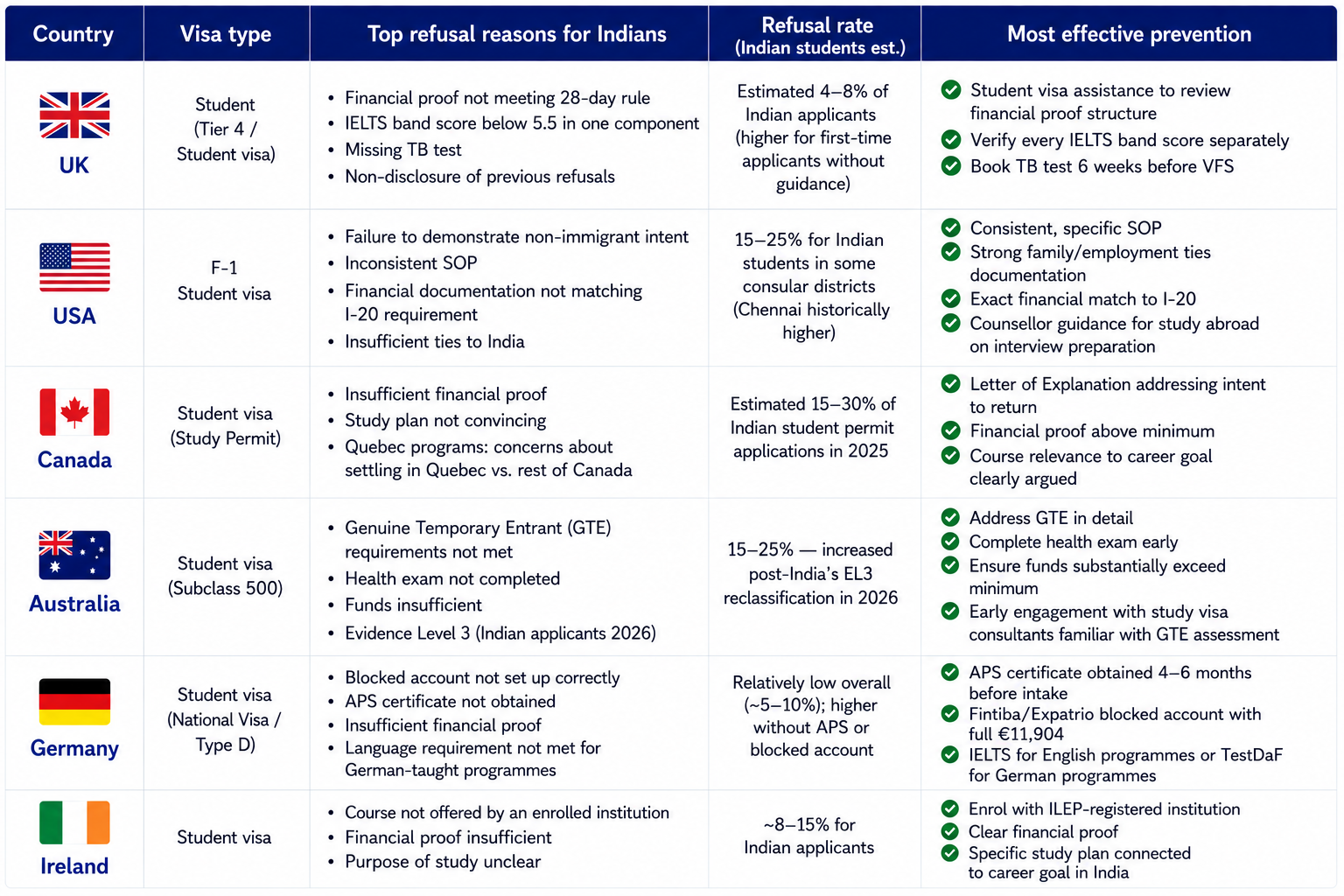
Country-by-Country: Rejection Patterns for Indian Students
Different destinations have different rejection patterns. Study visa consultants who specialise in specific country applications have pattern knowledge that generic guidance lacks. Here is what the data shows for Indian students in 2026:
⚠️ Australia's Evidence Level 3 reclassification for India (2026)
India was reclassified to Evidence Level 3 by Australia's Department of Home Affairs in 2026 — the highest scrutiny tier. This means Indian student visa applications receive stricter documentation review, stricter GTE (Genuine Temporary Entrant) assessment, and stricter financial proof standards than in previous years. Applications that would have been approved without incident in 2023 or 2024 may now require stronger evidence. Indian students applying for Australia in 2026 should engage student visa services from counsellors with specific 2026 Australian processing experience.
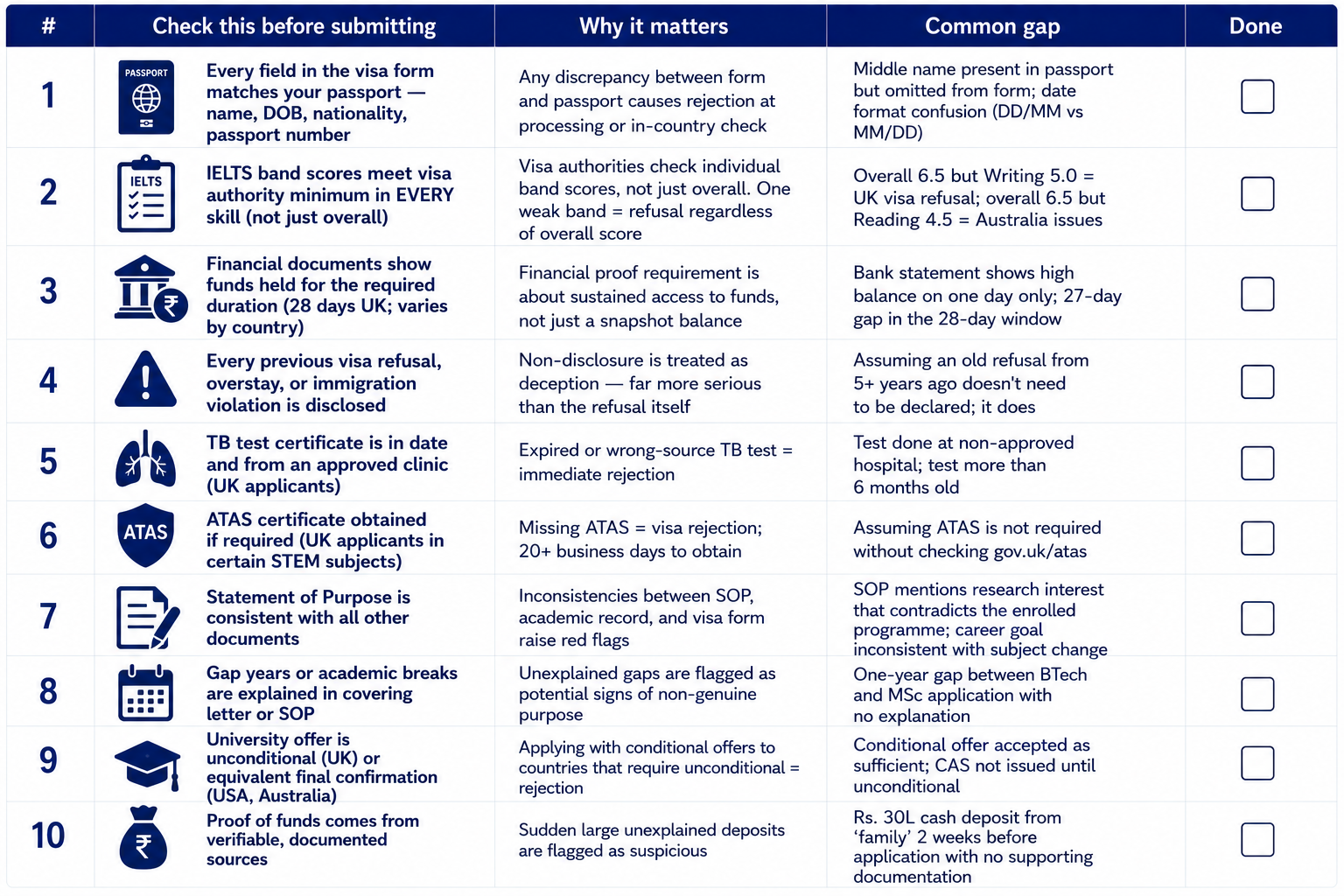
Pre-Application Self-Review Checklist — Catch Rejection Reasons Before Submission
Use this checklist before submitting any student visa application. This is the same review Vidysea's student visa assistance process covers — you can do it yourself, or a counsellor can do it with you:
💡 The value of professional student visa assistance on the checklist
The checklist above can be done independently. The value that experienced study visa consultants add is pattern knowledge: knowing which of these items is most likely to be an issue for your specific profile (academic background, financial structure, previous travel history) and which requires the most careful documentation. A counsellor who has seen 500 UK student visa applications knows exactly which IELTS band scores are most commonly flagged, which financial structures are most likely to be questioned, and what language in an SOP triggers additional scrutiny.
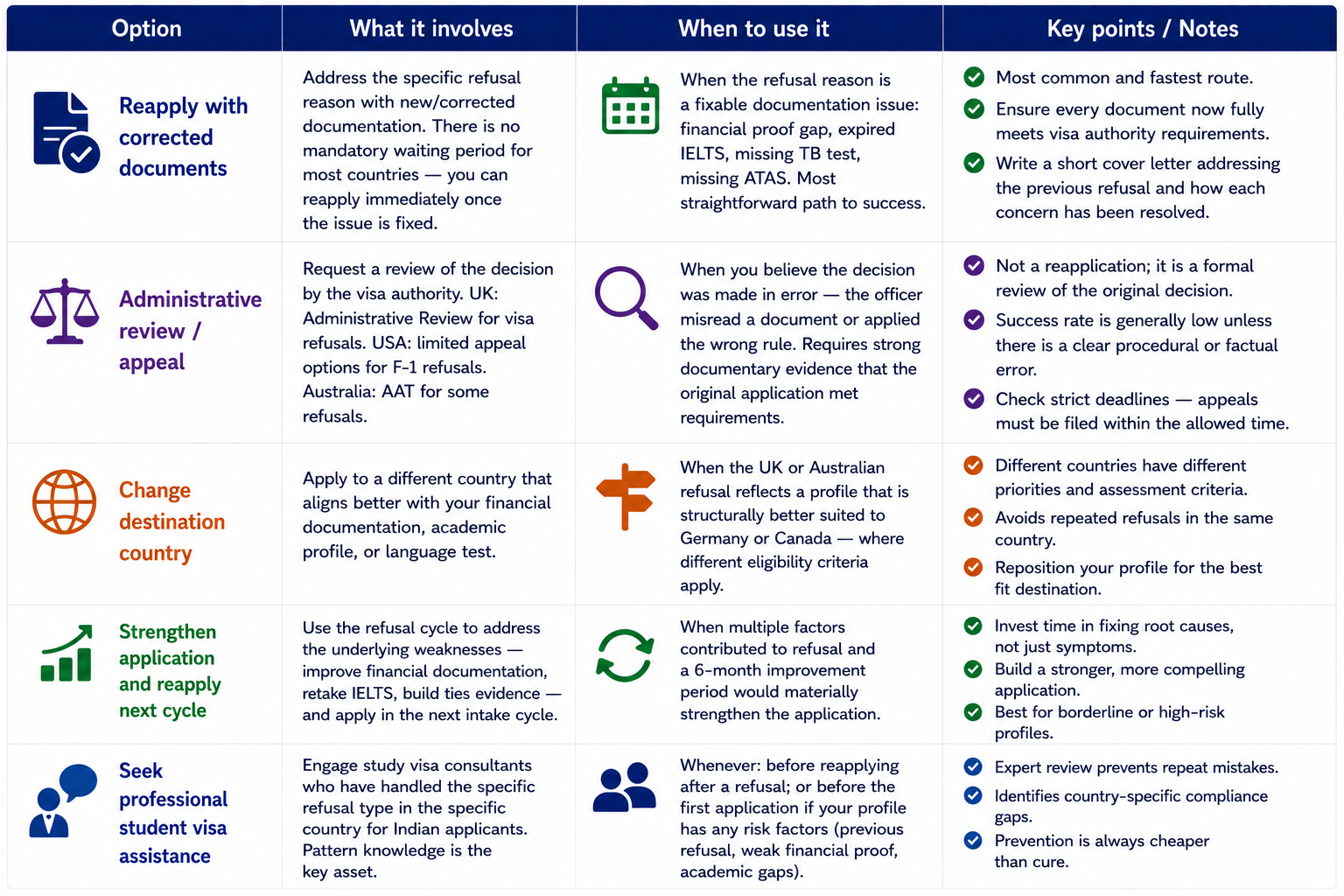
If You Receive a Refusal — Your Options
A visa refusal is not the end of your study abroad plan. It is a specific, documented reason why your application did not meet the requirements at the time of submission. Understanding your options — and which option fits your situation — determines your next step:
✅ The two actions to take immediately after receiving a refusal notice
First: read the refusal letter in full. The reason is specific — most letters identify exactly which requirement was not met. Second: do not submit a new application immediately. Understand whether the issue is a documentation gap (usually fixable quickly) or a substantive concern (genuinely not meeting visa criteria — needs a different approach). A rushed reapplication with the same underlying issue will produce the same result. Engage student visa assistance from a counsellor before reapplying.
Frequently Asked Questions
Does a visa refusal affect my future applications permanently?
A refusal must be disclosed in all future visa applications to any country that asks about immigration history. This is not a permanent bar — most countries accept that refusals occur and that circumstances change. What matters is honest disclosure + a genuine change in the circumstances that caused the refusal. A student refused for insufficient financial proof who returns with a clear, well-documented financial structure is in a completely different position from a student who reapplies without addressing the refusal reason.
Can I switch country if my UK or Australian visa is refused?
Yes — many Indian students who face UK or Australian refusals find that Germany or Canada is a better fit for their profile. Germany's student visa has a different financial proof structure (blocked account, not 28-day rule), no GTE requirement, and no ATAS. Canada's study permit process is different from Australia's. A Vidysea counsellor who reviews the refusal reason can advise on whether a different destination is a more structurally appropriate choice for your profile.
Do I need study visa consultants, or can I manage the visa process myself?
You can legally manage the process yourself — there is no regulatory requirement to use study visa consultants. The risk is pattern knowledge: knowing that a particular financial structure, a one-band IELTS weakness, or a specific academic gap creates a refusal risk requires experience across hundreds of applications. The cost of a refusal — re-application fees, delayed intake by 6 months, additional IHS payment for UK, and in some cases a full additional year — is usually far higher than the cost of student visa services from an experienced counsellor. Most refusals are preventable with a structured pre-submission review.
How long does a visa refusal stay on my immigration record?
Visa refusals are stored indefinitely in the immigration records of the relevant country's authorities. They do not automatically expire or disappear after a period of time. This is why non-disclosure is so serious — authorities can verify previous applications from years ago. Honest disclosure of a refusal from 8 years ago is far better than non-disclosure of a refusal from 8 years ago that is subsequently discovered.
The student visa process is predictable. The rejection reasons are documented and known. The prevention checklist is specific and checkable. The overwhelming majority of student visa refusals for Indian students are preventable — not by being exceptional applicants, but by avoiding the specific, identifiable documentation errors that cause the rejections in the first place. Guidance for study abroad that includes a pre-application document review is not a luxury — it is the most cost-effective investment in the entire study abroad process.