GMAT Preparation Guide for MBA Aspirants in India: How to Prepare for Abroad Studies — Complete 2026 Edition
The GMAT is the most important number in your MBA application — not because it is the only thing business schools evaluate, but because it is the first filter applied to every application in every round at every top global programme. A 650 does not compete with a 730 for the same spot at LBS, INSEAD, or Booth. The GMAT score determines which programmes are realistic targets and which are stretches — before a single essay is written.

Team Vidysea
June 3, 2026

For Indian MBA aspirants, the GMATcarries additional weight because of India's highly competitive applicant pool. Top business schools receive hundreds of applications from Indian engineers and consultants every cycle. A candidate whose profile is otherwise strong — IIT background, 5 years at a top-tier company, clear career progression — is not differentiated by those factors alone. GMAT score is often the variable that moves an application from 'strong pool' to 'offer'.
This guide covers everything you need to understand about how to prepare for abroad studies through the GMAT: the GMAT Focus Edition format (in use since November 2023), the score targets for every tier of global MBA programme, a complete 13-week study plan, the best resources for Indian aspirants, and the seven preparation mistakes that most commonly limit Indian applicants from reaching their target score.
GMAT Focus Edition vs. Classic GMAT — critical for Indian aspirants using older study materials
GMAT Focus Edition (launched November 2023) has replaced the Classic GMAT at all test centres globally. The differences are material: Data Sufficiency moved from Quant to the new Data Insights section, Sentence Correction removed from Verbal, scoring changed from 200–800 to 205–805, and section composition changed. Any preparation resource published before mid-2023 reflects the Classic GMAT format and is partially outdated. This guide covers GMAT Focus Edition specifically.
The GMAT Focus Edition — Format, Sections, and What It Tests
The GMAT Focus Edition is a computer-adaptive test administered by GMAC (Graduate Management Admission Council). It tests reasoning and analytical skills — not subject knowledge — across three sections. Each section is separately adaptive: the test adjusts question difficulty based on your real-time performance within each section.
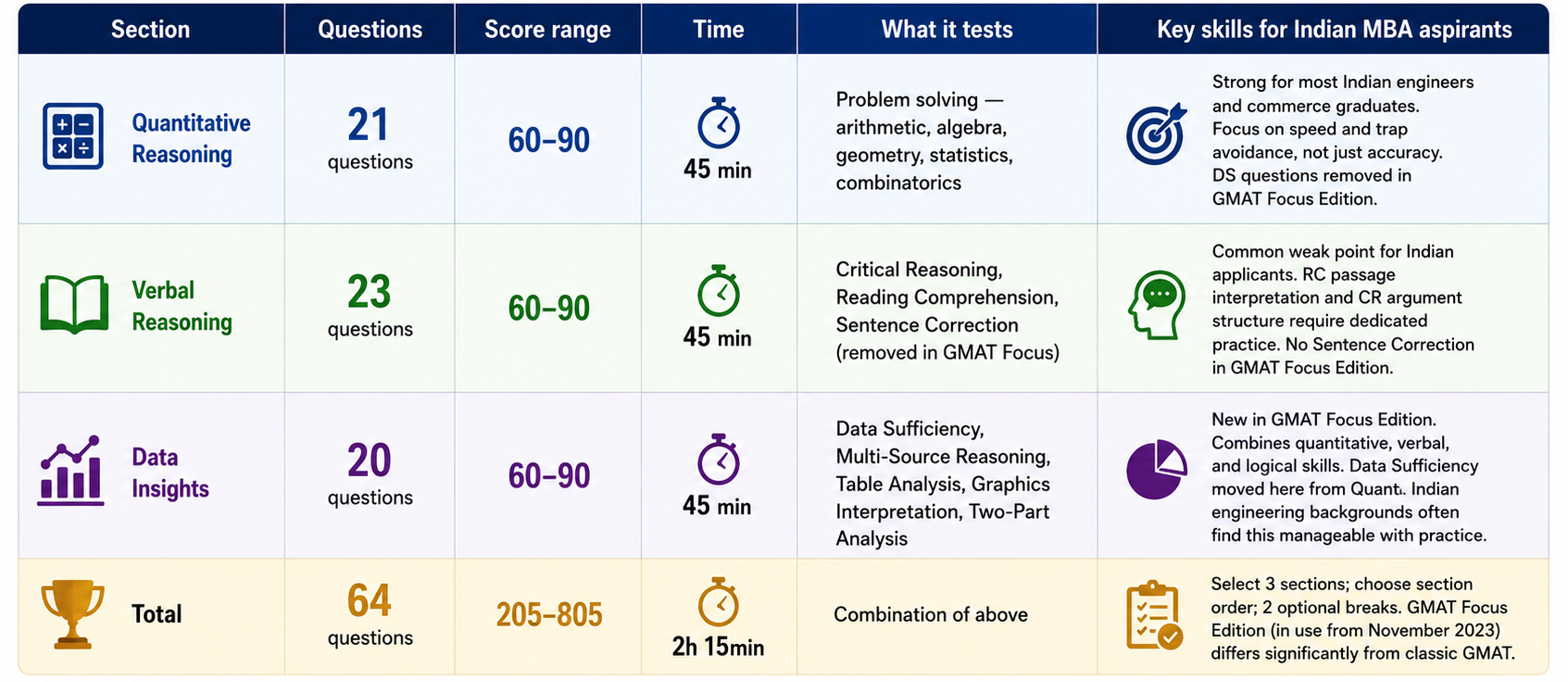
The GMAT Focus Edition adaptive engine rewards consistency, not peaks
The GMAT scoring algorithm rewards consistent performance across difficulty levels more than a few brilliant answers surrounded by errors. Getting difficult questions wrong after getting easy questions right signals score instability. The preparation strategy that follows is built around building consistent accuracy at progressively higher difficulty levels — not cramming for hard question types while neglecting the medium-difficulty foundation.
GMAT Score Targets — What Score Do You Actually Need?
The answer to 'what GMAT score do I need?' depends entirely on which programmes you are targeting. Here is the score landscape for global MBA programmes most relevant to Indian applicants in 2026:
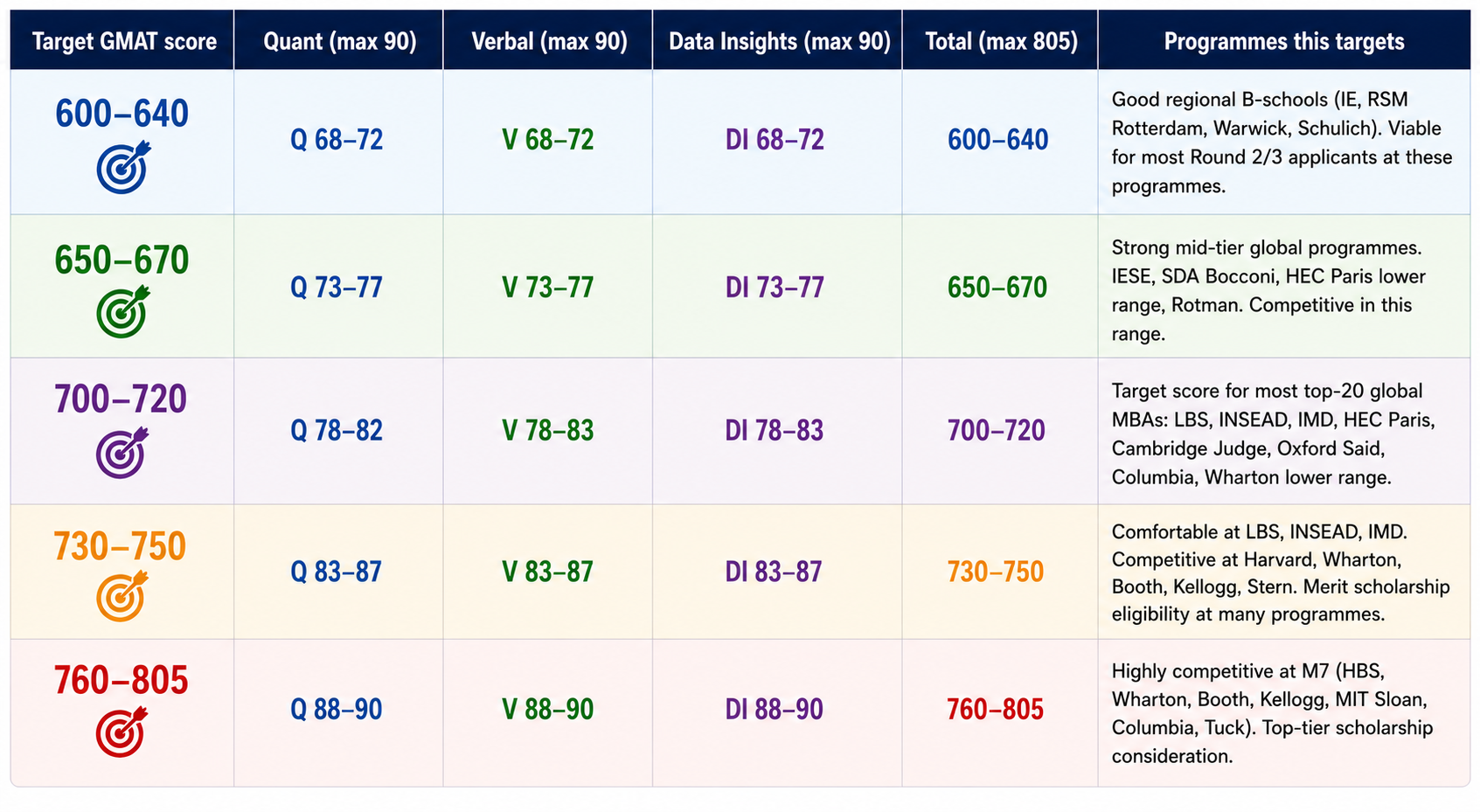
The Indian applicant pool problem — why your score needs to be above average
Business schools report average GMAT scores — but Indian applicants do not compete against the entire class average. They compete against the Indian applicant pool, which is among the highest-scoring in the world. A 700 GMAT is at the class average for LBS — but if the Indian applicant pool median at LBS is 720, a 700 is below average within your demographic. For Indian aspirants, targeting 20–30 points above the stated class average GMAT is the safer calibration. Check Indian admits' GMAT scores on MBA forums (GMAT Club, Poets & Quants), not just the school's stated average.
13-Week GMAT Study Plan — How to Prepare for Abroad Studies
This 13-week plan is designed for Indian MBA aspirants working full-time (20–25 hours per week preparation). It targets a 700–730 GMAT Focus Edition score from a typical starting baseline of 620–650. Students with a higher baseline can compress the timeline; those targeting 750+ should extend to 16–20 weeks and increase daily hours in Weeks 9–13.
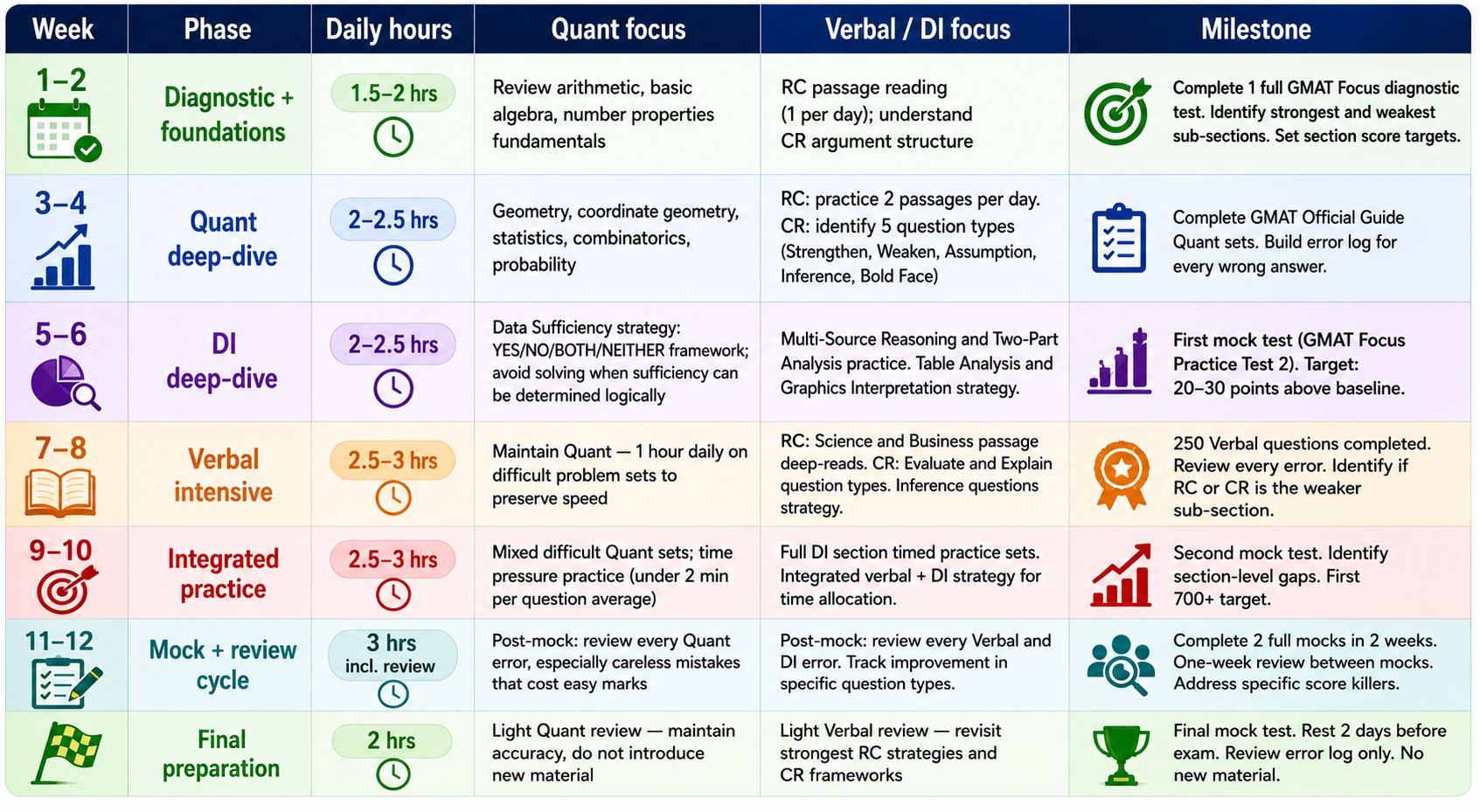
The error log is the most important tool in this plan
Every mock test review must be systematic. For every wrong answer: (1) Categorise the error — was it conceptual (did not know the rule), procedural (knew the rule, made an arithmetic error), or strategic (chose the wrong approach)? (2) Identify the specific question type and sub-type. (3) Note what the correct reasoning path was. A student who completes this review for every error across 6 mock tests has a complete map of their specific weaknesses. The student who just scores the mock and moves on repeats the same errors in the next test.
Section-by-Section Preparation Strategy
Quantitative Reasoning — where Indian applicants have the biggest advantage
Indian applicants from engineering and commerce backgrounds typically have strong Quant foundations. The GMAT Quant section does not test knowledge beyond Class 12 mathematics — the challenge is speed and trap avoidance, not concept difficulty.
- The 2-minute rule: average 2 minutes per Quant question. If you reach 2:30 on any question, make your best guess and move on — the opportunity cost of spending 4 minutes on one question is larger than the point lost.
- Trap vocabulary: GMAT Quant specifically uses 'integer', 'positive', 'negative', 'distinct', 'consecutive' in ways that create traps. When a question says 'positive integer', it is often testing whether you forget that zero is not positive.
- Estimation is legitimate: GMAT often rewards students who estimate rather than calculate. If four answer choices are 45, 90, 180, and 360, you may not need to compute — eliminate and estimate.
- Do not re-invent approaches on exam day: build a personal toolkit of 8–10 Quant approaches (number substitution, working backwards, testing extremes) and practise them until they are automatic.
Verbal Reasoning — the score separator for Indian applicants
Verbal Reasoning is the section where most Indian applicants leave the most points on the table. A strong Quant score combined with a moderate Verbal score produces a total GMAT that limits programme options. The two sub-types in GMAT Focus Verbal are:
- Critical Reasoning (CR): The most important Verbal sub-type. GMAT CR tests your ability to identify argument structure — premises, assumptions, conclusions — and evaluate whether new information strengthens, weakens, or reveals an assumption in an argument.
- Reading Comprehension (RC): 3–4 passages, 10–14 questions. The GMAT RC tests whether you can extract what the passage actually says versus what you infer or assume. Indian applicants often struggle with 'according to the passage' questions because they reason beyond the text.
The CR framework that most improves Indian applicants' Verbal scores: learn to identify the conclusion, the evidence, and the gap (the assumed connection between evidence and conclusion) in every argument. Every CR question type (Strengthen, Weaken, Assumption, Evaluate, Bold Face) is a version of testing that gap. This framework — not memorising question types — is the preparation that scales to unfamiliar questions.
Data Insights — the new section that rewards integrated thinking
Data Insights is the most distinctive GMAT Focus Edition section. It includes Data Sufficiency (moved from Quant), Table Analysis, Graphics Interpretation, Multi-Source Reasoning, and Two-Part Analysis. The section specifically tests whether you can integrate information from multiple formats and reason about sufficiency without necessarily computing final answers.
- Data Sufficiency strategy: the most important skill in DI. Learn to ask 'do I have enough information to answer this question — yes or no?' without actually solving for the answer. This sounds simple but requires systematic practice with the YES/NO/BOTH/NEITHER decision tree.
- Multi-Source Reasoning: questions present information across 2–3 tabs (email, chart, report). Practice switching between sources efficiently and note what each source provides vs. what it does not.
- Two-Part Analysis: two linked answers from a shared set of options. Each answer must satisfy the stated constraint while also being consistent with the other answer. Many students miss that both answers must be simultaneously valid.
Best GMAT Preparation Resources for Indian MBA Aspirants
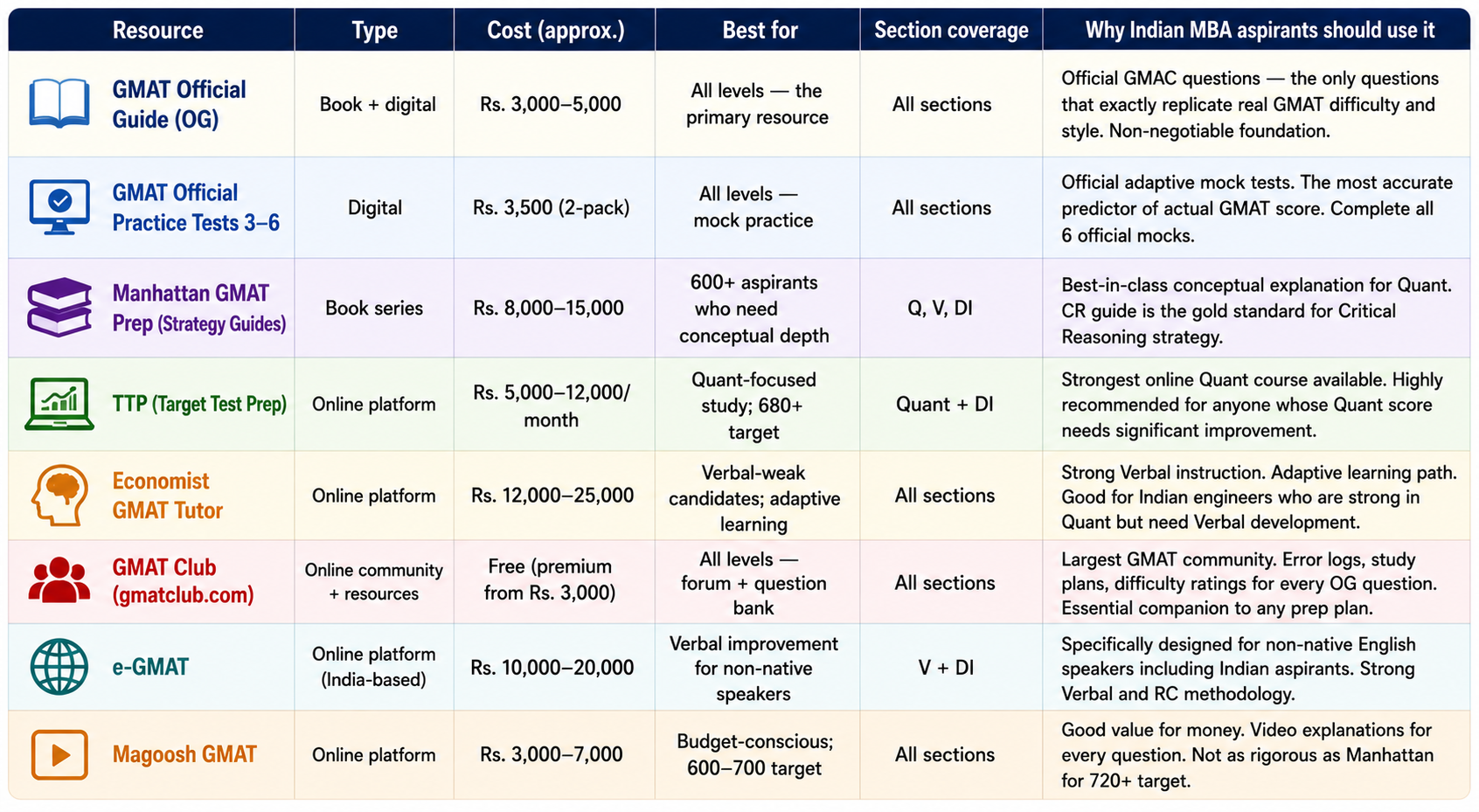
The official resources are non-negotiable; everything else is supplementary
The GMAT Official Guide and the 6 official GMAT Focus Practice Tests are the only resources that exactly replicate real GMAT question difficulty, style, and adaptive behaviour. Every other resource — Manhattan, TTP, e-GMAT, Magoosh — is valuable for building concepts and strategy, but no third-party question set accurately calibrates your expected score. Use official resources for all timed mock practice. Use third-party resources to build the skills you bring to official practice.
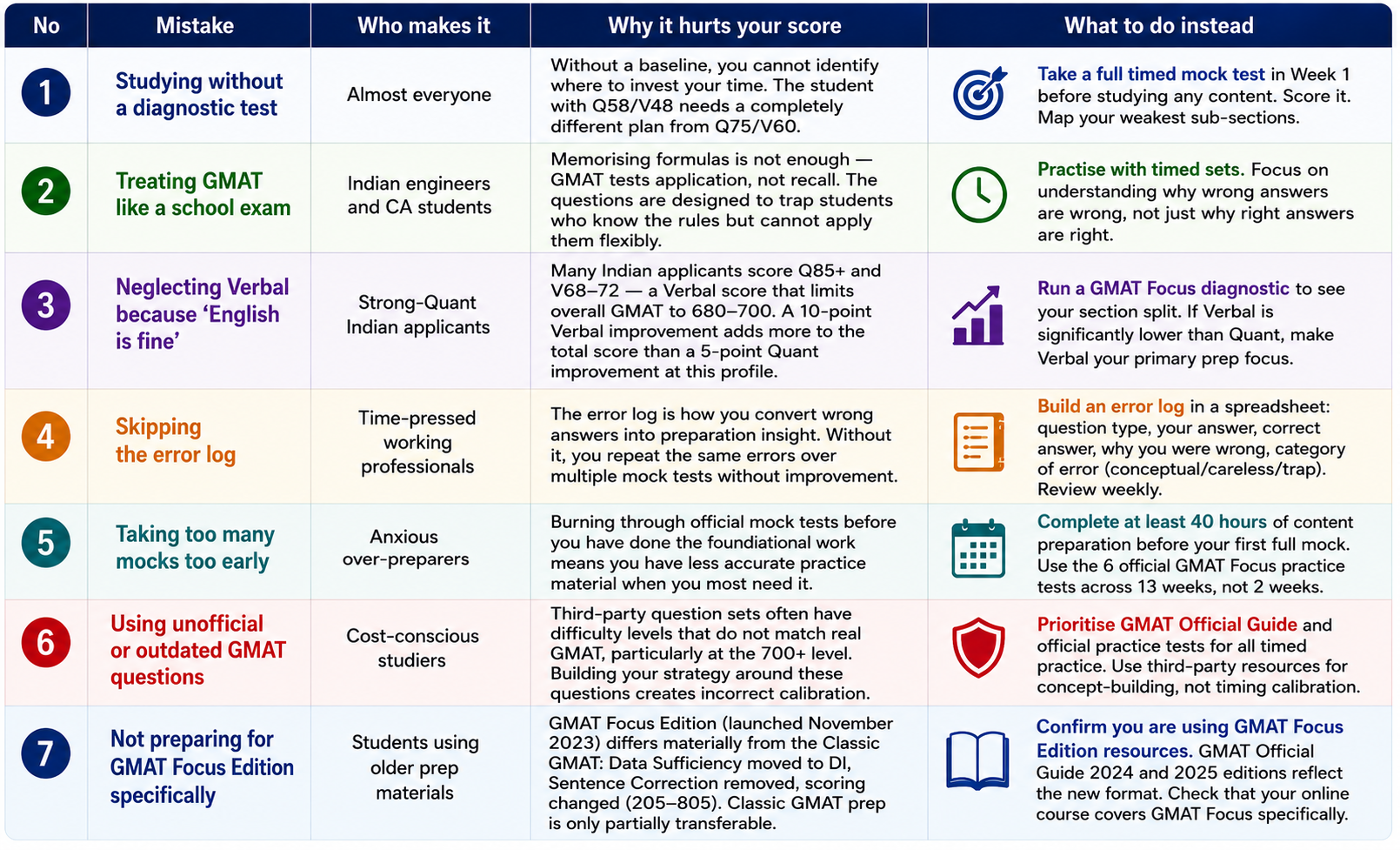
7 GMAT Preparation Mistakes Most Indian Aspirants Make
Beyond the GMAT Score — How to Prepare for Abroad Studies Holistically
The GMAT is the foundation of a global MBA application — but how to prepare for abroad studies encompasses much more than a test score. Once your GMAT target is in range for your target programmes, the remaining application components are:
Work experience and career clarity
Top global MBA programmes expect 4–8 years of post-undergraduate work experience at application time. More important than the number of years is career progression evidence — promotions, scope expansion, quantifiable impact. An Indian applicant with 5 years of flat progression at a well-known firm competes less favourably than one with 4 years of documented advancement at a regional firm. The MBA essays and interview are where career clarity is established: why MBA, why now, why this school, and what specifically will you do after.
Extracurricular profile and leadership outside work
Global MBA programmes specifically evaluate leadership in non-professional contexts — community initiatives, sports leadership, cultural activities, academic contributions. This is an area where many Indian applicants have genuine achievements that are not communicated effectively in applications — either because they are not included or because they are described passively ('I was a member of...') rather than as leadership evidence ('I founded and led...'). The MBA essay preparation process should include a complete audit of all non-professional activities since undergraduate education.
School shortlisting and application strategy
GMAT score determines which programmes are realistic targets — but the application strategy determines which of those realistic targets you should apply to first, which in Round 1 vs. Round 2, and how to position your profile against each school's stated and unstated preferences. Vidysea's MBA counselling specifically addresses this shortlisting and positioning work, mapping your GMAT score, career profile, and post-MBA goals to a shortlist with realistic admission probability at each programme.
Frequently Asked Questions
How many times can I take the GMAT, and does the number of attempts matter to business schools?
GMAC allows up to 5 attempts in a rolling 12-month period and a lifetime maximum of 8 attempts. Business schools receive all GMAT scores unless you use GMAC's 'Score Select' option, which allows you to choose which scores to send. Most top programmes allow Score Select and see only the scores you choose to report. Multiple attempts with improving scores demonstrate persistence — which is a positive signal. Multiple attempts with the same score range signals a ceiling. Realistically, plan for 2–3 attempts maximum before re-evaluating your preparation approach.
Is 640 GMAT enough for a top global MBA?
For the very top programmes (LBS, INSEAD, Wharton, HBS), 640 is below the class average and below the likely Indian applicant pool median — making admission very difficult even with a strong profile. For strong mid-tier global programmes (IESE, HEC Paris, Rotman, Schulich), 640 is competitive if the rest of the application is strong. A more useful question is: what is the Indian applicant score distribution at my target programme? Check recent Indian admits' GMAT data on GMAT Club and Poets & Quants for programme-specific benchmarking rather than relying on the overall class average alone.
Should I take GMAT or GRE for an MBA in India?
Most top global MBA programmes now accept both GMAT and GRE. GMAT is still the stronger signal for MBA-specific ambition and is preferred at most top programmes. GRE is sometimes a better choice for candidates who are borderline on GMAT Verbal but strong on GRE Quant and whose programme options include GRE-accepting schools. If your primary target is a top 30 global MBA and you are not considering MS alongside MBA, GMAT remains the standard choice. If you are applying to programmes that accept both and your GRE practice scores are higher, GRE may be the strategic choice.
How should I balance GMAT preparation with my full-time job?
The 13-week plan in this guide is designed for 20–25 hours per week — achievable for most working professionals in India. Consistency beats intensity: 2 hours every evening produces better preparation than 10 hours over a single weekend. The most effective working professional preparation model is: 1.5 hours on weekday evenings (content or question practice), 3–4 hours on Saturday (mock test review or targeted practice), and 1–2 hours on Sunday (light review and planning for the following week). Protect this schedule the way you protect client meetings.
The GMAT is not an IQ test and it is not a knowledge test. It is a preparation test — the students who score 740+ are almost never the most naturally intelligent applicants in the room. They are the applicants who built the right preparation framework, worked the error log systematically, understood what the GMAT actually tests (reasoning, not recall), and gave themselves enough time to internalise the skills. How you prepare for abroad studies through the GMAT is a direct predictor of how you will approach every structured challenge in your MBA programme. The approach matters as much as the score.