How Long Does a Student Visa Take? Country-by-Country Processing Times for Indian Students — 2026
The most dangerous sentence in study abroad planning is: "I’ll sort the visa out closer to the time." Student visa processing times for Indian applicants range from 3 weeks (UK priority) to 4–6 months (Japan, including Certificate of Eligibility). Missing the planning window does not delay your visa — it delays your intake by a full semester. This guide gives you the complete student visa application processing times for every major study destination — standard and priority — alongside the intake planning calendar that tells you exactly when to submit your application for September 2026 and January 2027 intakes. It also covers the eight "timeline killers" that add weeks to an otherwise straightforward process — and how to prevent each one.

Team Vidysea
May 22, 2026

Whether you are planning your student visa application yourself or working with study visa consultants, the most valuable thing you can know is your true total timeline — not just how long the government takes to process, but how long the prerequisites take to complete before you can even apply. That total timeline is what this guide covers.
⚠️ Processing times are government estimates — not guarantees
Every timeline in this guide reflects current government published estimates and patterns observed by Vidysea's student visa assistance team for Indian applicants. Individual applications vary. Peak seasons (June–August for September intake) consistently produce longer wait times than off-peak periods. Our recommended buffer times are designed for the busy season. Always verify current processing time estimates on the official government website of your destination country before finalising your timeline.
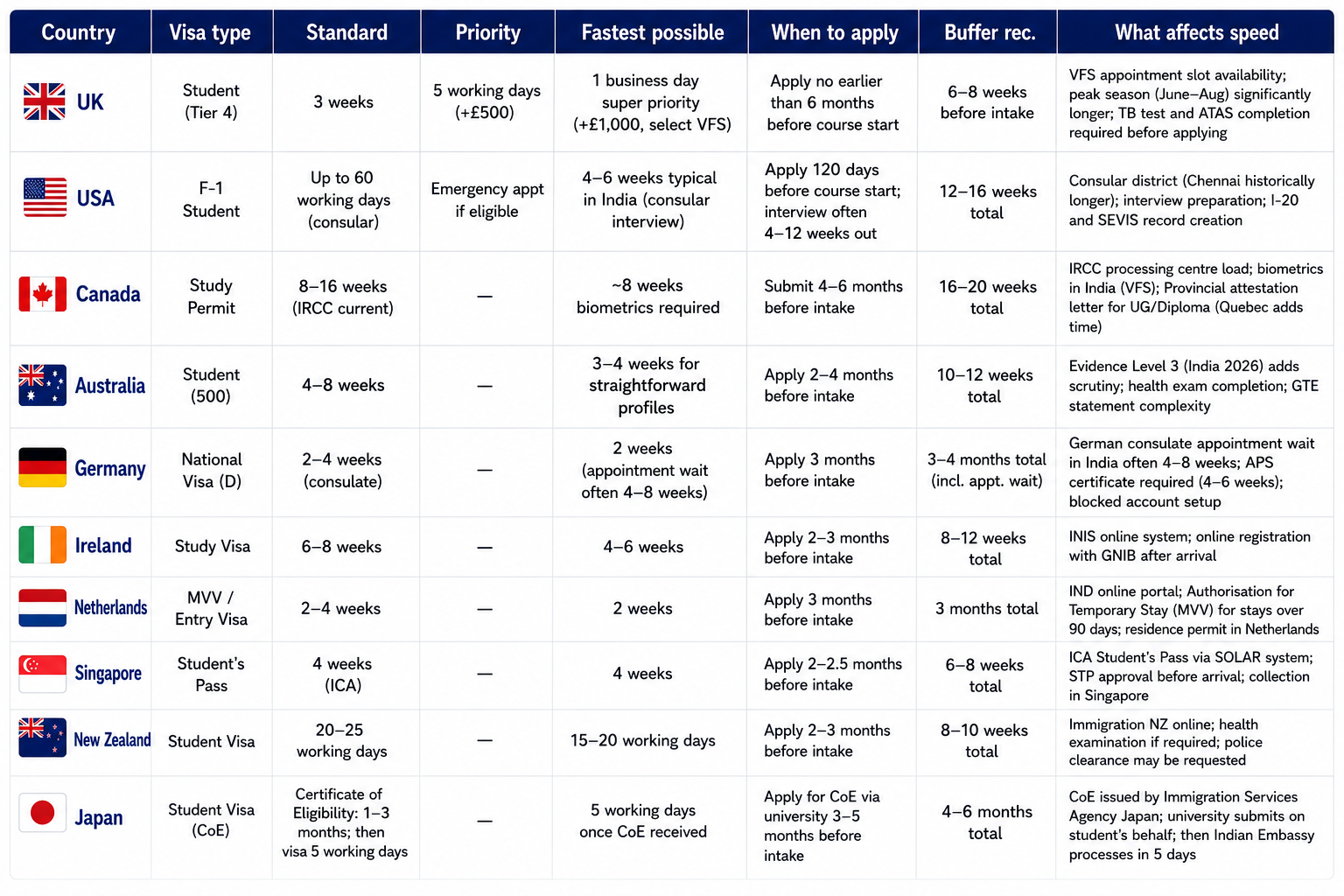
Student Visa Processing Times — 10 Destinations at a Glance
The total timeline column is what matters for planning. It includes the time to complete mandatory pre-application steps (APS for Germany, TB test for UK, health exam for Australia) — not just government processing time:
⏱ The Japan CoE is the longest single visa pre-requisite in any study destination
Japan's Certificate of Eligibility (CoE) is applied for by the university on the student's behalf — not directly by the student. The CoE takes 1–3 months for the Immigration Services Agency of Japan to issue. Once the CoE arrives in India, the actual visa is processed in 5 business days. This means the bottleneck is not the consulate but the CoE itself. Indian students targeting Japan must confirm with their university when CoE application will be submitted and factor that 1–3 month window into their planning.
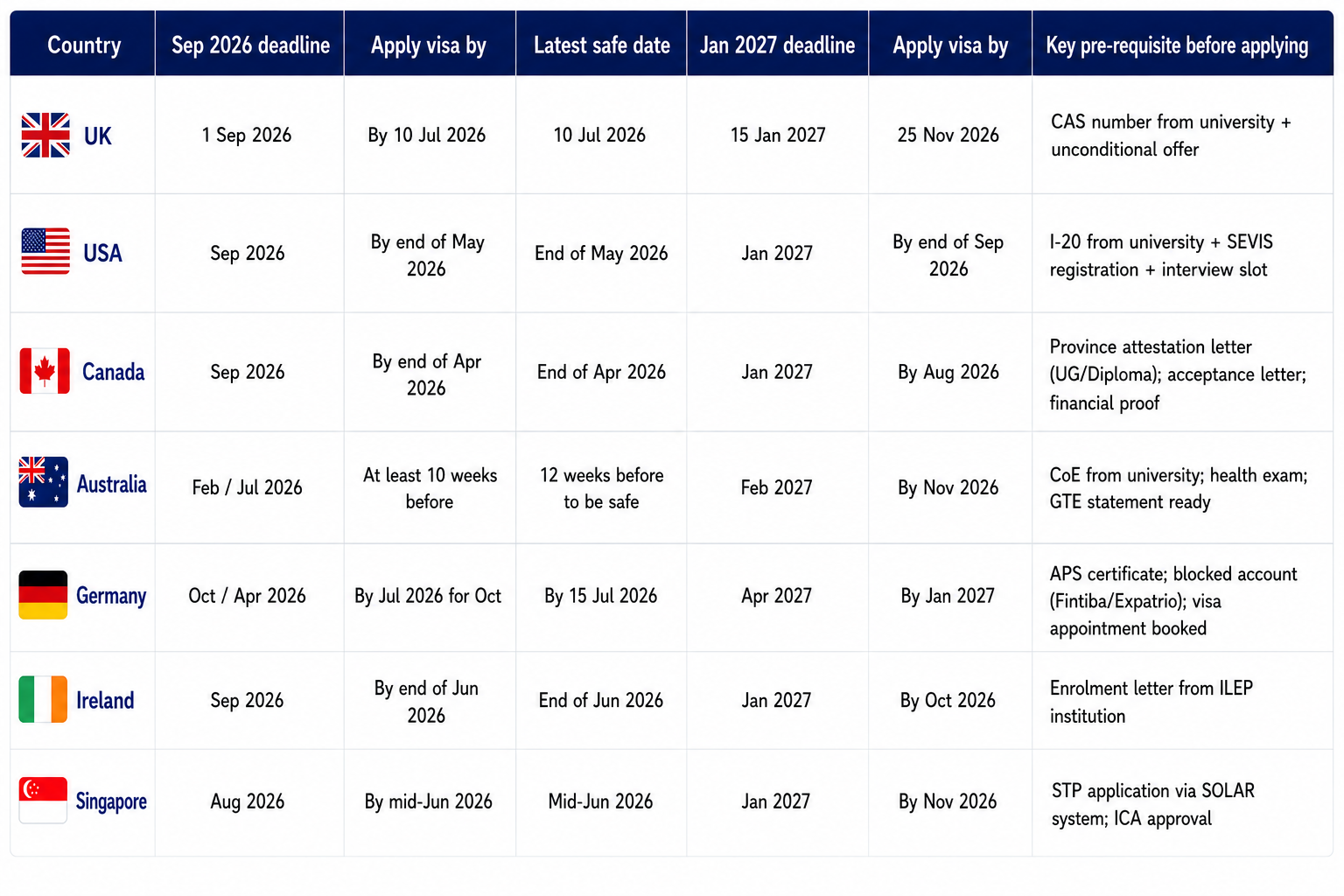
Intake Planning Calendar — When to Apply for Your Visa
This is the most actionable section of this guide. Reverse-engineering from your intake date, accounting for total timeline (including pre-requisites), tells you your visa application deadline. Missing this deadline does not mean waiting for your visa — it means deferring to the next intake...
✅ The rule that applies to every country in this table
Never submit your student visa application later than 6 weeks before the recommended deadline in the table above. Processing times are averages — peak season, administrative queries, and additional document requests can all add time. A buffer of 6 weeks beyond the expected processing time is not excessive — it is the difference between arriving for Week 1 of your programme and arriving for Week 3.
Country-by-Country: What Drives the Timeline
Understanding what actually takes time in each country's visa process allows you to start the right actions at the right time — rather than discovering a bottleneck 4 weeks before your intake.
United Kingdom — fastest with preparation
The UK Student visa is one of the fastest to process once submitted — 3 weeks standard, 5 days priority. The bottleneck is not government processing: it is VFS appointment availability and the pre-application requirements (CAS from university, TB test, ATAS if required).
- CAS is issued up to 6 months before course start — but only after an unconditional offer. Request CAS immediately on accepting your unconditional offer.
- TB test must be done at a UKVI-approved clinic in India. Allow 3–5 days for results. Book 6 weeks before your target VFS appointment date.
- ATAS (for certain STEM subjects) takes 20+ working days. Check gov.uk/atas immediately on receiving your offer. If required, apply the same day.
- VFS appointment booking opens after online application submission. Book the same day — do not wait. June–August slots fill 2–4 weeks in advance.
If all pre-requisites are in place, a UK Student visa from application submission to decision takes 3–5 weeks. The students who miss their September intake are almost always those who discover APS/TB/CAS timing issues in July rather than March.
United States — interview is the constraint
The US F-1 student visa requires a consular interview at a US Consulate in India (Mumbai, New Delhi, Chennai, Hyderabad, Kolkata). The interview cannot be waived. The wait time for an interview appointment varies significantly by consular district and season — Chennai historically has the longest waits, sometimes 8–12 weeks during peak season.
- I-20 must be issued by the university before you can pay the SEVIS fee and apply for a visa slot.
- You can apply for the F-1 visa up to 120 days before your programme start date. Earlier application = more appointment slot availability.
- After the interview, most decisions are given the same day. Some applications go into 'administrative processing' — which can add 4–12 weeks for certain profiles (specific research topics, dual-use technology fields).
- Book your interview slot as soon as your I-20 is issued and you have paid the SEVIS fee — not after you finish preparing for the interview.
Canada — the PAL requirement that most students miss
The Canada study permit process has a two-step bottleneck for undergraduate and diploma students: the Provincial Attestation Letter (PAL) and IRCC's own processing time.
- PAL is required for all undergraduate and diploma students. It is not required for Master's and PhD students — this is a critical distinction.
- The province issues the PAL directly. Different provinces have different processing times — some issue in 2–4 weeks, others may take longer. Apply immediately on deciding to study in Canada at the undergraduate/diploma level.
- IRCC study permit processing (after PAL and biometrics): currently 8–16 weeks. Total timeline for undergraduate students can reach 20 weeks from application start.
- Biometrics must be submitted at VFS in India early in the process. IRCC cannot advance the application until biometrics are confirmed on file.
Australia — Evidence Level 3 adds scrutiny in 2026
India was reclassified to Evidence Level 3 by Australia's Department of Home Affairs in 2026 — the highest scrutiny tier. This does not add a fixed number of days to processing time, but it means more documentation is reviewed more carefully, particularly the Genuine Temporary Entrant (GTE) statement.
- GTE statement must be thorough. A generic GTE for an EL3 applicant will be questioned. Explain specifically why you chose Australia, why this university and programme, and what your plans are on return to India.
- Offshore health examination must be completed at an approved panel physician. Book and complete the health exam within 5 days of submitting your student visa application.
- Financial proof should significantly exceed the minimum stated requirement for EL3 applicants. Showing exactly the minimum is a weaker application than showing comfortably above it.
- Allow 10–12 weeks total for Australian student visa applications from India in 2026. The 4-week historical baseline no longer applies reliably post-EL3 reclassification.
Germany — the APS certificate changes everything
Germany's APS certificate is the most-missed requirement among Indian students targeting Germany. APS (Akademische Prüfstelle, operated by the German Embassy in India) verifies Indian academic credentials. It is mandatory for all Indian students applying to German universities. It is not the same as the German student visa — it is a separate process that must be completed first.
- APS processing time: 4–6 weeks. This is the minimum — apply immediately on deciding to study in Germany.
- APS and university admission can run in parallel. You do not need an offer to start APS. You need all your academic transcripts and original certificates.
- German consulate appointment in India (Mumbai, New Delhi, Chennai, Kolkata): 4–8 weeks wait during peak season. Book immediately on receiving your APS certificate.
- Blocked account (Sperrkonto) at Fintiba or Expatrio must be set up and funded before the visa appointment. Allow 1–2 weeks for this process.
- Total realistic timeline: 3–4 months from decision to visa. Students who start in June for October intake are cutting it very close. Starting in March gives comfortable margin.
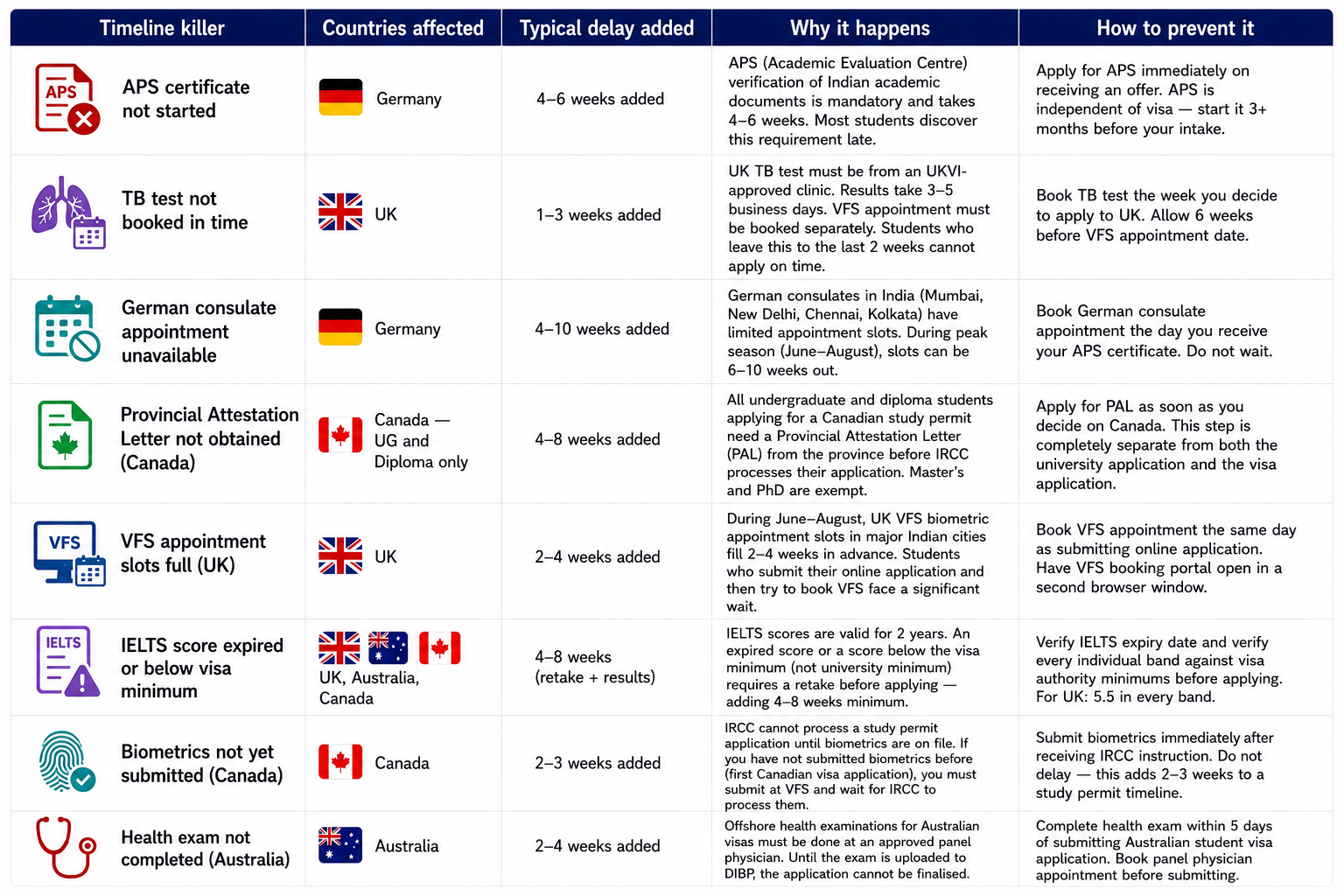
The 8 Timeline Killers — What Delays Visas and How to Prevent Them
Most visa delays are not caused by government processing backlogs. They are caused by predictable pre-application bottlenecks that students discover late. Here are the eight most common timeline killers for Indian students:
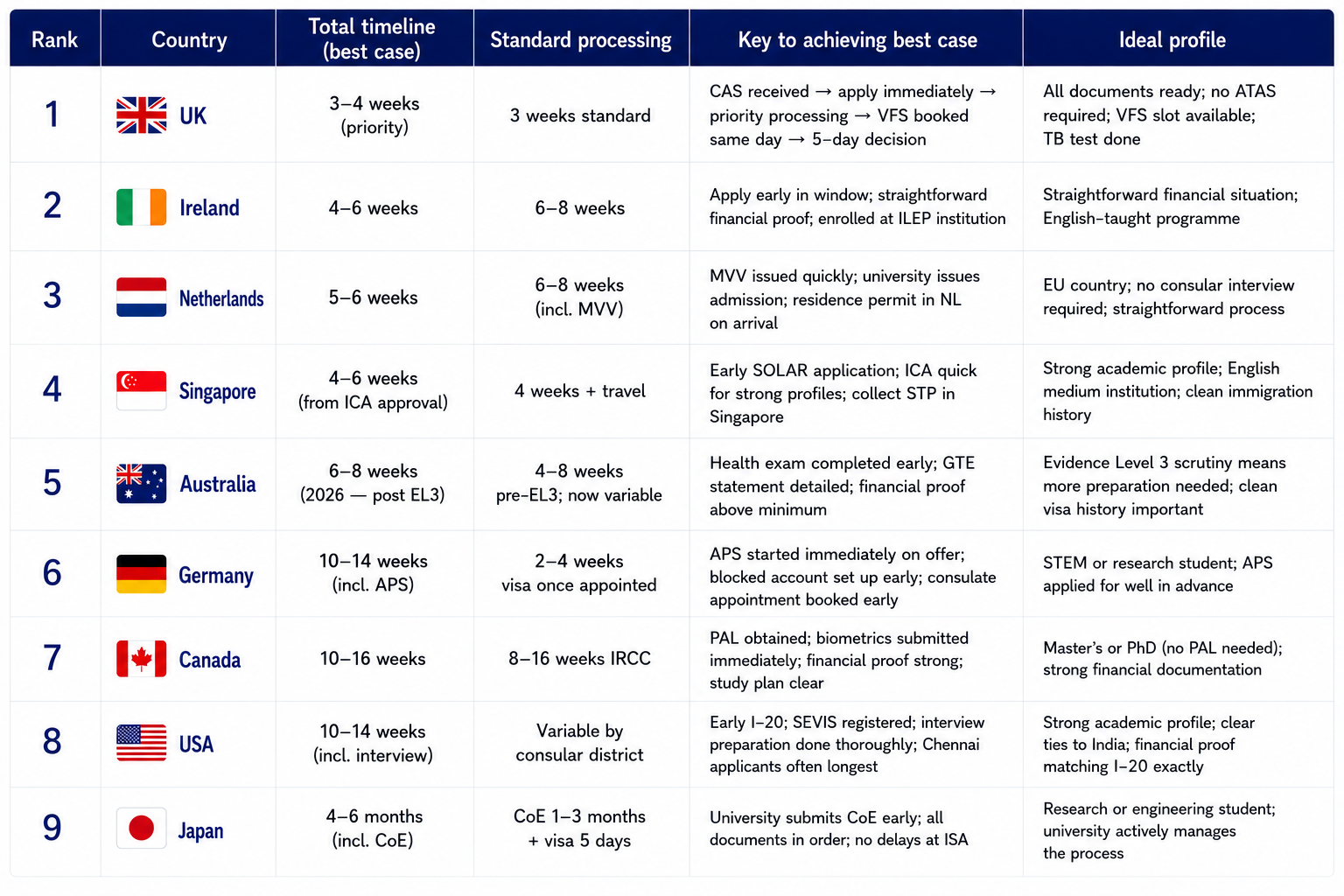
Fastest Visa Route — Countries Ranked by Total Timeline
If your timeline is tight — for example, you are applying for September 2026 intake with a late offer — this ranking tells you which destination is realistically achievable and which is not. Rankings are based on total timeline from document preparation to visa in hand, not just government processing time:
💡 A short processing time does not mean a quick total timeline
Germany's consulate processes visas in 2–4 weeks — faster than Canada or USA. But the APS certificate takes 4–6 weeks and the consulate appointment can be 4–8 weeks out. Total realistic timeline: 3–4 months. Japan's consulate processes the actual visa in 5 business days — but the Certificate of Eligibility takes 1–3 months. A student who evaluates only government processing time will systematically underestimate their real application window.
Frequently Asked Questions
Can I start my UK degree before my visa arrives?
No — you cannot enter the UK for study purposes without a valid student visa vignette in your passport. Universities are aware of visa processing times and most have a grace period for late arrivals of 1–2 weeks in the first semester. If you believe your visa will be delayed, contact your university's international student office as soon as possible. Do not book flights for an arrival date before your visa is expected.
What is the earliest I can apply for a UK Student visa?
You can apply for a UK Student visa up to 6 months before your course start date. Applying earlier than 6 months is not permitted — the application will be rejected as submitted too early. The CAS from your university is only valid for a limited period, so timing matters. Most Vidysea counsellors recommend applying 8–10 weeks before course start to allow for standard processing plus a buffer.
Does applying for priority processing guarantee a faster decision?
Priority and super priority processing are UKVI's commitments to process within the stated timeframe — 5 business days for priority, 1 business day for super priority. These are service commitments, not guarantees. UKVI will refund the additional fee if the commitment is not met, but the original visa fee is not refunded. Priority processing is reliable for straightforward applications — but cannot speed up additional document requests or queries that arise during processing.
My Canada study permit application has been in processing for 12 weeks. What should I do?
Canada's IRCC has published processing time estimates on their website. If your application has exceeded the stated timeline, submit a web form request through IRCC's online portal asking for a status update. Do not contact IRCC by phone before the stated processing time has elapsed. If you have an urgent intake deadline, you can request urgent processing by submitting evidence of your course start date and explaining the urgency — IRCC may expedite in genuine cases. Engaging a student visa assistance counsellor who has experience with IRCC escalation processes adds value here.
My offer was received late (6 weeks before intake). Is a student visa still possible?
It depends on the country. UK priority processing (5 days) makes a 6-week window achievable if all pre-requisites (CAS, TB test, financial proof) are ready. Ireland is achievable in 4–6 weeks with a clean application. Germany, Canada, and Japan are not realistically achievable in 6 weeks from a standing start. Australia post-EL3 is unlikely in 6 weeks without very careful preparation. In late-offer situations, student visa services from an experienced counsellor can identify which countries are still possible and build the fastest-path application strategy.
Student visa processing time is not a fixed number — it is the sum of pre-application requirements, government processing time, and the buffer for peak season variation. The students who make their intake are those who planned for the total timeline, not just the headline government processing figure. Guidance for study abroad that accounts for APS, PAL, TB tests, consulate appointment waits, and biometric submission deadlines is the difference between arriving for Day 1 and deferring by a semester.