How to Apply for a Masters Scholarship Abroad: Complete Guide for Indian Students 2026
A fully-funded master's scholarship abroad typically covers tuition, living costs, health insurance, and return flights — an aggregate value of Rs. 40–100L depending on the destination and programme. Every year, Indian students receive Chevening scholarships, DAAD grants, Fulbright-Nehru fellowships, and JN Tata Endowment awards that eliminate the study abroad cost entirely. Every year, a larger number of equally qualified Indian students miss these scholarships because they discovered the deadline two months after it closed, or because they submitted essays that were technically complete but generically written.

Team Vidysea
June 2, 2026

This guide covers the complete process of applying for a masters scholarship abroad — the 12 most important scholarships available to Indian students, the 18-month application calendar that keeps you ahead of every deadline, the essay quality framework that distinguishes funded from unfunded applications, the eligibility quick-check for fresh graduates vs. working professionals, and the specific mistakes that cause strong Indian candidates to be shortlisted but not selected.
The guide is structured so you can identify which scholarships you qualify for right now, what you need to start preparing today, and which deadlines are already in the window for your target intake. No scholarship search platform covers all 12 scholarships in this guide with India-specific context — and the India-specific context is what changes the application strategy.
🎯 The most important insight about master's scholarships for Indian applicants
The most commonly applied-for scholarships (Chevening, DAAD) are also the most competitive. The most underutilised scholarships for Indian students — JN Tata Endowment, Narotam Sekhsaria, Inlaks Shivdasani — are India-administered, less known globally, and cover the same level of international study with significantly less competition. Indian students who apply to three scholarships typically apply to the three most well-known ones. Students who apply to five or six — including the India-administered ones — have significantly higher overall award probability.
12 Major Master's Scholarships for Indian Students — 2026 Reference
Here are the most valuable and accessible master's scholarships available to Indian students, with India-specific application notes:
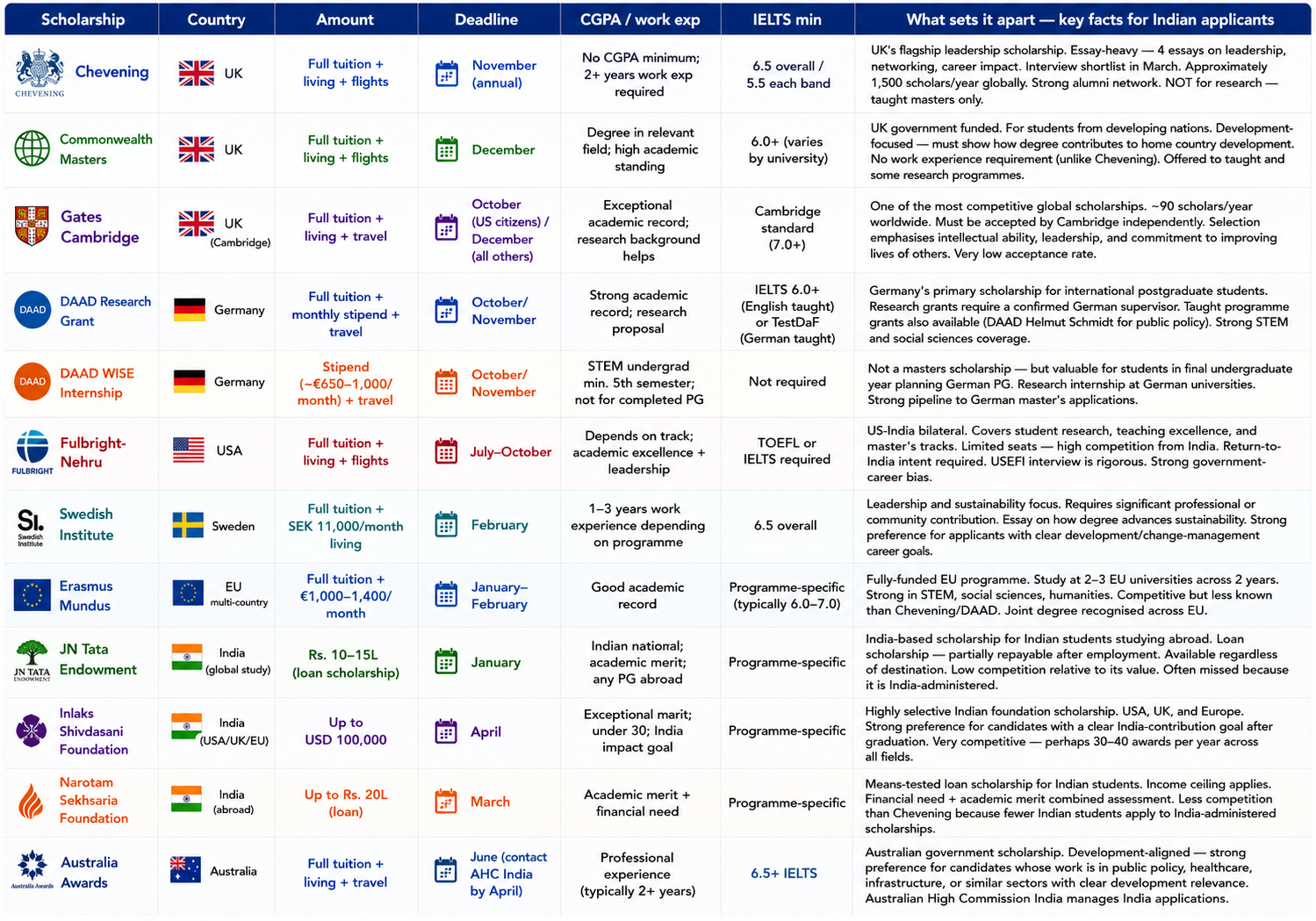
✅ The three most overlooked scholarships for Indian students
JN Tata Endowment, Narotam Sekhsaria, and Inlaks Shivdasani are India-based foundations that fund Indian students studying at any recognised international institution. They receive fewer applications than Chevening or DAAD because they are not marketed internationally. The JN Tata Endowment in particular — a loan scholarship of Rs. 10–15L — is available to qualified Indian students regardless of destination, and has a January deadline that many students discover too late. Apply to all three in parallel with international scholarship applications.
Eligibility Quick Check — Which Scholarships Can You Apply For Right Now?
Use this table to immediately identify which scholarships match your current profile:
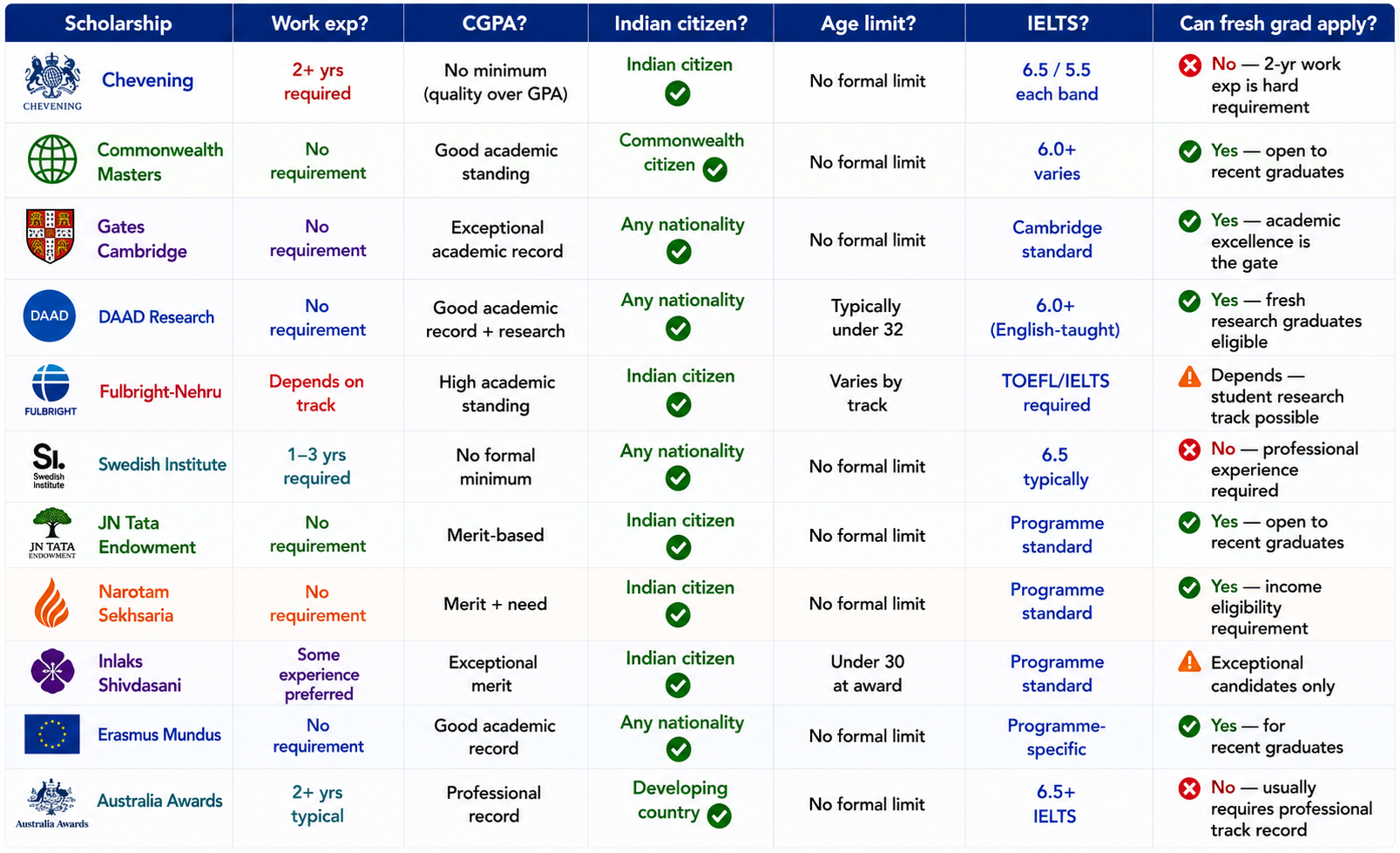
⚠️ The Chevening 2-year work experience requirement is a hard gate — no exceptions
Chevening requires a minimum of 2 years of full-time post-undergraduate work experience at the time of application. This is not a preference — it is a binary eligibility criterion. There is no waiver, no partial credit, and no alternative pathway. If you have 18 months of work experience in November, you are not eligible for that Chevening cycle. You will be eligible for the following year. Use the 6 extra months to strengthen your essays, build leadership evidence, and prepare a stronger application for the next cycle.
18-Month Scholarship Application Calendar
This is the complete calendar for Indian students targeting September 2026 intake scholarships, starting preparation in early 2025. The scholarship and university application tracks must run simultaneously — they are not sequential:
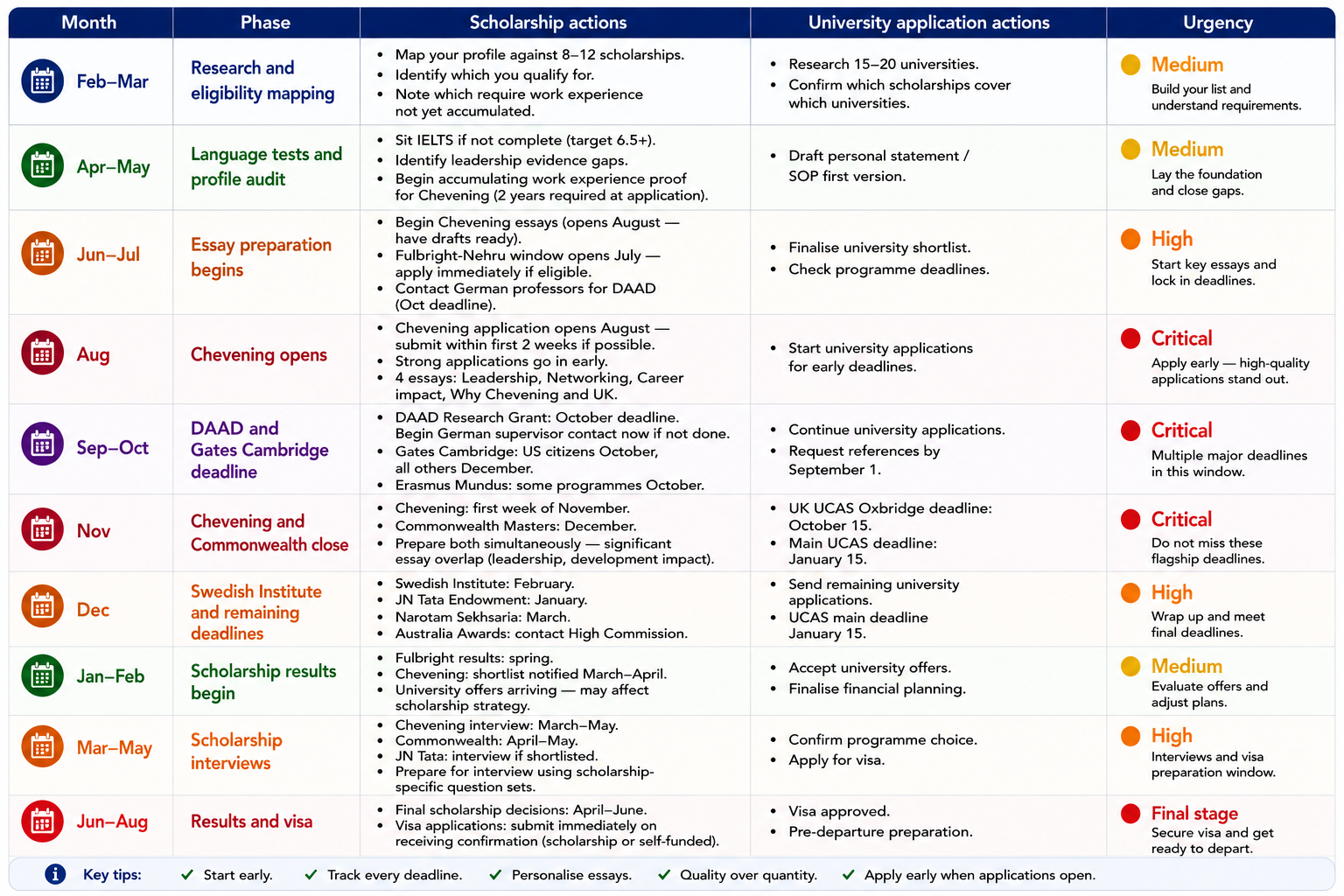
💡 The October–November window is the most important 8 weeks in the scholarship calendar
Chevening, DAAD, Gates Cambridge, Commonwealth, and some Erasmus Mundus programmes all close in October–November. If you are not prepared by October with essays drafted, references briefed, and IELTS complete, you are waiting a full year. These scholarships together represent the majority of fully-funded awards available to Indian master's applicants. The calendar above works backward from November to show exactly when each preparation step must begin.
Step-by-Step: How to Apply for a Masters Scholarship Abroad
Step 1 — Audit your eligibility
Before writing a single essay, systematically check your eligibility for every scholarship in the table above. Key variables: work experience (years and type), academic track record (CGPA and field), language scores (current IELTS vs. scholarship minimum), age (Inlaks: under 30), and nationality restrictions. Build a shortlist of scholarships you currently qualify for and scholarships you can reach by the deadline (e.g., you have 20 months of work experience and Chevening requires 24 — you may qualify for the following year's cycle).
Step 2 — Research each scholarship's purpose and values
Every major scholarship has an explicit or implicit value system. Chevening funds leadership and networking. DAAD funds academic research and Germany-connection. Fulbright funds US-India bilateral academic exchange. Commonwealth funds development impact. Gates Cambridge funds intellectual excellence and commitment to improving lives. Before writing any essay, read 5–10 funded scholar profiles from each scholarship. Notice the language they use to describe their goals. The essay framework should mirror the scholarship's stated purpose — not generic career advancement.
Step 3 — Gather and document leadership evidence
The biggest failure mode in master's scholarship applications from India is vague leadership claims — 'I led a team', 'I initiated a project', 'I contributed to my community'. International scholarship committees have read thousands of these. What differentiates funded applications: specific, measurable outcomes. How many people were on the team? What was the challenge? What decision did you make? What changed because of your action — in numbers, in people affected, in policy changed?
Spend time before essay writing documenting your actual leadership record: dates, roles, numbers, outcomes. For each example, answer: Situation (what was happening), Task (what were you responsible for), Action (what specifically did you do), Result (what was the measurable outcome), and Learning (what would you do differently). This STAR-L structure is the skeleton of every successful scholarship leadership essay.
Step 4 — Write for the specific scholarship, not for all scholarships
The most common shortcut that fails: writing one set of essays and adapting them superficially for multiple scholarships. Essay readers at Chevening, DAAD, and Fulbright can identify a templated essay in the first paragraph. Each scholarship requires a genuinely different essay — not because the underlying experiences are different, but because the lens through which you frame those experiences must match each scholarship's values.
Chevening wants leadership and networking evidence. The same experience at a DAAD application should foreground its research dimension. The same experience at a Fulbright application should foreground its US-India exchange relevance. Same event, different frame, different emphasis — and the reader who is a Chevening committee member should not be able to tell that you sent essentially the same essay to DAAD.
Step 5 — Brief your referees specifically
Reference letters are the most underinvested component of most scholarship applications from India. The typical Indian applicant asks a professor or senior colleague for a reference with two weeks' notice and no guidance. The reference letter arrives describing the applicant as 'diligent', 'hardworking', and 'a pleasure to work with'.
A reference that makes a difference includes: a specific anecdote of the applicant demonstrating the quality the scholarship seeks (leadership for Chevening, intellectual rigour for Gates Cambridge, research quality for DAAD), the referee's assessment of the applicant's potential rather than their current achievement, and comparative language — 'in my 15 years of teaching, this applicant is among the top 5% I have encountered.' Giving your referees the scholarship criteria, your essay themes, and 2–3 specific examples to reference produces categorically different letters.
Step 6 — Submit complete, reviewed applications before the deadline
Many scholarship portals close precisely at midnight on the deadline date. An application submitted at 11:45pm with a formatting error in the essay, a missing document, or an unsigned form cannot be corrected. Submit 48 hours before the deadline as a firm rule — not as a preference. This provides one full business day for the portal to confirm receipt, for any last-minute technical issues to be resolved, and for a final quality check of every uploaded document.
Essay Quality Framework — What Funded vs. Unfunded Applications Look Like
This is the most precise guide to what scholarship committees actually reward — shown through the contrast between weak and strong responses for five major scholarships:
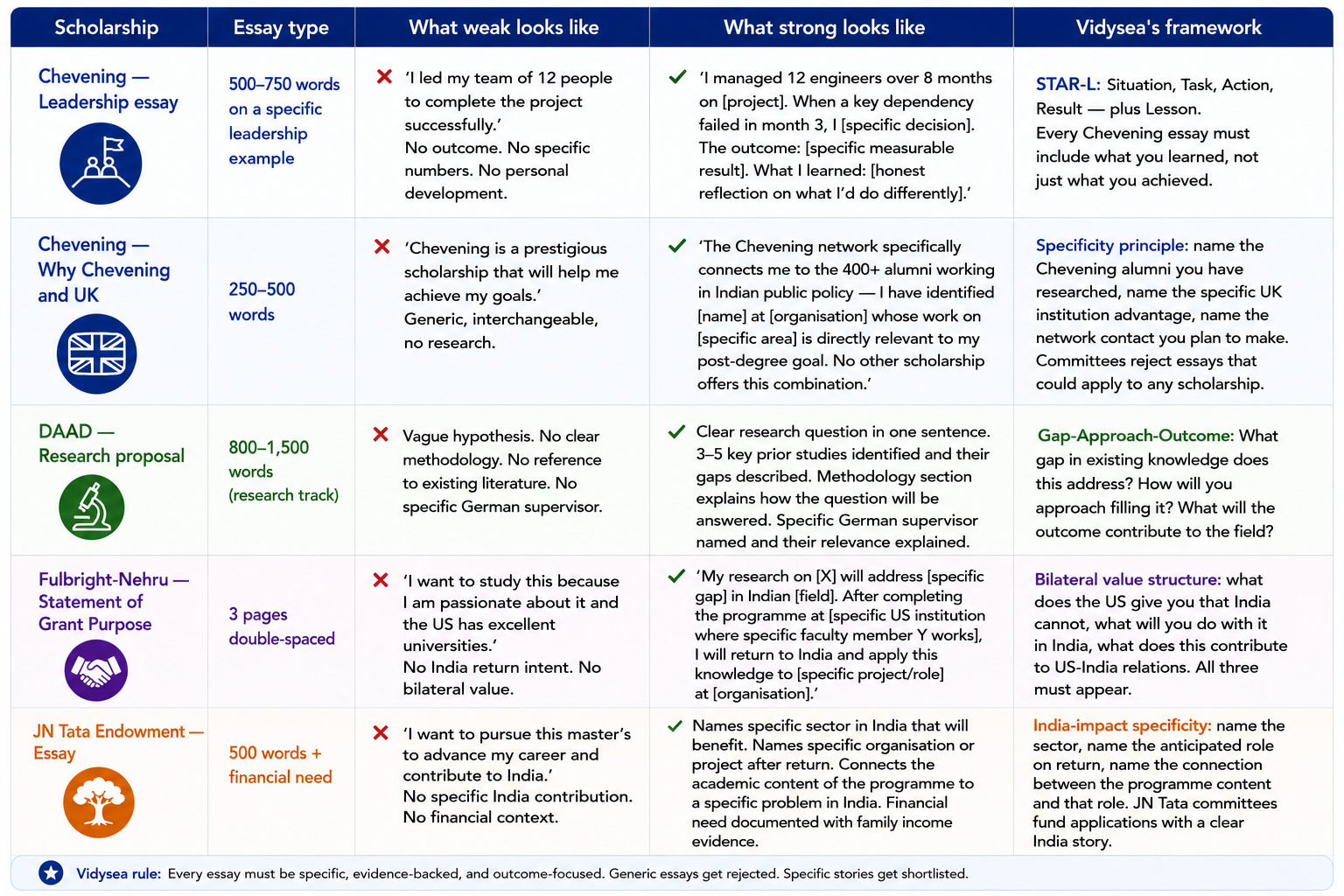
✅ The principle behind every successful scholarship essay: specificity over generality
Every weak response in the table above shares one characteristic: it could have been written by any applicant from any country with any background. Every strong response could only have been written by one specific person, describing one specific situation, with one specific outcome. Scholarship committees read hundreds of applications per reviewer. The essay that stands out — at every scholarship, across every cycle — is the one that describes something specific enough to be unmistakably yours. Generality is not modesty; it is invisibility.
Scholarship Interview Preparation — Chevening, Fulbright, and Commonwealth
The most competitive scholarships include an in-person or video interview as the final selection stage. Chevening interviews are conducted by British Council or Chevening alumni panels. Fulbright interviews are conducted by USEFI. Commonwealth interviews vary by university.
What interview panels assess
- Whether the application accurately represents the applicant — can they elaborate on the leadership examples in their essays with the same level of specificity?
- Whether the post-scholarship plan is genuine and credible — do they know what they will do after the degree, or is the answer vague?
- Whether they can articulate the scholarship's value specifically — do they know why Chevening and not other scholarships, why this university and not alternatives?
- Whether they can handle disagreement or unexpected questions — do they capitulate when challenged, or maintain their position respectfully with evidence?
See Vidysea's scholarship interview guide (internal link) for the specific question sets, strong and weak response examples, and the mock interview preparation process for each major scholarship.
6 Mistakes That Cause Strong Indian Candidates to Be Shortlisted but Not Selected
Mistake 1: Generic 'why Chevening?' essay
The essay asks 'why do you need the Chevening network?' Most applicants write 'Chevening's global alumni network will help me achieve my goals.' Strong applicants write: 'I have identified three specific Chevening alumni — [Name 1] at [Organisation], [Name 2] at [Organisation], [Name 3] in [field] — whose work connects directly to my [specific goal]. The Chevening community event in [city] and the alumni mentorship programme are how I plan to make those connections. No other scholarship provides this combination of UK network and cross-country cohort in my field.'
Mistake 2: Not briefing referees
A reference letter that says 'she was an excellent student who worked hard and showed leadership potential' does not help a Chevening application. A reference that says 'In [month], when [specific challenge] arose, she [specific action that showed leadership], and the outcome was [specific measurable result] — this is the type of decision-making that distinguishes her from the 300+ students I have taught over 20 years' is what moves an application from shortlisted to selected.
Mistake 3: Submitting the same essay to multiple scholarships with minimal changes
Essay readers can identify templated essays. If your Chevening leadership essay could be submitted to DAAD with only the scholarship name changed, it will not succeed at either.
Mistake 4: Post-scholarship plan that is vague or non-specific
'I plan to contribute to India's development' is not a post-scholarship plan — it is a sentiment. 'I will return to my role at [Organisation] and lead the implementation of [specific programme], using the [specific skills or knowledge from the degree] to [measurable impact goal]' is a post-scholarship plan.
Mistake 5: Submitting all essays on the deadline day
Portal crashes, upload failures, and format errors on the deadline day are common. Every essay submitted at 11:59pm is one technical glitch away from a missed deadline.
Mistake 6: Applying to only the most well-known scholarships
Most Indian students apply to Chevening and DAAD — the two most well-known international scholarships. The JN Tata Endowment, Narotam Sekhsaria, and Erasmus Mundus receive significantly fewer Indian applications relative to their award value. A student who applies to five scholarships with one India-administered scholarship in the mix has better overall probability than one who applies to five internationally-branded scholarships exclusively.
Frequently Asked Questions
Can I apply for a scholarship before I have a university admission offer?
It depends on the scholarship. Chevening: yes — you apply to Chevening and to four UK universities simultaneously. You do not need an offer at the time of Chevening application. DAAD Research: you need a confirmed German supervisor (not a university offer, but a faculty agreement). Commonwealth: varies by cycle and university — some require an offer, some accept applications in parallel. Gates Cambridge: requires simultaneous Cambridge university application — Cambridge must accept you independently before you can be considered for Gates Cambridge. Check each scholarship's specific requirement before applying.
Is a 7.2 CGPA competitive for master's scholarships abroad?
It depends on the scholarship and institution. For Chevening: CGPA is not the primary criterion — leadership and post-scholarship plan are. A 7.2 CGPA applicant with 5 years of strong leadership evidence is more competitive than a 9.0 CGPA applicant with no leadership narrative. For Gates Cambridge: academic excellence is the primary gate — 7.2 from most Indian institutions would be below the threshold. For DAAD Research: depends on the research quality and supervisor relationship more than the CGPA number. For JN Tata and Narotam Sekhsaria: merit + financial need combination — a 7.2 with strong professional record and financial need can be competitive. Know which scholarships your profile fits before concluding 'my CGPA is too low for scholarships.'
How many scholarships should I apply to?
The answer depends on how many you are eligible for and how many you can prepare with quality. Applying to 3–5 scholarships is the standard recommendation for serious scholarship applicants. Applying to more than 5 usually means essay quality suffers — no applicant can give 8 scholarships the time each requires. Apply to the 3–5 that best fit your profile, write each essay genuinely and specifically for that scholarship's values, and give each one the preparation it deserves. A strong application to 4 scholarships outperforms a weak application to 8.
Every year, hundreds of Indian students receive fully-funded master's scholarships abroad. They are not universally the strongest academic profiles in the applicant pool. They are the candidates who understood what each scholarship was for, started preparation early enough to develop genuine evidence of the qualities being assessed, wrote essays specific enough to be unmistakably theirs, briefed their references to address the criteria directly, and submitted before the deadline with every document complete. The process is documented and learnable. The only barrier is beginning it at the right time.