How to Choose the Best Study Abroad Consultant in India
Every year, hundreds of thousands of Indian students begin the process of applying to universities abroad. Most of them, at some point, look for a consultant to guide them through it. And most of them make that choice the same way — by searching online, reading a few reviews, attending a free seminar, and going with whoever seemed most confident or charged the most reasonable fee. This is almost always the wrong way to make a decision that will shape the next two to five years of your life.

Team Vidysea
May 25, 2026

The market for study abroad consultants in India is large, fragmented, and almost entirely unregulated. There are excellent consultants who deliver genuine outcomes — students who get into better universities, win scholarships, and navigate the visa process without avoidable errors. There are also consultants who overstate their success rates, provide outdated advice, push students toward university partners that pay commission rather than universities that fit the student, and disappear after the application fee is paid. The difference between these two categories is not always visible from the outside — which makes knowing how to evaluate them critically important.
This guide is a complete framework for evaluating and selecting abroad education consultants in India. It covers what a good consultant actually does, the specific questions to ask before signing anything, the warning signs that should end a conversation, and the structural conflicts of interest that exist in this industry — so you can account for them. If you are beginning your study abroad journey and are trying to decide whether to use a consultant and which one to choose, this guide gives you the framework to make that decision correctly.
The most important thing to understand about the study abroad consulting industry in India before you begin: many consultants are paid commission by universities for every student they place. This creates a structural incentive to recommend universities that pay the highest commission — not universities that are the best fit for you. Understanding this conflict of interest is the single most important starting point for evaluating any overseas education consultant.
Do You Actually Need a Study Abroad Consultant?
The honest answer: it depends on your destination, your programme level, the complexity of your profile, and your own capacity to research and manage a multi-step process. Let us be specific about when a study abroad consultant genuinely adds value — and when you may be paying for something you could do yourself.
| Situation | Value of using a consultant | Why |
|---|---|---|
| Applying to multiple countries simultaneously | High | Each country has different application structures, document requirements, and visa processes; managing these in parallel without expert guidance produces errors and inconsistencies |
| Targeting competitive universities (top 50 globally) | High | Statement of purpose and application strategy at competitive institutions requires experienced review; the cost of a weak application is rejection from programmes that were within reach |
| Applying for major scholarships (Chevening, Fulbright, DAAD, Australia Awards) | High | Scholarship applications require months of preparation and are evaluated against a global pool; experienced guidance on essay strategy and positioning significantly improves outcomes |
| First-generation study abroad applicant (no family reference point) | High | The volume of unknown unknowns — visa requirements, financial documentation norms, institution red flags — is substantial; experienced guidance prevents costly mistakes |
| Applying for a PhD or research degree | High | Supervisor identification, research proposal development, and funding strategy require specific expertise beyond standard application support |
| Straightforward Master's application to a familiar destination | Moderate | Application process is manageable independently; value depends on quality of SOP review and visa guidance provided |
| Undergraduate application to non-competitive institutions | Lower | Application process is well-documented; self-application is feasible; main value is in university shortlisting and avoiding institutions with poor outcomes |
Even in situations where the application process itself is manageable independently, the strategic decisions — country selection, programme evaluation, scholarship identification, shortlist calibration — benefit from the knowledge of an experienced overseas education consultant. The question is not only whether to use a consultant, but what kind of engagement you need: full-service strategic counselling, or targeted support at specific stages.
How the Study Abroad Consulting Industry in India Actually Works
Before evaluating individual foreign education consultants, it is essential to understand the structural dynamics of the industry. Most students are not aware of these — and they explain a great deal of the variation in the quality of advice being offered.
The University Partnership Model
A large proportion of abroad education consultants in India operate under formal partnership or referral agreements with universities. Under these agreements, the consultant receives a commission — typically 10–15% of the first year's tuition fee — for every student they successfully place at that university. These partnerships are not inherently problematic; they are how many universities recruit internationally, and a partner consultant can have genuine institutional knowledge about the universities they work with.
The problem arises when the commission structure shapes the advice. A consultant who earns significantly more for placing you at University A than University B has a financial incentive to recommend University A — regardless of which is actually better for your profile and goals. This incentive is structural, not personal. Even a well-intentioned consultant operating under this model will find it difficult to recommend a non-partner institution when a partner institution is plausible.
Ask every consultant you evaluate: which universities are you a formal partner or referral agent for, and do you receive commission from them? A consultant who refuses to answer this question, or who claims to have no financial relationships with any university, should be viewed with significant scepticism. The honest answer — naming the partnerships and acknowledging the commission structure — is a mark of transparency, not a disqualifier.
The Free Consultation Model
Many study abroad consultants in India offer free initial consultations and charge no direct fee to students — their revenue comes entirely from university commissions. For the student, this appears to be a no-cost service. In practice, it means the consultant's advice is entirely funded by the institutions they are recommending. This model can work when the consultant's partner network genuinely includes good options for your profile. It can produce significantly skewed advice when it does not.
Fee-charging consultants — who charge the student directly for their services — have a more aligned incentive structure: their revenue comes from delivering good advice to you, not from placing you at specific institutions. This does not automatically make them better, but it removes the most significant structural conflict. Evaluate both models; understand how each is funded; and factor this into how you interpret the advice you receive.
The Accreditation and Regulation Gap
Unlike immigration advisors in countries such as Canada and Australia, overseas education consultants in India are not regulated by a statutory body. There is no licensing requirement, no mandatory professional qualification, and no formal complaints process with regulatory teeth. The Association of Australian Education Representatives in India (AAERI) and similar bodies provide voluntary membership and codes of conduct, but membership is optional and enforcement is limited. This means that the quality of consultants in the Indian market varies from genuinely excellent to actively harmful — and external markers of quality are unreliable.
This is not an argument against using a consultant — it is an argument for evaluating them rigorously rather than relying on surface indicators like office size, brand name, or the number of country flags on the website. The framework in the sections below is designed to help you do exactly that.
What a Good Study Abroad Consultant Actually Does
Before you can evaluate whether a specific study abroad consultant is good, you need a clear picture of what good looks like. Here is what a high-quality consultant engagement includes — at every stage of the process:
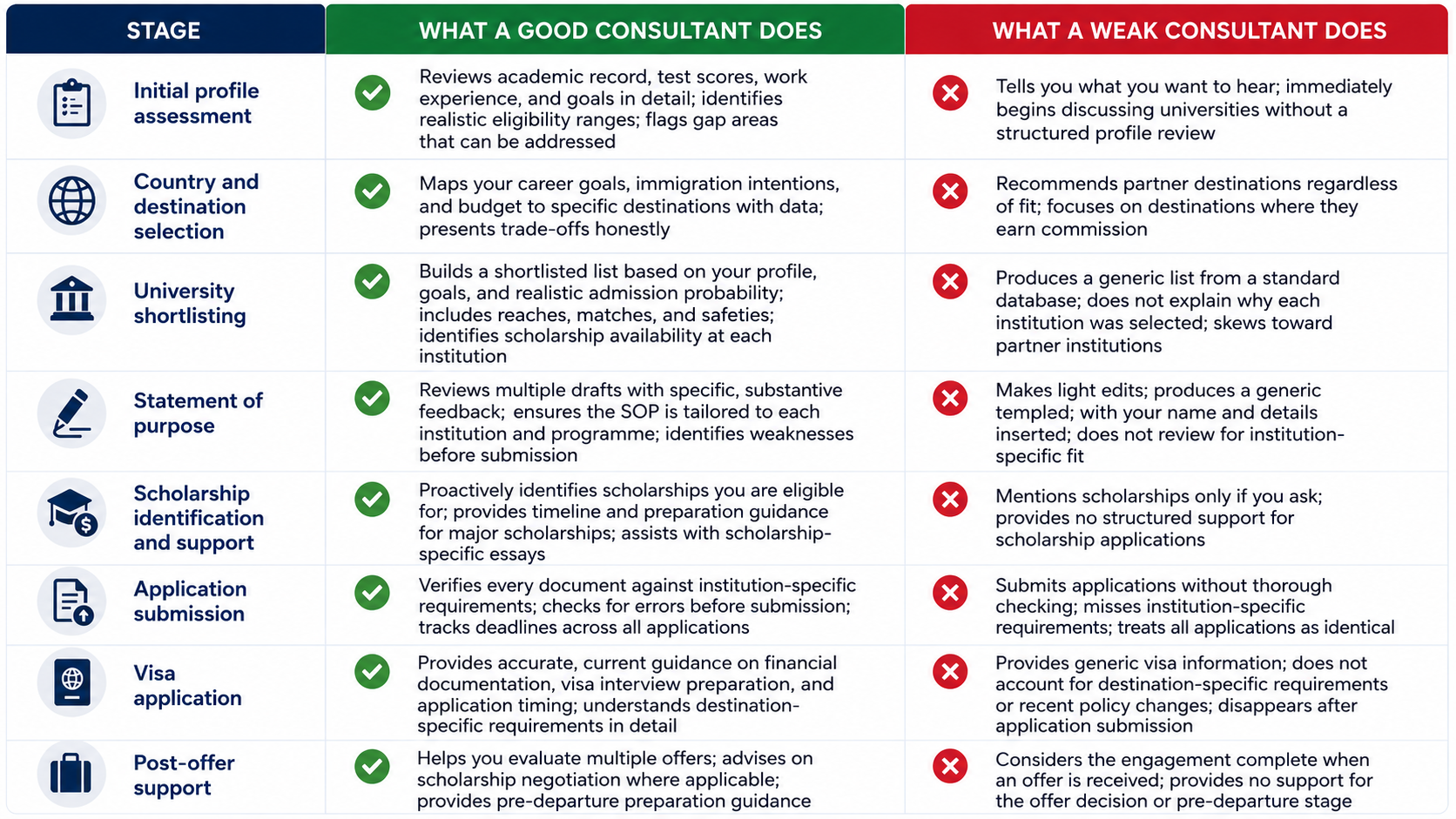
A foreign education consultant who covers all of these stages well is genuinely rare. Most consultants are strong in some areas and weak in others. The question is whether the areas where they are strong align with what you need most — and whether the areas where they are weak are ones you can manage independently or supplement with other resources.
The Questions to Ask Every Consultant Before Signing Anything
These are the specific questions that will tell you more about the quality of a study abroad consultant than any brochure, testimonial, or free seminar. Ask them directly, and evaluate not just the answers but the willingness to answer clearly.
About Their Track Record
- How many students have you placed at universities in my target destination in the last two years? Can you give me specific numbers?
- What is your visa approval rate for my target destination? How many applications have been refused, and what were the reasons?
- Have any of your students won major scholarships — Chevening, Fulbright, DAAD, Australia Awards — in the last three years? What was your role in those applications?
- Can you share anonymised profiles of students with a similar background to mine who you have placed successfully? Where did they get in, and what scholarships did they receive?
A study abroad consultant who cannot answer these questions with specifics — or who responds with general claims about thousands of students placed globally — is not giving you useful information. Vague answers to track record questions are a significant warning sign.
About Their Conflicts of Interest
- Which universities are you a formal partner or referral agent for?
- Do you receive commission from any of the universities you recommend? If so, which ones and at what rate?
- Are there universities in my target destination that you would recommend but are not your partners? Can you give me examples?
- If the best university for my profile is not in your partner network, will you recommend it and help me apply?
An overseas education consultant who answers these questions transparently — naming partners, acknowledging commission, and confirming willingness to recommend non-partner institutions — is operating with integrity regardless of the business model. One who deflects, denies all commercial relationships, or becomes defensive is signalling that the conflict exists and is not being managed honestly.
About Their Process and Expertise
- Who specifically will be working with me? What is their educational background and experience with my target destination?
- How many students is each counsellor managing simultaneously? What is the maximum caseload per counsellor?
- How many drafts of my statement of purpose will you review? Who reviews them — the counsellor I meet, or a different team?
- How do you stay current on visa policy and university admission requirements? Can you tell me about any significant policy changes in my target destination in the last 12 months?
- What happens if my application is refused? Do you continue supporting re-applications, and at what cost?
About Their Fee Structure
- What exactly is included in your fee? At what stages do payments fall due?
- Is there any refund policy if I do not receive an offer from any institution you apply to on my behalf?
- Are there any additional costs I should expect — for visa applications, courier, document attestation, or scholarship applications?
- Do you charge differently for different destinations or programme levels?
The best study abroad consultants in India will answer every question on this list directly and without hesitation. Reluctance to disclose partner relationships, inability to give specific outcome data, or vague answers about who will actually be working on your application are the clearest signals that a consultant is not operating at the standard you need.
Warning Signs That Should End the Conversation
These are the red flags that consistently appear in engagements with weak or actively harmful foreign education consultants. If you encounter any of these in a consultation, treat it as a signal to look elsewhere:
| Warning sign | What it signals | What to do |
|---|---|---|
| Guaranteed admission to specific universities | No legitimate consultant can guarantee admission; admissions decisions are made by universities, not consultants. This claim is either false or refers to institutions with near-universal acceptance rates. | Ask which specific universities are being guaranteed, and look up their admission statistics. Walk away from any consultant who maintains this claim. |
| Immediate university recommendations before understanding your profile | A shortlist produced before a thorough profile review is based on inventory — what the consultant can place you at — not on your goals and eligibility. | A first consultation should be primarily a profile assessment. University names should come after, not during or before, that assessment. |
| Pressure to sign or pay quickly | Genuine consultants do not need to create artificial urgency. Pressure to commit immediately — 'this offer expires today', 'we only have one slot left' — is a sales tactic, not a service standard. | Take the time you need. A consultant who is right for you will still be right for you after you have taken a week to evaluate other options. |
| No clear information about who will actually work on your application | Large consulting firms sometimes sell on the strength of senior counsellors but assign work to junior staff. If you cannot get a direct answer about which individual will review your SOP and manage your application, assume the answer is not reassuring. | Ask for the name and credentials of the specific person who will manage your case before signing. |
| Claims to have 'special relationships' with admissions teams that improve your chances | Universities do not give preferential treatment to applicants based on which consultant submitted them. Admissions decisions are made on the merit of the application. 'Special relationships' claims are almost always false. | Treat this as a red flag for dishonesty. Move on. |
| Unwillingness to recommend non-partner institutions | If a consultant cannot or will not name any institution outside their partner network as potentially suitable for your profile, their advice is structurally constrained by commission rather than by your interests. | Ask directly for three universities that are not their partners that could be good options for your profile. Evaluate the answer carefully. |
| SOP templates or very fast turnaround on statement drafts | A statement of purpose that can be completed in 24–48 hours without multiple substantive rounds of feedback is almost certainly a lightly customised template. Template SOPs are among the most common reasons for application refusal at competitive institutions. | Ask to see the process: how many rounds of revision, who reviews, how institution-specific the final document will be. |
| No post-visa support or pre-departure guidance | An engagement that ends with the visa approval is one that treats your application as the product rather than your successful arrival and integration as the outcome. | Ask explicitly what support is provided after the visa is issued. |
Types of Study Abroad Consultants in India — And Which Is Right for You
The market for abroad education consultants in India includes several distinct types of providers, each with different strengths and appropriate use cases. Understanding these categories helps you match the type of consultant to what you actually need:
Large Multi-Destination Franchised Consultancies
These are the large brand-name consulting firms with offices in multiple Indian cities, often operating as franchises under an international parent brand. They typically cover many destinations, have established university partnerships, and have high visibility through advertising and walk-in traffic.
- Strengths: established processes; wide destination coverage; large partner university network; brand recognition that may reassure parents
- Weaknesses: high counsellor caseloads; junior staff often manage most of the actual work; commission-driven university recommendations are common; inconsistent quality across offices and counsellors within the same brand
- Best suited for: students applying to straightforward programmes at well-known universities in major destinations where the process is largely standardised
Destination-Specialist Consultants
These are consultants — often smaller firms or individual practitioners — who specialise in one or two specific destinations. A study abroad consultant who focuses exclusively on the UK and Canada, for example, is likely to have significantly deeper knowledge of those markets than a generalist covering eight countries.
- Strengths: deeper institutional knowledge of target destinations; more current on visa policy and admission trends; often have more direct relationships with relevant universities
- Weaknesses: cannot support you if your target destination changes; may not be the right fit if you are genuinely undecided between destinations
- Best suited for: students who have already decided on a destination and want deep, current expertise in that specific market
Subject or Field Specialists
Some consultants focus on specific fields — MBA admissions, medical programmes, law, or STEM — rather than on destinations. These specialists understand the particular application conventions, ranking considerations, and employer relationships relevant to their field.
- Strengths: deep understanding of field-specific application norms; knowledge of programme accreditation requirements; awareness of employer preferences within the field
- Weaknesses: may not have broad destination coverage; field specialisation does not automatically translate to visa or post-study work expertise
- Best suited for: students applying to competitive field-specific programmes — top MBA programmes, research degrees, professional qualifications — where field knowledge matters as much as destination knowledge
Independent Education Counsellors
These are individual practitioners — often former admissions officers, academics with international education backgrounds, or experienced counsellors who have left larger firms — who work independently and charge directly for their time. They represent some of the best and some of the most uneven quality in the market, because there is no institutional quality control.
- Strengths: direct access to the senior person handling your application; often lower caseloads; fee-based model reduces commission conflicts; frequently have specific institutional expertise from prior roles
- Weaknesses: limited resources compared to larger firms; may not have the same breadth of university relationships; quality is entirely individual-dependent
- Best suited for: students who need high-touch, senior-level engagement — competitive university applications, complex profiles, scholarship-focused applications — and want direct accountability
University-Embedded Representatives
Some universities employ their own representatives in India, or work exclusively through a small number of authorised representatives who handle all applications from a specific region. These representatives are not independent advisors — they are effectively extensions of the university's admissions process for their specific institution.
- Strengths: deepest possible institutional knowledge for the specific university; current on requirements and preferences; can sometimes facilitate direct communication with admissions
- Weaknesses: represents one institution only; cannot give you independent advice on whether that institution is actually right for you; structural incentive is to place you at that university regardless of fit
- Best suited for: students who have already decided on a specific university and want logistical support with the application — not for students who are still deciding where to apply
A Practical Evaluation Framework: How to Compare Consultants
Once you have spoken with two or three study abroad consultants, use this framework to compare them systematically rather than going with the one that made the best impression in a sales meeting:
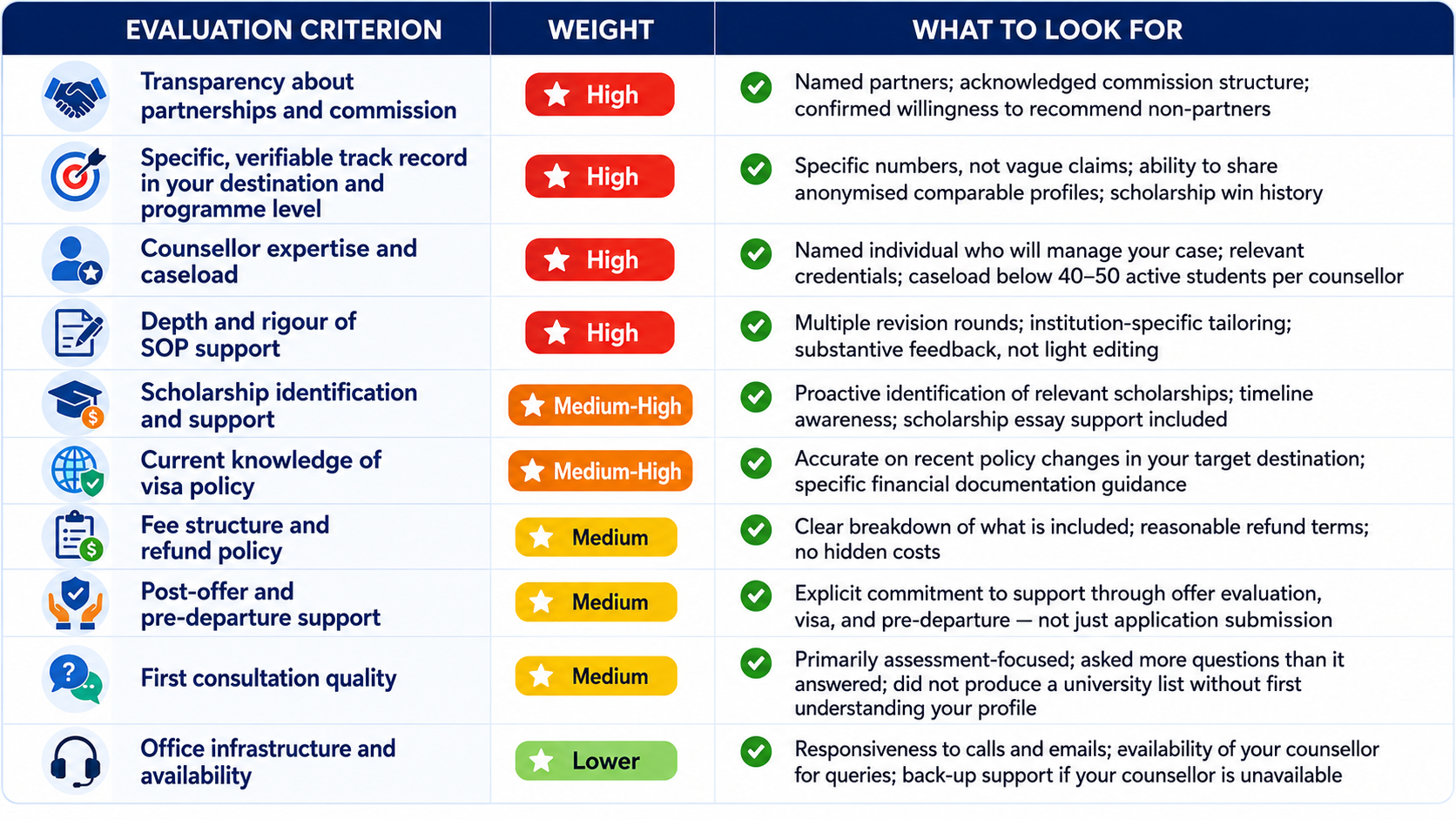
Score each consultant against these criteria honestly after your consultations. The best study abroad consultants in India will score consistently well across the high-weight criteria — and no amount of impressive office infrastructure or glossy brochures compensates for a weak track record or a commission structure that shapes the advice.
Navigating the Study Abroad Consulting Landscape in India
The market for abroad education consultants is most concentrated in Delhi, Mumbai, Bengaluru, Hyderabad, Chennai, Pune, Ahmedabad, and Chandigarh — cities with the highest density of students considering international education. However, the presence of a consultant in a major city is not a quality signal. Some of the best-quality counselling available to Indian students is delivered remotely by specialist consultants who do not maintain large physical offices.
A few patterns worth knowing about the Indian study abroad consulting market:
- The largest brand-name consultancies are most visible but not consistently the highest quality; their variability across counsellors within the same firm can be significant
- University-sponsored education fairs and events are useful for gathering information about specific institutions but are not a neutral environment for shortlisting advice — every exhibitor has an interest in placing you at their institution
- Online reviews on Google and education forums are useful as a screening tool to filter out clearly problematic consultants, but are not reliable as a positive signal; review profiles are manipulable and do not reflect the experience of students with complex cases
- Alumni networks from your undergraduate institution who have studied abroad are often among the most useful and unbiased sources of consultant recommendations — they have experienced the full process and have no financial interest in which consultant you choose
- The best referrals typically come from students who encountered and overcame a genuine complication in their application — visa refusal, scholarship negotiation, late application — because these situations reveal how a consultant performs under pressure rather than in straightforward cases
Remote and online counselling has become a genuine option for Indian students since 2020 and should not be dismissed. A specialist overseas education consultant based in Delhi or Bengaluru who works remotely with students across India may offer better destination-specific expertise than a generalist consultant with a physical office in your city. Evaluate the quality of the counsellor, not the location of the office.
What to Expect From a First Meeting With a Study Abroad Consultant
The quality of a first consultation is one of the most reliable indicators of the quality of the full engagement. A genuinely good overseas education consultant will use the first meeting primarily to understand you — your academic history, your career goals, your financial situation, your timeline, and your reasons for considering study abroad. Here is what a good first consultation looks like, and what a poor one looks like:
A Good First Consultation
- Begins with structured questions about your academic background, work experience, career goals, target destination, and budget — before any recommendations are made
- Asks specifically about your reasons for studying abroad: career advancement, immigration, academic development, or a combination
- Identifies gaps between your current profile and the requirements of your target programmes — and discusses whether these are addressable in your timeline
- Is honest about where your profile is competitive and where it is not — without either inflating your prospects or unnecessarily deflating your ambitions
- Does not produce a finalised university shortlist in the first meeting — builds toward one based on the profile assessment
- Discusses scholarship options proactively, including eligibility and timeline requirements
- Explains clearly how the engagement works, who will manage your case, and what the next steps are — without pressure to sign immediately
A Poor First Consultation
- Begins with a university list or country recommendation before asking about your goals and profile
- Focuses primarily on success stories and testimonials rather than on your specific situation
- Produces guaranteed admission claims or unrealistically optimistic assessments of your prospects
- Rushes to fee discussion and contract signing before establishing whether the fit is right
- Cannot answer specific questions about visa policy, programme accreditation, or scholarship timelines
- Assigns your case to a junior counsellor immediately after the senior counsellor who ran the consultation
You are evaluating the consultant as much as they are evaluating your profile in that first meeting. Treat it as a two-way assessment — and trust your reading of whether the counsellor is genuinely engaged with your situation or is running through a standard sales process.
The Real Cost of Choosing the Wrong Consultant
Students who engage a weak or misaligned foreign education consultant do not always know it until significant damage has been done. These are the ways in which the wrong consultant creates costs that go well beyond the consulting fee:
- Application to the wrong universities: a shortlist built on commission incentives rather than profile fit leads to rejections from universities that were supposed to be matches, or offers from universities that are not actually suitable
- Missed scholarship deadlines: a consultant who does not proactively manage scholarship timelines causes students to miss deadlines for scholarships they were eligible for — this is a cost measured in lakhs, not thousands
- Weak statement of purpose: a template-based or lightly edited SOP submitted to competitive institutions is a primary driver of rejections that could have been avoided; re-application takes an additional year
- Visa refusal due to documentation errors: incorrect financial documentation, incomplete disclosure of travel history, or misunderstood visa requirements result in refusals that delay the programme start by a full intake cycle
- Enrolment at an institution with poor outcomes: a student placed at a university with weak graduate employment in their field, poor PGWP eligibility, or limited scholarship support has paid full fees for an outcome that does not deliver on its purpose
- Loss of the full consulting fee with no recourse: many consultants charge upfront with limited or no refund provisions; a poor outcome leaves the student with neither the offer they wanted nor the fees paid
The combined financial and time cost of these errors is frequently ten to twenty times the consulting fee itself. The decision of which best study abroad consultants in India to work with deserves proportionately more time and rigour than most students give it.
Frequently Asked Questions
How much should a good study abroad consultant in India charge?
Fees for study abroad consultants in India range from zero (commission-only models) to INR 50,000–2,00,000 or more for comprehensive, fee-based engagements. The fee alone is not a reliable indicator of quality — some of the best consultants charge modestly, and some of the most expensive provide poor service. What matters is whether the fee structure is transparent, what it includes, and whether there is a clear refund policy if agreed deliverables are not met. Always ask for a written breakdown of what the fee covers before paying anything.
Is it safe to use a consultant who charges no fee to the student?
It is not inherently unsafe — many students receive adequate support from commission-funded abroad education consultants — but it requires additional vigilance. A consultant who is funded entirely by university commissions has a structural incentive to recommend partner institutions regardless of whether they are the best fit. Mitigate this by asking directly which universities they are partnered with, asking for recommendations that include non-partner institutions, and independently verifying that any recommended university genuinely suits your profile and goals.
Can I use multiple consultants for different parts of the process?
Yes, and in some cases this is the right approach. A student might use a destination specialist for strategic university selection and a separate visa specialist for the permit application, particularly if their primary consultant has weaker visa expertise. The main risk is inconsistency — if two consultants give conflicting advice about documents or application strategy, it creates confusion and potential errors. If you use multiple providers, establish clearly who is responsible for what and ensure all advice is cross-referenced before acting on it. Experienced overseas education consultants will typically cover all stages within a single engagement to avoid exactly this fragmentation.
How do I verify a consultant's claimed track record?
Ask for anonymised case studies of students with profiles similar to yours — similar academic background, similar target destination, similar career goals. Ask specifically about the outcomes: which universities offered admission, which scholarships were won, what the visa result was. Where possible, ask for references from past students you can contact directly. Check for any specific success claims — named scholarships won, named universities placed at — against publicly available information where possible. A consultant confident in their track record will facilitate this verification rather than resist it.
What should I do if I am unhappy with my consultant mid-process?
If you identify serious concerns about your consultant's performance or integrity mid-process — missed deadlines, undisclosed conflicts of interest, poor quality SOP feedback, inaccurate visa advice — address them directly first. Request a meeting, document your concerns in writing, and ask for specific remediation. If the issues are not resolved, consider whether switching consultants is feasible given your timeline. Switching mid-process has costs — a new consultant needs time to get up to speed, and any deadlines already missed cannot be recovered — but continuing with a consultant who is actively undermining your application is worse. Before signing with any study abroad consultant, understand the contract terms for termination and refund so you know what your options are if this situation arises.
Does the city where a consultant is based matter?
Less than it used to. Most of the interactions in a consulting engagement — profile assessment, SOP review, scholarship guidance, document preparation — can be conducted effectively remotely. What matters is the counsellor's expertise and caseload, not their physical proximity to you. For visa applications that require in-person document verification or biometrics at specific centres, the student handles these directly with the relevant authority (VFS Global, visa application centre) rather than through the consultant. Do not choose an overseas education consultant primarily based on the location of their office; choose based on the quality of their counsellors, their track record in your target destination, and the transparency of their process.
Choosing the right study abroad consultant in India is a decision that will shape the quality of your application, the universities you end up applying to, the scholarships you do or do not access, and the ease with which you navigate the visa process. It deserves the same rigour you would apply to any decision of equivalent financial and life consequence.
The framework in this guide — understanding the industry's structural conflicts, knowing what to ask, recognising the warning signs, and comparing consultants systematically rather than by impression — gives you the tools to make that choice well. The best study abroad consultants in India are not the most visible or the most expensive. They are the ones who are transparent about how they operate, honest about your profile and prospects, rigorous in their application support, and genuinely invested in your outcome rather than in their next commission.
Vidysea's approach to overseas education consultant services is built on exactly these principles: transparent disclosure of all institutional relationships, fee structures that align incentives with student outcomes, counsellor caseloads designed for genuine engagement, and a process that covers every stage from initial profile assessment through to pre-departure preparation. If you are evaluating your options, we welcome the questions in this guide — and will answer every one of them directly.