How to Select the Right Course and University Abroad
Choosing a course and university abroad is one of the most consequential decisions a student will make — and one of the most frequently made on the wrong basis. Most students begin this process by searching for rankings. They look at the QS World University Rankings or the Times Higher Education list, identify the highest-ranked institutions their grades might support, and build a shortlist from there. This approach produces a shortlist — but rarely the right one.

Team Vidysea
May 26, 2026

A university that ranks in the top 100 globally may have a weak programme in your specific subject. A country that seems prestigious may offer post-study work rights that do not align with your career goals. A course that sounds relevant may lead to a qualification that employers in your target industry do not recognise. These are not edge cases — they are among the most common reasons students spend significant money on an international education and emerge without the outcome they were expecting.
This guide covers the complete framework for selecting the right course and university abroad — from clarifying your goals and understanding what rankings actually measure, to evaluating programmes on the factors that genuinely matter, navigating study abroad scholarships, and understanding how study abroad counselling fits into the decision-making process. The decisions covered here are best made early — ideally with structured counselling for study abroad that begins well before applications open.
The single most important principle in selecting a course and university abroad: rankings tell you about institutional reputation. They tell you almost nothing about programme quality in your subject, graduate employment outcomes in your field, or whether the qualification will be valued by the employers or institutions you are targeting. A well-informed shortlist is built on programme-specific data, not headline rankings.
Start With Your Goals — Not With Rankings
Before you look at a single university, you need clarity on what you are trying to achieve. This is the first conversation that any serious overseas education counselling engagement will have with you — and it is the conversation that shapes every decision that follows. There are four questions that define your goals:
1. What career outcome are you targeting?
This is not a question about which industry you are interested in. It is a question about the specific role, level, and geography of the career you want after your degree. The answer determines which countries have the right industry presence, which programme structures are most valued by employers in that field, and which universities have the alumni networks and employer relationships that will help you get there.
- If you want to work in investment banking in London, the universities that matter are those with strong recruitment relationships with the major banks — not the highest-ranked universities in an abstract sense
- If you want to work in technology in the US, post-study work authorisation (OPT/STEM OPT) and proximity to major tech hubs are as important as programme quality
- If you want to return to India and work in a multinational, the brand recognition of your institution among Indian employers matters — which correlates with rankings but is not identical to them
- If you want to remain in the destination country and pursue permanent residency, post-study work rights, PR pathways, and the immigration value of your qualification are critical considerations that have nothing to do with rankings
2. Are you optimising for education, immigration, or both?
This is a question that most students do not ask explicitly — but that determines the right destination and institution. Some students are primarily seeking the best possible education in their field and will return to India afterward. Others are primarily seeking a pathway to permanent residency in a developed country, with the education as a means to that end. Most students fall somewhere between these positions, but understanding where you fall is essential for making the right country and university decision. Counselling for study abroad that does not address this question explicitly is not giving you the full picture.
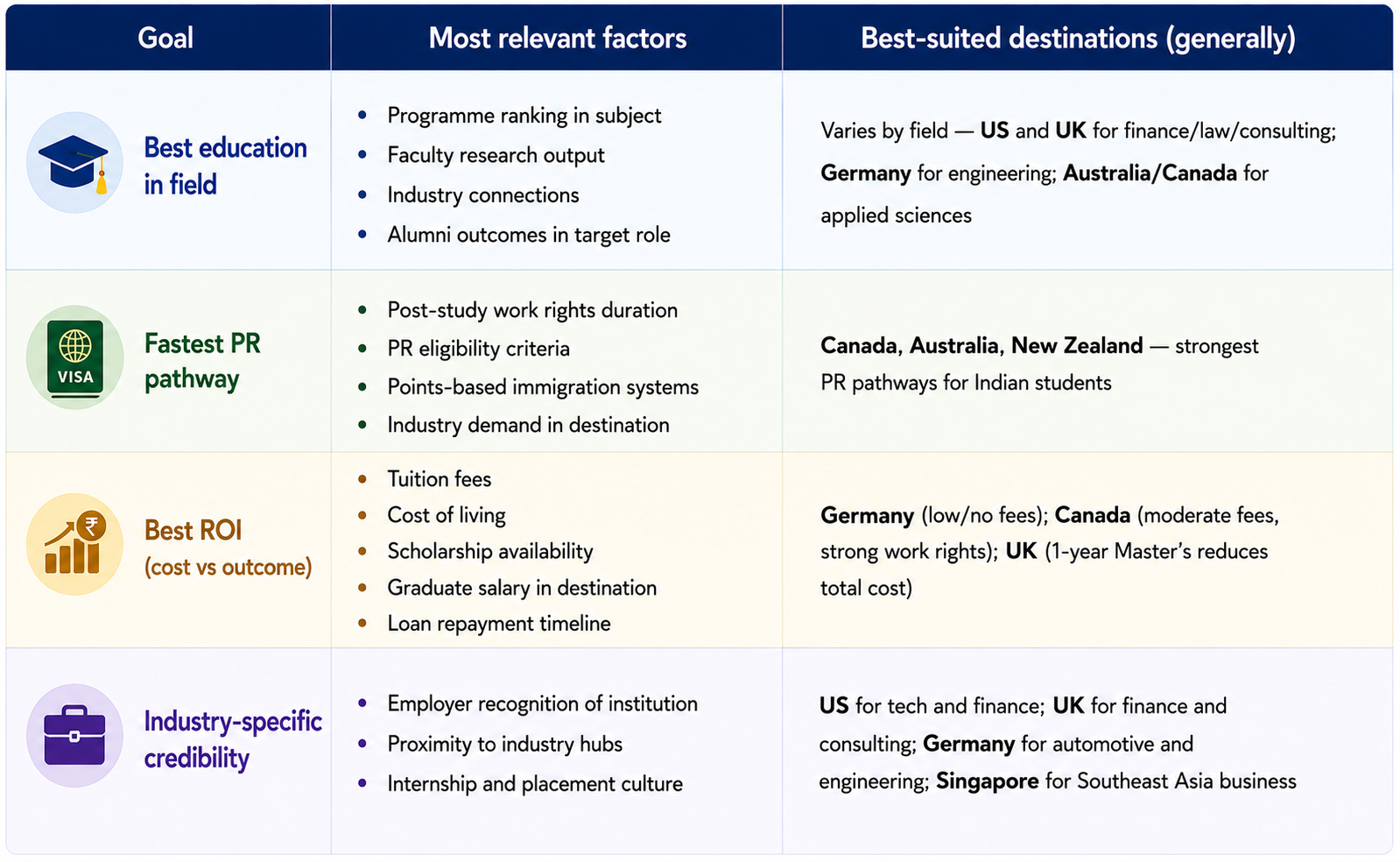
3. What is your realistic budget — and what scholarships are you eligible for?
Budget is not just a constraint — it is a selection criterion. The total cost of an international education (tuition, living expenses, travel, and opportunity cost) varies enormously by country, city, institution, and programme length. Understanding your budget realistically, and identifying the study abroad scholarships you may be eligible for, should happen before you shortlist universities — not after you have fallen in love with a programme you cannot afford.
One of the most common and most costly mistakes in university selection: building a shortlist around institutions you want to attend, then discovering that no scholarship covers the gap between your budget and the cost of attendance. The right approach is to build your shortlist with scholarships and financial aid as part of the initial filtering — not as an afterthought. Early overseas education counselling ensures scholarship eligibility is assessed from the start.
4. What are your non-negotiables?
Every student has constraints that are not primarily financial or career-driven — family considerations, health requirements, climate preferences, cultural and community factors, language of instruction, or proximity to an existing support network. These are legitimate inputs into the decision and should be named explicitly rather than silently ruling out options without articulation. A counsellor who understands your full picture will factor these in; one who does not ask will produce a shortlist that looks good on paper but does not fit your life.
What University Rankings Actually Measure — And What They Don't
University rankings are useful — but only if you understand what they are measuring. Using them incorrectly is one of the most reliable ways to end up at the wrong institution. Every student beginning the study abroad counselling process should understand the following about the major ranking systems:
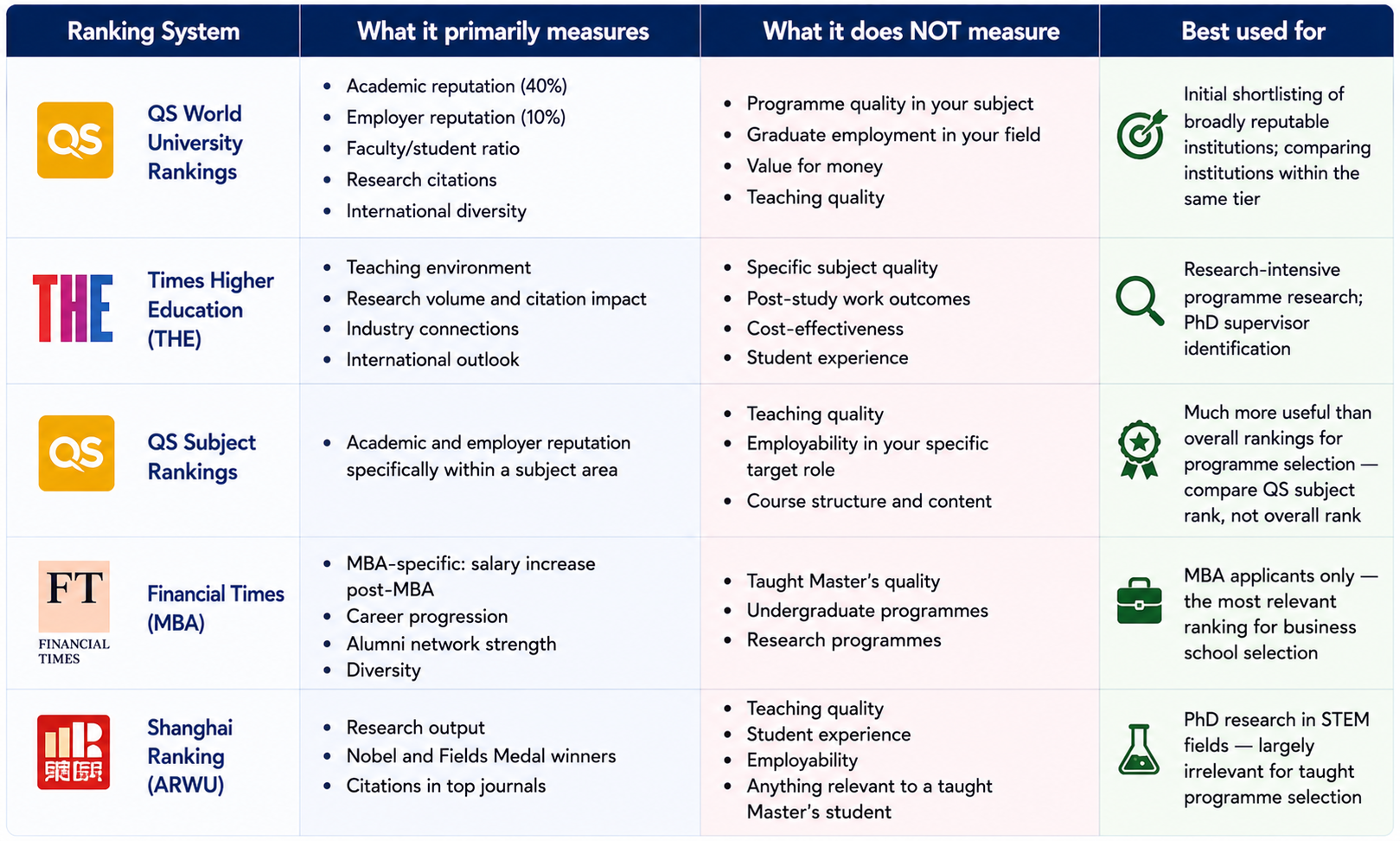
The most important implication of the above: for most postgraduate taught programme students, QS Subject Rankings are significantly more useful than overall QS World Rankings. A university ranked 150th overall may rank 20th in your specific subject — which is the number that matters. Conversely, a university ranked 30th overall may rank outside the top 100 in your subject.
This is a distinction that early overseas education counselling will make explicit. It is also a distinction that students researching independently — or relying on general online advice — frequently miss.
How to Evaluate a Specific Programme — The Factors That Actually Matter
Once you have a working shortlist of institutions, the next step is evaluating the specific programmes within those institutions. This is where the most important decisions are made — and where most students do the least research. Here is the complete framework used in Vidysea's counselling for study abroad process for programme evaluation:
Curriculum and Course Structure
Read the full curriculum — not the programme title and the headline description. Understand which modules are core and which are elective. Identify whether the programme has a dissertation, capstone project, or coursework-only pathway, and which of these is valued by employers in your target field. Check whether the curriculum has been updated recently; an MBA that last updated its core curriculum in 2018 is not the same as one that has integrated current industry practice.
- Does the curriculum include the specific technical or analytical skills your target employers look for?
- Are there specialisation tracks or elective clusters that align with your intended career path?
- Is there a dissertation or research component — and do employers in your field value this?
- Has the programme structure changed in the last 3–5 years, and in what direction?
Faculty and Research Strength in Your Specific Area
If you are applying for a research degree or a programme where academic mentorship matters, the research interests of individual faculty members are more important than the department's overall ranking. Identify three to five faculty members at each institution whose work aligns with your interests. Check when they last published, how frequently they supervise students, and whether they are currently accepting students.
For taught programmes, faculty research strength matters less than industry experience and teaching quality. Look for programmes where faculty members have recent industry experience in your target sector — not just academic credentials. This is a distinction that experienced study abroad counselling will surface; it is rarely visible in published programme materials.
Graduate Employment Outcomes
This is the most important data point for most students — and the one that is hardest to find in useful form. Most universities publish graduate employment statistics that are either too aggregated to be useful ('93% of graduates are in employment or further study within six months') or too curated to be representative. Here is how to find meaningful employment data:
- Look for destination reports broken down by programme, not just by faculty or school
- Identify whether top employers in your target field appear in graduate destinations — not just 'major employers' in a generic sense
- Search LinkedIn for alumni from the specific programme and track where they are working 2–3 years after graduation
- Ask the admissions team for employment outcomes specifically for your programme, broken down by role and industry — if they cannot provide this, that is informative
- For MBA and business programmes, the Financial Times employment report is the most reliable published source of graduate outcome data
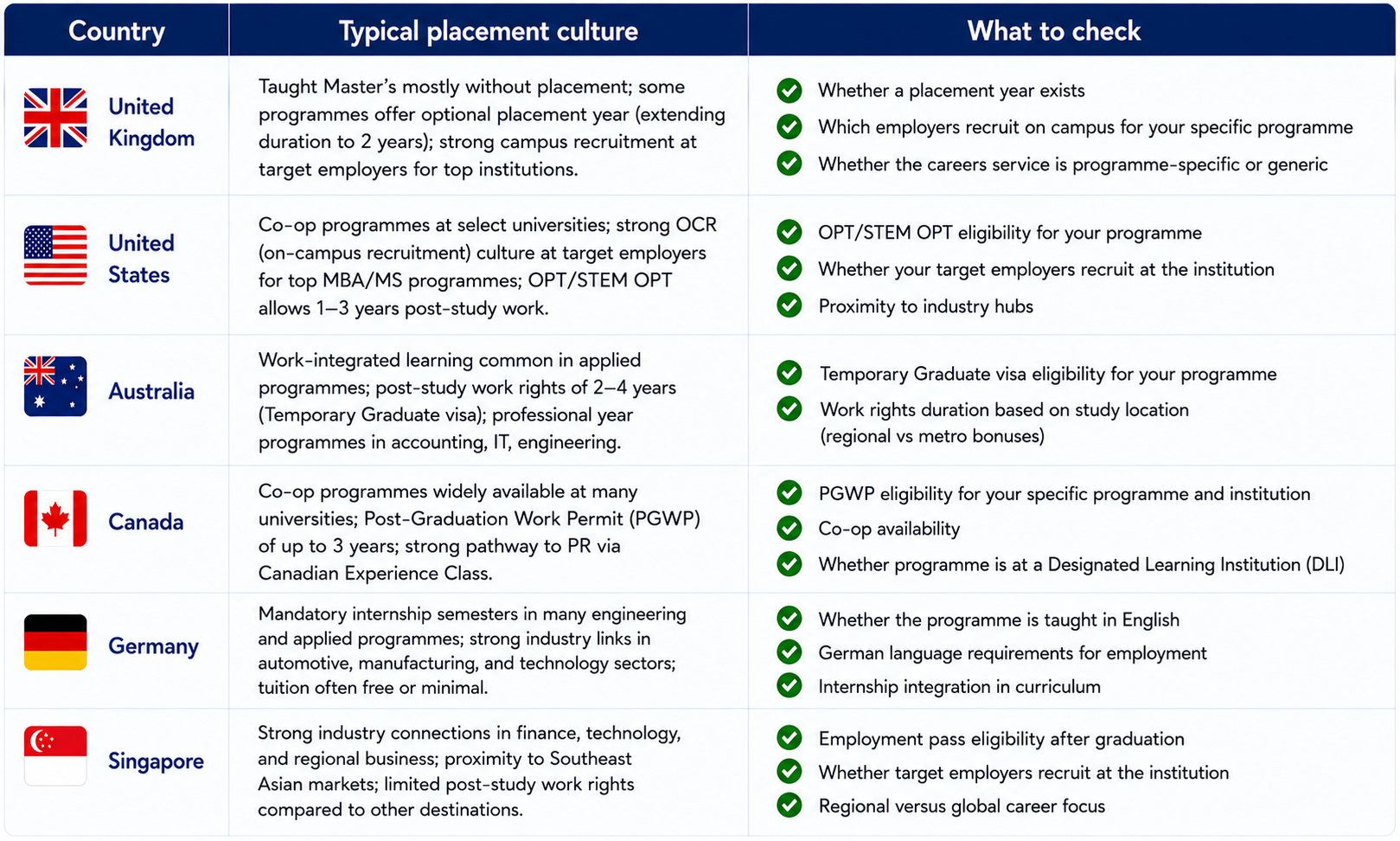
Industry Connections and Placement Culture
The presence or absence of a structured placement or internship culture varies enormously between countries and institutions, and it is one of the most underweighted factors in university selection. In the UK, most taught Master's programmes do not include a formal placement year — though some do, and it requires specific identification. In Australia, many programmes include a work-integrated learning component. In the US, co-op programmes at certain universities provide significant employer access that purely academic programmes do not.
Accreditation and Professional Recognition
For certain fields, accreditation is not optional — it is the difference between a qualification that opens doors and one that does not. This is a factor that overseas education counselling must verify before any programme is recommended to a student:
- MBA programmes: AACSB, AMBA, and EQUIS accreditation ('triple accreditation') is the gold standard; unaccredited MBA programmes carry significantly less weight with employers
- Engineering: IET (UK), Engineers Australia, PEO (Canada) recognition determines whether your degree is recognised for professional registration
- Accounting: ACCA, ICAEW, CPA exemptions depend on which programmes are accredited — a non-accredited accounting degree means sitting all professional exams from scratch
- Law: LLM programmes need to be evaluated against bar admission requirements if legal practice is the goal — a UK LLM does not automatically qualify you to practise in India or the US
- Medicine and healthcare: country-specific medical council recognition is mandatory and varies significantly; always verify with the relevant regulatory body
Accreditation is one of the areas where mistakes are most costly and most difficult to reverse. A student who completes a three-year engineering programme only to discover it is not recognised by the professional body in their target country has lost both time and money with no recourse. Verifying accreditation should happen before applying, not after receiving an offer letter. This is a non-negotiable part of thorough counselling for study abroad.
Country Selection — The Decision That Frames Everything Else
Country selection shapes your university options, your financial requirements, your post-study work rights, your study abroad scholarships eligibility, and your long-term immigration prospects. It should not be made by default or by following peers — it should be made deliberately, with full information about what each destination offers and what it costs.
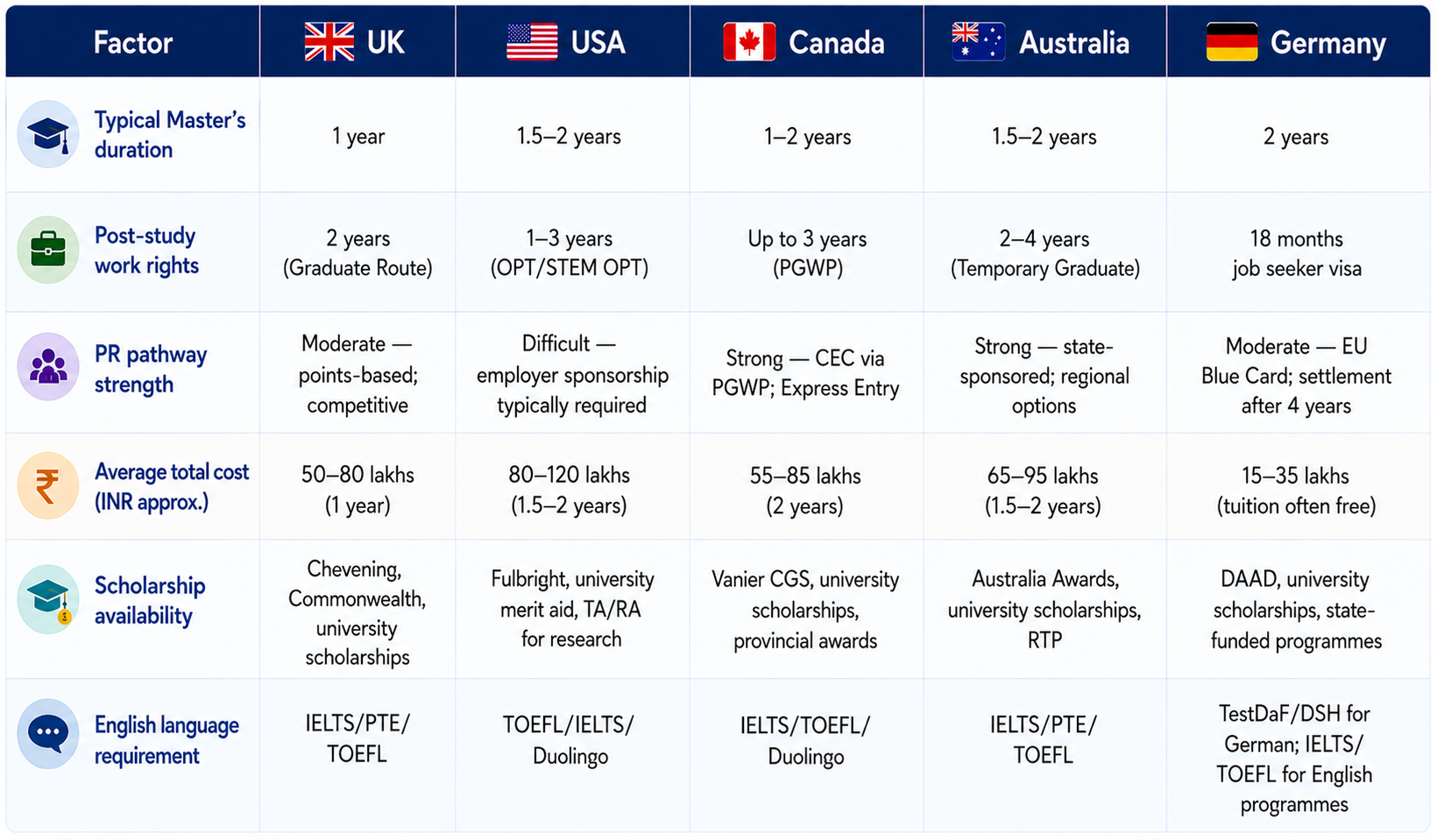
The right country depends on how these factors align with your personal goals, budget, and career trajectory. A student targeting a career in London's financial services sector may find that a one-year UK Master's at a target employer-affiliated institution offers better ROI than a two-year programme in Canada. A student planning to settle abroad long-term may find that Canada's PR pathway — accessible through the PGWP and Canadian Experience Class — outweighs a marginally stronger academic programme elsewhere. Structured overseas education counselling maps these trade-offs explicitly so you make the decision with full information.
How Study Abroad Scholarships Should Influence Your University Selection
Most students treat study abroad scholarships as something to pursue after selecting a university — applying for whatever scholarships happen to be available at the institution they have chosen. This is the wrong sequence. For many students, scholarship eligibility and financial aid availability should be a primary input into university selection, not an afterthought.
Types of Scholarships and How They Interact With University Choice
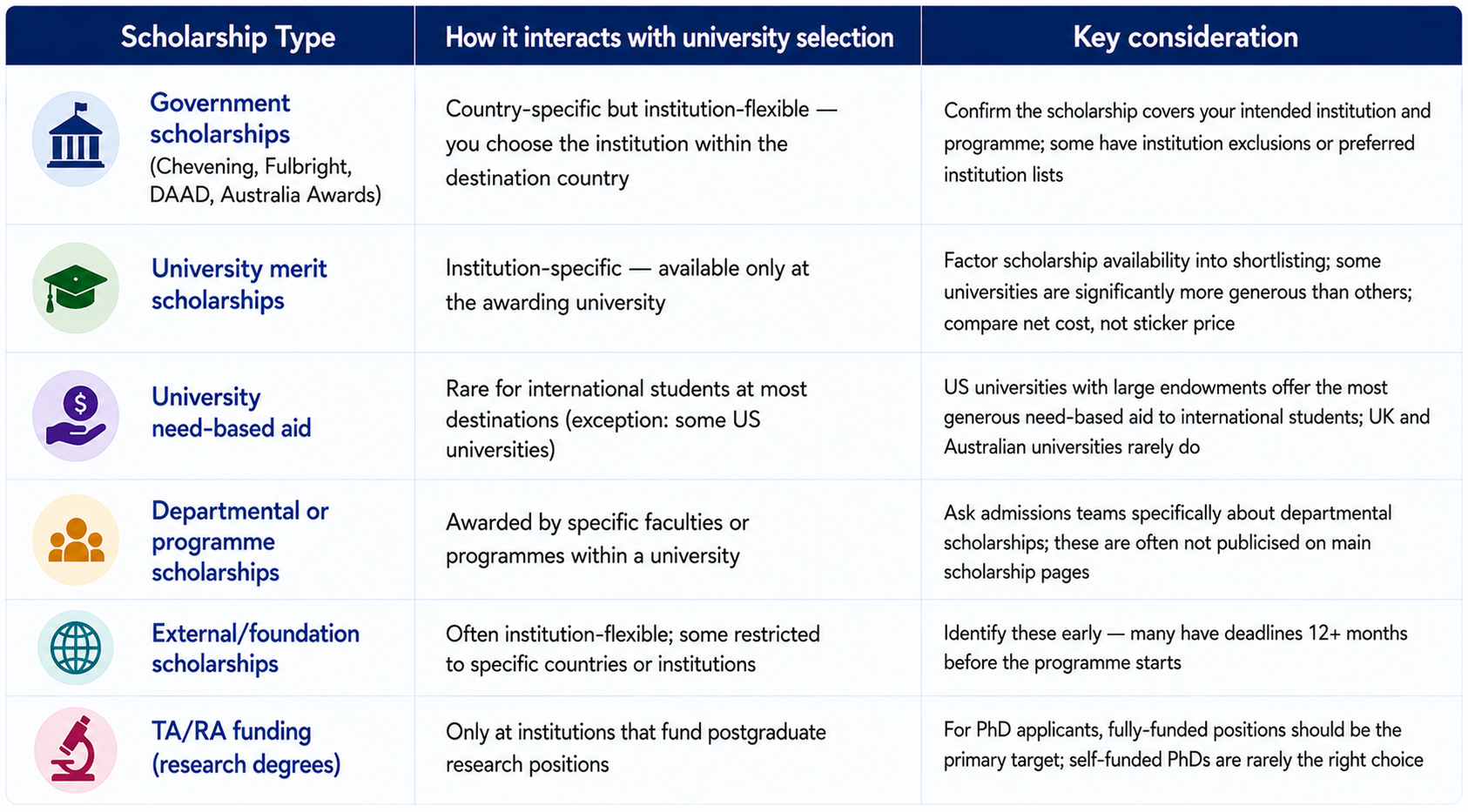
A critical implication of the above: comparing universities purely on headline tuition fees without accounting for scholarship availability produces the wrong shortlist. A university charging £30,000 per year that offers a 50% merit scholarship is cheaper than one charging £20,000 with no aid available. This comparison — net cost versus sticker price — is one of the core exercises in effective counselling for study abroad.
Scholarships for Students Studying Abroad — The Timeline Problem
The most valuable scholarships for students studying abroad — Chevening, Fulbright, Australia Awards, DAAD, Rhodes, Gates Cambridge — require preparation that runs parallel to, or ahead of, the university application process. Most students who miss these scholarships do not miss them because they are ineligible. They miss them because they discovered the deadline after it had passed, or they applied without the months of preparation that a competitive application requires.
- Chevening closes in November for programmes starting the following September — 10 months before the intake
- Fulbright closes in May–June for the following academic year — 15 months of lead time is realistic for a competitive application
- Australia Awards close in April–May, also for the following year's intake
- Gates Cambridge and Rhodes Scholarship close in October–November — requiring academic excellence and a leadership profile built over years, not months
- DAAD scholarships have multiple rounds with varying deadlines — research the specific programme and round relevant to your intake
This timeline makes it clear why study abroad counselling that begins 18–24 months before your intended start date creates scholarship opportunities that later engagement cannot recover. Scholarship applications submitted without adequate preparation — rushed to meet a deadline discovered late — almost never succeed at the most competitive levels.
Building the Right Shortlist — Reach, Match, and Safety Applied Correctly
The reach-match-safety framework is widely used in overseas education counselling — but it is frequently applied too loosely to be useful. Here is how to apply it correctly for international study:
Reach Institutions
A reach institution is one where your academic profile (grades, test scores) falls at or below the 25th percentile of admitted students. You may be eligible, but your admission is uncertain. Reach institutions should represent the top of your ambition — but the selection should be specific: apply to reaches where something in your profile (research experience, professional background, an unusual perspective) gives you a genuine point of differentiation, not simply because they are prestigious.
Number of reach institutions in a well-structured shortlist: 2–3 maximum. Applying to more than three reaches dilutes the time and quality of the applications that matter most.
Match Institutions
A match institution is one where your profile falls at or slightly above the median of admitted students. These are institutions where, with a strong application, you are a genuinely competitive candidate. Match institutions should be the core of your shortlist — and they should be institutions you would be genuinely happy to attend, not institutions you are applying to as a fallback.
Number of match institutions: 3–4. This is where most of your application effort should be concentrated.
Safety Institutions
A safety institution is one where you are comfortably above the typical admitted profile and can reasonably expect an offer barring an unusual application error. Safety does not mean low quality — it means high probability. Many excellent programmes in strong destinations are accessible to students who are overqualified by their academic profile. A well-chosen safety institution in a strong destination with available scholarships for students studying abroad can be an excellent outcome.
Number of safety institutions: 1–2. More than two begins to dilute your application effort and signals a shortlist that has not been built with confidence in the match tier.
A well-structured shortlist for most postgraduate applicants contains 6–9 universities total: 2–3 reaches, 3–4 matches, and 1–2 safeties. Across these, the distribution of countries should reflect your genuine goals — not an attempt to cover every possible destination. If you are genuinely targeting Canada, your shortlist should be weighted toward Canada. Spreading a shortlist across five countries to 'keep options open' typically means that no individual application receives the depth of research and tailoring it deserves.
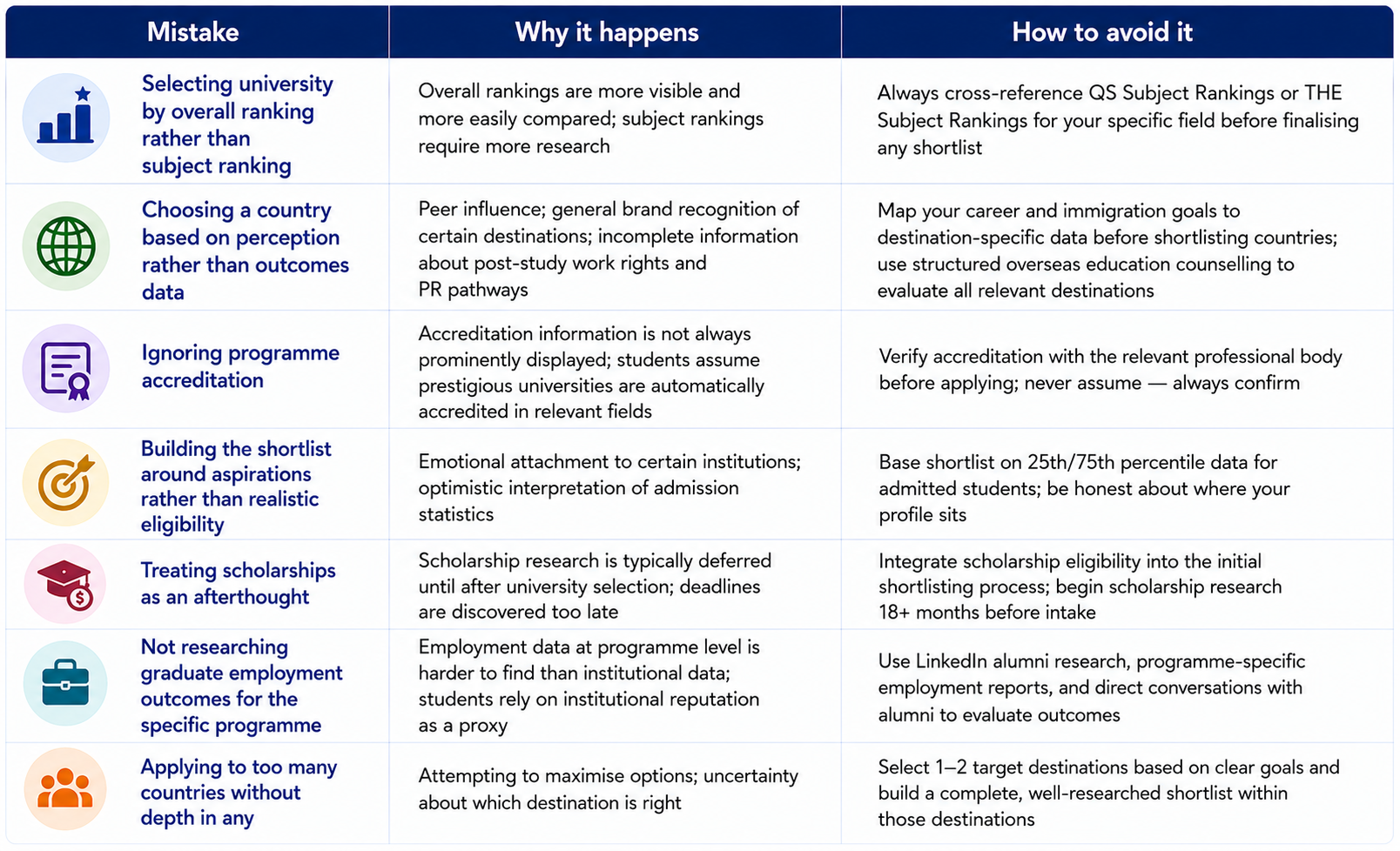
The Most Common Mistakes in Course and University Selection — And How to Avoid Them
These are the mistakes that experienced counselling for study abroad consistently identifies and prevents. Each one is preventable with early, structured engagement:
The Role of Study Abroad Counselling in Course and University Selection
The decisions described in this guide — course selection, programme evaluation, country comparison, scholarship strategy, shortlist construction — are each individually researchable. A determined student with sufficient time can work through each of them independently. The challenge is that each decision interacts with every other one. A country selection affects scholarship eligibility. A scholarship timeline affects when the application must be submitted. A programme's accreditation affects its career value. The visa implications of your institution choice affect your post-graduation work rights.
This is where study abroad counselling provides its core value — not by doing research that you could theoretically do yourself, but by integrating all of these decisions into a coherent strategy, surfacing the interactions and trade-offs that are not visible when each decision is made in isolation, and bringing the expertise of having guided many students through the same process with documented outcomes.
What effective overseas education counselling does for course and university selection specifically:
- Profile assessment that maps your academic record, test scores, work experience, and extracurricular background against realistic programme eligibility — not aspirational targets
- Country and destination analysis that reflects your career goals, immigration intentions, and budget — not general prestige rankings
- Programme-level research that goes beyond what is publicly available, drawing on institutional knowledge, alumni networks, and ongoing relationships with admissions teams
- Scholarship identification and eligibility assessment that is integrated into the shortlisting process from the start — not added after the fact
- Shortlist construction that balances ambition with realistic probability across reaches, matches, and safeties — calibrated to your specific profile
- Accreditation and professional recognition verification for fields where this is critical
- Ongoing calibration as offer letters arrive, scholarship outcomes are known, and the final decision between multiple offers needs to be made
The best time to begin this engagement is before any of the above decisions are made — before a country is chosen, before a shortlist is drafted, and certainly before any applications are submitted. For students who are already further along in the process, the value of counselling for study abroad shifts toward optimising what remains — but it does not disappear. At any stage, a structured assessment of your current position against your goals will produce better outcomes than continuing without one.
Frequently Asked Questions
Should I choose my course first or my country first?
In most cases, course and country decisions are best made together rather than sequentially, because each significantly constrains the other. A student who selects a country first and then looks for the best programme within it may discover that the destination they have chosen does not have strong programmes in their specific field. A student who selects a course first may find that the best programmes in that field are concentrated in a destination that does not match their immigration or financial goals. Study abroad counselling typically runs both analyses in parallel, allowing the decisions to inform each other rather than treating one as fixed.
How important are rankings really — should I ignore them entirely?
Rankings should neither be the primary decision-making tool nor be ignored entirely. They are a useful starting point for institutional reputation, particularly when comparing institutions you have no other information about. The key adjustment is to use subject-specific rankings rather than overall rankings, and to treat rankings as one data point among several rather than as a definitive guide. Graduate employment outcomes in your specific field, programme accreditation, scholarship availability, and the quality of employer relationships are all factors that rankings do not capture well — and that experienced overseas education counselling will weight appropriately alongside ranking data.
Is it possible to transfer from one university to another abroad if I make the wrong choice?
Credit transfer between universities in different countries is possible in some cases but is rarely straightforward. Credit transfer policies vary by country, institution, and programme — and the academic year structures, credit systems, and module equivalences required for transfer approval are frequently incompatible. In practice, most students who find themselves at the wrong institution either complete the programme and adjust their post-graduation plans, or return to their home country and reapply. The administrative and financial cost of a mid-degree transfer is high enough that prevention — through careful initial selection — is always the better strategy.
How do I evaluate a university I have never visited?
Virtual open days, programme webinars, and one-to-one sessions with admissions teams are the most direct sources of current programme information. Beyond these, LinkedIn is the most useful tool for evaluating real graduate outcomes — searching for alumni from the specific programme and seeing where they work two to three years after graduation gives ground-level data that official employment statistics do not always provide. Student forums and communities (Reddit, The Student Room, Quora) provide qualitative experience data, though with less reliability. And experienced counselling for study abroad providers with ongoing institutional relationships can access programme-level information that is not publicly visible.
What if I am torn between two offers from good institutions?
A decision between two genuine offers is a good problem to have — but it is also a decision that benefits from structured analysis rather than gut feeling. The framework to apply: return to your original goals (career outcome, immigration intention, budget, non-negotiables) and evaluate each offer explicitly against these criteria. Map the scholarship and financial aid difference between them, not just the headline tuition. Research the graduate employment outcomes of each programme specifically in your target role or industry. Consider the visa and post-study work rights implications of each destination. If the decision remains genuinely close after this analysis, study abroad counselling can provide an objective perspective from a position of knowing your full profile and goals — which is more useful than any general ranking comparison.
Can I apply to universities in multiple countries simultaneously?
Yes — there is no restriction on applying to universities across multiple countries simultaneously, and for students who are genuinely undecided between destinations, applying to two to three countries in parallel is reasonable. The practical constraint is application quality: each country and university has its own application requirements, essay prompts, and document specifications. A student applying to ten universities across five countries almost always produces weaker individual applications than one who applies to six universities across two countries with genuine depth of research. Effective overseas education counselling will help you identify which countries genuinely serve your goals so that your application effort is concentrated where it matters most.
Selecting the right course and university abroad is not a single decision — it is a series of interconnected decisions, each of which affects the others. Made with full information, in the right sequence, and with a clear understanding of your goals, this process produces an outcome that serves your career, your finances, and your long-term life plans. Made reactively, on incomplete information, or under time pressure, it produces the outcome you happen to arrive at — which is frequently not the same thing.
The foundation of a good outcome is early, structured study abroad counselling that begins with your goals and works forward — through country and programme selection, scholarship strategy, shortlist construction, and application preparation — with every decision informed by the ones that preceded it. If you are at the beginning of this process, the best time to start is now. If you are already partway through it and are uncertain about decisions you have made, a structured reassessment is almost always worth undertaking before the next commitment is made.