How Vidysea's AI-Powered Counselling Works
When a Vidysea counsellor sits down with a new student, the first 15 minutes of the session look like this: the student answers a structured set of questions — grades, field, test scores, budget, timeline, goal. The counsellor types nothing. The AI does. This is where modern study abroad counselling begins to evolve.

Team Vidysea
May 16, 2026

By the time the student has finished answering, the system has already scored 43 study destinations across 8 dimensions, built a tiered university shortlist with intake-specific admission probabilities, flagged three visa risk factors in the student's financial profile, and modelled the 10-year salary and loan repayment trajectory for the top four countries — making counselling for study abroad more data-driven and accurate.
Then the counsellor opens their mouth — and the real session begins.
This is not AI replacing a counsellor. It is AI handling the data-processing work that used to take four separate sessions, so the counsellor can spend the entire first meeting doing what only a human can do: asking the questions the form cannot, reading what the student is not saying, and challenging the assumptions the family walked in with. This is the next level of overseas education counselling.
Why this matters in 2026
The study abroad landscape has become too complex and too fast-moving for any counsellor to hold in their head. UK ILR policy changed in April 2026. Canada's cap exemptions for Master's students were clarified in January. Australia's Evidence Level 3 reclassification for India happened mid-cycle. A human counsellor who tracks all of this in real time, for all 43 destinations, while also conducting sessions — is not possible. An AI layer that updates within 48 hours of a policy change, and feeds that update into every subsequent session, is — strengthening modern study abroad counselling.
The six-stage process: what happens in a Vidysea session.
Here is the complete workflow — what the AI does at each stage, and what the counsellor does that the AI cannot.
| No | Stage | What the AI does | What the counsellor adds |
|---|---|---|---|
| 1 | Profile intake | Processes your grades, CGPA, backlogs, field, test scores, budget, and timeline against a live dataset of 2026 admission patterns across 40+ destinations. Flags where your profile is above-average, average, or weak for each country. | Asks the questions the form cannot: Why abroad? What does 'staying back' mean to you? What does your family expect? These answers reshape every downstream recommendation in counselling for study abroad. |
| 2 | Country matching | Scores destinations 0–100 on 8 dimensions: academic fit, visa difficulty, PR pathway speed, post-study salary, living cost, scholarship availability, field-specific employer demand, and 2026 policy stability. | Contextualises the score. A country that ranks 82/100 on the algorithm might be overridden for a student whose father has a specific visa history. Pattern-matching cannot know that. The counsellor does — a key strength of study abroad counselling. |
| 3 | University shortlist | Builds a tiered list of 6–8 programmes sorted by admission probability (derived from intake-specific acceptance data for Indian applicants), ranking, scholarship fit, and post-study employment outcome. | Reads the shortlist and adjusts for things the data does not capture: a department whose faculty recently changed, a university whose India-specific intake quota tightened this cycle, a programme with known SOP bias — an important part of overseas education counselling. |
| 4 | SOP narrative mapping | Analyses your academic background, work experience, and career goal against admitted student profiles for each target programme. Identifies the narrative angle most likely to resonate with each admissions committee. | Writes nothing. Instead, conducts a 45-minute conversation to surface the experiences, motivations, and moments that make your story genuinely yours — something AI cannot fully replace in counselling for study abroad. |
| 5 | Visa risk flagging | Cross-references your financial documentation profile, source-of-funds narrative, and destination country against known visa rejection patterns from Indian consulates in the past 6 months. | Prepares you for the interview. Flags the specific questions Indian applicants have been asked this intake cycle. Identifies which documentation gaps are real risks versus procedural footnotes — critical in study abroad counselling. |
| 6 | Post-offer comparison | When multiple offers arrive, models the 10-year outcome for each: loan EMI vs. starting salary in that country, PR timeline probability, cost of living adjusted net savings, and career trajectory by field. | Sits with you and your family to make the final call. Numbers are inputs. The counsellor facilitates the conversation between what the data recommends and what the family actually wants — the final step of overseas education counselling. |
What data does the AI actually run on?
The value of an AI system in study abroad counselling is entirely dependent on the quality of the data it processes. Here is what Vidysea's system ingests and how frequently it updates:
Live policy & visa data
• Student visa approval rates by nationality and destination• Policy change alerts within 48 hours• Visa rejection pattern tracking
University admission intelligence
• Acceptance data for Indian students• Scholarship availability• Job outcomes
Financial modelling
• Salary ranges by field and country• Living cost by city• Loan EMI calculations• PR probability models
This ensures counselling for study abroad is based on real, updated insights.
What the AI does not do
The AI does not read SOPs, write application essays, conduct mock visa interviews, or make the final recommendation. It does not override the counsellor. It processes patterns — not personal judgement — which is why human guidance remains essential in overseas education counselling.
What AI cannot replace — and will not try to.
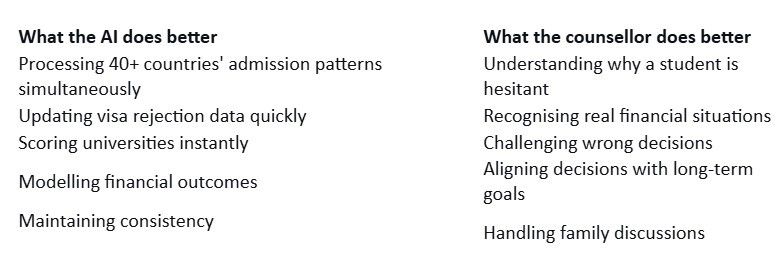
This balance defines modern study abroad counselling.
When a family is making a decision involving ₹30–80 lakh, a career pause, and relocation — they need more than just data.
They need a counsellor who understands the full picture.
AI improves speed, but human expertise ensures the decision is right — which is why counselling for study abroad cannot rely on automation alone.
How this compares to standard counselling.
Most study abroad consultants in India operate on manual workflows.
This leads to:
- Inconsistent advice
- Outdated information
- Limited options
With AI-powered overseas education counselling:
- Analysis is faster
- Shortlists are ready in the first session
- Risks are identified early
The consistency advantage
AI ensures:
- Equal data quality for every student
- Updated policies
- Consistent recommendations
This improves the reliability of study abroad counselling.
Questions families ask about AI counselling.
Is my data safe?Yes. It is used only within your session.
What if the AI gets it wrong?The counsellor reviews and adjusts all outputs.
Can I use the AI tool independently?Yes, but it works best with expert counselling for study abroad.
Does AI-powered counselling cost more?No. It is included in standard overseas education counselling services.
Final Thoughts
Study abroad counselling has always been about turning complex information into clear decisions.
AI makes it:
- Faster
- More detailed
- More accurate
Counsellors make it:
- Personal
- Practical
- Reliable
Together, they create the best counselling for study abroad experience.