

Got dreams to achieve? Hop on as we take you on your journey to success!


Services
Contact Info

Noida office
+91 7428715522Bangalore office
+91 8861432223 support [at] vidysea.com
Copyright@Vidysea
Got dreams to achieve? Hop on as we take you on your journey to success!
Noida office
+91 7428715522Bangalore office
+91 8861432223support [at] vidysea.comCopyright@Vidysea
Complete 2026 Guide for Indian Students — How to Prepare for Abroad Studies

Team Vidysea
Published Updated
Your IELTS score is not just an admission requirement — it is a visa eligibility requirement, an individual band requirement, and a score that means different things depending on which country, which university, and which programme you are applying to. A 6.5 overall IELTS opens most UK university doors. The same 6.5 with a 5.0 in Writing closes the UK Student visa door entirely.
Most Indian students make one of two IELTS planning errors. The first: comparing their overall score against the university's requirement without checking whether each individual band meets the visa authority's requirement — which is set separately and checked separately. The second: not knowing that a 6.5 that is sufficient for Edinburgh is insufficient for Oxford, or that a 6.0 accepted by most Australian universities is below the 6.5 required by Melbourne and Sydney.
This guide covers both layers: visa IELTS requirements by country (the floor you must meet to get a student visa) and university IELTS requirements at 20+ major global universities (the requirements set by each institution independently). It also covers how to prepare for abroad studies with a targeted IELTS improvement strategy — including the specific band that most Indian students score weakest in and how to close the gap before the application deadline.
The most important distinction in this guide: university requirement vs. visa requirement
These are two separate requirements set by two separate authorities. UK universities set their own IELTS requirements. The UK Home Office (UKVI) sets the visa requirement separately (6.5 overall / 5.5 in every band). You must meet both. A student who scores 7.0 overall with Writing 5.0 meets the university requirement for many UK programmes but will have their student visa refused. Check BOTH requirements before deciding whether a retake is needed.
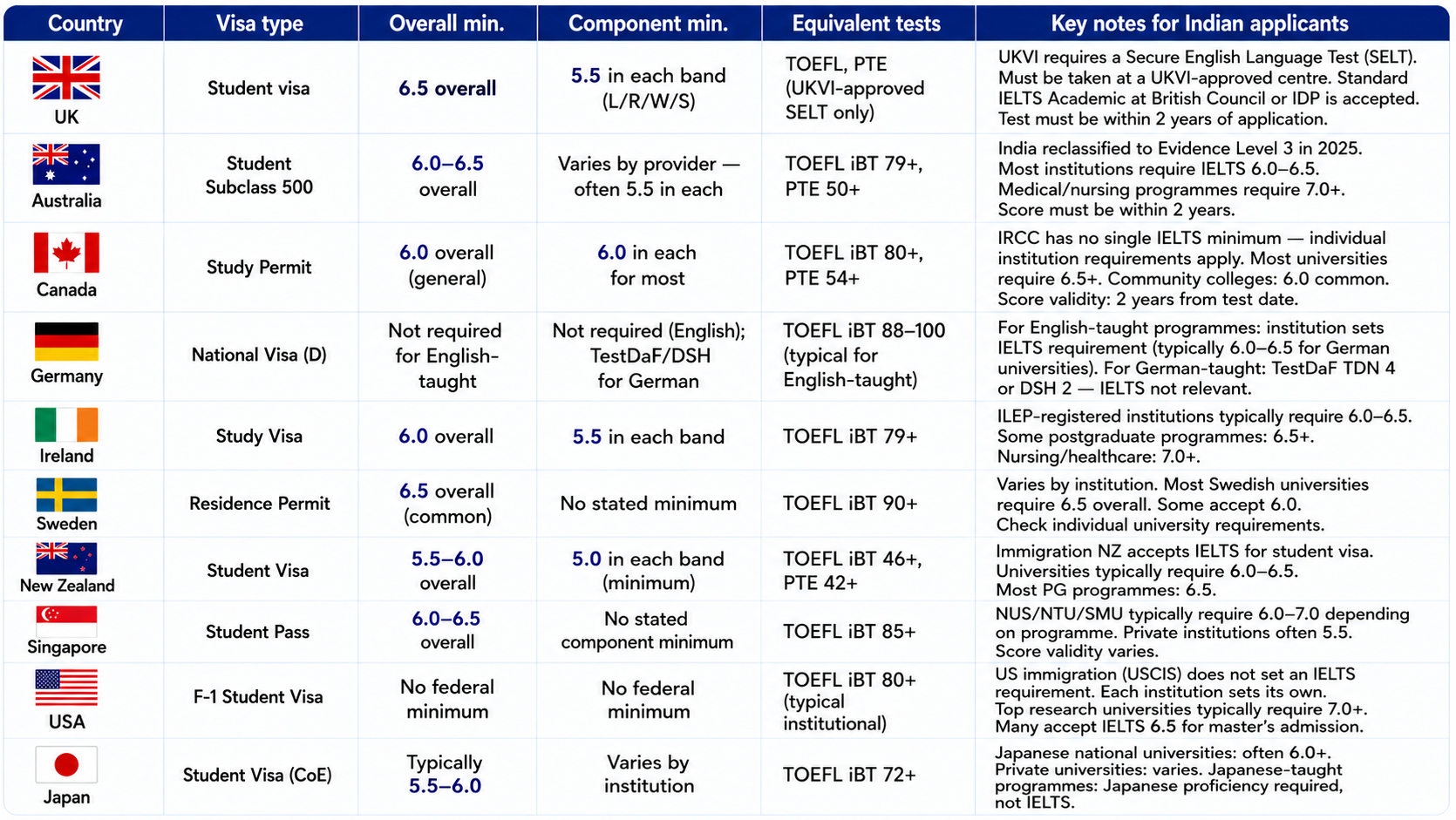
IELTS Requirements by Country — Visa Authority Minimums
These are the visa authority requirements — the floor every Indian student must meet to receive a student visa, independent of what any university requires:
The UK SELT requirement — taking the wrong IELTS test
For UK student visa purposes, IELTS must be taken at a UKVI-approved Secure English Language Test (SELT) centre — specifically British Council or IDP centres. An IELTS test taken at an unofficial or non-approved centre is not accepted by UKVI regardless of the score. Standard IELTS Academic taken at British Council or IDP India is SELT-compliant. If you are booking IELTS specifically for a UK visa application, confirm your test centre is listed on the gov.uk approved SELT providers list.
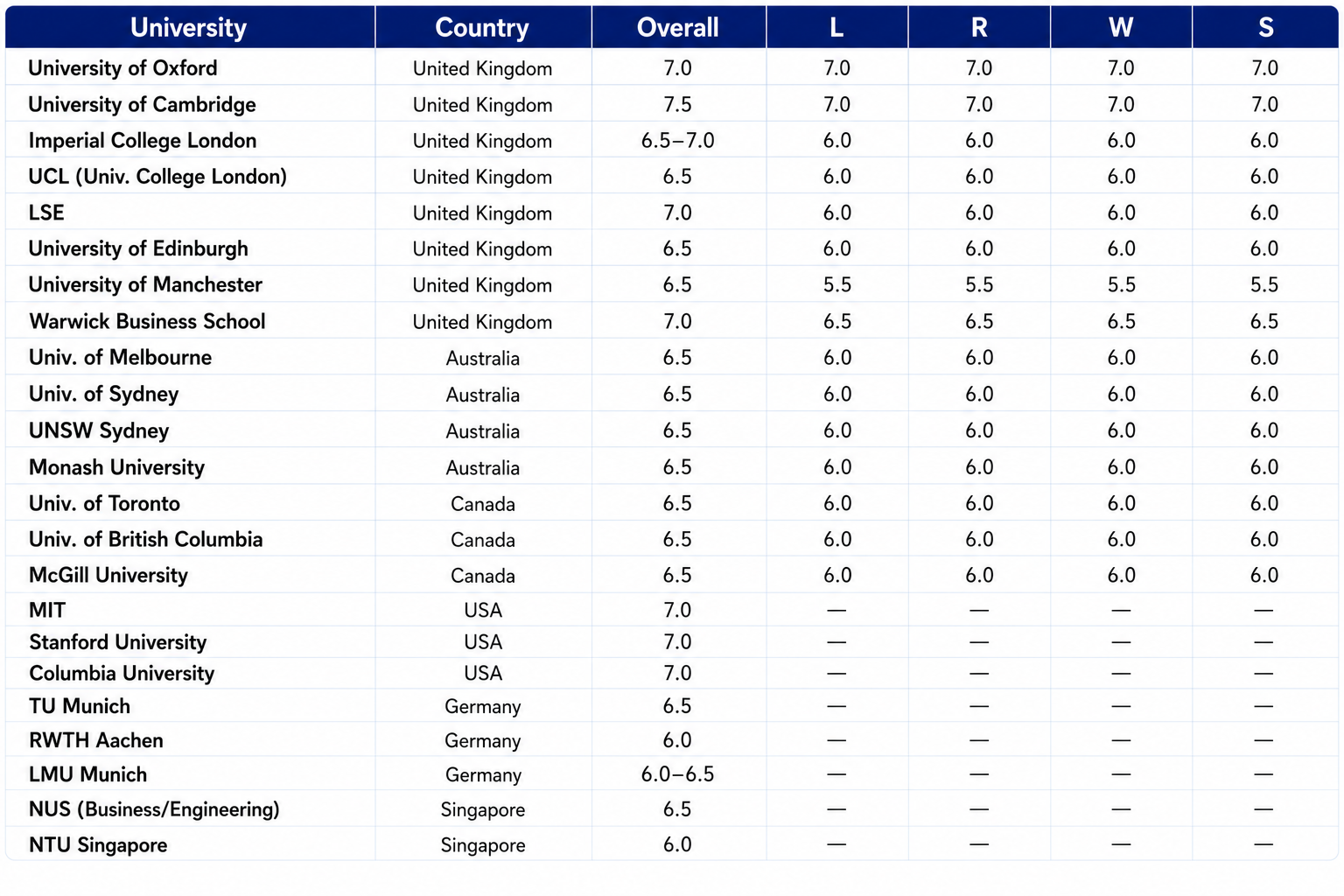
IELTS Requirements at Major Universities — 2026
These are the university-level IELTS requirements for 23 major global universities most targeted by Indian students. Note that component (band) minimums at the university level may differ from the visa authority minimums. For programmes not listed, check the specific programme page — postgraduate health, law, and education programmes often have higher requirements than the general university minimum. '—' indicates no published component minimum.
Always check the specific programme page, not the university homepage
University IELTS requirements are often listed at two levels: a general university minimum and a programme-specific requirement that may be higher. Medical, nursing, law, and education programmes at most universities require 7.0–7.5 even where the university general minimum is 6.5. Engineering and computer science programmes at the same university may accept 6.0–6.5. When planning how to prepare for abroad studies, use the programme-specific requirement, not the general university statement.
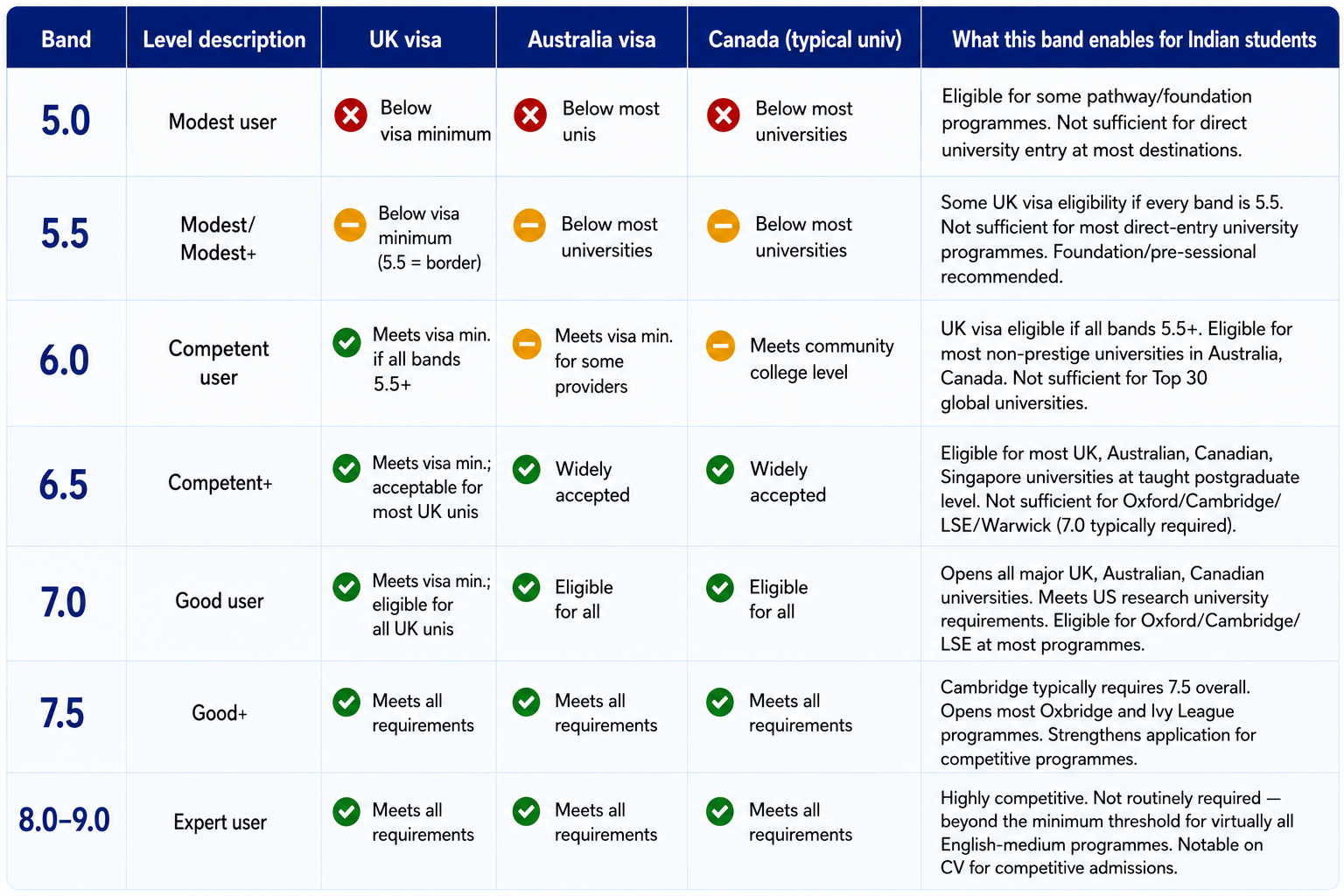
What Each IELTS Band Score Actually Enables — Quick-Check Reference
Use this table to identify which destinations and universities are realistic targets at your current band score — and whether a retake is needed to prepare for abroad studies at your target programme:
The band that matters most: Writing
For Indian students, IELTS Writing is consistently the band most likely to require improvement. A student who scores 6.5 overall with Writing 5.5 will be refused a UK student visa (minimum 5.5 is technically met, but many students score exactly 5.5 and remain at risk). A student targeting Oxford or Cambridge (7.0–7.5 required in all bands) with Writing at 6.0 needs a dedicated Writing retake. The band improvement table later in this guide covers exactly how to address Writing weaknesses.
IELTS vs PTE vs TOEFL — Which Test for Which Destination?
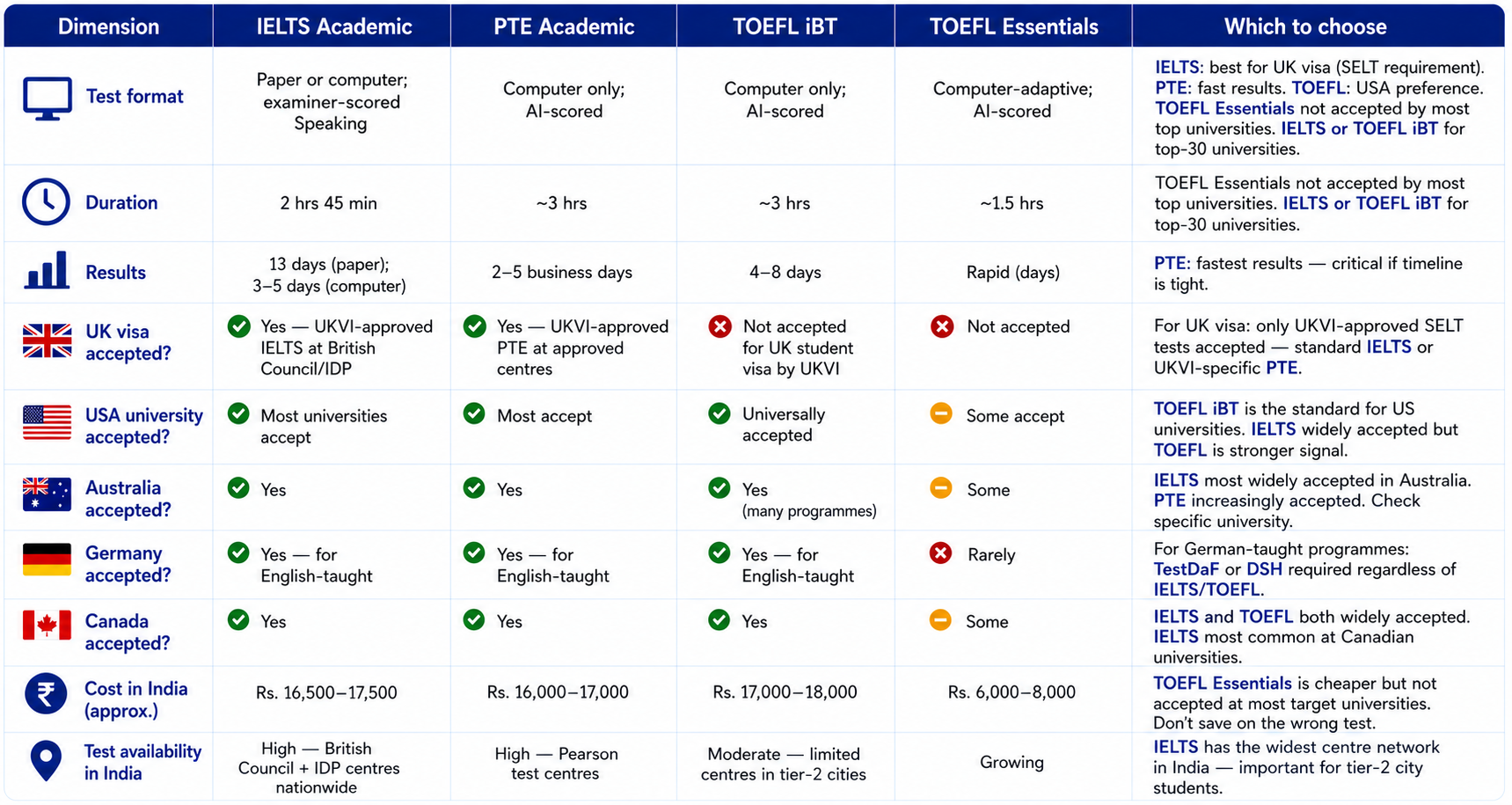
IELTS is the most widely accepted English proficiency test for study abroad from India — but it is not the only option. In some situations, PTE or TOEFL is the better strategic choice. Here is the complete comparison:
The case for PTE Academic when your timeline is tight
PTE Academic results arrive in 2–5 business days vs. 13 days for paper-based IELTS. If you are applying with a tight visa deadline (UK VFS appointment in 6 weeks), PTE at a UKVI-approved centre gives you a faster turnaround. IELTS computer-based also provides results in 3–5 days — faster than paper-based. If your application deadline is imminent, book computer-based IELTS or PTE rather than paper-based IELTS.
How to Prepare for Abroad Studies Through IELTS — Targeted Band Improvement
The most effective approach to how to prepare for abroad studies through IELTS is section-specific preparation — identifying your weakest band and targeting that section specifically, rather than treating all four skills equally. This table maps the most common weak-band patterns for Indian students and the specific strategies to address each:

The 30-day targeted retake strategy
If you scored 5.5 in one band and need 6.0, a 30-day targeted programme can achieve this. Vidysea's IELTS 30-day improvement guide (see internal link) covers this in detail. The principle: 30 days of 1.5 hours/day of targeted practice on the specific weak section, using Cambridge official IELTS practice tests for all timed practice. Do not distribute practice across all four skills equally when only one band is below target.
Best IELTS Preparation Resources for Indian Students
Official and Free Resources
Skill-Specific Resources
Paid Courses (for students needing significant improvement)
The Most Common IELTS Preparation Mistakes Indian Students Make
Mistake 1: Checking overall score only, not individual bands
This is the most consequential error. A student who scores IELTS 6.5 overall with Writing 5.5 is visa-eligible for the UK (meets 5.5 minimum in all bands) but may be rejected by specific programmes requiring 6.0 in all bands. A student with 6.5 overall and Writing 5.0 fails the UK visa requirement entirely. Always present your four band scores when checking eligibility, not just your overall score.
Mistake 2: Taking the wrong test type for your destination
IELTS Academic and IELTS General Training are different tests. For university admissions, IELTS Academic is always required. IELTS General Training is accepted only for immigration (not university admission) and for some professional registration routes. Taking IELTS General Training for a university application will have the application disqualified, regardless of your score.
Mistake 3: Not accounting for test score validity
IELTS scores are valid for 2 years from the test date. A student who took IELTS in October 2023 and applies for a September 2026 intake has an expired score. Most universities check validity at the time of enrolment, not application — but UK UKVI checks validity at the time of visa application. Build your IELTS retake timing around your target visa application date, not your university application date.
Mistake 4: Using free online practice tests from unofficial sources
Third-party IELTS practice tests often have inflated difficulty or incorrect calibration. A student who practices exclusively on unofficial materials may over- or under-estimate their real score. Cambridge official IELTS books and the official IELTS.org sample tests are the only resources that accurately simulate the real test experience. Use these for all timed practice.
Frequently Asked Questions
Can I get a conditional UK university offer with a low IELTS score and then improve it before enrollment?
Yes — many UK universities issue conditional offers with an IELTS condition. For example: 'We offer you a place conditional on achieving IELTS 6.5 with no band below 5.5.' If your current score is below this, you must achieve the condition before the university converts the offer to unconditional. Important: you cannot apply for a UK Student visa with a conditional offer — the offer must be unconditional before the university issues your CAS. Plan your IELTS retake timeline to achieve the required score at least 6–8 weeks before your intended visa application date.
My IELTS is 6.5 but I am applying to Oxford, which requires 7.5. How long will a 1-point improvement take?
A 1.0 band improvement across all four skills typically takes 3–6 months of dedicated preparation for students starting from 6.5. Moving from 6.5 to 7.5 in Writing — typically the hardest band to improve — requires a sustained period of daily writing practice with expert feedback. The 30-day targeted approach is effective for closing a 0.5 gap; a 1.0 gap requires longer. If Oxford is your target, take a diagnostic to identify which bands are furthest from 7.5 and build a specific preparation plan around those. Achieving 7.0 across all bands first, then targeting 7.5, is a more reliable path than trying to jump directly.
Does taking IELTS multiple times hurt my application?
No — universities and visa authorities see only the score you submit. IELTS does not report a 'number of attempts' to universities. There is no penalty for retaking IELTS, and multiple attempts with improving scores demonstrate preparation quality. The practical constraint is timing: IELTS results take 3–13 days (depending on paper-based vs. computer-based), so each retake cycle adds at minimum 2–4 weeks to your timeline. Budget for 2–3 attempts in your application timeline to avoid last-minute pressure.
The IELTS score is not a hurdle to clear — it is a specific signal to every country, every university, and every visa authority about your English language capacity. Understanding precisely what each destination requires — overall score, individual band minimums, visa vs. university, Academic vs. General Training — is the foundation of how to prepare for abroad studies effectively. The students who plan their IELTS preparation around their specific target programme, retake when needed, and check both the visa and university requirement before each application rarely have IELTS as the reason their application fails.