

Got dreams to achieve? Hop on as we take you on your journey to success!


Services
Contact Info

Noida office
+91 7428715522Bangalore office
+91 8861432223 support [at] vidysea.com
Copyright@Vidysea
Got dreams to achieve? Hop on as we take you on your journey to success!
Noida office
+91 7428715522Bangalore office
+91 8861432223support [at] vidysea.comCopyright@Vidysea
IELTS is the first test in the study abroad process that actually controls your outcome. Your CGPA affects which universities you can target. Your IELTS score affects which countries you can enter. A student with a 7.0 CGPA and an IELTS 7.5 has more options than a student with an 8.5 CGPA and an IELTS 6.0 — because the second student will fail the UK Tier 4 visa component score requirement at some universities, and fall below the competitive threshold at others. This guide covers everything an Indian student needs to know about IELTS in 2026: what scores are required for study abroad, what the test actually measures, how to prepare section by section, what the most common mistakes Indian students make, and how to structure 8 months of preparation for a target score.

Team Vidysea
Published Updated
Two keywords in the title deserve explanation: 'how to prepare for abroad studies' and 'test preparation to study abroad'. IELTS preparation is not just test practice — it is the foundational language skill-building that determines whether you will be able to function academically, professionally, and socially in an English-speaking environment abroad. The preparation you do for IELTS is, if done well, the same preparation that helps you write a compelling SOP, ace your visa interview, and survive your first seminar discussion. This guide treats it that way.
IELTS Academic vs. IELTS General Training
Almost all university admissions and student visa applications require IELTS Academic, not IELTS General Training. If your goal is to study abroad — undergraduate, postgraduate, or PhD — you should always book IELTS Academic. IELTS General Training is primarily used for immigration (PR) applications and work visas. This entire guide is written for IELTS Academic.
IELTS Band Score Reference — What Each Score Means for Study Abroad
Before planning any preparation, you need to know what score you are aiming for. This depends on your target country, your target university tier, and your immigration goal — not just the exam's general band descriptors.
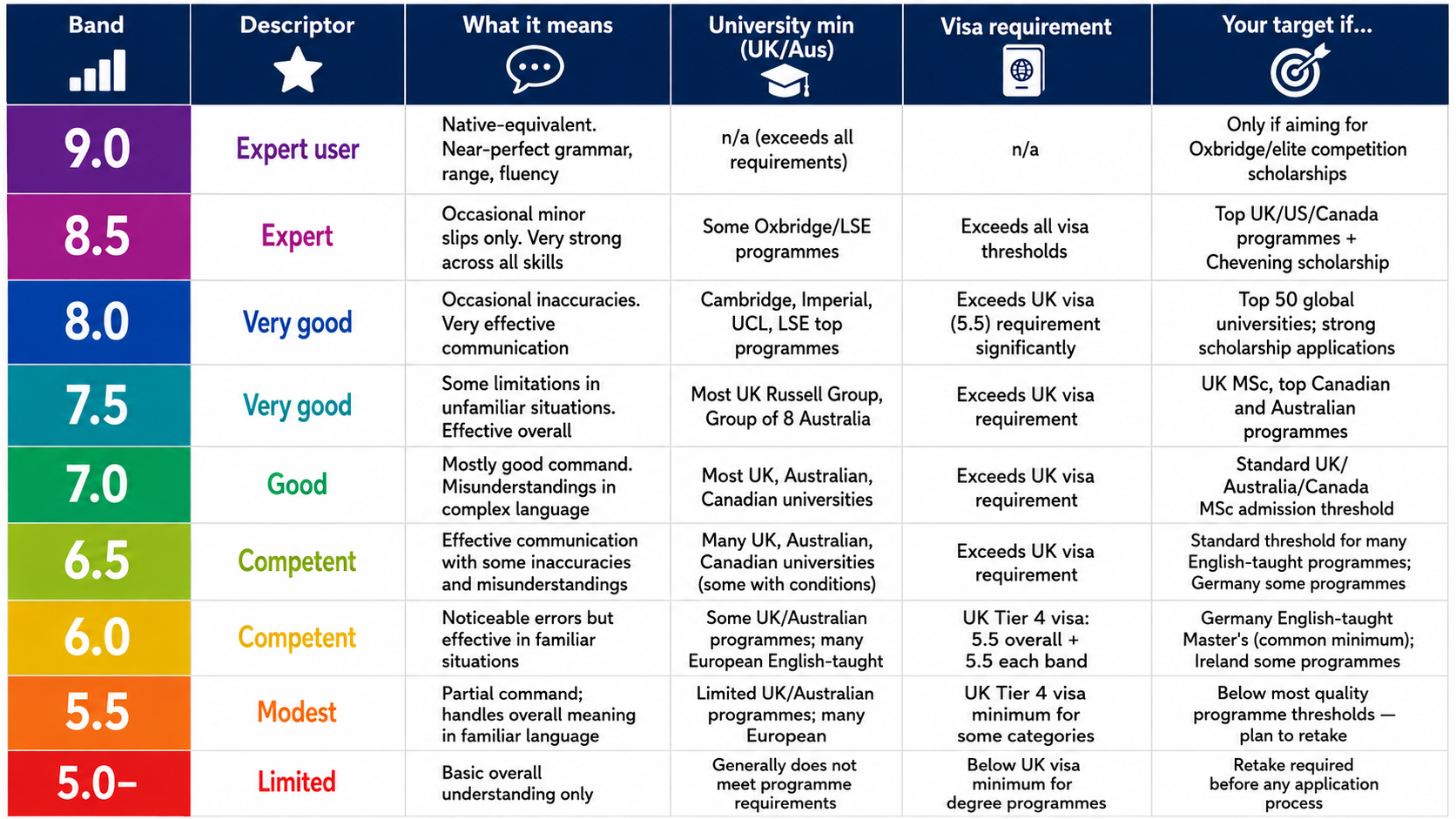
The visa IELTS requirement is different from the university IELTS requirement
This is the most misunderstood aspect of IELTS for Indian students. The UK Tier 4 student visa requires a minimum of 5.5 overall AND 5.5 in each individual skill band (Listening, Reading, Writing, Speaking). A student who scores 7.0 overall but 5.0 in one component will have their UK student visa refused, even with a valid university offer. Check both the university requirement and the visa requirement separately before deciding your target score.
IELTS Score Requirements by Country — 2026 Reference
These are the typical ranges for university admissions. Always verify against the specific programme and year of application, as requirements shift.
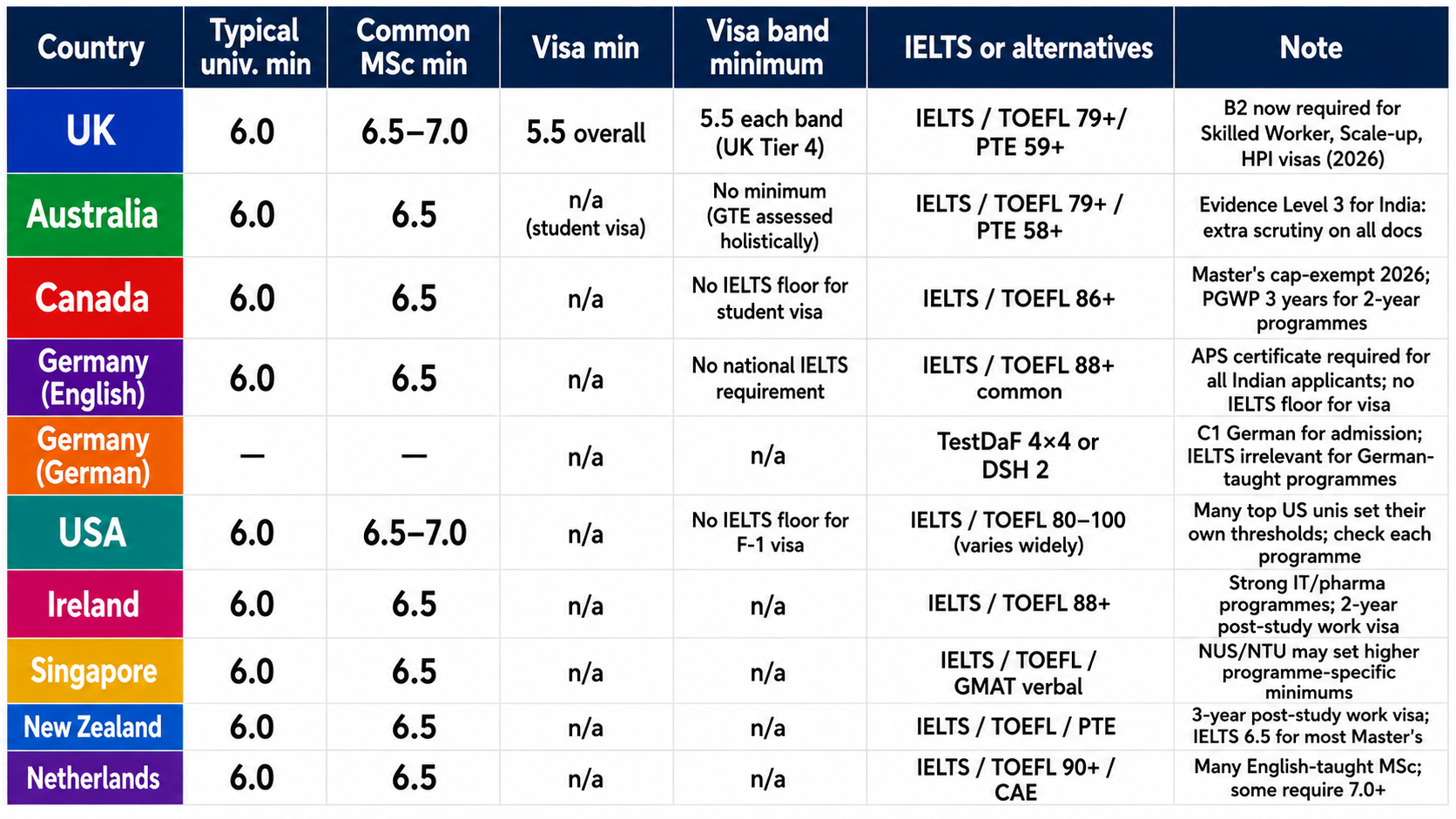
✅ Germany is the most common IELTS misconception
There is no national IELTS minimum for a German student visa. Each university sets its own requirement for English-taught programmes, typically 6.0–6.5 overall with no component minimums specified. However, APS certificate (mandatory for all Indian applicants) does not involve IELTS. German-taught programmes require TestDaF or DSH German proficiency tests, not IELTS at all. If your target is Germany, clarify whether your target programme is English-taught or German-taught before booking any test.
Section-by-Section Strategy — What Indian Students Need to Know
The four IELTS skills are not equally challenging for Indian test-takers. Understanding where Indian students typically lose marks — and why — allows you to design a preparation strategy that focuses effort where it has the most impact on your total score.
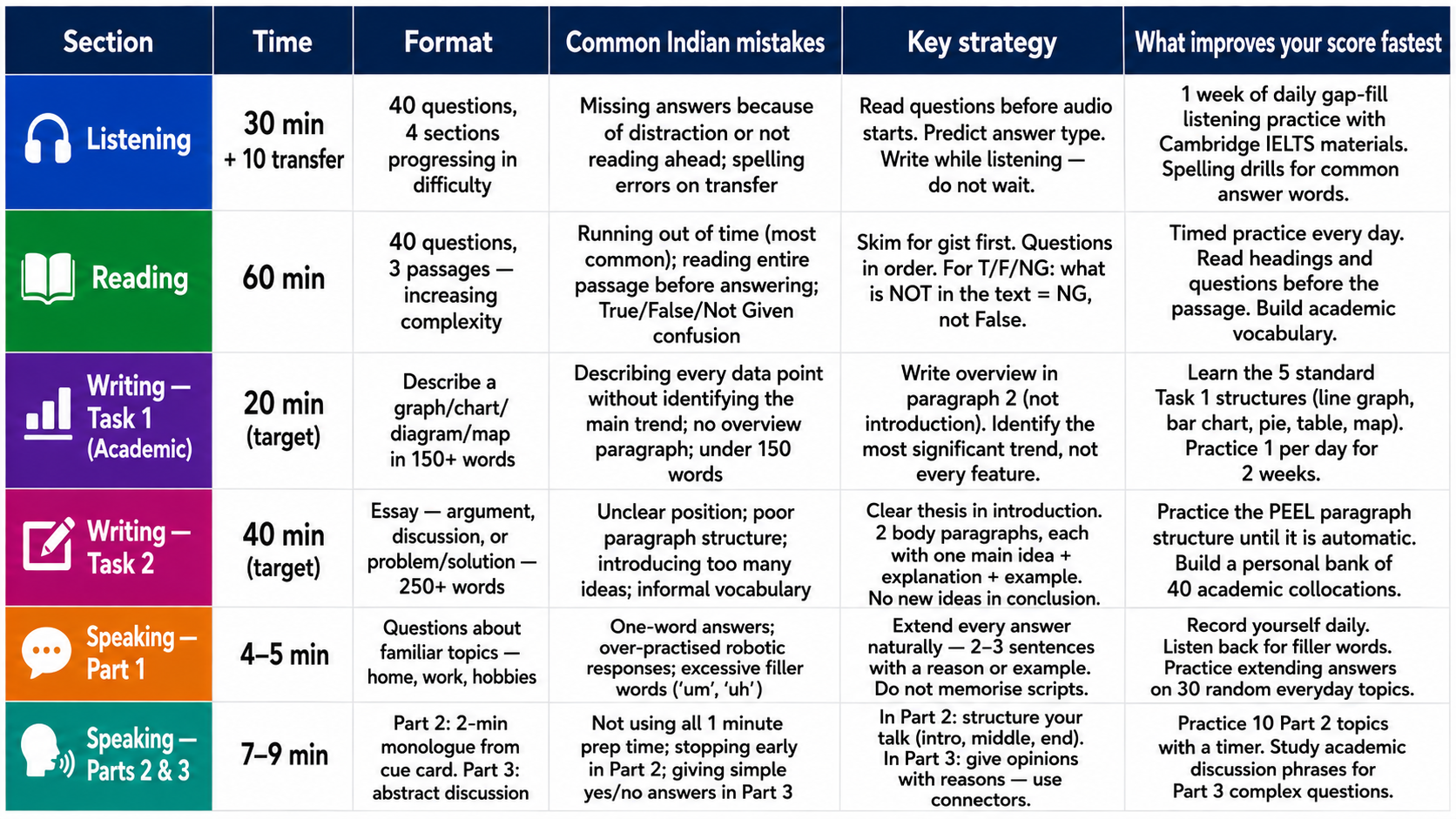
Why Indian students score higher on Reading than Speaking
Indian students typically score 0.5–1.0 band higher on Reading and Listening than on Writing and Speaking. The reason: Reading and Listening have objectively correct answers that reward analytical skills Indian students have developed through school. Writing and Speaking require demonstrating flexible command of language — varied vocabulary, complex sentence structures, natural discourse organisation — that strong academic performance in Indian universities does not necessarily develop. A targeted preparation strategy invests proportionally more time in Writing and Speaking.
The four sections — what actually matters for a high score.
Every section has a small set of skills that disproportionately drive the band score. Most IELTS preparation guides list everything. This section lists what actually moves your score from 6.0 to 7.0 or from 7.0 to 7.5.
Listening: The transfer phase is where marks are lost.
The audio in IELTS Listening is heard once. You have 10 minutes after the test ends to transfer your answers to the answer sheet. In that 10 minutes, most marks are lost — not because of wrong answers, but because of spelling errors. The IELTS marking scheme accepts only perfectly spelled answers. 'Accomodation' instead of 'accommodation'; 'seperate' instead of 'separate' — both incorrect.
The highest-ROI listening practice:
Reading: You do not have time to read.
The IELTS Reading section contains 2,000–2,750 words across three passages. You have 60 minutes. That is approximately 20 minutes per passage. You cannot read every word carefully and answer 13–14 questions in 20 minutes. High scorers skim for structure, locate answers by keyword scanning, and read carefully only the specific sentence where the answer is.
The True / False / Not Given trap:
The most common error: treating 'Not Given' as a failure — students assume if they cannot find it, they must be looking in the wrong place. In IELTS, 'cannot find it in the text' is the answer. The text does not discuss everything.
Writing Task 2: Three things the examiner is scoring.
IELTS Writing Task 2 is marked on four criteria of equal weight: Task Response (TR), Coherence and Cohesion (CC), Lexical Resource (LR), and Grammatical Range and Accuracy (GRA). Most students practise writing essays without knowing which of the four dimensions their specific writing is weakest on.
What each criterion actually measures:
The practical implication: get your Task 2 essays marked by someone who can tell you which of the four criteria is dragging your score down. Generic feedback ('write better essays') is not useful. Criterion-specific feedback is.
Speaking: Fluency is not speed.
Indian students frequently mistake speed for fluency. IELTS examiners mark Fluency and Coherence — which means the ability to speak naturally without excessive hesitation, repetition, or self-correction. A student who speaks at natural conversational speed without long pauses scores well on fluency. A student who speaks rapidly but fills every gap with 'um', 'you know', 'kind of' does not.
What actually improves Speaking band score:
The 8-Month IELTS Preparation Timeline for Study Abroad
This timeline is designed for an Indian student with an estimated current IELTS level of 5.5–6.0, targeting 7.0–7.5 for September 2027 intake. Adjust the start date and weekly hours based on your current level and target score.
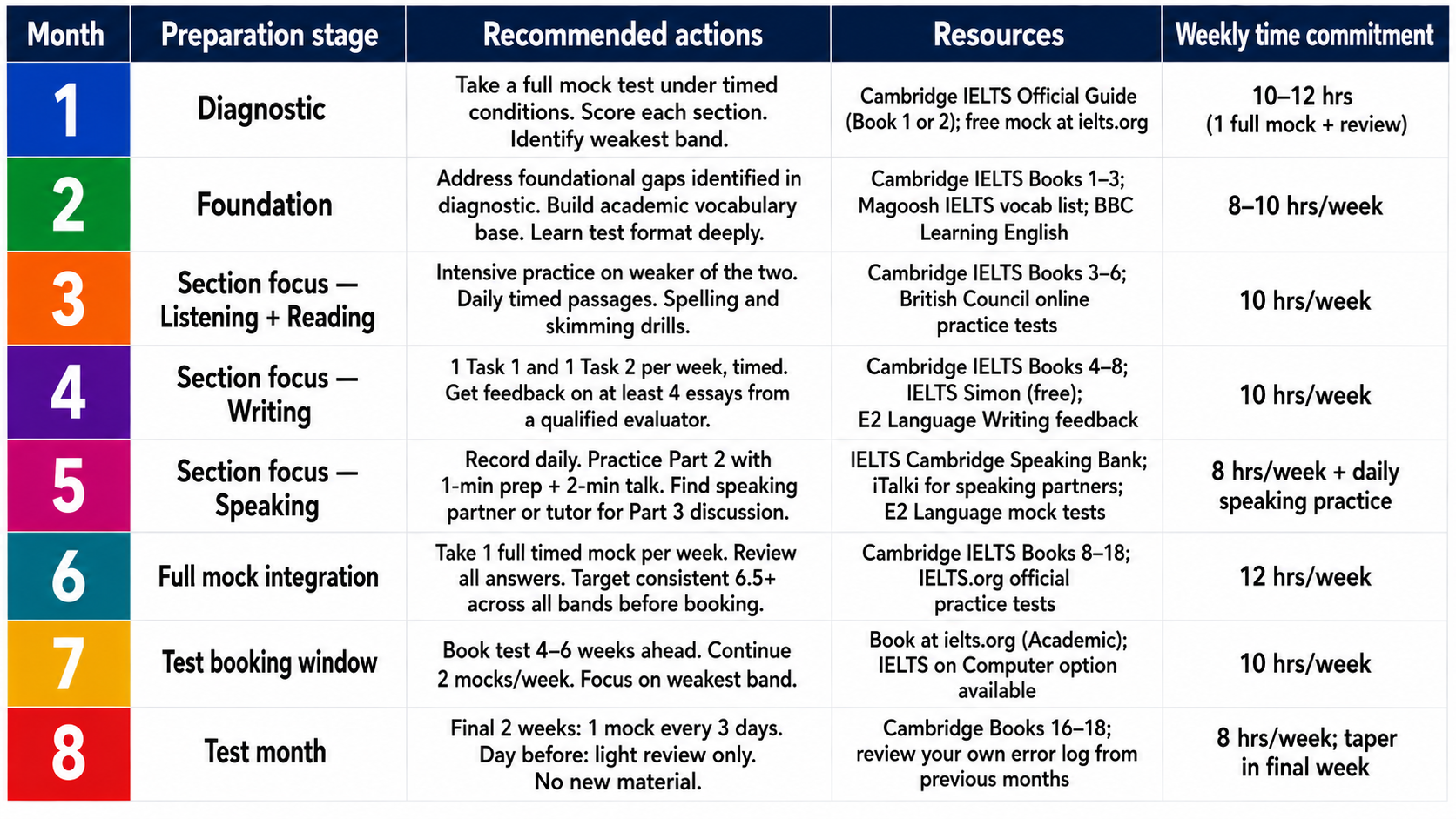
✅ When to book your IELTS test
Book the test when your mock test scores are consistently 0.5 bands below your target score — not when you feel ready, but when the data says you are close. A student targeting 7.0 should book when they are consistently scoring 6.5 in full mocks. This allows a buffer for the real test without over-preparing beyond the point of diminishing returns. IELTS test dates fill 3–4 weeks in advance in major Indian cities. Book early.
IELTS vs. TOEFL: Which Should Indian Students Take?
Both IELTS and TOEFL are accepted at almost all English-speaking universities globally. The choice is a preference decision, not an eligibility one — in most cases.
Choose IELTS Academic if:
Choose TOEFL iBT if:
PTE Academic is the third option — and often the fastest
Pearson Test of English (PTE Academic) is accepted by Australian, UK, Canadian, and New Zealand universities and for Australian/New Zealand student and PR visas. PTE results are available in 48 hours (versus 2–13 days for IELTS). It is fully computer-scored, eliminating human marker variability. Many Indian students who have retaken IELTS multiple times find PTE easier because its computer-based speaking component reduces the speaking anxiety that face-to-face IELTS examiners can induce. If you have had multiple IELTS attempts with inconsistent Speaking scores, consider PTE as an alternative.
IELTS as the gateway — where test preparation meets study abroad preparation.
Understanding how to prepare for abroad studies begins with understanding the role IELTS plays in the larger process — and where it ends. IELTS is a gateway document. It unlocks eligibility. It does not choose the right country, the right university, or the right programme. Those decisions require a different kind of preparation.
Here is where IELTS preparation ends and study abroad preparation begins:
After your IELTS score: the next six decisions
Each of these decisions is best made with a counsellor who understands the current state of admissions, visa requirements, and scholarship thresholds — not with a static guide. Your IELTS score is your entry ticket. The counselling session maps where that ticket takes you.
Frequently Asked Questions
How many times can I take IELTS?
There is no limit on the number of times you can take IELTS. Most universities accept your best score from any sitting within the last two years. If you have taken IELTS twice and want to try a different format, PTE Academic or TOEFL iBT are valid alternatives accepted by most of the same institutions.
How long is my IELTS score valid?
IELTS scores are valid for 2 years from the test date. If you took IELTS in April 2024, the score is valid until April 2026. If you are applying for a September 2027 intake, take IELTS no earlier than September 2025. Many Indian students take IELTS too early and then need to retake it simply because the score has expired.
Do I need IELTS for Germany?
For English-taught Master's programmes in Germany, you need IELTS Academic with a typical minimum of 6.0–6.5 (or TOEFL equivalent). There is no IELTS requirement for the German student visa — only for university admission to English-taught programmes. For German-taught programmes, you need TestDaF or DSH German proficiency tests instead — IELTS is not relevant for those programmes.
I scored 6.0 but my target programme needs 6.5. Should I retake?
Yes — if 6.5 is the minimum and you scored 6.0, you do not meet the requirement. However, before booking a retake, identify which bands are below 6.5. If your overall is 6.0 because your Writing is 5.5 and your other three bands are 6.5–7.0, a targeted 6–8 weeks of Writing-focused preparation can move your score. If you are below 6.5 across all bands, you need broader preparation. A counsellor who has seen hundreds of IELTS profiles can advise on the fastest path to your target score.
Is IELTS on Computer easier than paper-based IELTS?
The test content and marking criteria are identical. The only differences are administrative: results in 3–5 days (vs. 13 days for paper), computer typing for Writing (which many find faster but some find unfamiliar), and a headphone-based Listening section. Most Indian students find the computer format neutral or slightly faster due to result delivery. If you are not comfortable typing quickly, practise typed writing before attempting the computer format.
IELTS preparation is not a sprint. The students who achieve the scores they need for their study abroad goals are those who begin 8–12 months before they plan to sit the test, practise with real Cambridge materials, identify their weakest section early, and treat the preparation as the beginning of their study abroad experience — not just a hurdle before it. The score you achieve determines your options. The options you choose determine your next decade.