MEXT Scholarship Japan: Complete Guide for Indian Students 2026
The MEXT scholarship — formally Monbukagakusho, Japan's Ministry of Education, Culture, Sports, Science and Technology scholarship — is one of the most valuable government scholarships available to Indian students. It covers full tuition at Japan's national universities, provides a monthly stipend of ¥117,000 (approximately Rs. 66,000 at current rates), pays for arrival and departure flights, and runs for the full duration of the Master's (2 years) or PhD (3 years) programme, plus an additional 18-month Japanese language preparatory period for some categories.

Team Vidysea
June 2, 2026

Japan receives far fewer Indian scholarship applicants than the UK or Germany — not because the scholarship is less valuable, but because most Indian students are unfamiliar with the application routes, the two-track structure (Embassy recommendation vs. University recommendation), and the role of Japanese language preparation in the success of the application. This guide covers everything an Indian student needs to know about MEXT in 2026: the five scholarship categories, the Embassy vs. University route comparison, the step-by-step application process, the top Japanese universities for Indian students, and the financial structure of the scholarship.
One important framing note before the guide begins: MEXT is genuinely accessible to motivated Indian students with strong academic records — even without prior Japanese language knowledge. The Embassy route does not require Japanese as a condition of application. The University route does not require Japanese for many research-level positions. Japanese language is, however, strongly recommended to start immediately — because it determines the quality of your research environment, your employment prospects after graduation, and ultimately the speed of your path to Japanese permanent residency if that is a long-term goal.
🎯 The two things that most improve a MEXT application from India
First: contact a Japanese professor before applying (University route) or prepare a highly specific research plan that mentions Japanese research institutions and researchers (Embassy route). Generic research plans — 'I want to study AI because it is an important field' — are not competitive. Second: begin Japanese language preparation before you apply, not after you are selected. Even JLPT N5 at the time of Embassy interview demonstrates commitment. N2 at the time of application is a significant differentiator. The combination of a specific research plan and demonstrated Japanese language effort separates funded from unfunded applications.
What Is the MEXT Scholarship — Five Categories
MEXT offers five scholarship categories. For Indian students, the Research Student (Graduate) category — covering Master's and PhD study — is the most relevant. Here is the complete picture:
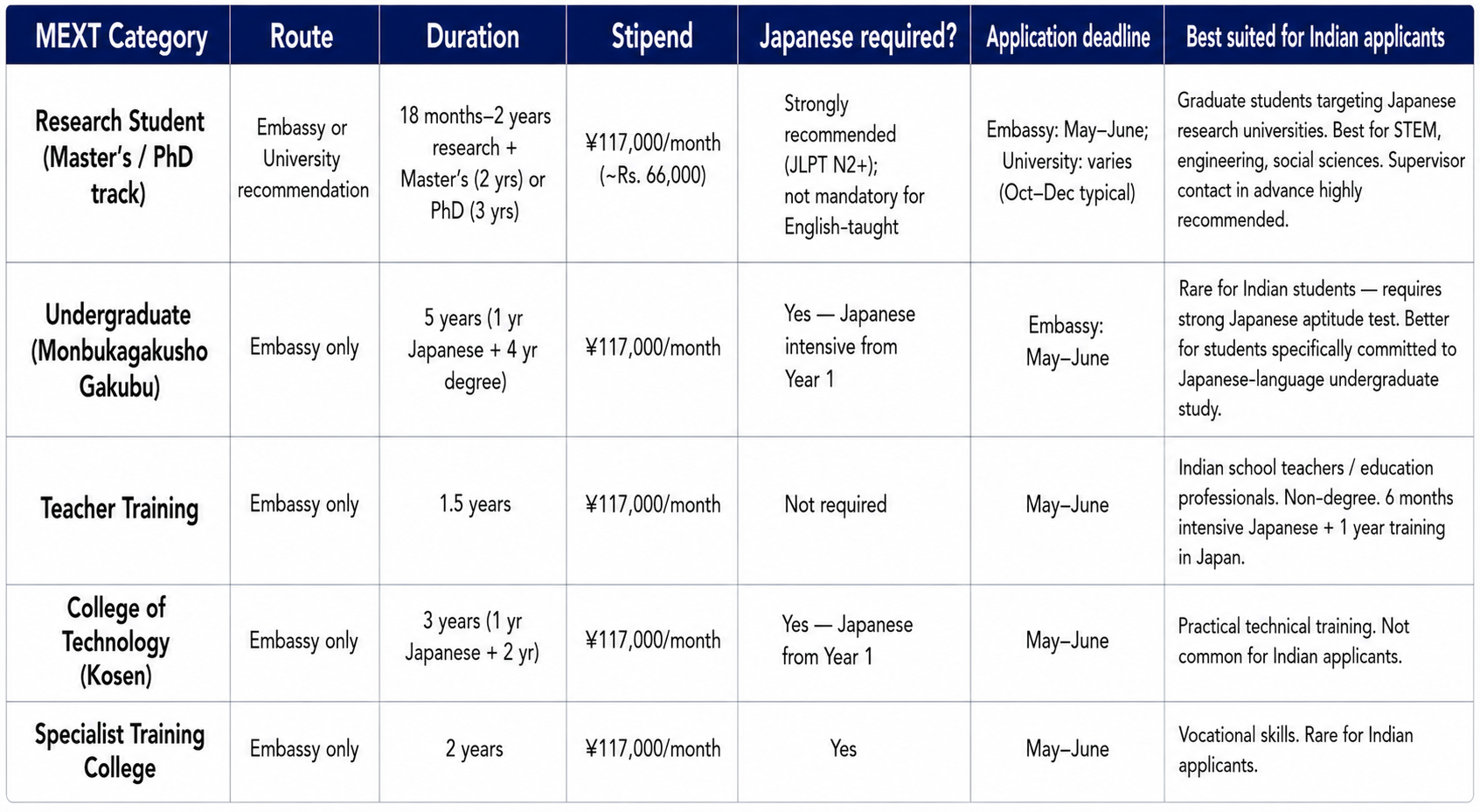
✅ The Research Student category is the right choice for almost all Indian graduate applicants
The MEXT Research Student category is the gateway to both Master's and PhD study in Japan. It includes 18 months of Japanese language and foundational coursework before the formal degree programme begins. This means the total duration is approximately 3.5 years for a Master's (18 months + 2 years) and 4.5 years for a PhD (18 months + 3 years). The stipend covers the full period including the preparatory phase. For Indian students targeting Japanese research universities for graduate study, this is the category to focus on.
Embassy Recommendation vs. University Recommendation — Which Route?
The MEXT Research Student scholarship can be obtained through two routes with very different application processes. Understanding the distinction is the most important planning decision in the MEXT application:
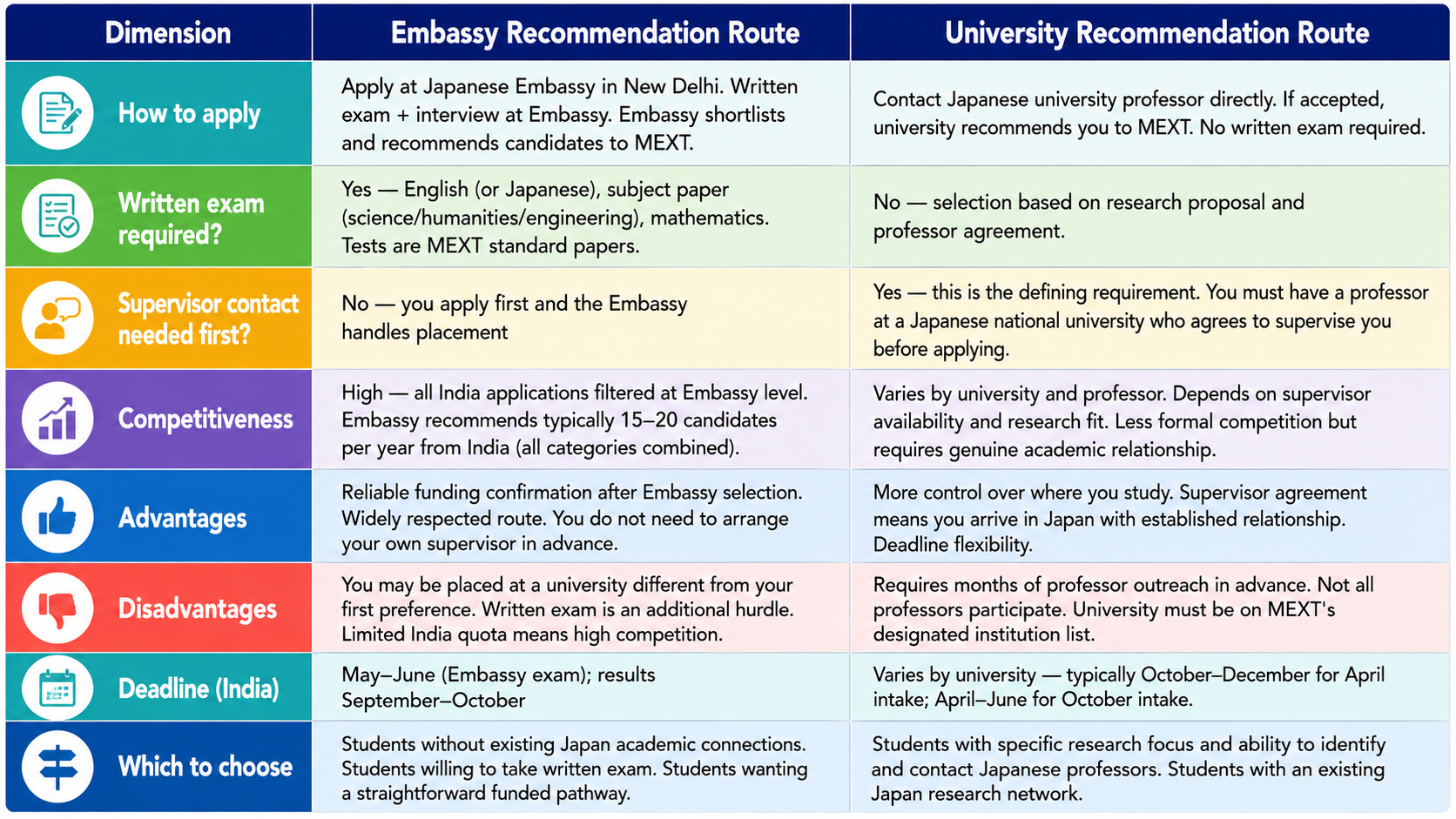
💡 The University route is underused by Indian applicants — and often more accessible
Most Indian students default to the Embassy route because it is more visible. The University route requires more initial effort — finding and contacting a Japanese professor — but is often more accessible for students with a specific research focus and the ability to identify relevant faculty. Japanese professors who supervise international students under MEXT are experienced with the process and often actively seeking qualified international research students. A well-written, specific research interest email to 5–8 targeted professors has a meaningful response rate. Start this outreach 10–12 months before your target intake.
Step-by-Step MEXT Application Process for Indian Students
This is the complete MEXT application process for the Research Student (Graduate) category. Steps 3 and 4 are route-specific — only one applies to your chosen route:
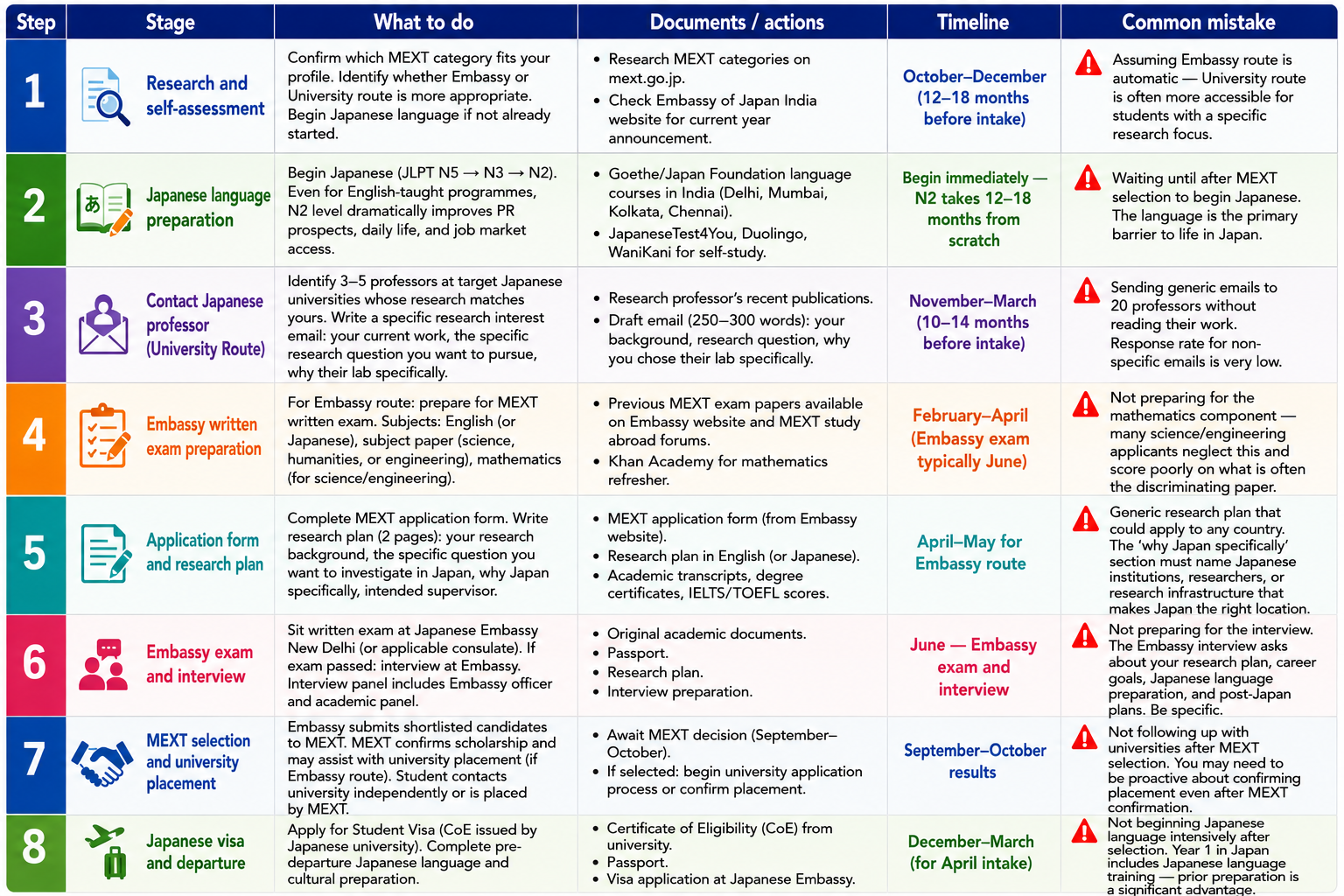
⚠️ The Embassy exam mathematics paper — the most under-prepared component
Many Indian applicants to the MEXT Embassy route are strong researchers who underestimate the Embassy's written mathematics examination. The paper tests undergraduate-level mathematics at reasonable depth — calculus, linear algebra, statistics. Science and engineering students are typically well-equipped. Social science and humanities students applying under the science/engineering classification may need targeted preparation. Previous MEXT exam papers are available through the Japanese Embassy in India and on MEXT study abroad forums — practise specifically with these papers, not general mathematics textbooks.
Top Japanese Universities for MEXT Students — Indian Applicant Guide
All of Japan's national universities (国立大学, or Kokuritsu Daigaku) are eligible for MEXT scholarship placement. Here are the most relevant for Indian graduate students:
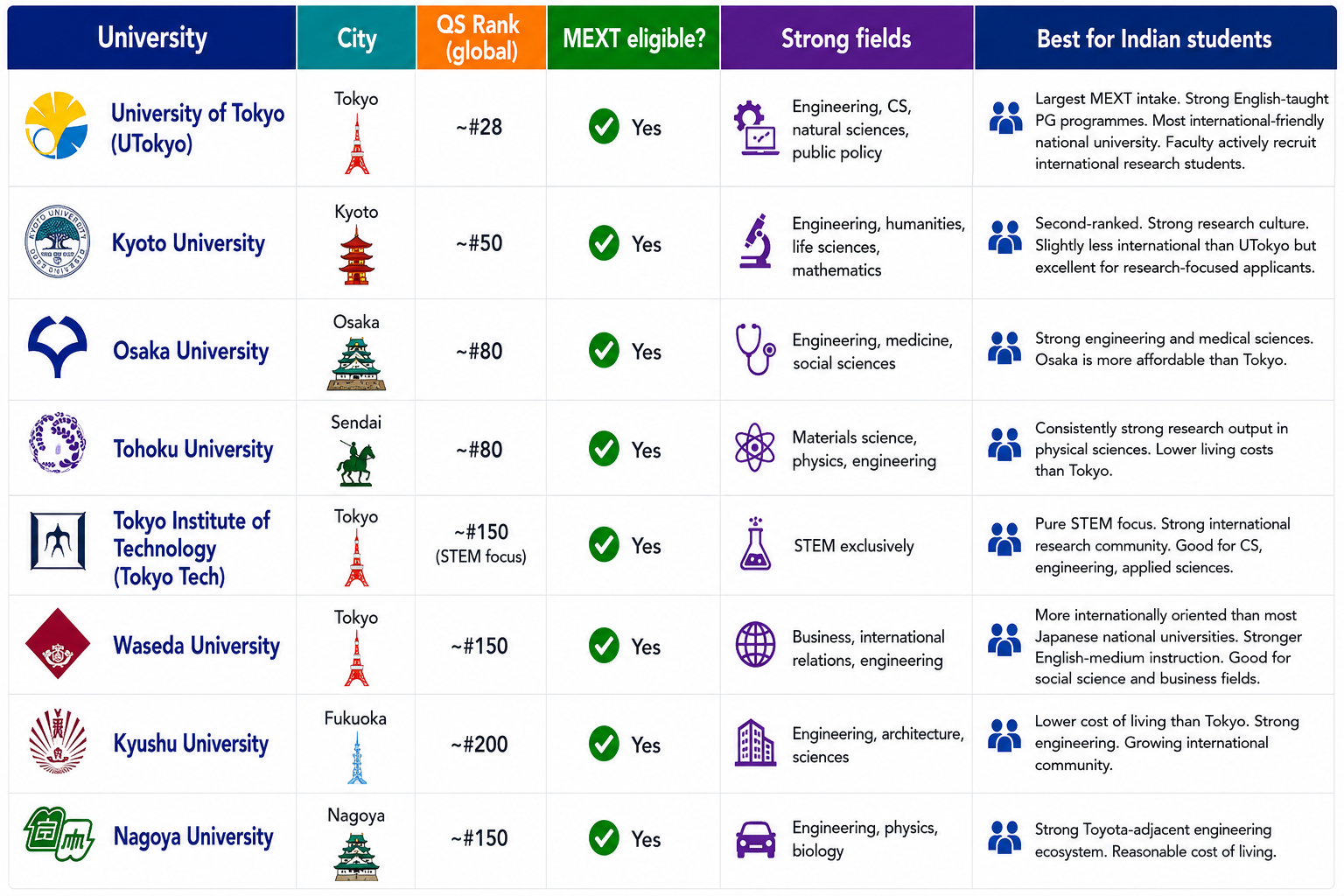
✅ UTokyo for the widest range of MEXT-funded fields; Waseda for the most international environment
The University of Tokyo and Kyoto University receive the most MEXT Research Student placements and have the most developed international student infrastructure. For Indian students specifically: UTokyo's Graduate Schools of Engineering, Information Science and Technology, and Frontier Sciences have the highest concentration of Indian researchers and are the most English-accessible. Waseda University, though a private institution with slightly different MEXT arrangements, has the most genuinely international academic culture of any major Japanese university and is well-suited for students in social sciences, business, and international relations.
MEXT Financial Structure — What Is Covered and What Is Not
Understanding exactly what MEXT covers — and what must come from the stipend — is essential for financial planning before departure:
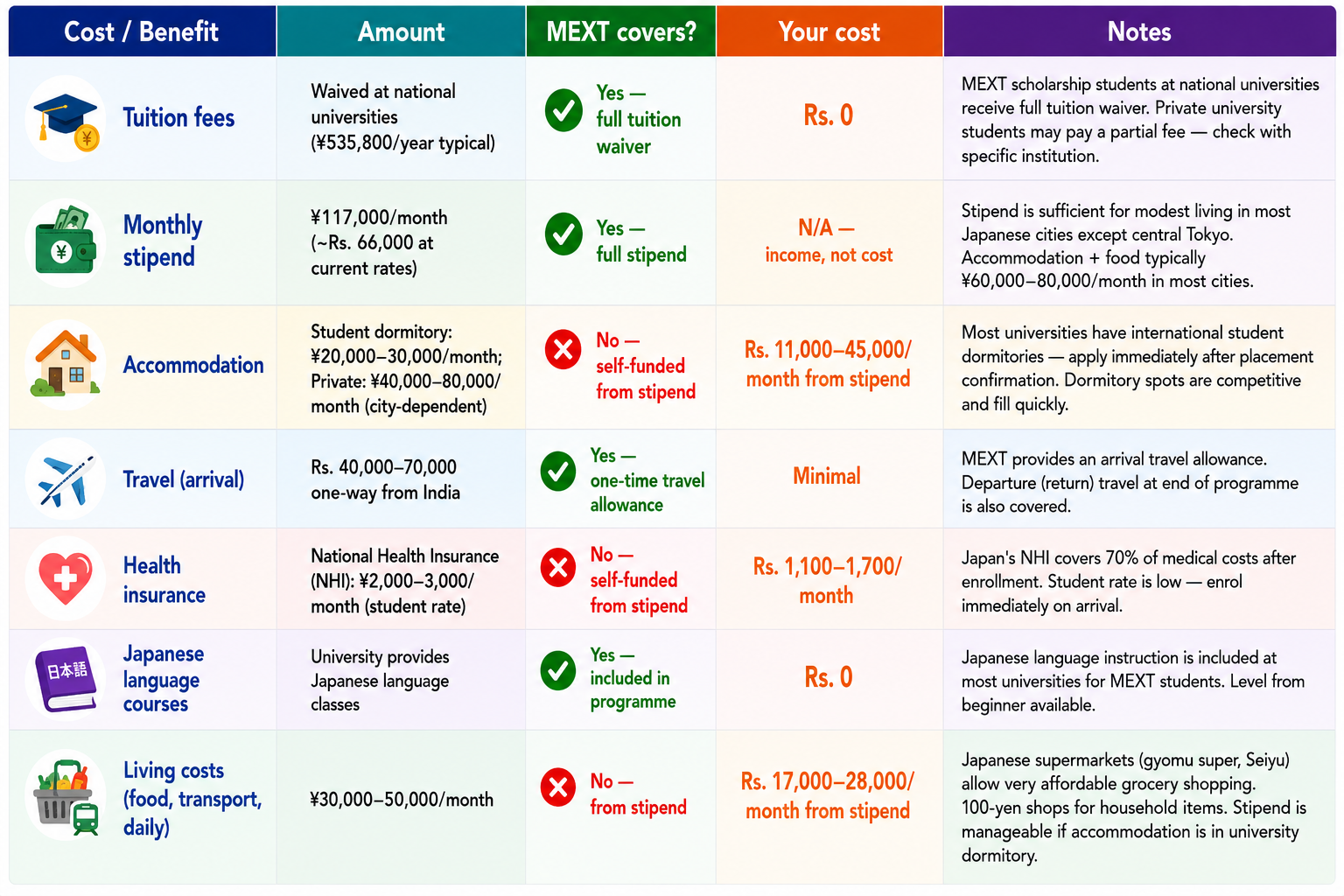
💡 The ¥117,000 stipend is liveable — but not comfortable in central Tokyo
¥117,000/month (~Rs. 66,000) is sufficient for student life in most Japanese cities. The critical variable is accommodation. A university dormitory at ¥25,000–30,000/month leaves approximately ¥85,000 for food, transport, and daily expenses — very manageable. Private accommodation in central Tokyo at ¥80,000–100,000/month leaves ¥17,000–37,000 for all other expenses — tight. Apply for university dormitory placement immediately upon receiving your placement confirmation. Dormitory spots at Tokyo universities are competitive. Students who apply immediately after selection have the best chances.
Japanese Language — Why It Matters More Than the Application Says
The MEXT Research Student application does not require Japanese language proficiency as a formal eligibility criterion for many English-taught positions. This leads many Indian applicants to deprioritise Japanese language preparation. That is a strategic mistake for three reasons:
- Research environment: Japanese professors and lab colleagues communicate primarily in Japanese even in 'English-taught' environments. A student who cannot participate in lab meetings, group discussions, or informal academic conversations is isolated from the research community that makes Japanese study valuable.
- Post-graduation employment: Japan's engineering, technology, and research job market is 90%+ Japanese-language. A MEXT graduate without Japanese proficiency is employable only in international firms' Japan offices or in English-medium roles — a significantly smaller market than the full Japanese employment ecosystem.
- Permanent residency: Japan's standard PR timeline is 10 years. The Highly Skilled Professional (HSP) visa can reduce this to 3–5 years — but HSP requires Japanese language proficiency (N2+ strongly advantageous) and Japan-based employment. MEXT students who invest in Japanese from arrival are the ones who access the faster PR pathway.
The recommendation for every Indian MEXT applicant: begin Japanese at JLPT N5 level immediately — before you apply, not after selection. The MEXT preparatory language year brings students to approximately N4–N3. Students who arrive at N3 from prior self-study reach N2 within the preparatory year, which is the level that opens the Japanese employment market and the faster HSP PR pathway.
Life in Japan as an Indian MEXT Student — What to Expect
Cost of living
Japan is not as expensive as its reputation suggests at student income levels. Supermarkets, convenience stores (combini), and ¥100 shops (Daiso, Seria) make daily life very affordable. A monthly food budget of ¥15,000–20,000 is achievable with grocery shopping. Monthly transport (commuter pass between home and university): ¥5,000–12,000 depending on city. Utilities: ¥10,000–15,000. Total non-accommodation monthly costs: ¥30,000–50,000 — well within the stipend if university dormitory accommodation is secured.
Indian community and food
Major Japanese cities — Tokyo, Osaka, Nagoya, Fukuoka — have Indian communities and several Indian restaurants. Indian grocery stores are present in areas with South Asian populations (Nishi-Kasai in Tokyo, for example). Spices and basic Indian pantry items are available. Cooking is the most practical approach to Indian food access in smaller cities. The Indian community in Japan is smaller than in the UK, Canada, or Australia — which means less of the peer-network comfort some students rely on, but also a strong and tight-knit community when you connect with it.
Work rights during MEXT
MEXT scholarship students are on a Student visa (留学ビザ). Student visa holders in Japan can work up to 28 hours per week during academic term with a part-time work permit (資格外活動許可 — Shikakugai Katsudo Kyoka). Apply for this permit immediately on arrival at the local immigration office. Common student work: English conversation tutoring, research assistant positions at universities, convenience stores, cafes. Income from part-time work of ¥15,000–30,000/month significantly supplements the stipend.
Healthcare in Japan
Japan's National Health Insurance (NHI) covers 70% of medical costs for all enrolled residents including international students. Student rate is ¥2,000–3,000/month. Enrol at your local municipal office within 14 days of arrival. For mental health support — a concern that many international students face in the first year — most Japanese national universities have international student counselling services, and some have English-language counselling available.
After MEXT — Career Pathways and Japan PR
MEXT graduates have several post-scholarship options that make Japan increasingly attractive as a long-term destination:
- Japanese employment (most MEXT graduates): large Japanese firms (Fujitsu, NTT, Sony, Toyota, Mitsubishi) and multinational Japan offices actively recruit MEXT graduates. Engineering, CS, and data science MEXT graduates are highly employable. Salary: ¥4,000,000–6,000,000/year (approximately Rs. 22–34L) at entry level.
- Designated Activity Visa (求職活動): after graduation, MEXT students can apply for a 1-year job-seeking visa to remain in Japan while searching for employment. Apply at your local immigration office before your student visa expires.
- Highly Skilled Professional (HSP) visa: Japan's points-based skilled immigration system. A MEXT graduate with Japanese employment in a research or engineering field, N2+ Japanese, and a Japanese national university degree typically qualifies. HSP holders can apply for PR after 3 years (tier 1) or 5 years (tier 2) vs. 10 years for standard permanent residency.
- Return to India: many Indian MEXT graduates return to India to positions at research institutions, MNCs with Japanese partnerships, or start ventures in Japan-India trade and technology corridors. MEXT network in India is growing.
Frequently Asked Questions
Do I need to know Japanese to apply for MEXT?
No — MEXT does not require Japanese proficiency as a formal application criterion for the Research Student category. However, knowing even basic Japanese (JLPT N5) at the time of Embassy interview significantly strengthens the application — it demonstrates commitment to Japan specifically, not just to a funded scholarship anywhere. The Embassy interview panel includes Japanese academics who value applicants who have begun engaging with Japanese language and culture. Additionally, as described above, Japanese proficiency has large post-admission benefits for research quality and employment prospects that make it worth starting immediately regardless of whether it is formally required.
Can I choose my university for the Embassy recommendation route?
You can express preferences, but the Embassy and MEXT make the final placement decision for the Embassy recommendation route. You typically submit a list of 3 preferred universities in your application. MEXT considers these preferences alongside available supervisor positions and institutional capacity. Students are generally placed at one of their stated preferences if supervisors are available, but cannot be guaranteed a specific institution. If you have a strong preference for a specific Japanese university or professor, the University recommendation route gives you more control — because placement is determined by the professor who accepts you, not by MEXT placement.
How competitive is MEXT for Indian students?
The Embassy recommendation route from India is highly competitive — the Japanese Embassy in India recommends a limited number of candidates across all categories each year (typically 15–25 total, across all categories). The overall acceptance rate is low, but the pool is also smaller than Chevening or DAAD applications from India. Strong engineering, CS, and STEM profiles with specific, Japan-relevant research plans are the most competitive. The University recommendation route is more variable — it depends on the specific professor and university, and a strong research interest email to the right professor can open a pathway that the competitive Embassy route would not. Indian students who apply to both routes simultaneously maximise their probability of MEXT selection.
The MEXT scholarship represents a fully-funded route to world-class research at Japan's national universities — with a financial structure that is genuinely liveable, a post-graduation employment market with strong demand for STEM graduates, and a PR pathway (HSP visa) that is achievable in 3–5 years for qualified graduates. For Indian students who are willing to invest in Japanese language and engage genuinely with Japan's research culture, MEXT is one of the most complete study-to-career-to-residency pathways available anywhere in the world. The barrier is not the scholarship itself — it is the preparation quality of the research plan, the professor outreach for the University route, and the commitment to Japanese language that turns an application into an award.