Nuffic Scholarships Netherlands: Eligibility, Process, and Complete Guide for Indian Students 2026
Nuffic — the Dutch organisation for internationalisation of education — administers the Netherlands' primary scholarship infrastructure for international students. The Orange Tulip Scholarship (OTS), Holland Scholarship, and the development-focused NFP programme (Netherlands Fellowship Programme, now operating through successor mechanisms) represent the main funding pathways for Indian students at Dutch universities. Combined with university-specific scholarships at TU Delft, Wageningen, UvA, and Leiden, the Netherlands offers a surprisingly accessible scholarship landscape that most Indian students are not aware of.

Team Vidysea
June 2, 2026

The Netherlands is also one of the most underutilised study destinations for Indian students. TU Delft ranks approximately #50 globally, Wageningen University is among the top 3 in the world for agriculture and life sciences, and UvA is in the QS top 60. Almost all graduate programmes are taught in English. Tuition ranges from €8,000–20,000/year — significantly lower than UK or US — and living costs in cities like Groningen, Eindhoven, and Wageningen are among the most affordable in Western Europe. A partial OTS scholarship of 50% tuition waiver at TU Delft brings the total annual cost to approximately €5,000–10,000 + €800–1,000 in living costs — lower than a funded Chevening year in London.
This guide covers the complete Nuffic scholarship landscape for Indian students in 2026: all major scholarships with eligibility and deadlines, the Orange Tulip Scholarship process step by step, top Dutch universities with their scholarship availability, costs before and after scholarship, the eligibility quick-check for Indian applicants, and the Netherlands student visa process. It also covers the post-graduation pathway — Netherlands' Orientation Year visa and EU freedom of movement — that makes the Netherlands an increasingly strategic study destination.
Why the Netherlands is underused by Indian scholarship applicants
India sends approximately 15,000–20,000 students to the UK annually. It sends fewer than 3,000 to the Netherlands. Yet TU Delft is ranked higher globally than any UK university outside Oxford and Cambridge. Wageningen is the world's top agriculture university. The OTS is awarded to Indian students every year — India is explicitly a priority country. The scholarship amounts are not as large as Chevening, but the combination of OTS partial waiver + lower tuition + lower living costs often produces a total cost lower than a fully-funded UK scholarship year in London. The Netherlands should be on every Indian student's shortlist before committing to a more expensive and more competitive destination.
What Is Nuffic — Understanding the Netherlands Scholarship Ecosystem
Nuffic (Netherlands Organisation for Internationalisation of Education, formerly Nuffic) is the Dutch government agency responsible for supporting internationalisation of Dutch education. It does not directly operate all scholarships — instead, it administers some programmes (like the Holland Scholarship) and acts as the central information hub for others (like OTS, which is administered by individual Dutch universities).
The scholarship landscape in the Netherlands is more fragmented than Germany's DAAD or the UK's Chevening — because individual Dutch universities have significant autonomy over their own scholarship budgets. This means: (a) scholarship availability and amounts vary significantly by university and by year, and (b) the first step in any Netherlands scholarship application is always checking the specific university's scholarship page for the current cycle, not assuming a previous year's award is available.
Key Nuffic resources for Indian applicants:
- nuffic.nl/en/scholarships — Nuffic's central scholarship database. Search by country, level, and field.
- studyinholland.nl — Netherlands study portal. University profiles, programme finder, scholarship search.
- Each university's international scholarship page — the most accurate source for OTS and university-specific scholarships for the current cycle.
All Major Nuffic-Affiliated Scholarships — Indian Student Reference 2026
Here are all major scholarships available to Indian students for Netherlands study, administered by or affiliated with Nuffic:
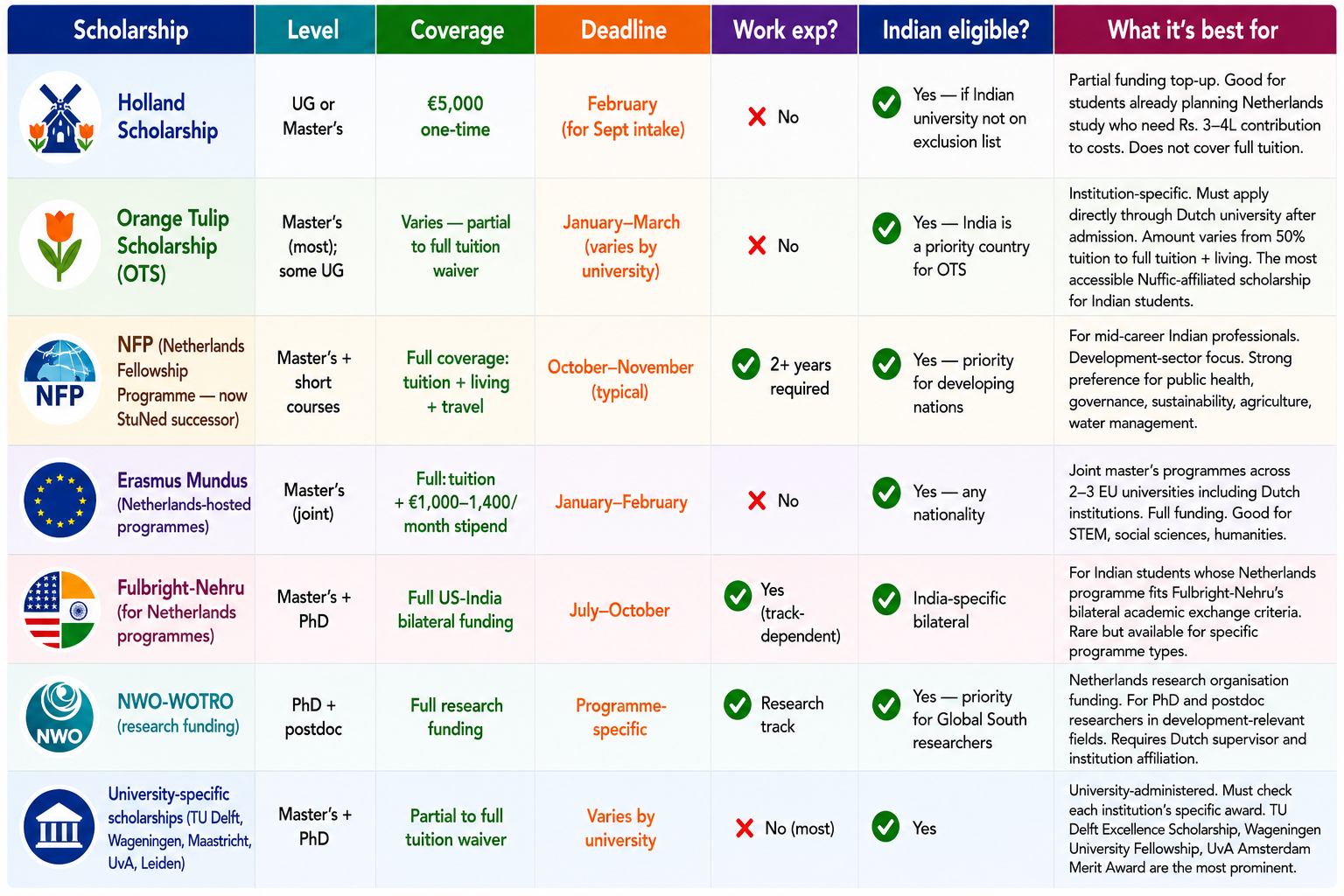
OTS is the most accessible and most relevant scholarship for most Indian master's applicants
The Orange Tulip Scholarship is the single most important scholarship for Indian students planning a Netherlands master's. India is explicitly an OTS priority country — meaning Indian applicants are specifically targeted by OTS at most Dutch universities. The award varies from partial tuition waiver to full tuition waiver depending on the university and programme. It requires Dutch university admission first, then a separate OTS application through the university portal. Most Indian students who apply to Dutch universities do not apply for OTS — which means the competition is lower than the scholarship value would suggest.
Eligibility Quick Check — Which Nuffic Scholarships Can Indian Students Apply For?
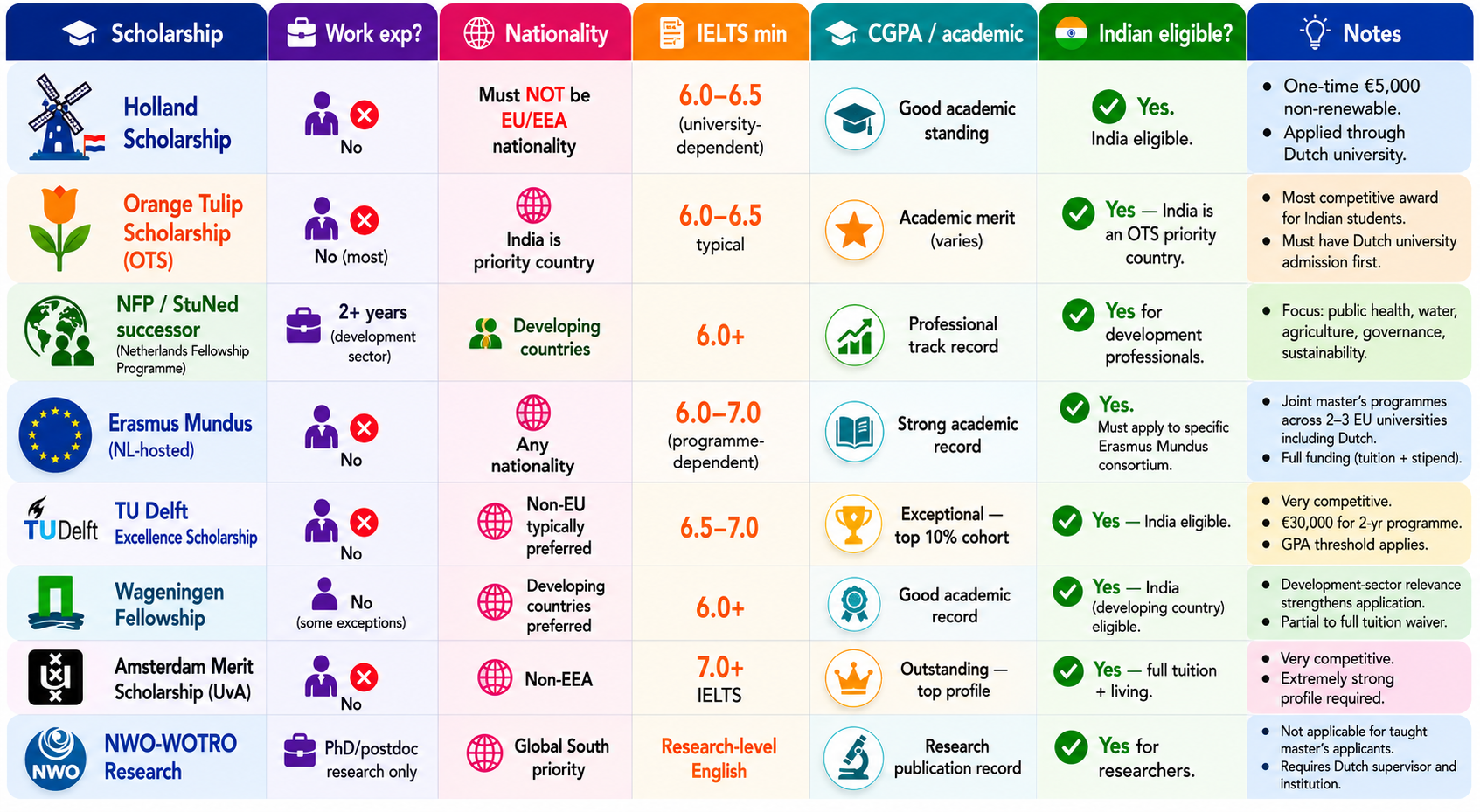
Holland Scholarship exclusion list — check your Indian university first
The Holland Scholarship has an exclusion list of specific Indian universities and institutions whose graduates are not eligible. Check the current exclusion list on nuffic.nl before planning your application. The list changes annually. Most major Indian universities (IITs, NITs, DU, Osmania, etc.) are not on the exclusion list — but some private universities and certain institutions have been excluded in past cycles. Verify before assuming eligibility.
Orange Tulip Scholarship — Step-by-Step Application Process
The OTS is the most relevant scholarship for most Indian master's applicants to Netherlands universities. Here is the complete process:
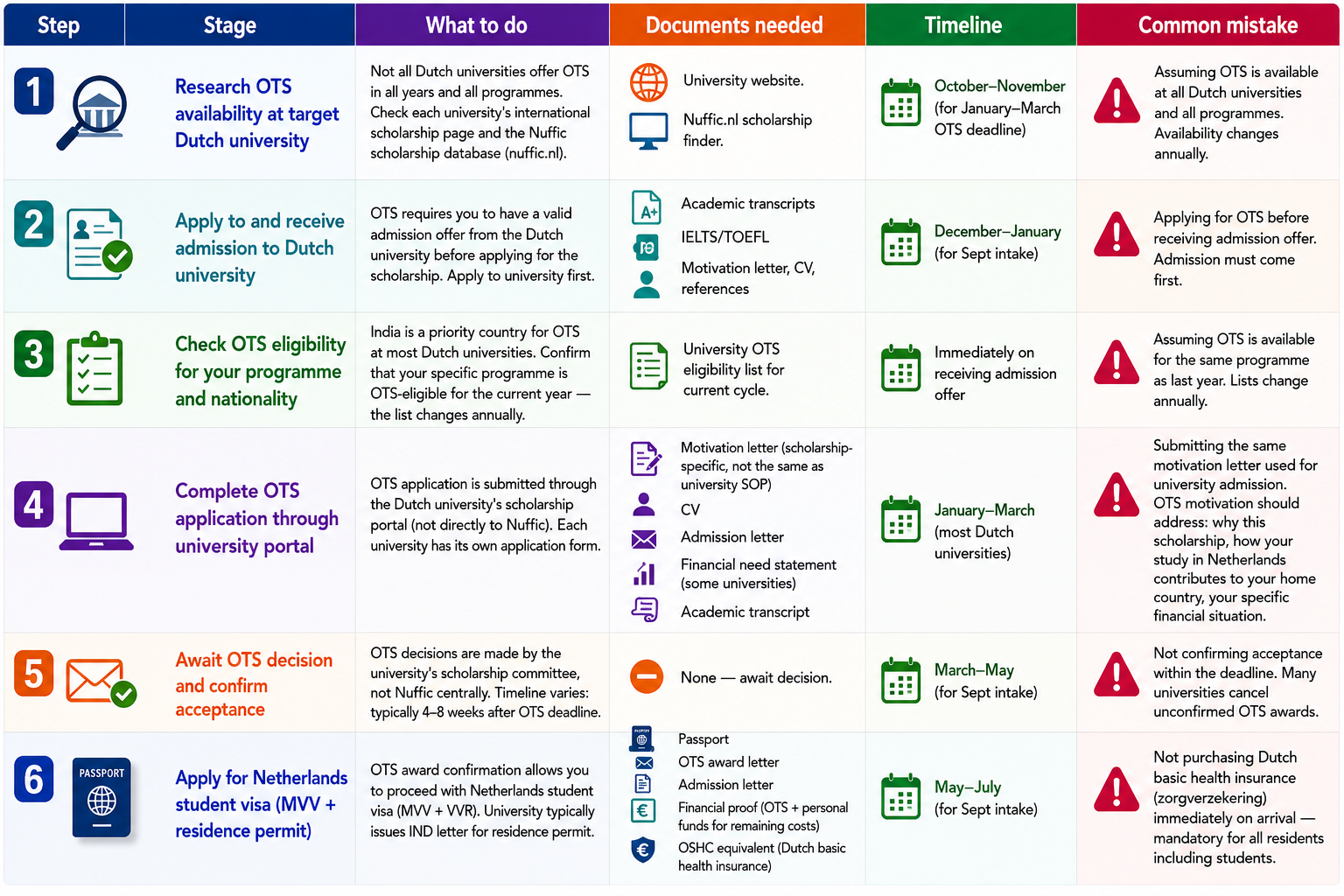
OTS motivation letter — what Dutch university scholarship committees look for
The OTS motivation letter is not the same as your university admission SOP. The university SOP covers academic and professional fit with the programme. The OTS motivation should cover: (1) why you specifically need financial support (your financial circumstances, briefly and honestly), (2) what this Netherlands education will contribute to your work or field in India after graduation — not generic 'development,' but a specific role, project, or sector, and (3) why this Dutch university specifically (not just the Netherlands in general). Committees award OTS to applicants who demonstrate genuine need, genuine programme fit, and genuine post-graduation contribution intent.
Top Dutch Universities for Indian Students — Scholarship Availability
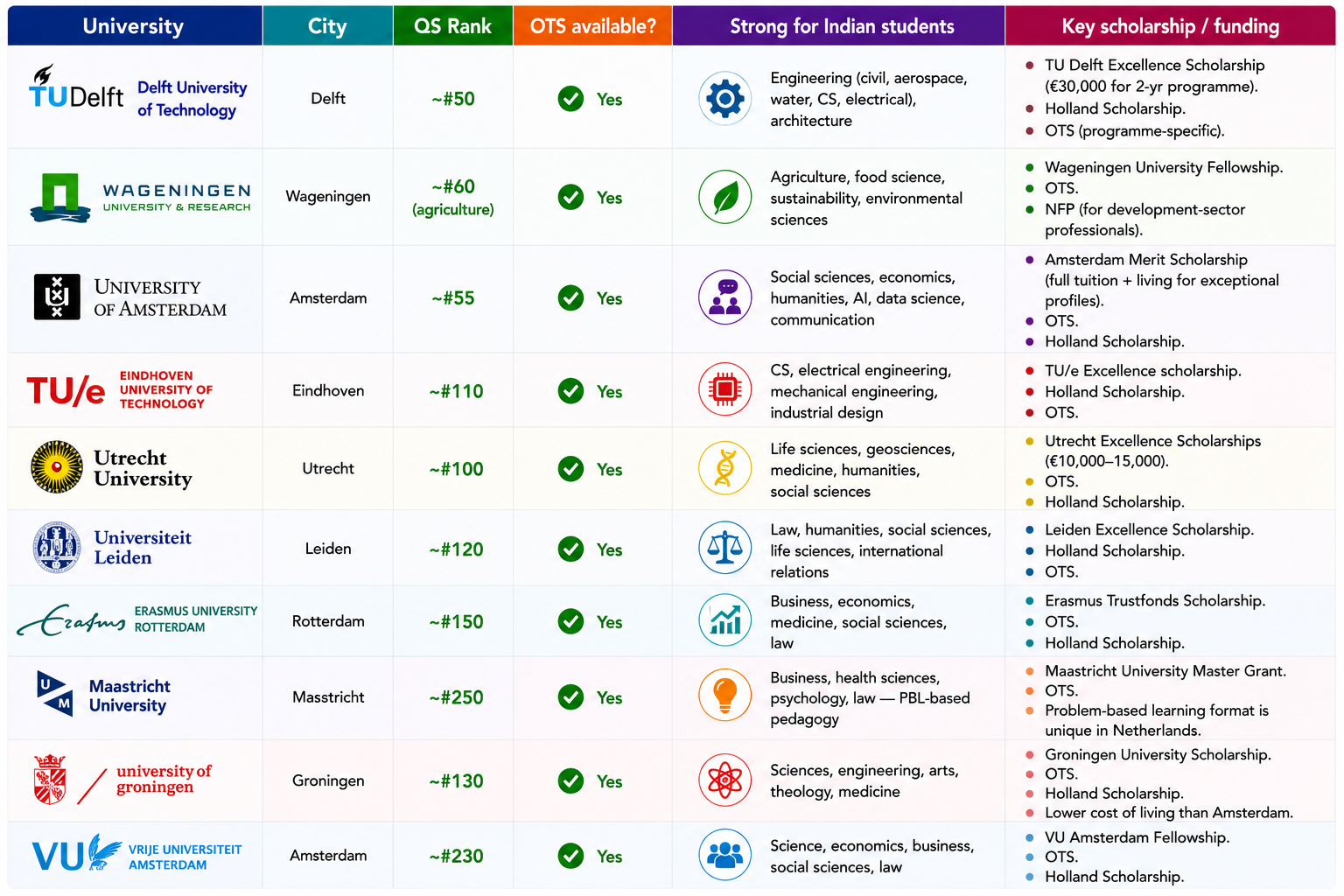
TU Delft and Wageningen are the strongest combination of global rank and scholarship availability for Indian students
TU Delft's Excellence Scholarship (€30,000 for 2-year MSc) combined with OTS eligibility makes it one of the best-funded options in the Netherlands for STEM-focused Indian students. Wageningen's Fellowship Programme — with its explicit developing-country priority — is particularly strong for Indian students in agriculture, food science, sustainability, and environmental management. Both are QS top-60 globally ranked institutions with very strong English-taught graduate programmes and well-established Indian student communities.
Cost of Study in Netherlands — Before and After Scholarship
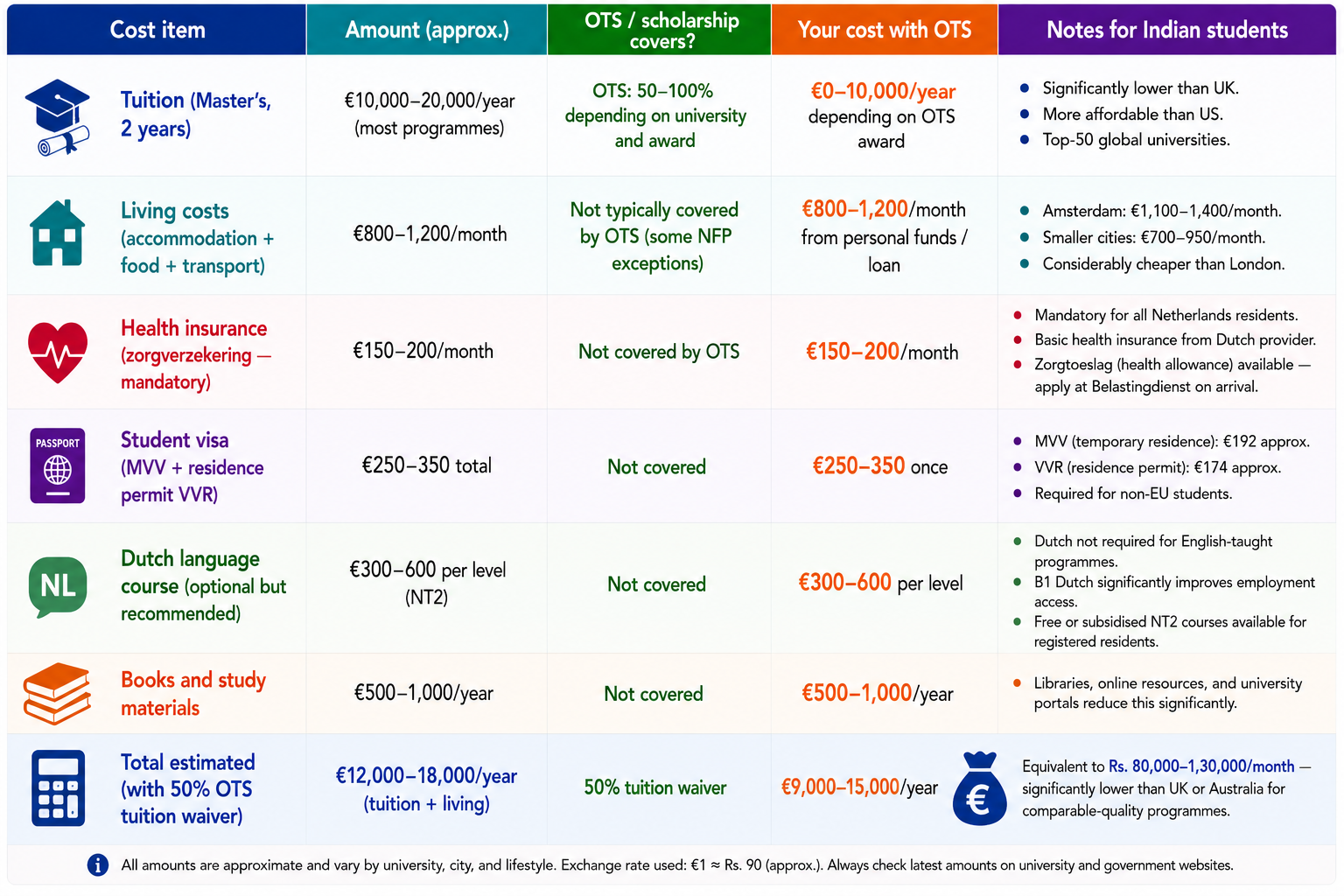
The Netherlands offers a compelling cost profile: top-50 global university education at tuition rates significantly lower than the UK, US, or Australia. Here is the full financial picture, with and without OTS:
The Zorgtoeslag — Dutch health allowance that most Indian students miss
Dutch residents — including international students on a residence permit — can claim zorgtoeslag (health insurance allowance) from the Dutch Tax and Customs Administration (Belastingdienst) if their income is below a threshold. Most international students qualify for a partial zorgtoeslag of €100–130/month that offsets the mandatory health insurance cost. Apply at belastingdienst.nl within 3 months of arriving in the Netherlands. Most Indian students are unaware of this benefit and leave €1,200–1,500/year unclaimed.
Netherlands Student Visa — The MVV + VVR Process for Indian Students
Indian students require two documents to legally study in the Netherlands: an MVV (Machtiging tot Voorlopig Verblijf) — a temporary residence authorisation issued as a sticker in the passport before departure — and a VVR (Verblijfsvergunning) — the actual Dutch residence permit issued on arrival. For students staying longer than 90 days (all degree programmes), the MVV is mandatory.
The MVV process:
- Dutch university applies to IND (Immigration and Naturalisation Service) on your behalf. University is the sponsoring institution.
- IND processes the application and notifies the Dutch Embassy in New Delhi when approved. Processing: 2–4 weeks after university submission.
- Attend Dutch Embassy New Delhi for MVV collection. Present passport — MVV is affixed as a sticker. Biometrics taken.
- On arrival in Netherlands: collect VVR (residence permit) from IND. University arranges this appointment.
Financial proof for Netherlands student visa:
Unlike the UK (28-day rule) or Germany (Sperrkonto), the Netherlands financial proof requirement is less prescriptive but assessed holistically. You must demonstrate sufficient funds for the first year of tuition + living costs. If you have an OTS award letter covering tuition, show: OTS letter + personal/family bank statements covering €12,000–15,000 for the first year's living costs and remaining tuition. If fully self-funded: show €20,000–25,000 for first year total (tuition + living). Education loan sanction letters from Indian lenders are accepted — include the sanction letter with proof of disbursement capacity.
After Graduation — Netherlands Orientation Year and EU Freedom of Movement
The Netherlands offers one of the most generous post-graduation stay rights for international graduates:
- Orientation Year Visa (Zoekjaar): graduates of Dutch universities (bachelor's or master's) can apply for a 1-year orientation year visa to seek employment in the Netherlands. Full work rights during this period. Apply before the student visa expires.
- Highly Skilled Migrant (HSM) permit: once employed with a Dutch employer above the HSM salary threshold (€3,909/month for under-30s; €5,330/month for 30+ as of 2025), the HSM permit converts to a long-term work permit.
- EU/EEA freedom of movement: after obtaining Dutch long-term residence (after 5 years), the holder can apply for EU long-term resident status — which provides the right to work and live in any EU member state.
- Dutch PR timeline: 5 years of legal residence in Netherlands. Shorter pathways exist for Dutch nationals' partners and other specific categories.
The Netherlands'Orientation Year + HSM route is a clear and well-defined post-graduation pathway. For Indian STEM graduates from TU Delft, TU/e, or Wageningen — in engineering, data science, agriculture, or water management — the Dutch employment market in these specialisations is strong and the Orientation Year gives genuine search time. The full EU mobility that follows Dutch long-term residence is the strategic long-term advantage: once Dutch PR is obtained, it opens access to Germany, France, Denmark, and 24 other EU employment markets without separate visa requirements.
Life in the Netherlands as an Indian Student
Language and daily life
The Netherlands has the highest English proficiency of any non-English-speaking country in the world (EF EPI rankings consistently place it first or second). Daily life — shops, banks, transport, services — functions comfortably in English. Dutch language is not required for English-taught programmes or for the visa. However, NT2 (Dutch as a second language) level B1 significantly improves employment access and social integration. Free NT2 courses are available through municipal adult education centres (volksuniversiteit) for registered Netherlands residents.
Indian community and food
The Netherlands has a well-established South Asian community, primarily in Amsterdam (Bijlmermeer), The Hague (Transvaal), and Rotterdam. Indian restaurants, spice shops, and Indian grocery stores are widely accessible in all major Dutch cities. Surinamese cuisine — which has strong Indian culinary influence due to the historical Surinamese Indian diaspora — means roti, dhaal, and Indian-derived dishes are part of mainstream Dutch food culture in a way they are not in Germany or Scandinavia.
Cycling culture and practical life
The Netherlands'cycling infrastructure is the best in the world — and a bicycle is the primary mode of student transport between accommodation, university, and city. A secondhand bicycle costs €50–150 and eliminates most transport costs. Dutch public transport (NS trains, intercity buses) connects all major university cities reliably. A student OV-chipkaart with university discount reduces transport costs further.
Frequently Asked Questions
Can I apply for OTS without getting admission to a Dutch university first?
No — the Orange Tulip Scholarship requires a valid Dutch university admission offer before the OTS application. The sequence is fixed: apply to Dutch university → receive admission → apply for OTS through the university's scholarship portal. There is no pre-admission OTS pathway. This means your Netherlands application timeline must allow for the university admission decision to arrive before the OTS deadline — typically 1–3 months between them.
Is the Holland Scholarship the same as the Orange Tulip Scholarship?
No — they are different programmes with different structures. The Holland Scholarship is a €5,000 one-time payment administered by the Dutch government (Nuffic/EP-Nuffic) and applied for through the university. It is a contribution toward costs, not a tuition waiver. The Orange Tulip Scholarship is an institution-specific award offered by individual Dutch universities — amounts range from partial to full tuition waiver and vary by university, programme, and year. Both require Dutch university admission. A student can in principle receive both, but most universities limit the accumulation of scholarships — check the specific university's policy.
Does the Netherlands have a PR pathway for Indian STEM graduates?
Yes — the route is: Dutch master's degree → 1-year Orientation Year visa → Dutch employment above HSM salary threshold → HSM permit → 5 years legal residence → Dutch PR + EU long-term resident status. The total timeline from degree completion to Dutch PR is typically 5–7 years — longer than Germany's EU Blue Card route (21 months) but shorter than the UK's post-ILR extension (10+ years). The EU mobility advantage — once Dutch PR is granted, unrestricted access to 25+ EU countries — is the long-term strategic value of the Netherlands route.
Is studying in the Netherlands worth it for Indian students who can't get a full scholarship?
Yes — for the right programme and profile. A 50% OTS tuition waiver at TU Delft (ranked ~#50 globally) brings the programme cost to approximately €5,000–10,000/year in tuition plus €10,000–12,000 in living costs. Total: approximately €15,000–22,000/year — significantly lower than a UK programme at a comparable university ranking (£25,000–35,000/year). The Dutch programme gives access to the Orientation Year visa, the European engineering employment market, and EU long-term residence — none of which a comparable UK programme provides. For cost-conscious STEM and agricultural science students, the Netherlands is one of the best-value high-quality study destinations available in 2026.
The Netherlands is one of the most strategically undervalued study destinations for Indian students in 2026. World-class universities at lower tuition than the UK or US. A partial scholarship (OTS) that is specifically targeted at Indian students. A post-graduation orientation year visa that gives real job-search time. EU long-term residence that ultimately opens 25 European employment markets. The barrier is not the scholarship or the university — it is awareness. Indian students who include the Netherlands in their shortlist, check OTS availability for their programme, and submit a genuine scholarship motivation letter have a material probability of receiving funding at a global top-50 university at a cost lower than most funded UK positions.