Post-Study Work Visa Options by Country: Complete Comparison for Indian Students — 2026 Edition
The most consequential decision in study abroad planning is not which university to attend — it is which country to study in. And that decision should be made with a clear understanding of what comes after the degree: the post-study work visa, the path to permanent residency, and the realistic employment market for your field in that destination. A student who chooses the UK in 2026 based on a blog post from 2023 may be planning around a PR timeline that has just more than doubled.

Team Vidysea
June 3, 2026

Post-study work visa rules changed materially in 2025 and 2026. The UK extended its ILR qualifying period from 5 to 10 years in April 2026. Canada capped PGWP eligibility for college graduates. Germany updated its EU Blue Card salary thresholds — in a direction favourable to Indian STEM professionals. The USA's H-1B lottery and India-born EB backlog remain unchanged, which means US immigration for Indian nationals is not a realistic near-term PR pathway for the vast majority of graduates.
This guide compiles the complete post-study work visa landscape for 2026 — covering 11 countries, their visa names, durations, eligibility, work rights, and PR pathways. It includes the current policy changes that any study visa consultant or student visa services provider should be advising on, and a field × country matrix that maps your academic area to the destinations where your post-graduation employment prospects are strongest.
2026 is a year of major post-study immigration policy changes — do not rely on advice from 2024 or earlier
The UK ILR extension (April 2026), Canada's PGWP cap (2024), Germany's updated Blue Card thresholds (2025), and Australia's EL3 reclassification of India all affect the post-study work and PR landscape meaningfully. Any guidance for study abroad that does not account for these changes is giving Indian students an inaccurate picture of their post-graduation options. This guide is current as of April 2026 — verify each country's policy on official government immigration websites before making decisions.
Post-Study Work Visa Options — 11 Countries at a Glance
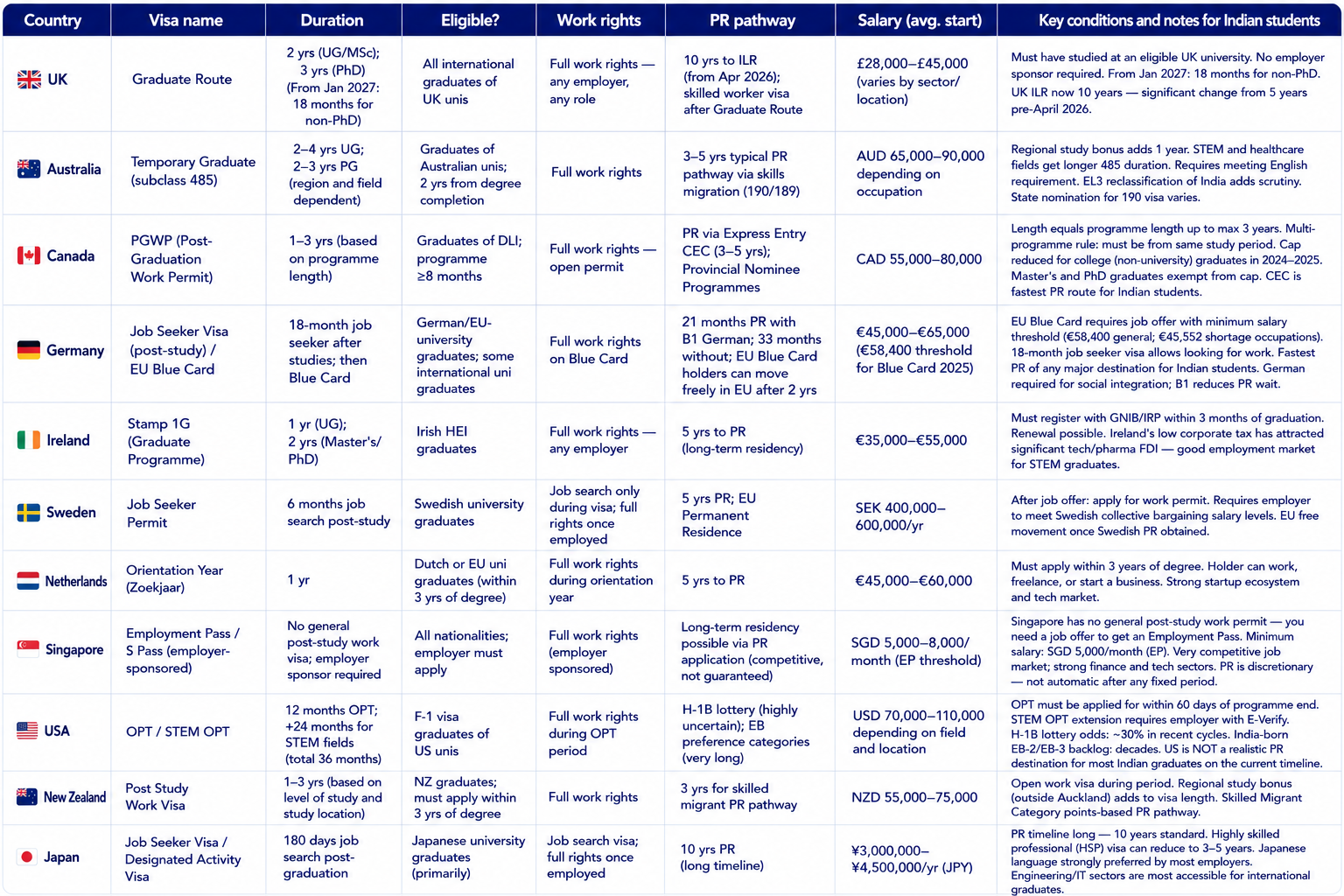
This is the complete reference table for post-study work visa options available to Indian student graduates in 2026. Policy notes in the final column reflect current 2026 status — not historical descriptions:
The column that matters most: PR pathway
The post-study work visa duration tells you how long you can work. The PR pathway column tells you whether you can stay permanently — and how long it will take. For Indian students whose long-term goal is settlement abroad, these are not the same decision. Germany's 21-month PR pathway and Canada's 3–5 year pathway are fundamentally different from the UK's 10+ years or the US's decades-long backlog. Build your country decision around the PR pathway that matches your actual long-term goal, not just the programme's reputation or the starting salary.
PR Pathway Speed Ranking — Best to Worst for Indian Students 2026
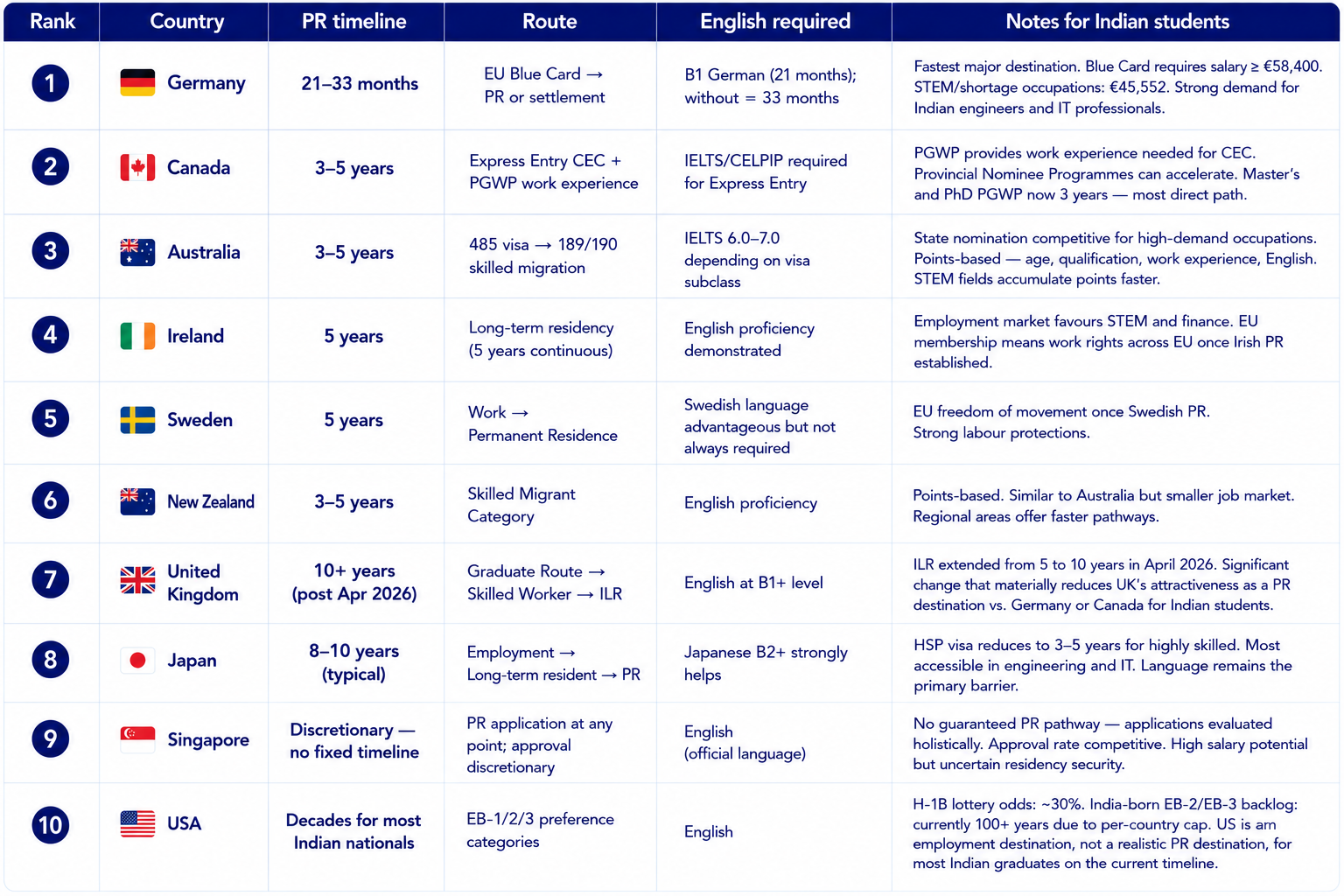
This ranking orders destinations by realistic time to permanent residency for Indian graduates in 2026. Rankings account for the most recent policy changes and realistic employment timelines in each destination:
The USA ranking reflects the current EB backlog reality
India-born applicants in the EB-2 and EB-3 preference categories face wait times of multiple generations under the current per-country cap system. The US is an excellent destination for high-earning employment — but it is not a realistic path to permanent residency for the vast majority of Indian graduates within any foreseeable timeline. Students planning a study-to-PR pathway should not select the USA as their primary destination unless they have a specific path to an EB-1 category (extraordinary ability or multinational manager/executive) or have accepted that employment is the goal rather than settlement.
Which Country Is Right for Your Field?
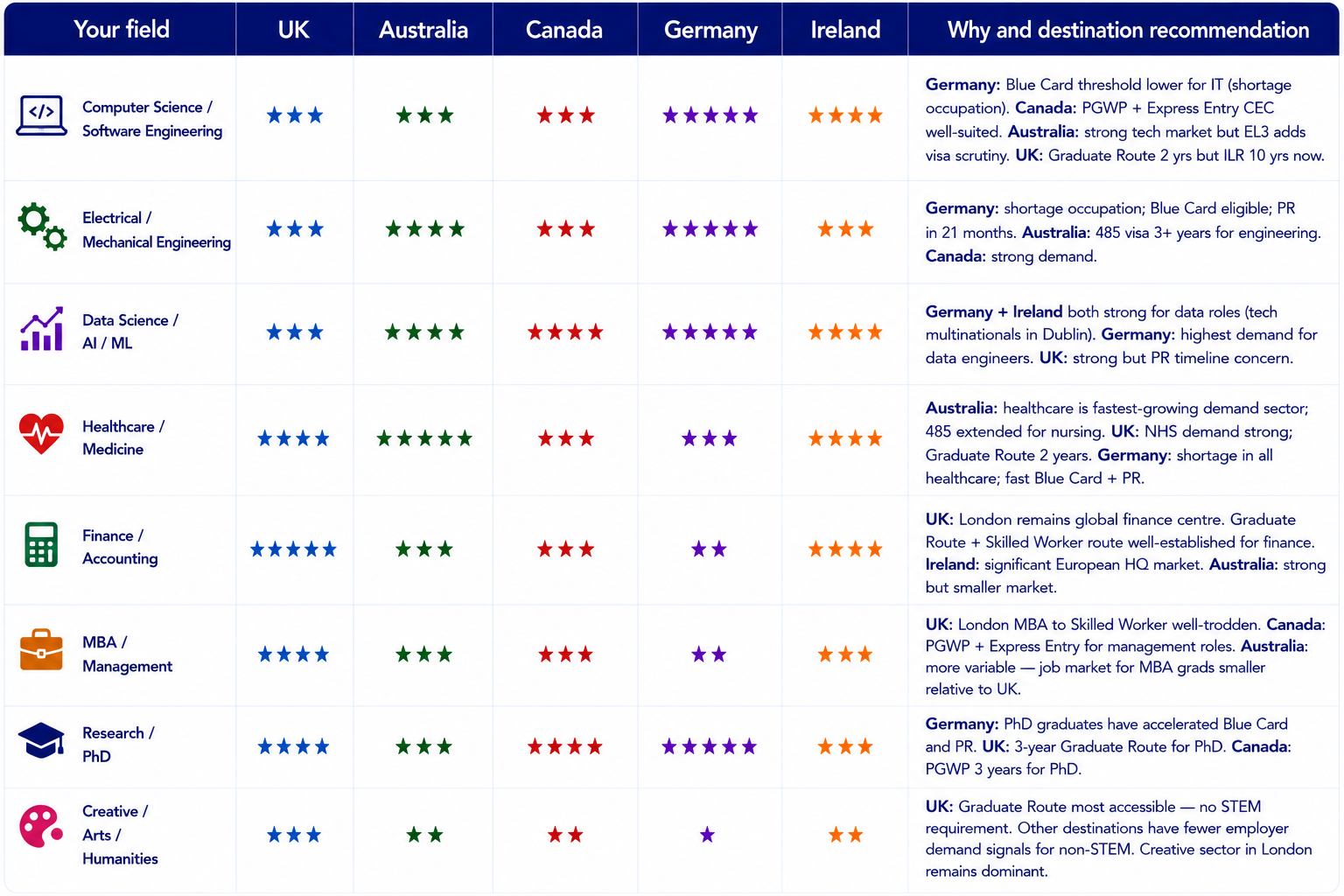
Post-study employment prospects vary significantly by field and destination. A finance graduate and an engineering graduate looking at the same destination will find very different job markets. This matrix maps field of study to the best post-study work destinations for Indian students in 2026 (★★★★★ = strongest; ★ = weakest):
The Germany opportunity for Indian STEM graduates deserves special attention
Germany's shortage occupation list covers almost every STEM field. The EU Blue Card requires a salary of €45,552 for shortage occupations — a threshold that most STEM graduates in Germany reach within 1–2 years of employment. The PR timeline (21 months with B1 German) is the fastest of any major English-speaking or STEM destination. Germany receives significantly less Indian student interest than the UK or Canada relative to this advantage. Indian students in engineering, computer science, data science, and healthcare who are comfortable learning conversational German have access to one of the most direct study-to-PR pathways available anywhere in 2026.
UK Post-Study Work Visa — Graduate Route 2026 Update
The UK Graduate Route was launched in 2021 to give international graduates 2 years (3 for PhD) to work in any role for any employer without sponsorship. It was, briefly, one of the most attractive post-study work visas in the world. Two changes have materially altered its value for Indian students:
Change 1: ILR extended to 10 years (April 2026)
From April 2026, the qualifying period for Indefinite Leave to Remain (ILR) — the UK equivalent of permanent residency — was extended from 5 years to 10 years for most routes, including the Graduate Route → Skilled Worker pathway. This means a student who arrives in the UK in September 2026, completes a 2-year Graduate Route, then works on a Skilled Worker visa, can now expect to apply for ILR no earlier than approximately 2038. For context: a comparable student in Germany reaches permanent residency in 2028–2029. In Canada, 2029–2031. The UK's value proposition as a PR destination has fundamentally changed.
Change 2: Graduate Route duration reducing to 18 months (January 2027)
Students beginning programmes in September 2026 and completing in 2027 will receive the current 2-year Graduate Route. Students beginning in September 2027 (completing in 2028) will receive 18 months. For job searching, securing sponsorship, and transitioning to a Skilled Worker visa, 18 months is a materially tighter window than 2 years — particularly in competitive fields where visa sponsorship negotiations and role onboarding timelines often consume 6+ months of the post-graduation period.
The practical conclusion for Indian students evaluating the UK in 2026: UK remains an excellent destination for career quality, salary, and professional development — particularly in finance, consulting, and technology. But the UK as a PR destination is no longer competitive with Germany or Canada for students whose primary long-term goal is settlement. This is the most important piece of guidance for study abroad that any student visa consultant should be providing in 2026, and it is advice that many counsellors using outdated information are still failing to give.
Canada PGWP — What Changed and What Remains
Canada's Post-Graduation Work Permit (PGWP) remains one of the most valuable post-study work visas globally for Indian students — but the 2024 college graduate cap and programme eligibility changes require careful navigation:
- Master's and PhD graduates from Canadian Designated Learning Institutions (DLIs): PGWP of 3 years regardless of programme length. Unaffected by the cap. This remains the most direct Express Entry CEC pathway to PR.
- Bachelor's degree graduates: PGWP equal to programme length, up to 3 years. Not affected by the college cap.
- College (non-university) diploma graduates: more restricted eligibility depending on programme type and sector. Check specific programme eligibility on the IRCC website before enrolling.
- Express Entry CEC: requires 1 year of Canadian work experience. A 3-year PGWP from a Canadian master's programme gives 2+ years of buffer before CEC application. Provincial Nominee Programmes (PNPs) can accelerate the process in specific provinces.
Germany EU Blue Card — The Best-Kept Secret for Indian STEM Graduates
Germany's EU Blue Card is the fastest post-study PR pathway available to Indian students anywhere in the world. It is significantly under-used by Indian students relative to its advantage — primarily because of language concerns (German) and lower familiarity compared to UK and Canada.
Here is what the Germany pathway looks like for an Indian computer science graduate:
- Study MSc Computer Science at TU Munich, TU Berlin, or RWTH Aachen (all QS top-100 for CS, low or zero tuition).
- Graduate. Apply for 18-month job seeker visa or apply for EU Blue Card directly with job offer.
- EU Blue Card requires job offer with minimum €45,552/year (CS is a shortage occupation). Achievable for most CS graduates in Germany's strong tech market.
- Hold Blue Card for 21 months while reaching B1 German level. Apply for permanent residence settlement permit. PR in less than 2 years after starting work.
- Once German PR obtained, EU Blue Card holders can apply for long-term residence in any other EU member state after 2 years in Germany. This opens the entire EU employment and residency market.
The German Blue Card pathway to EU permanent residency in under 3 years is the most efficient immigration route available to any Indian professional anywhere in the world. The primary barrier is German language — B1 (conversational) is required for the accelerated 21-month timeline. Students who begin German alongside their degree (university courses, Goethe Institut, online apps) typically reach B1 within 18–24 months.
Why Student Visa Assistance Matters for Post-Study Planning
Post-study work visa planning is not just a question of visa rules — it is a strategic decision that should inform which country you choose to study in, which programme you enrol in, and what you prioritise in your first year after graduation. Getting this guidance for study abroad right requires current policy knowledge that most families cannot reasonably maintain independently.
Here is where student visa services from experienced study visa consultants add the most measurable value in post-study planning:
- Country selection mapped to post-study goal: A student who tells their counsellor 'I want to settle in Europe' should receive a German/Irish recommendation, not a UK recommendation, in 2026. A counsellor still recommending UK on a 5-year ILR basis is working with outdated information.
- PR pathway planning built into the programme choice: A student targeting Canada PR should understand that a 2-year Canadian master's programme generates a 3-year PGWP and sets up the CEC Express Entry pathway. A 1-year UK programme generates a 2-year Graduate Route with a 10-year ILR horizon. These are not equivalent from a settlement perspective.
- Employer sponsorship navigation: For the UK Skilled Worker visa after the Graduate Route, many Indian graduates do not understand that they need an employer licensed for sponsorship, that the salary threshold matters, and that not all jobs lead to a path to ILR. Professional student visa assistance covers this planning as part of the post-study transition.
- Policy currency: Policy changes like the UK ILR extension propagate immediately to every student planning a UK destination. A Vidysea counsellor updated this guidance within 48 hours of the April 2026 announcement. Students who received Vidysea guidance in March 2026 were updated proactively. Students who relied on a blog post from 2024 were not.
Frequently Asked Questions
Can I extend my post-study work visa?
It depends on the country. UK Graduate Route: cannot be extended, but you can switch to a Skilled Worker visa if you have a job offer with a licensed sponsor. Australia 485: some conditions allow extension (regional study, STEM occupation extension). Canada PGWP: cannot be extended — the duration is fixed at the time of issue. Germany job seeker visa: not extendable, but once you have a job offer you apply for the Blue Card, which can lead to PR. Understanding the specific student visa application pathway and transition requirements is part of pre-departure planning that good student visa assistance covers.
If I study in the UK now, does the 10-year ILR rule apply to me?
Yes — the 10-year ILR rule applies to qualifying periods from April 2026 onwards. Students who began their Graduate Route before April 2026 may have different qualifying requirements — check with UKVI directly or through a licensed immigration adviser. For students beginning their studies in September 2026 or later, the 10-year ILR timeline is what applies to their post-graduation pathway.
Should I rule out the UK for post-study work?
No — the UK remains an excellent destination for the quality of the degree, career development, professional network, and salary potential. The Graduate Route's no-sponsor requirement for 2 years (or 18 months from 2027) is still generous. The change that has occurred is specifically to the PR timeline, not to the work rights. If your primary goal is career quality and salary rather than permanent settlement, the UK remains one of the top three destinations globally. If your primary goal is permanent settlement, Germany and Canada are now significantly more competitive options than the UK in 2026.
Post-study work visa planning is not a decision to make after you arrive at your destination — it is a decision that should shape which destination you choose. The 2026 policy landscape is clear: Germany is the fastest PR route, Canada is the most established study-to-PR pathway, and the UK's value proposition has shifted from settlement to career and network quality. Any guidance for study abroad that does not start with 'what do you want to achieve 5 years after graduation?' is starting from the wrong place.