Role of an Overseas Education Consultant in Admission Success — What Changes When You Work with One
An overseas education consultant is not a travel agent who books your university admission the way you book a flight. The comparison that is actually useful is a financial advisor for a Rs. 50 lakh investment — someone who understands the market better than you do, has seen the same decision made hundreds of times before, and can tell you which choices will serve your goals and which will cost you significantly more than you expect. The study abroad market in India in 2026 is simultaneously more accessible and more complex than it has ever been. More accessible because NBFCs now offer unsecured education loans at scale, because AI tools have reduced information asymmetry, and because the number of English-medium programmes available globally has expanded dramatically. More complex because the policy landscape — UK ILR, Canada's permit caps, Australia's Evidence Level 3 reclassification, Germany's updated Blue Card thresholds — has shifted materially in the last 24 months, and most available advice online has not kept up.

Team Vidysea
May 21, 2026

This guide explains what a good overseas education consultant actually does — specifically — and why the outcomes for students who work with one are systematically different from those who don't. It also tells you how to evaluate any consultant: five questions that distinguish genuine expertise from a well-decorated waiting room.
💡 The Vidysea difference — AI + human counsellor
Vidysea's approach combines AI-powered profiling (43 destinations, 8 dimensions, updated within 48 hours of policy changes) with human counsellors who interpret the data and handle what AI cannot: reading unstated goals, navigating family dynamics, and making final recommendations with genuine accountability. The free first session generates a country analysis in the first 15 minutes. The counsellor spends the rest explaining what the algorithm gets right — and where your specific situation is an exception.
What an Overseas Education Consultant Actually Does — and What Changes
The table below maps six core roles of a study abroad consultant against what happens without one — and the concrete difference each role makes:
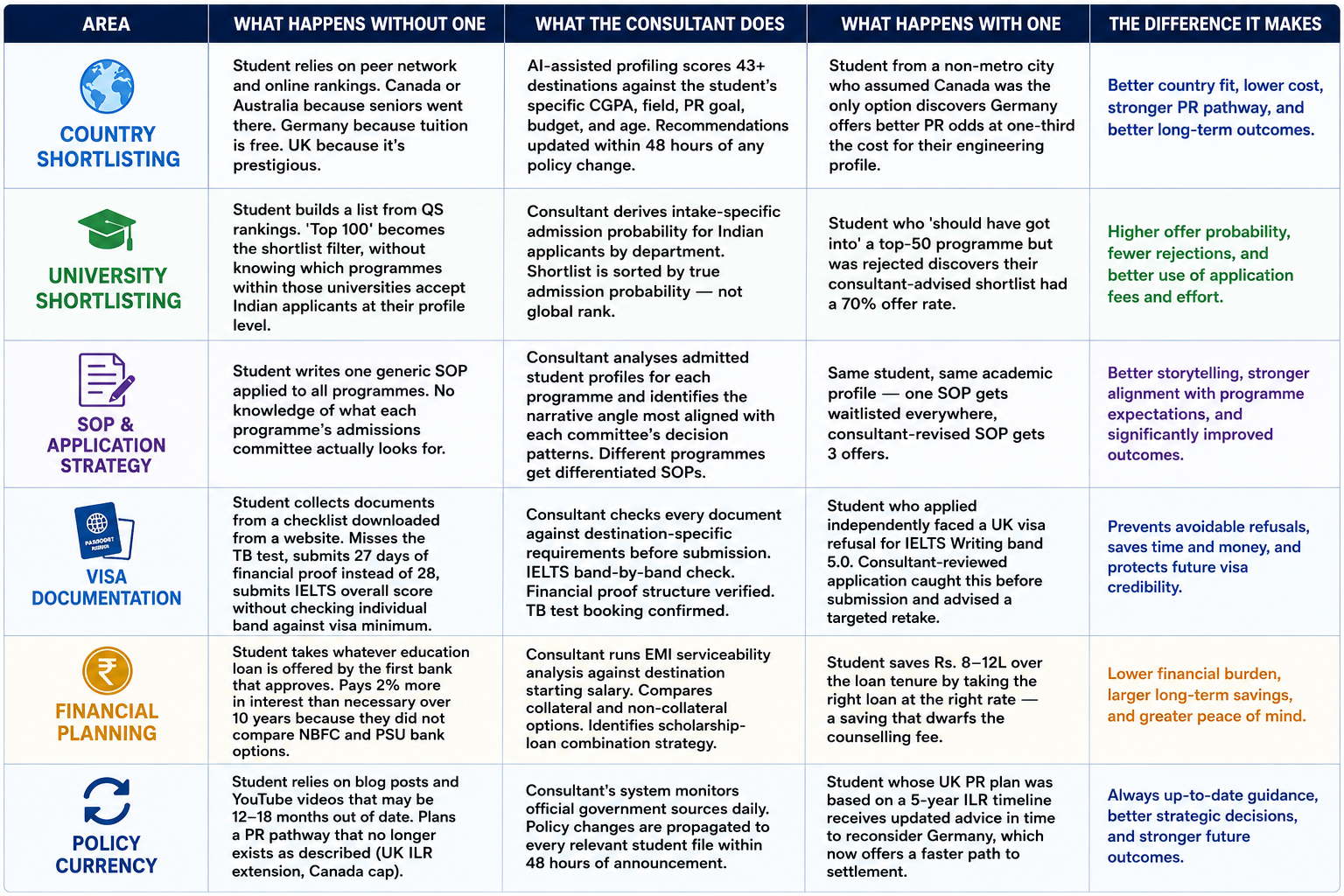
✅ The country shortlist decision is the most consequential one a consultant affects
Most families who choose the wrong country discover it 2–3 years into their study abroad journey — when post-study work pathways become unclear, when a PR timeline turns out to be longer than expected, or when a destination salary doesn't service the loan EMI. A consultant who correctly identifies that a student's profile and goals are better served by Germany than by the UK in 2026 — accounting for the ILR extension, the PR timelines, and the loan serviceability — has delivered more value than any amount of SOP editing.
What Good Consultants Do That Students Cannot Replicate on Their Own
There is a category of value that a good education consultant provides that is simply not accessible through research, regardless of how diligent the student is. This is not information asymmetry that the internet closes — it is pattern knowledge that accumulates only through repeated practice with real applications and real outcomes:
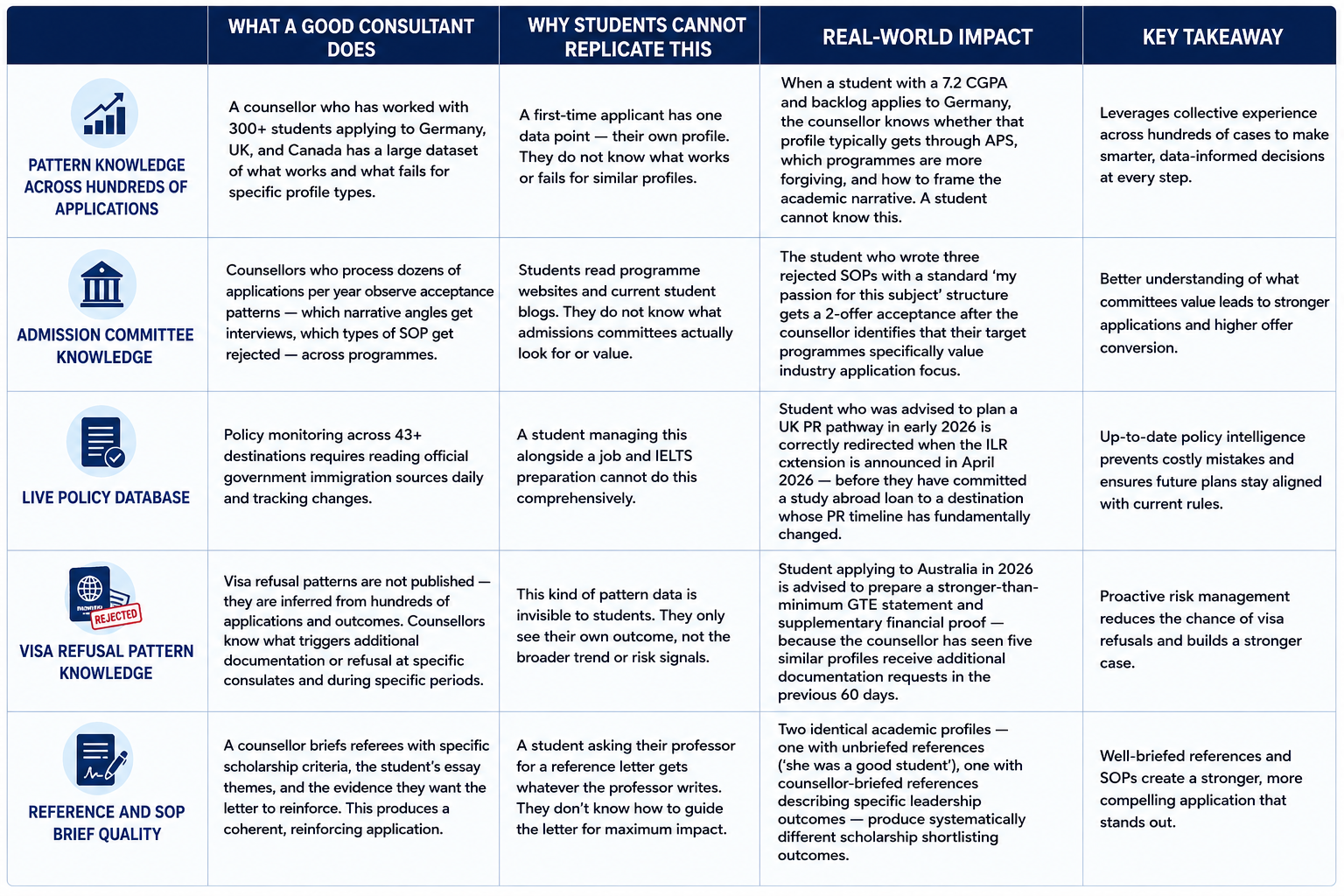
🎯 The pattern knowledge advantage is the most underappreciated part of good counselling
A student can read every published study about admission rates at German universities. They cannot read the unpublished pattern that applications with a specific type of academic gap, from a specific Indian university tier, presenting a specific SOP narrative, have a materially lower acceptance rate at a specific programme. That knowledge exists only in the minds of counsellors who have processed enough applications to observe the pattern. It cannot be Googled. It is the reason that an experienced counsellor's shortlist is consistently more accurate than a student's self-built shortlist.
The Counsellor's Role at Each Stage of the Study Abroad Journey
Stage 1: Profile assessment and destination matching
The first and most important role. Before a single university is discussed, a good counsellor conducts a structured profile assessment: academic history, CGPA, backlogs, field, work experience, age, budget, PR goal, language scores, and — most critically — what the student actually wants vs. what they think they want.
The distinction between stated goal and actual goal is where the most valuable counselling happens. A student who says 'I want to go to the UK' may have an underlying goal of permanent residency, a desire for salary maximisation, or a family expectation being fulfilled rather than a genuine preference. A skilled counsellor identifies this mismatch and addresses it directly — because a student who goes to the wrong destination for the wrong reason is not well-served regardless of how good the programme is.
Stage 2: University shortlisting and application strategy
With the destination confirmed, the counsellor builds a reach/target/safe shortlist based on actual Indian applicant admission data at the programme level — not global rankings. They identify which programmes within a university have higher or lower acceptance rates for Indian students from the student's institution tier, what the programme's stated and unstated preferences are, and how the student's narrative can be positioned against each programme's stated criteria.
The SOP strategy follows from this. A consultant who has reviewed 50 accepted SOPs for a specific programme knows what the committee rewards — not in general, but for that specific programme in that specific field. The student who submits the same SOP to all programmes is applying blind. The student with counsellor-guided SOP differentiation is applying with programme-specific intelligence.
Stage 3: Scholarship identification and application support
A good counsellor identifies scholarship eligibility that the student has not found independently — because scholarship eligibility is a function of the combination of profile factors (CGPA + field + age + work experience + financial situation) that most students have not mapped against the specific criteria of 15+ scholarships.
Beyond identification, the counsellor co-ordinates the scholarship and university application timelines — ensuring that scholarship deadlines (Chevening: November; DAAD: October) do not conflict with university application deadlines, and that the reference briefings serve both application types simultaneously. Poor scholarship-university timeline co-ordination is the most common avoidable planning failure in the study abroad process.
Stage 4: Financial planning and loan strategy
Many students take the first education loan offered to them. A consultant who understands the difference between NBFC and PSU bank loans, the 28-day financial proof structure for UK visas, the blocked account requirement for Germany, and the TCS implications of large overseas remittances adds direct financial value — not just process guidance.
The scholarship-loan combination strategy — applying for both simultaneously, adjusting the loan amount if a scholarship comes through, having a backup plan if it does not — is something most families do not arrive at independently. It requires understanding both financial products and scholarship probability simultaneously, which is a combined competence that very few students can develop without guidance.
Stage 5: Visa documentation and pre-departure
The final stage is where documentation errors have the most irreversible consequences. A visa refusal delays the intake by a full semester. A counsellor who reviews every document before submission — checking IELTS band scores against visa minimums (not university minimums), confirming TB test from an approved clinic, verifying financial proof structure, checking ATAS requirements — is the last line of defence against preventable refusals.
Pre-departure preparation — understanding what arrives, what is expected of an international student from Day 1, how to navigate the BRP collection in the UK or the blocked account withdrawal in Germany — is the final value a counsellor adds. Students who arrive prepared transition more smoothly than those who discover these practicalities after landing.
How to Evaluate Any Overseas Education Consultant — 5 Questions
The overseas education consulting market in India is unregulated and varies enormously in quality. These five questions distinguish genuinely expert counsellors from well-branded offices with outdated knowledge:
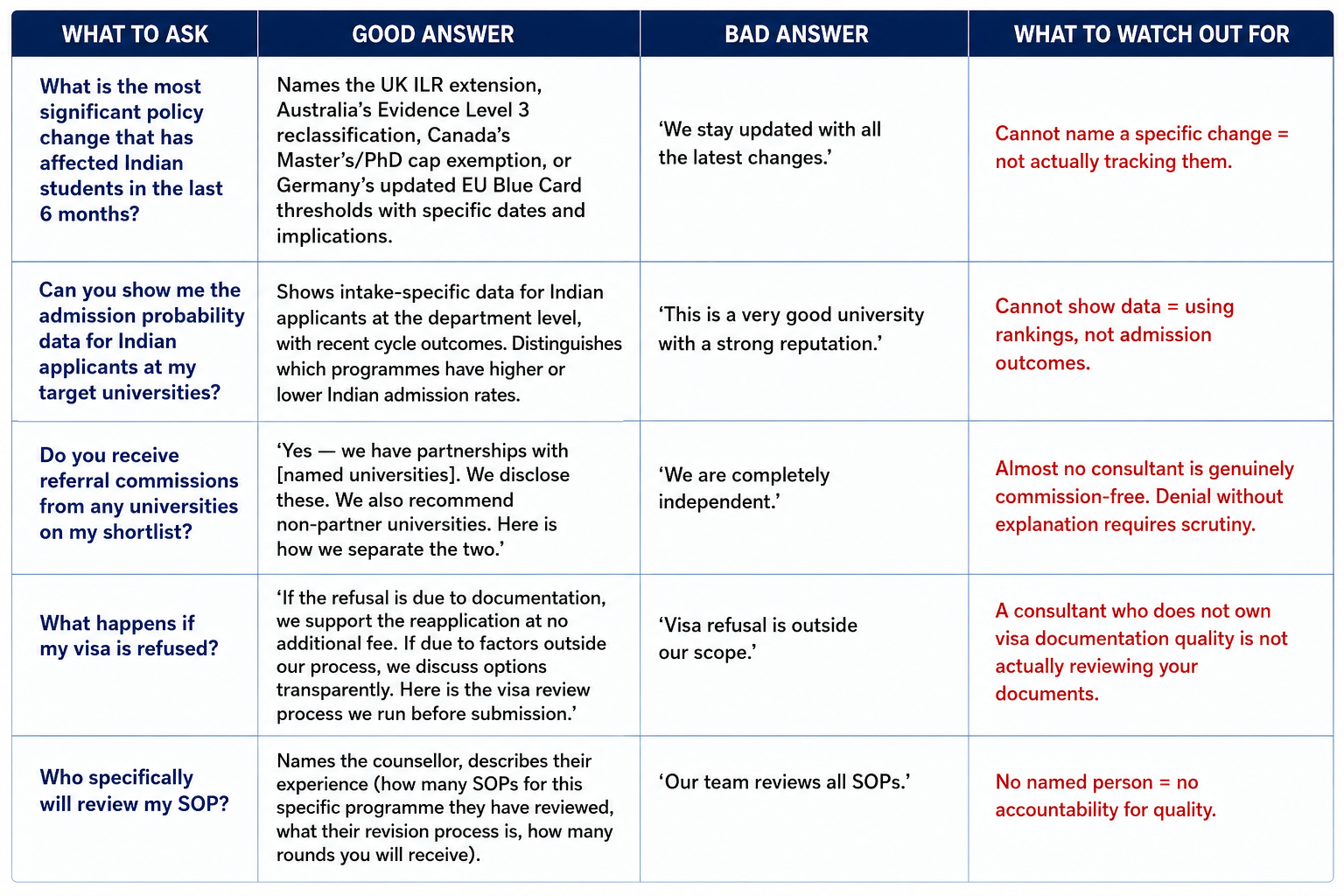
⚠️ The most reliable single test for current policy knowledge
Ask any consultant: 'What is the most significant policy change that has affected Indian students in the last 6 months?' A counsellor who names the UK ILR extension to 10 years (April 2026), Australia's Evidence Level 3 reclassification for India, or Canada's Master's and PhD cap exemption with specific dates is demonstrably current. A counsellor who answers generically is working from outdated information — and the advice they give about PR timelines, post-study work, and destination comparison is correspondingly unreliable.
When Does Counselling Add the Most Value?
Counselling is not equally valuable at every point in the study abroad journey. These are the situations where the return on a good counselling engagement is highest:
First-time applicants without a clear destination preference
The student who 'wants to go abroad' but has not decided where or why is the candidate for whom counselling pays the highest dividend. A structured country analysis against their specific profile frequently produces a shortlist that differs significantly from what peer networks suggest — and the difference is often Rs. 20–30L in total cost or a materially different PR pathway.
Students with non-standard profiles
A career change (engineering to business), an academic gap, a backlog, or a non-top-tier institution — any deviation from the 'standard' profile creates uncertainty that generic advice cannot resolve. Pattern knowledge is most valuable precisely in these cases, because the student's situation does not match any of the general advice available online.
Scholarship applicants
The scholarship application process — essay quality, reference briefing, timeline co-ordination, interview preparation — is the area where expert guidance most directly affects a binary outcome (awarded vs. not awarded). A scholarship worth Rs. 50–80L represents a return on counselling investment that no other service can match.
Post-refusal planning
A visa refusal or scholarship rejection requires diagnosis before reapplication. Understanding specifically why the outcome occurred — which document was wrong, which essay missed the committee's criteria, which timeline error caused a missed deadline — is the starting point for a successful reapplication. Without that diagnosis, reapplication with the same inputs produces the same output.
Frequently Asked Questions
Is there any situation where a student should not use a counsellor?
Yes. If you have a very clear destination preference based on strong personal knowledge (you have lived in the country, a close family member has studied there, you are applying to a department where you already have a faculty relationship), the value a counsellor adds on country selection is limited. If your profile is straightforward, your target university is well-known to you, and you have the time to manage the process carefully, self-application is viable. The risk is in the details — IELTS band scores vs. visa minimums, financial proof structure, ATAS requirements — where pattern knowledge matters most. A document review session rather than full counselling may be the appropriate level of engagement in this case.
How do I know if my consultant is giving me current advice?
Ask them to cite a specific policy change from the last 6 months. If they cannot, their advice about destination comparison, PR timelines, and post-study work pathways may be 12–24 months out of date. At Vidysea, our AI system monitors official government and university sources daily. Every policy change is propagated to every relevant student file within 48 hours. When you receive a recommendation from a Vidysea counsellor, you can ask: 'Is this current?' and receive a specific, dated answer.
What does Vidysea's free first session include?
In your first 30-minute Vidysea session, the AI system generates a country analysis for your specific profile — 43 destinations scored across 8 dimensions (admission fit, visa difficulty, PR timeline, salary, living cost, policy stability, field strength, budget fit). You see the country scores. The counsellor then explains the ranking, identifies the 2–4 destinations most aligned with your profile, and tells you where the algorithm's recommendation might need to be overridden based on context the AI cannot capture. You leave the first session with a country shortlist, a risk assessment, and a clear next-steps plan. There is no charge and no obligation to proceed further.
The role of an overseas education consultant in admission success is not to substitute for the student's decisions — it is to make those decisions with better information. Better information about which destinations genuinely suit the profile. Better information about which programmes are realistic. Better information about what policy changes have just occurred. Better information about which documents need to be prepared how. The difference between the right information and the wrong information, at the wrong time, is measured in lakh rupees and years of life trajectory.