

Got dreams to achieve? Hop on as we take you on your journey to success!


Services
Contact Info

Noida office
+91 7428715522Bangalore office
+91 8861432223 support [at] vidysea.com
Copyright@Vidysea
Got dreams to achieve? Hop on as we take you on your journey to success!
Noida office
+91 7428715522Bangalore office
+91 8861432223support [at] vidysea.comCopyright@Vidysea
For Indian students in Class 11 and 12 targeting undergraduate admissions abroad — primarily in the USA, Canada, and increasingly Singapore and Hong Kong — the SAT is the standardised test that most directly connects their academic preparation to their university shortlist. A 1400 SAT opens a fundamentally different set of universities than a 1200. And within India's highly competitive applicant pool at US universities, the difference between 1480 and 1550 can determine whether an application to Carnegie Mellon or Georgetown is realistic.

Team Vidysea
Published Updated

This guide covers how to prepare for abroad studies through the SAT — the Digital SAT (DSAT) format in use since March 2023, section-specific preparation strategies for Indian students, a complete 12-week study plan, the best preparation resources, and an honest comparison between SAT and ACT. It is written specifically for Indian students on the CBSE, ICSE, and IB curricula, drawing on what the strengths and gaps of Indian school education mean for SAT performance.
One important framing note before the guide begins: many top US universities are now test-optional, meaning SAT scores are not required. However, for Indian applicants — who represent one of the most competitive demographic pools at US universities — submitting a strong SAT score is almost always advantageous. When thousands of applicants have similar academic records and extracurriculars, a 1500+ SAT provides clear differentiation. The advice in this guide is: prepare for the SAT, target a score that strengthens your application, and submit it confidently.
Digital SAT (DSAT) — what changed in 2023 and why it matters
The College Board launched the Digital SAT for international students in March 2023 and for US students in March 2024. The DSAT has 98 questions (vs. 154 for the old SAT), runs in 2 hours 14 minutes (vs. 3 hours), is fully adaptive (section difficulty adjusts to your performance), and is taken on the Bluebook app on a school-provided or personal device. All Indian students now take the DSAT. Resources and practice tests from before 2023 are for the old SAT format and are NOT equivalent for DSAT preparation. Use only DSAT-specific resources.
Digital SAT Format — What the Exam Tests
The DSAT has two sections. Unlike the old SAT, there is no separate 'no-calculator' Math module and no Essay component. The entire test is taken on Bluebook:
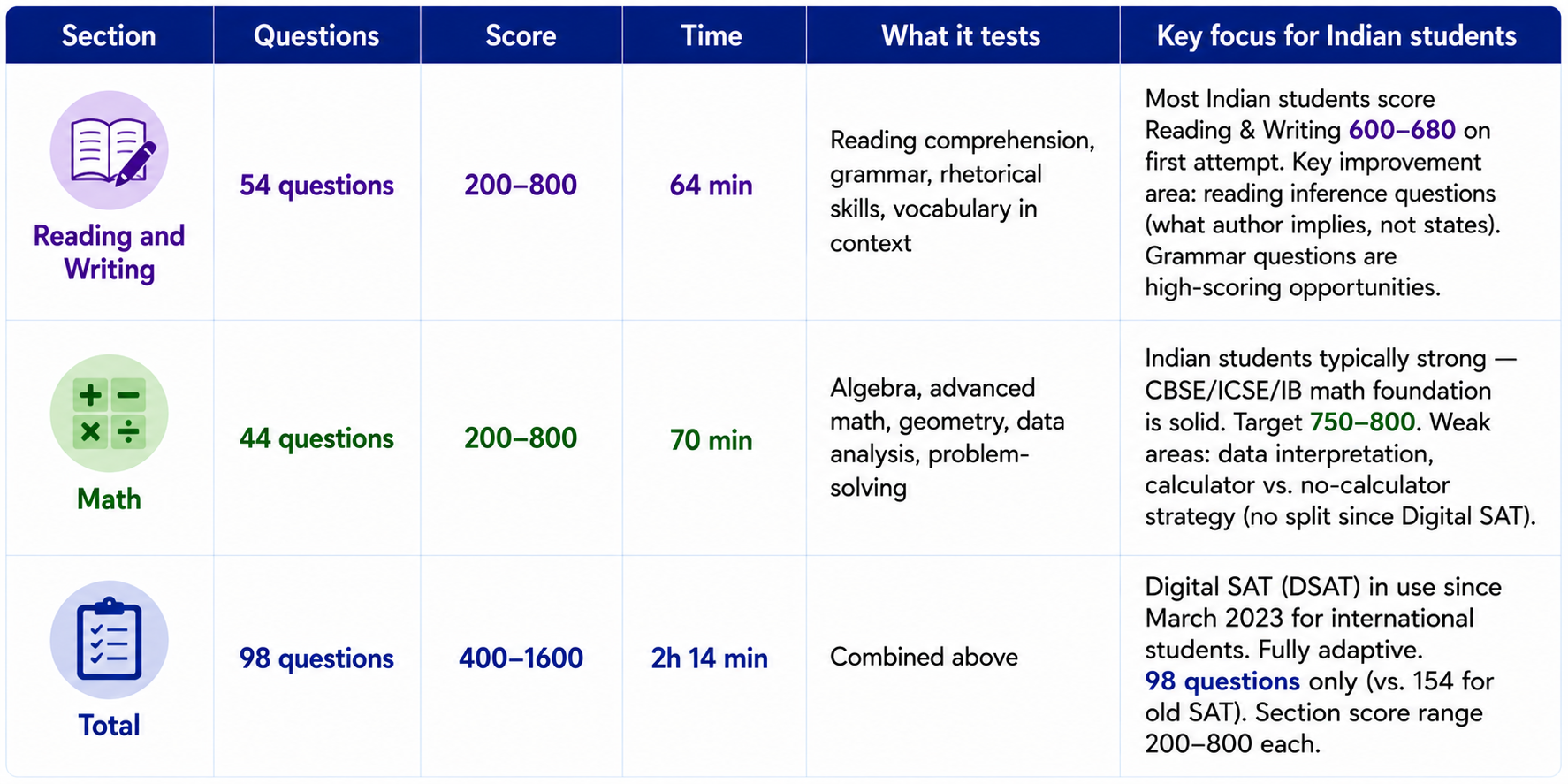
The adaptive engine rewards students who start strong
The DSAT's adaptive structure means Module 1 of each section is the same for everyone — medium difficulty. Based on your Module 1 performance, Module 2 is either harder (if you did well) or easier (if you struggled). Harder Module 2 = access to higher scores. Easier Module 2 = score ceiling is lower. The practical implication: do NOT rush through Module 1 to save time for Module 2. Module 1 performance determines your score ceiling. Treat every question in Module 1 as equally important regardless of apparent difficulty.
SAT Score Targets — What Score Do You Actually Need?
The score you need depends entirely on which universities you are targeting. Here is the realistic landscape for Indian students applying abroad for undergraduate admissions:
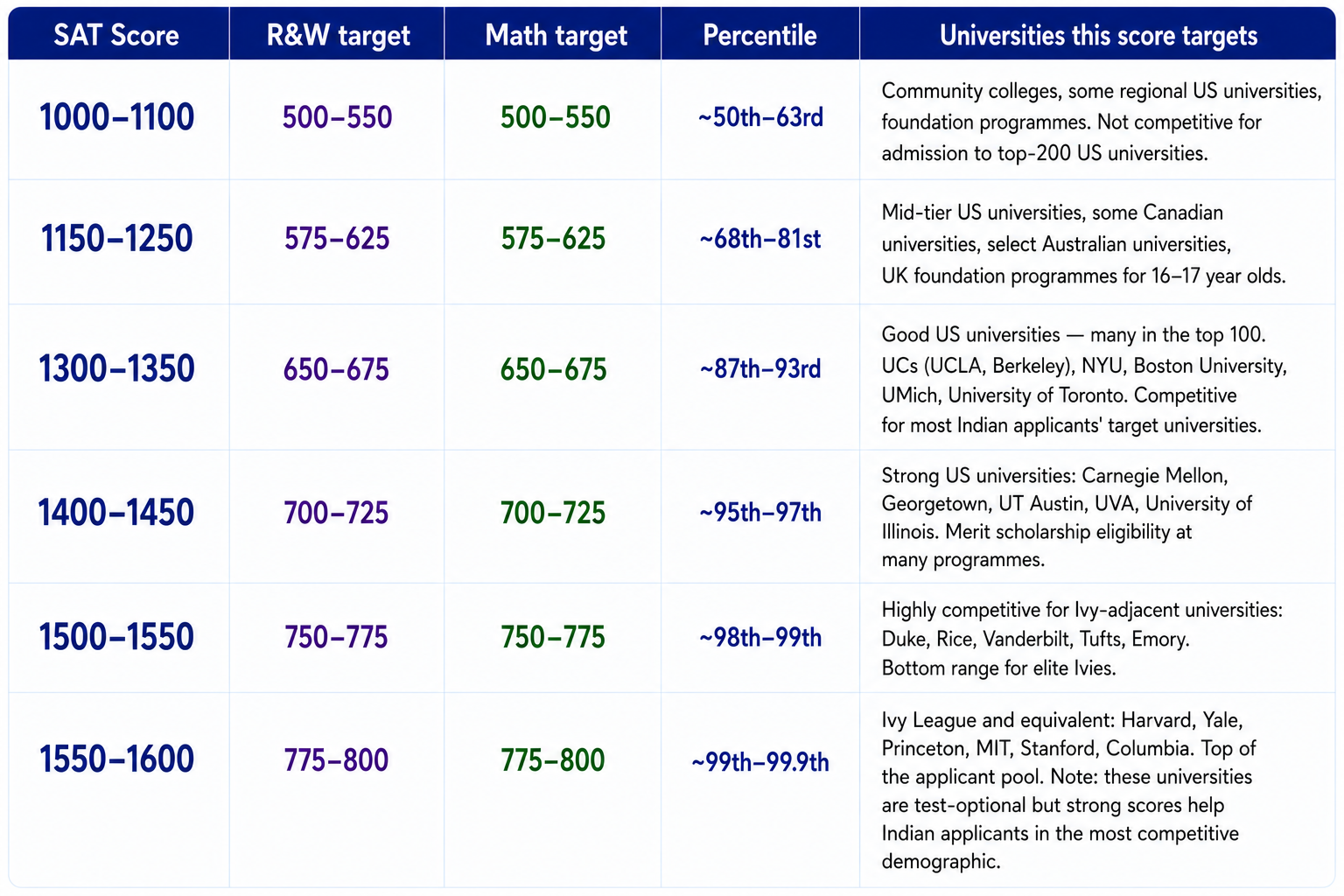
The Indian applicant pool problem — why 1400 may not be enough at top schools
US admissions operates by demographic cohort. Indian applicants do not compete against the entire class — they compete against other Indian applicants. At MIT, Harvard, and Stanford, Indian applicants represent a highly self-selected, academically strong pool. The average admitted Indian student at these schools typically scores 1550+. A 1400 SAT — excellent in absolute terms — may not be competitive within the Indian applicant pool at these specific universities. Check Indian admit statistics on PrepScholar, CollegeVine, and GMAT Club (for MBA equivalent) to understand your demographic-specific baseline.
12-Week SAT Study Plan for Indian Students
This plan targets a 1400–1500 DSAT from a starting baseline of 1150–1250. Students targeting 1500+ should extend to 16 weeks. Students already at 1300+ can compress to 8 weeks. The plan assumes 1.5–2.5 hours per day for Class 12 students and 2–3 hours for students preparing during holidays or gap periods.
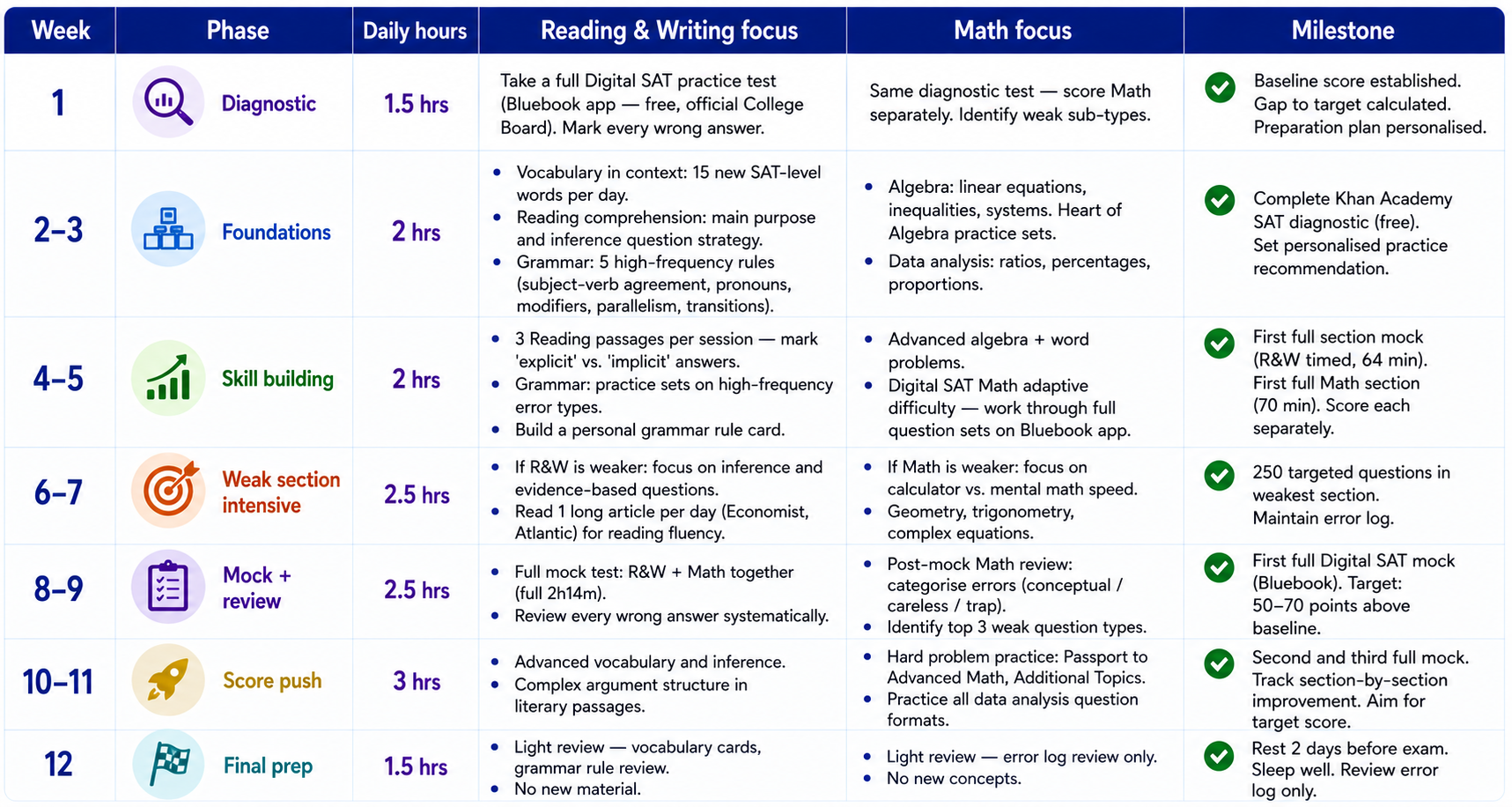
The error log for SAT — same principle as GMAT, equally important
After every practice session, categorise every wrong answer: Was it a concept gap (did not know the rule/formula)? A careless error (knew the rule, made a silly mistake)? A trap (chose the answer that looked right but was intentionally misleading)? Tracking this across 8 weeks reveals whether you are improving on concepts (answer: study more) or still making the same careless errors (answer: slow down, not study more). Most Indian students find their Math errors are careless — which requires a different intervention than a concept gap.
Section-by-Section Preparation Strategy
Reading and Writing — the section that surprises Indian students most
Indian students often underestimate the DSAT Reading & Writing section because their English is strong. The challenge is not language fluency — it is academic reading inference, a specific skill that Indian school curricula do not systematically develop. SAT R&W tests whether you can identify what an author implies, what the main purpose of a paragraph is, and what evidence supports a specific claim — not just whether you can read the text correctly.
High-frequency R&W question types for Indian students:
The most effective preparation tool for DSAT R&W is reading long-form English articles regularly — The Economist, The Atlantic, Scientific American. Not for vocabulary, but to develop the reading stamina and inference skills that the test rewards. 15 minutes of article reading per day over 10 weeks is more effective than 10 hours of practice questions without this foundational exposure.
Math — where Indian students have a natural advantage
CBSE and ICSE mathematics education to Class 12 covers approximately 90–95% of the mathematical content tested on the DSAT. Indian students from these curricula typically enter DSAT preparation with a strong foundational advantage in Math — the question is whether they can apply that knowledge at SAT speed and under SAT-style problem framing.
DSAT Math key areas and Indian student context:
The most important Math preparation principle: build and protect accuracy before speed. The DSAT adaptive format penalises errors in Module 1 disproportionately (by lowering your Module 2 ceiling). A student who completes 40/44 Math questions with 38 correct is better positioned than one who completes all 44 with 40 correct, because the 38-correct student may have been more careful in Module 1. Accuracy comes before coverage.
Best SAT Preparation Resources for Indian Students
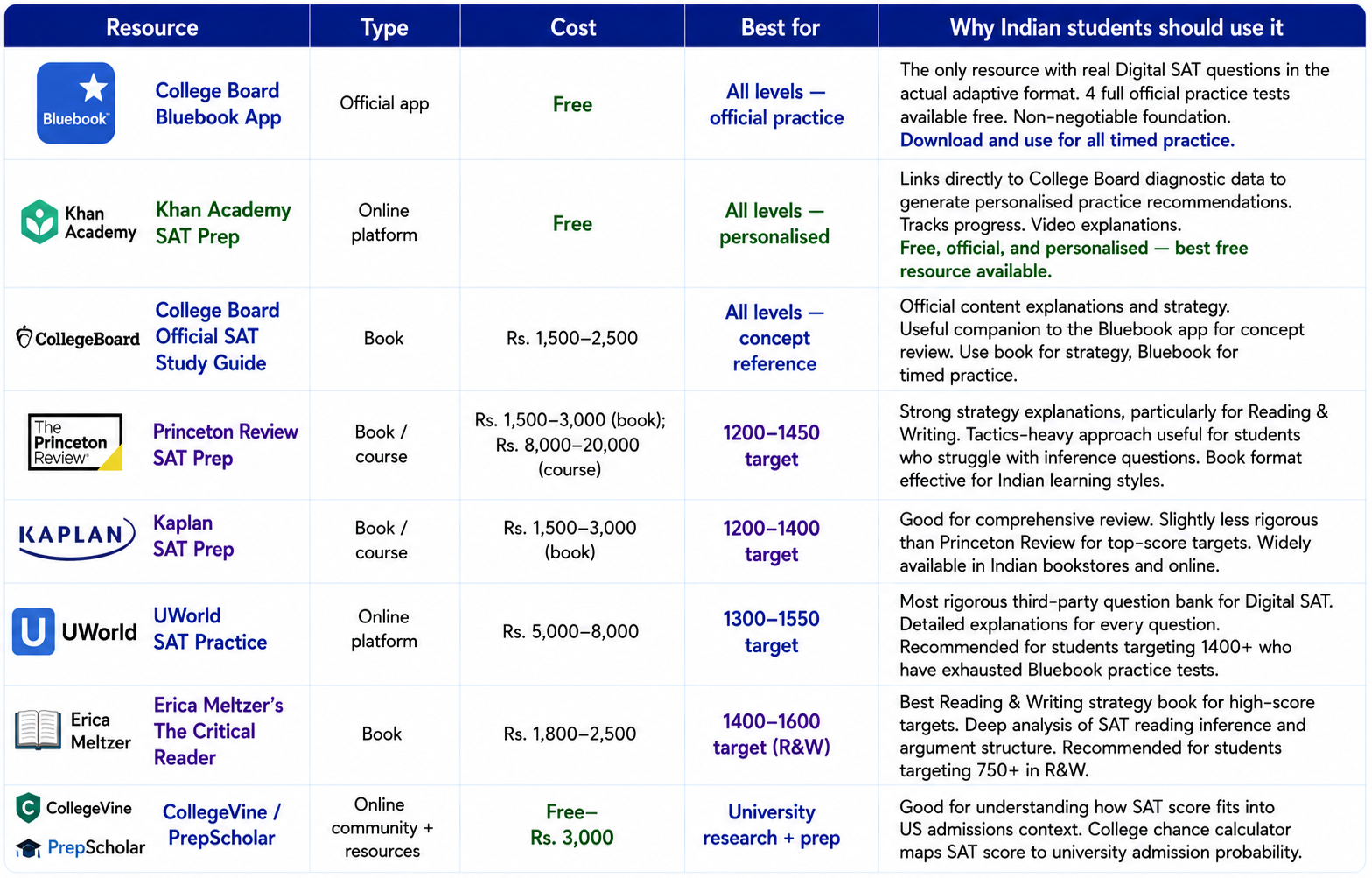
The Bluebook app is non-negotiable — start there
The College Board's Bluebook app is free, official, and provides the exact Digital SAT adaptive experience. It includes 4 full practice tests with automatic scoring and explanations. Indian students often start with third-party prep books before taking any official Bluebook practice — which is backwards. Take a Bluebook diagnostic first. Understand your score and weak areas. Then use third-party resources to build specific skills, and return to Bluebook for timed practice. Every timed practice session should be on Bluebook or Khan Academy SAT (which uses official College Board questions), not on third-party unofficial materials.
SAT vs ACT — Which Should Indian Students Choose?
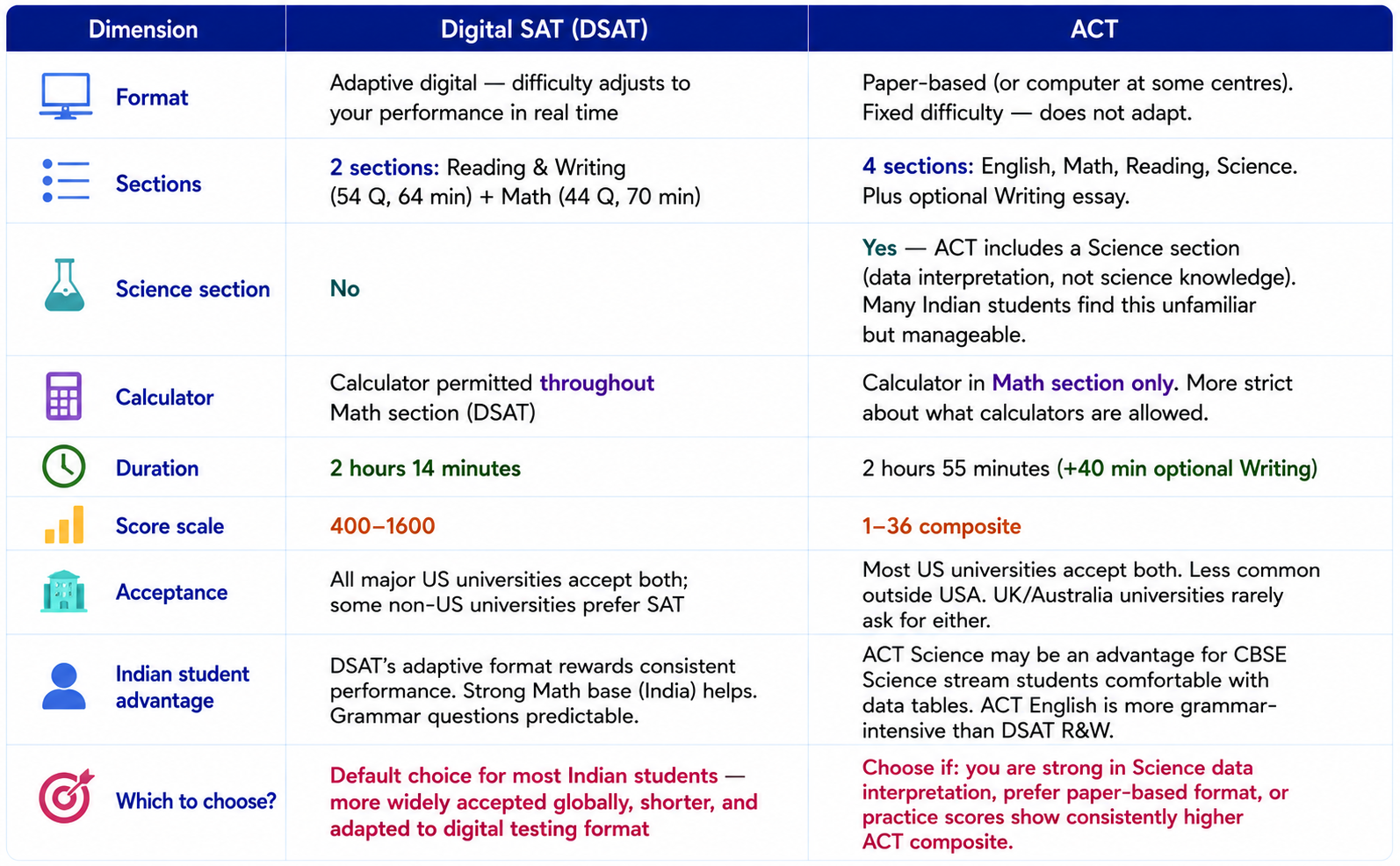
Most Indian students default to the SAT without comparing the ACT. For the majority, SAT is the right choice — but there are specific profiles where ACT is the stronger option:
The diagnostic approach to choosing between SAT and ACT
The most reliable way to decide: take one full practice test for both (Bluebook for DSAT, ACT.org for ACT) in the same week, score both, and compare percentiles. Do not compare raw scores — compare the percentile each score corresponds to. If your ACT composite converts to a higher percentile than your SAT total, take the ACT. If equivalent or SAT higher, take SAT. This diagnostic takes 5 hours and can save months of preparation on the wrong test.
Test-Optional Admissions — Does the SAT Still Matter in 2026?
A large number of US universities that went test-optional during COVID have maintained or reinstated SAT/ACT requirements. In 2026, the landscape is mixed — some universities are test-optional, some have reinstated testing, and some have gone test-free (meaning scores are not considered even if submitted). Understanding this for each target university is part of how to prepare for abroad studies strategically.
SAT Timeline for Indian Students — When to Take It
The SAT timeline for Indian students depends on when you are applying to university. For US undergraduate applications for Fall 2027 entry:
Frequently Asked Questions
Is the SAT required for UK and Australian university applications?
No — UK and Australian universities do not require the SAT for undergraduate admission. UK universities use A-Level/IBDP/CBSE/ICSE board results directly. Australian universities similarly use board results. The SAT is primarily relevant for US, Canadian, and some Asian university (NUS, NTU Singapore, HKU) applications. If you are targeting exclusively UK or Australia, you do not need to take the SAT.
My CBSE board exam is in March. How do I manage SAT preparation alongside boards?
Most Indian students target their SAT in May or October — after CBSE boards end in March. Do not attempt serious SAT preparation between January and March of Class 12 — board preparation takes priority and your SAT performance will be suboptimal with divided attention. The ideal strategy: complete your 12-week SAT preparation plan between April and July (after boards), take DSAT in August or October, and have your score before Early Decision deadlines in November. This sequence is realistic and allows full focus on each task in sequence.
What is a superscore and do I need to know about it?
A superscore is the combination of your highest section scores across multiple SAT sittings. For example: SAT 1 = R&W 680, Math 720. SAT 2 = R&W 720, Math 700. Superscore = R&W 720 + Math 720 = 1440 — higher than either individual test total (1400 and 1420). Most US universities now use superscoring, which makes retaking the SAT to improve one section a lower-risk strategy. If your Math is strong but R&W is weak, a second attempt focused on R&W can improve your superscore without needing to re-improve Math.
The SAT is not a measure of intelligence — it is a measure of preparation. The Indian students who score 1500+ are not the most naturally intelligent applicants. They are the students who understood the Digital SAT's adaptive structure, targeted their weakest section specifically, used official Bluebook practice tests consistently, and gave themselves enough time to improve. How to prepare for abroad studies through the SAT is a planning question before it is a studying question: which score do you need, when is your test date, and what is the specific preparation path between your current baseline and that target?