Scholarship Eligibility Criteria for Indian Students Complete Guide to Study Abroad Scholarships — What You Need to Qualify
Most Indian students who are eligible for study abroad scholarships never apply for them. The most common reason is not that they investigated and found themselves ineligible — it is that they assumed they were ineligible without checking. 'My CGPA is only 7.8, that won't be enough.' 'My family earns too much for a need-based scholarship.' 'I don't have research experience, so DAAD is out.'

Team Vidysea
May 20, 2026

These assumptions are often wrong. Chevening does not publish a CGPA floor — it evaluates leadership first. DAAD's stated minimum is 75% — well within reach of most Indian students from engineering and science backgrounds. Commonwealth evaluates development impact, not just academic rank. And for the hybrid scholarships (Inlaks, JN Tata, Narotam Sekhsaria), the eligibility criteria are genuinely accessible to a wide range of Indian students who simply are not aware the scholarships exist.
This guide documents the scholarship eligibility criteria for every major study abroad scholarship available to Indian students in 2026 — criterion by criterion. Use it to check exactly where your profile stands, what opens at each threshold, and what the actual (not assumed) barriers are for each award.💡 How to use this guide
Start with the self-assessment checklist near the end — it maps your current profile (CGPA, work experience, age, nationality, language score, financial situation) to which scholarships each factor opens and which it closes. Then read the specific sections for the scholarships where you have gaps, to understand whether those gaps are fixable before your target application deadline.
Major Study Abroad Scholarships — Eligibility at a Glance
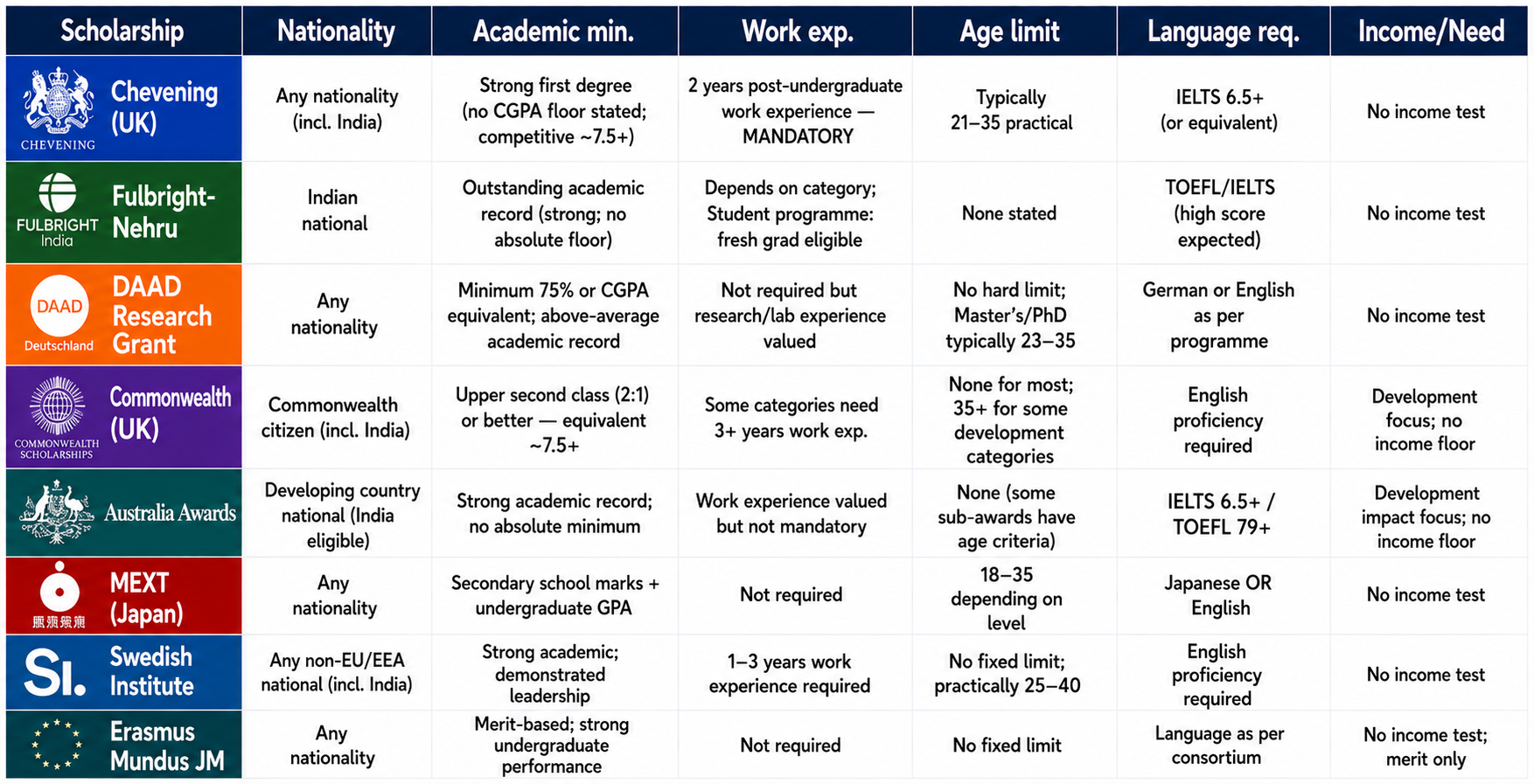
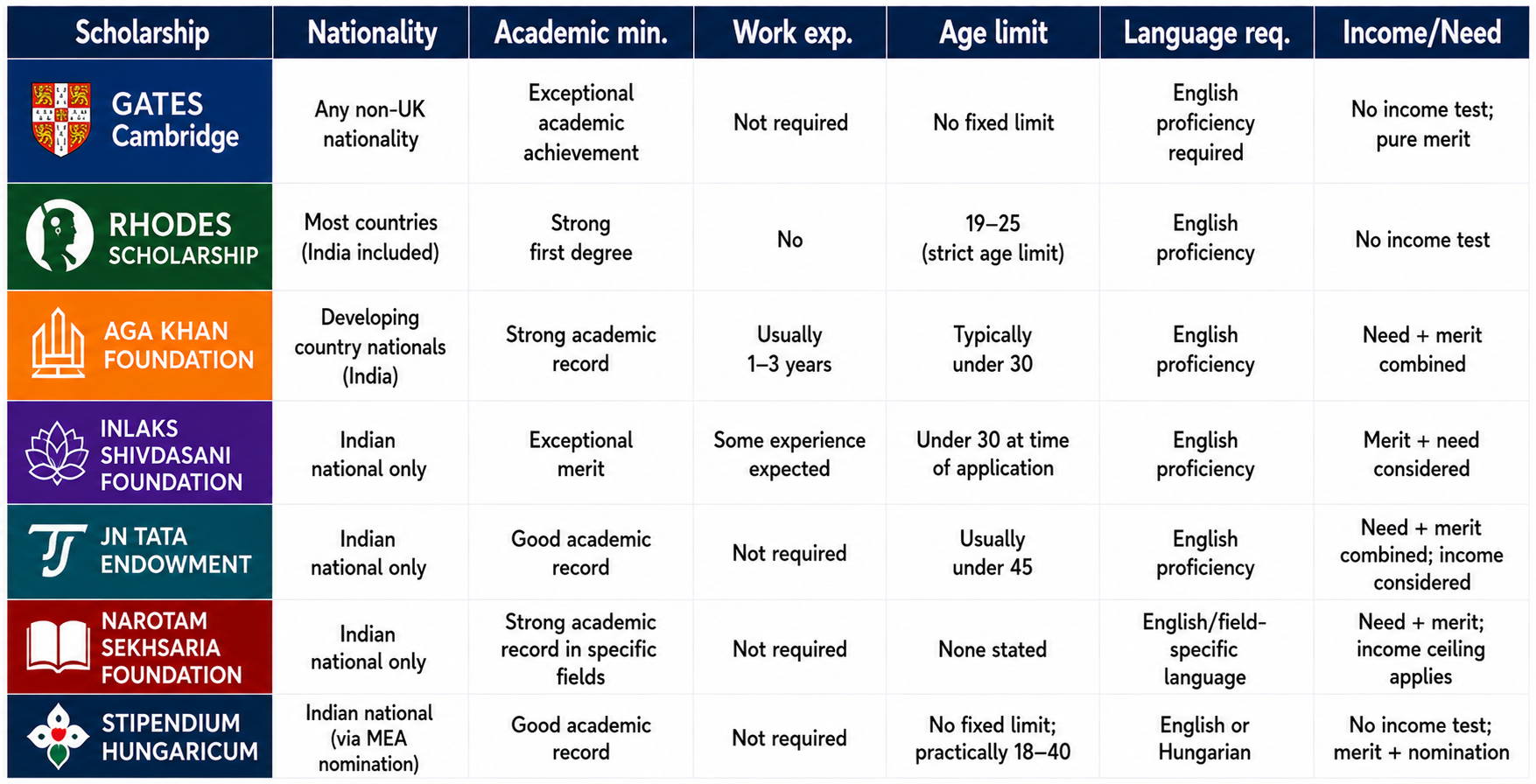
This table covers the eligibility requirements for scholarships for students studying abroad that are most relevant to Indian applicants in 2026:
Government & bilateral scholarships for students studying abroad
Foundation, university & private scholarships for students studying abroad
✅ The most important eligibility fact about flagship scholarships
Chevening, Fulbright-Nehru, DAAD, Commonwealth, and Australia Awards — the five most prestigious study abroad scholarships available to Indian students — do NOT have an income or family wealth ceiling. A student from a wealthy family is fully eligible for all of them based on merit alone. The assumption that government scholarships are 'for poor students' is incorrect for these awards.
CGPA and Academic Requirements — What Each Scholarship Actually Needs
The CGPA requirements for study abroad scholarships are widely misunderstood. Most students either overestimate the minimum (assuming top marks are required) or apply without checking the competitive range (which is significantly higher than the stated floor for elite awards). Here is the honest picture:
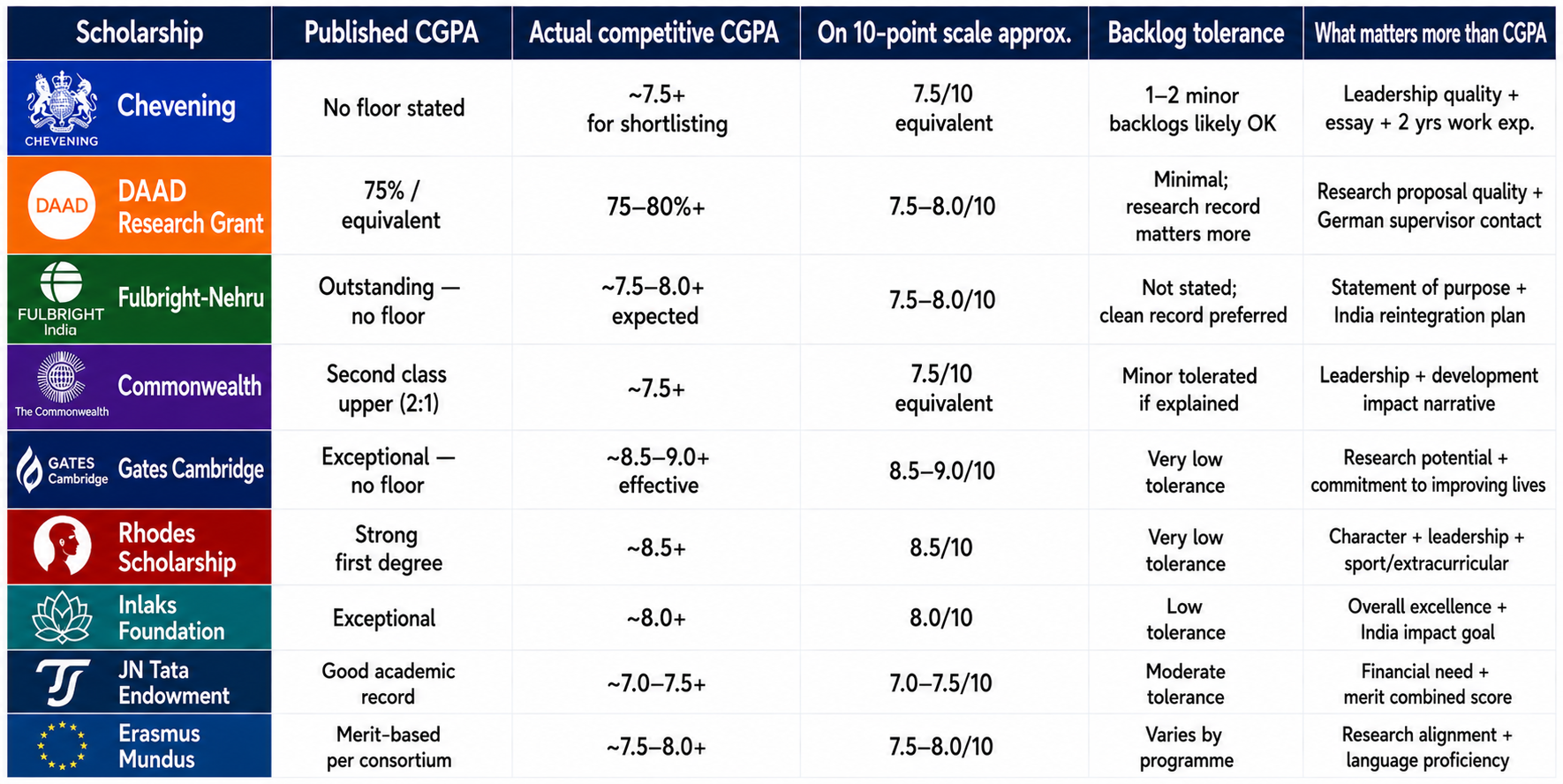
⚠️ The 'competitive CGPA' vs 'minimum CGPA' distinction
Scholarships like Chevening and Fulbright do not publish a CGPA floor — which means candidates assume there is no minimum. There is an effective one: the competitive pool is made up of applicants with strong academic records. A student with CGPA 6.5 applying to Chevening is technically eligible but practically uncompetitive. The 'competitive CGPA' column in the table above reflects the realistic range of admitted candidates, not the stated rule. Apply at or above the competitive range for meaningful odds.
Work Experience Requirements — The Criterion Most Indian Students Miss
Work experience is the eligibility criterion that eliminates the most otherwise-qualified Indian applicants from study abroad scholarship pools — specifically from Chevening, which makes 2 years of post-undergraduate full-time work experience a hard, non-negotiable requirement. Many students discover this after spending 40–60 hours on a Chevening application, find out they do not qualify, and have to wait 2–3 years before they can apply. Checking this criterion first costs 3 minutes and saves 60 hours.
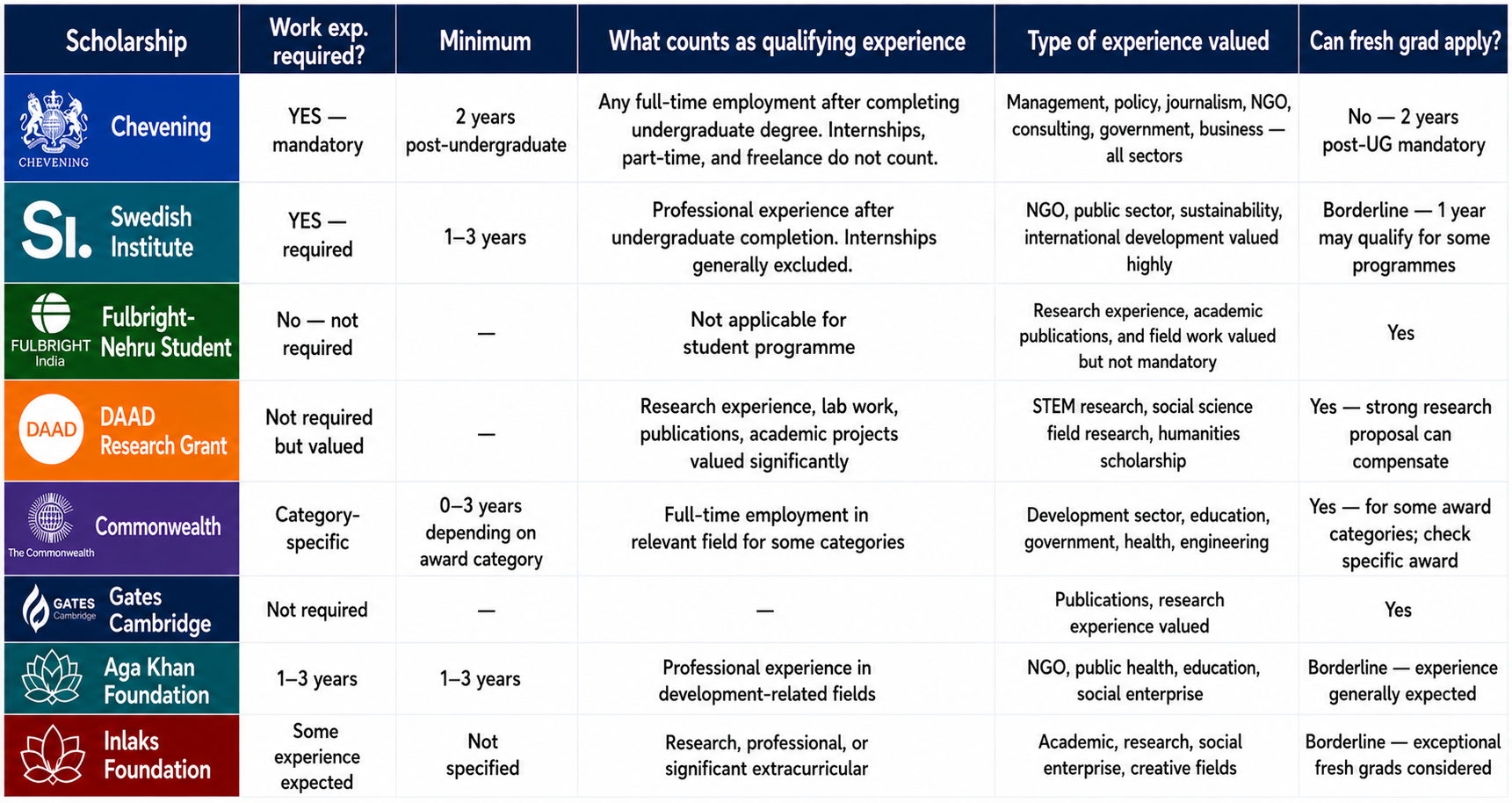
✅ The Chevening work experience rule — exactly what qualifies
Chevening requires 2 years of post-undergraduate full-time work experience at the time of application (which closes in November). Internships, part-time jobs, freelance work, and voluntary positions do NOT count. Counting starts from the date of undergraduate degree completion (not the date you stopped attending classes). A student who completed their BTech in May 2023 and has worked full-time since June 2023 has approximately 2.5 years of qualifying experience by November 2025 — making them eligible for the 2025–26 cycle. Verify your exact qualifying months before applying.
Age and Citizenship Requirements
Most major study abroad scholarships do not have age limits — this is more common in lower-tier awards. The most notable exception is the Rhodes Scholarship, which has a hard age limit of 25 at the time of application. Indian students who are over 25 are permanently ineligible for Rhodes regardless of their academic profile.
Scholarships with age limits
- Rhodes Scholarship: 19–25 at time of application. No exceptions.
- MEXT (Japan): 18–35 depending on level of study and specific award category.
- Some Commonwealth categories: under 35 for specific development-focused awards.
- Inlaks Foundation: under 30 at time of application.
- Aga Khan Foundation: typically under 30, though the foundation considers profile holistically.
Scholarships with no meaningful age limit
- Chevening, DAAD, Fulbright-Nehru, Gates Cambridge, Swedish Institute, Erasmus Mundus, JN Tata Endowment, Narotam Sekhsaria: no published age limit. Practically, most successful applicants are 22–40 for merit-based and 22–45 for research/PhD tracks.
Citizenship and nationality requirements
The key distinction for Indian students: whether a scholarship is open to all nationalities, restricted to Commonwealth citizens, or restricted to Indian nationals only:
- Open to all nationalities (India included): DAAD, Gates Cambridge, Erasmus Mundus, MEXT, Swedish Institute
- Commonwealth citizens only (India is a member): Chevening, Commonwealth Scholarship, Australia Awards
- Indian nationals only: JN Tata Endowment, Inlaks Foundation, Narotam Sekhsaria, Fulbright-Nehru (Indian side)
- Via Indian government nomination: Stipendium Hungaricum (MEA nominates Indian candidates)
Language Score Requirements for Study Abroad Scholarships
Most study abroad scholarships require English proficiency documentation. The requirement is almost always IELTS 6.5+ overall (or TOEFL 79+) for government scholarships. Some specify component score minimums as well. Here are the key language requirements for major awards:
- Chevening: IELTS 6.5 overall with no component below 6.0 — must be achieved BEFORE the scholarship deadline (November). Students who apply without a current valid IELTS score are disqualified.
- Commonwealth: English proficiency required; standard is IELTS 6.5. Specific requirement varies by university.
- Australia Awards: IELTS 6.5 overall with no component below 6.0 or TOEFL 79+.
- Swedish Institute: English proficiency required; IELTS 6.5 is the common benchmark.
- DAAD: English or German depending on programme. For English-taught German programmes, IELTS 6.0–6.5 or TOEFL 88–100 is typical. German-taught programmes require TestDaF or DSH.
- Fulbright-Nehru: High English proficiency expected; no single stated minimum but competitive applicants typically score TOEFL 100+ or IELTS 7.5+.
- Gates Cambridge, Rhodes: English proficiency required; no standard floor but elite academic register expected throughout the application.
⚠️ Take IELTS before the scholarship deadline — not after it
Chevening's most common application error among otherwise-qualified Indian students: submitting a scholarship application with an expired IELTS score or no score at all, intending to take the test later. Chevening requires a valid IELTS score (within 2 years) AT THE TIME of application submission. The application window closes in November. If you are planning to apply for the 2025–26 Chevening cycle, take IELTS by September at the latest. An IELTS score takes up to 13 days for paper-based results.
Your Personal Eligibility Checklist — Map Your Profile to Scholarships
Use this table to self-assess your eligibility across the ten most important criteria for scholarships for students studying abroad. The 'Your status' column is blank — fill it in against your actual profile to identify your shortlist:
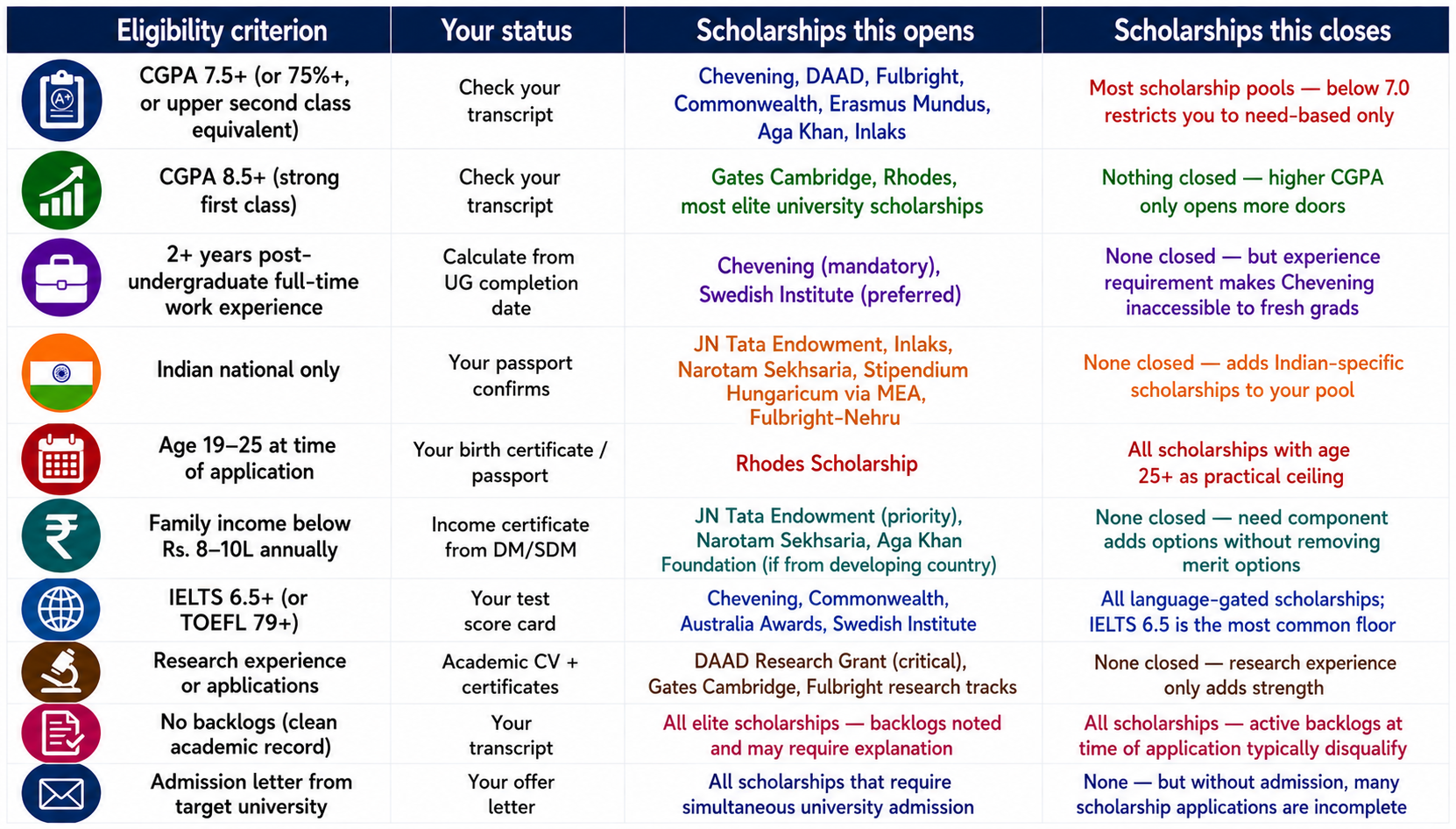
💡 The checklist reveals your scholarship shortlist
After completing the checklist, count how many criteria you meet. A student with CGPA 7.8, 2+ years work experience, Indian nationality, IELTS 7.0, no backlogs, and family income Rs. 12L should apply to: Chevening (all criteria met), DAAD (academic standard met, German supervisor outreach needed), Commonwealth (leadership narrative required), and Erasmus Mundus (programme-specific application). That is a genuine shortlist, not an aspirational one.
Common Disqualifications — and Whether They Can Be Fixed
Understanding what disqualifies an application — and whether the disqualification is permanent or fixable — is the most practically important content in this guide. Many students give up on study abroad scholarships for reasons that are either incorrect assumptions or fixable within 6–12 months:
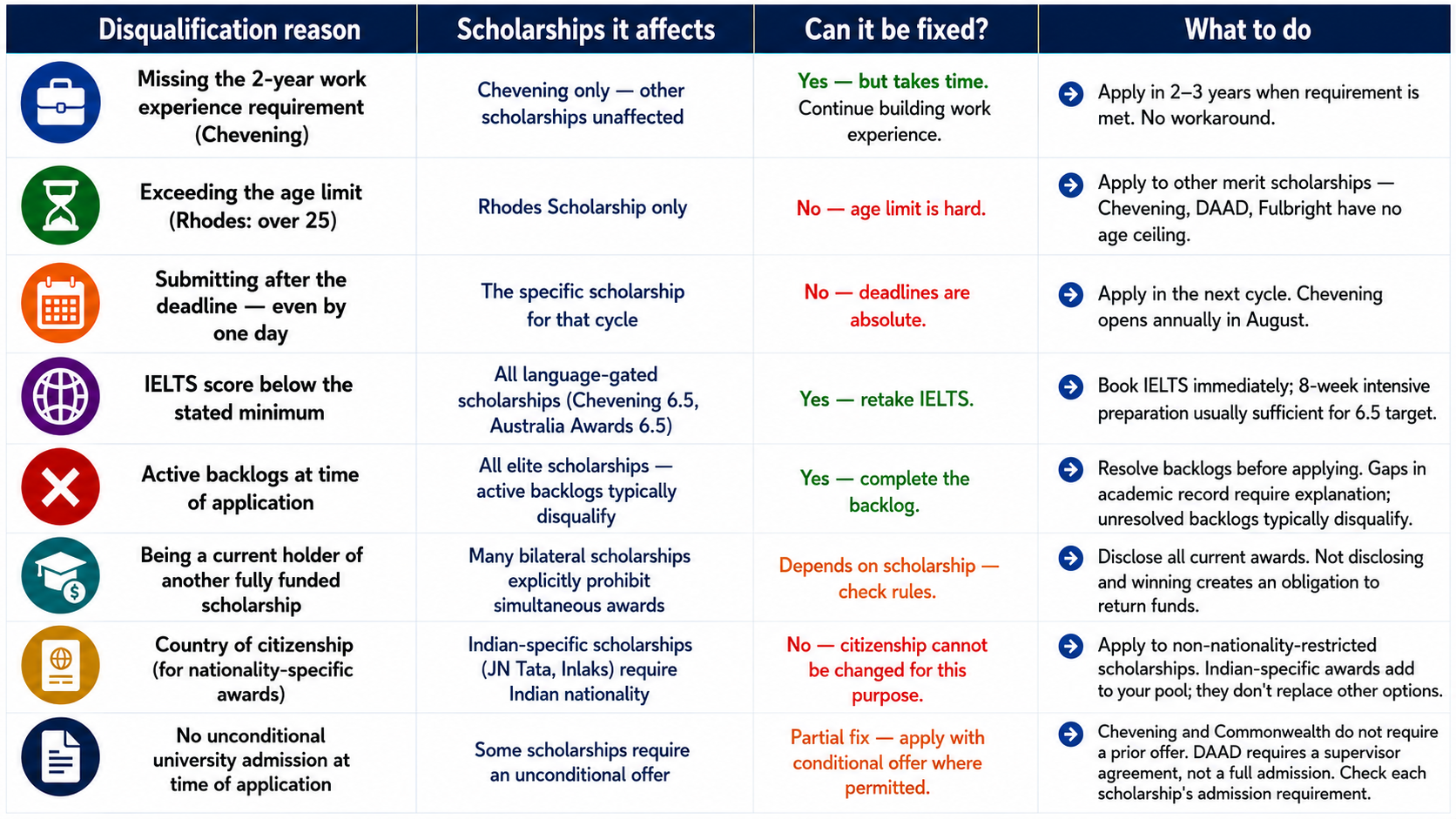
✅ The most valuable insight in this section
Most disqualifications are fixable with time — IELTS retake, backlog resolution, building work experience. Only age limits (Rhodes) and citizenship requirements are permanent. Every other eligibility gap is a planning challenge, not a permanent barrier. The student who discovers at 22 that they are 18 months short of Chevening's work experience requirement is not disqualified — they are on a 18-month path to eligibility.
Frequently Asked Questions
Do I need a university admission letter to apply for most scholarships?
No — most flagship study abroad scholarships do NOT require an unconditional university offer at the time of scholarship application. Chevening requires only that you be eligible to apply to UK universities — you are not required to have an offer. Commonwealth similarly does not require a prior offer. DAAD requires a supervisor agreement (not a full admission). The scholarships that do require admission are primarily university-specific departmental awards, not the major government scholarships. Check each scholarship's FAQ — this requirement is clearly stated where it applies.
My CGPA is 7.2. Am I eligible for any study abroad scholarships?
Yes. JN Tata Endowment and Narotam Sekhsaria both consider candidates with ~7.0–7.5 CGPA when combined with financial need and a strong personal profile. Some DAAD research categories focus more on research experience than CGPA. Scholarship eligibility is not a single threshold — it is a multi-criteria assessment, and strong performance on one criterion (research, leadership, need) can compensate for a modest CGPA in the right scholarships. Chevening, Gates Cambridge, and Rhodes will be difficult but not impossible with strong other-criteria evidence.
Can I apply for multiple study abroad scholarships simultaneously?
Yes — and you should. Applying to 3–5 scholarships in the same cycle is standard practice. Most scholarship rules state that if you accept another award, you must inform them — they do not prevent simultaneous applications. The practical limit is essay time: each scholarship requires a tailored set of 2–4 essays (40–80 hours per application). Prioritise the 3–4 scholarships most aligned with your profile and build each application carefully rather than submitting 8 generic ones.
What is the most common reason Indian students are rejected from Chevening?
Based on Vidysea's experience with Chevening applications: generic leadership essays are the most common reason for rejection. The Chevening leadership essay requires specific, named, measurable evidence of leading others. 'I served as student council president' without describing who you led, what you changed, and what the outcome was is not a Chevening leadership essay — it is a job title. The Chevening committee reads 20,000+ applications; generic content is identified and rejected immediately. The second most common reason: a vague networking essay that describes knowing people rather than a specific plan for building and leveraging a global network.
The scholarship eligibility criteria for study abroad scholarships are not designed to be impenetrable. They are designed to identify candidates who genuinely match the scholarship's purpose — and there are almost certainly at least 2–3 major scholarships that your profile qualifies for right now. The work is identifying which ones, understanding what each committee is looking for, and building an application that makes the match visible. That is what the eligibility checklist, the criterion tables, and a Vidysea counsellor session are for.