

Got dreams to achieve? Hop on as we take you on your journey to success!


Services
Contact Info

Noida office
+91 7428715522Bangalore office
+91 8861432223 support [at] vidysea.com
Copyright@Vidysea
Got dreams to achieve? Hop on as we take you on your journey to success!
Noida office
+91 7428715522Bangalore office
+91 8861432223support [at] vidysea.comCopyright@Vidysea
The most common reason strong candidates miss study abroad scholarships is not a weak profile, a low CGPA, or a poor essay. It is a missed deadline. Chevening closes the first week of November — every year, without exception. DAAD Research Grant applications close in October–November. The Swedish Institute closes in February. Students who discover Chevening in December are not applying for that cycle. They are waiting a full year.

Team Vidysea
Published Updated

The scholarship calendar is fixed. Your preparation calendar is variable. The students who win study abroad scholarships are almost never the strongest profiles in the pool — they are the candidates who started 12–18 months before the deadline, gave their essays the time they required, and had their IELTS score, German supervisor contact, and reference letters in place before the October–November window opened.
This guide gives you the complete scholarship application timeline — the master deadline calendar for every major scholarship for students studying abroad, the 18-month reverse planning table, and a month-by-month guide to exactly where you should be in your preparation today. If you are reading this in April 2026, you are in the ideal position for September 2027 intake. If you are reading this in October 2026, the Chevening window is open right now.
🔥 The October–November window is the most important period in the scholarship calendar
Chevening, DAAD Research Grant, DAAD WISE, Commonwealth (some cycles), and Gates Cambridge (Global round) all have deadlines in October–November. More than half of all fully funded scholarships available to Indian students for study abroad close in an 8-week window. If you are not prepared by October, you are waiting until the following year. This guide is built around that window — every preparation step works backward from it.
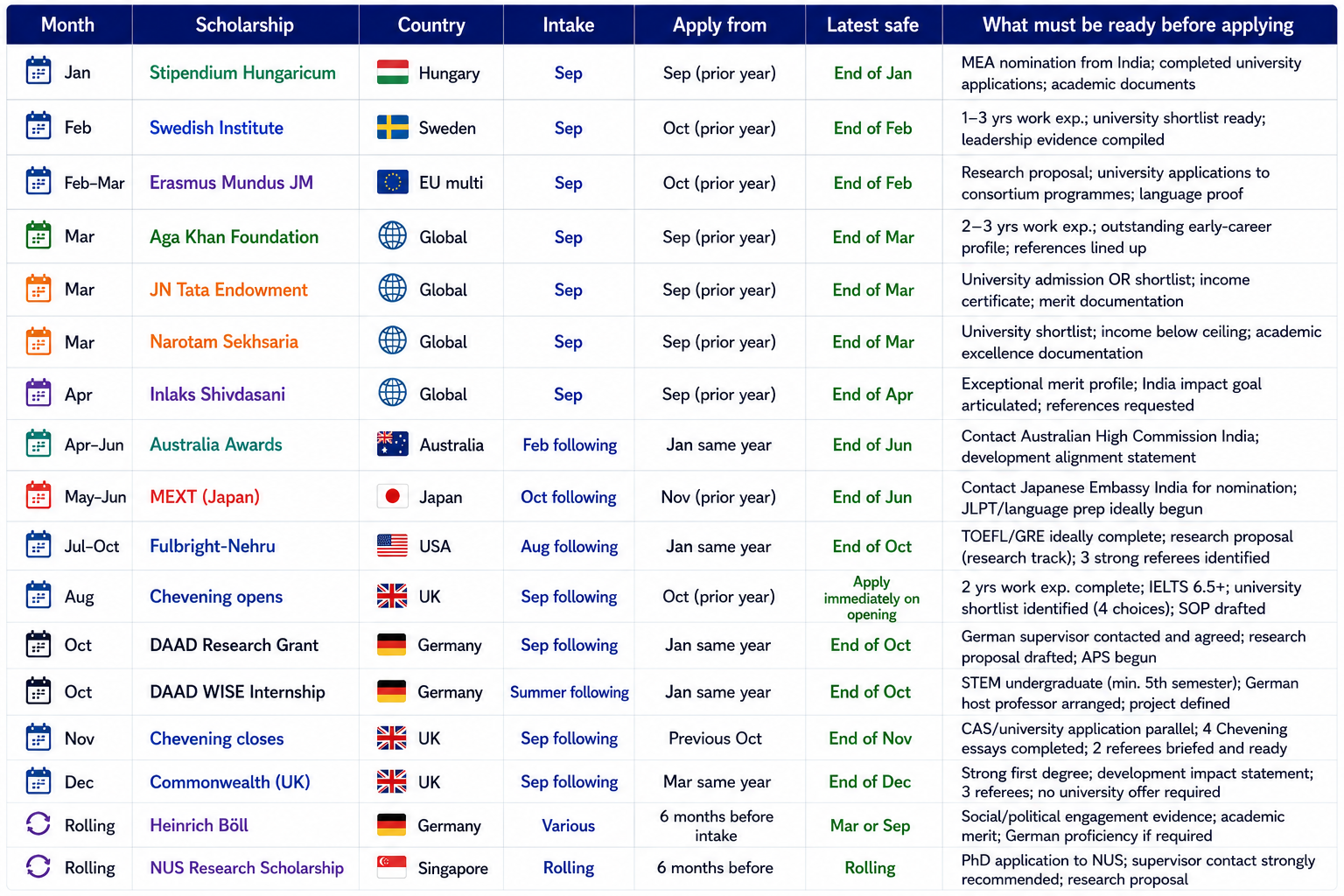
Master Scholarship Deadline Calendar — All Major Study Abroad Scholarships
This is the complete deadline calendar for scholarships for students studying abroad that are open to Indian applicants. Deadlines are approximate and should be verified on each scholarship's official website before applying. The calendar covers both September intake and other intake cycles:
✅ Verify deadlines on official websites every cycle
Scholarship deadlines shift by 1–4 weeks between cycles. Chevening has opened in August and sometimes September. Commonwealth has shifted between November and December. Always verify the exact deadline for your cycle on the official scholarship website — not on a blog post from a previous year, including this one. Use this calendar for planning order and relative timing, not for exact dates.
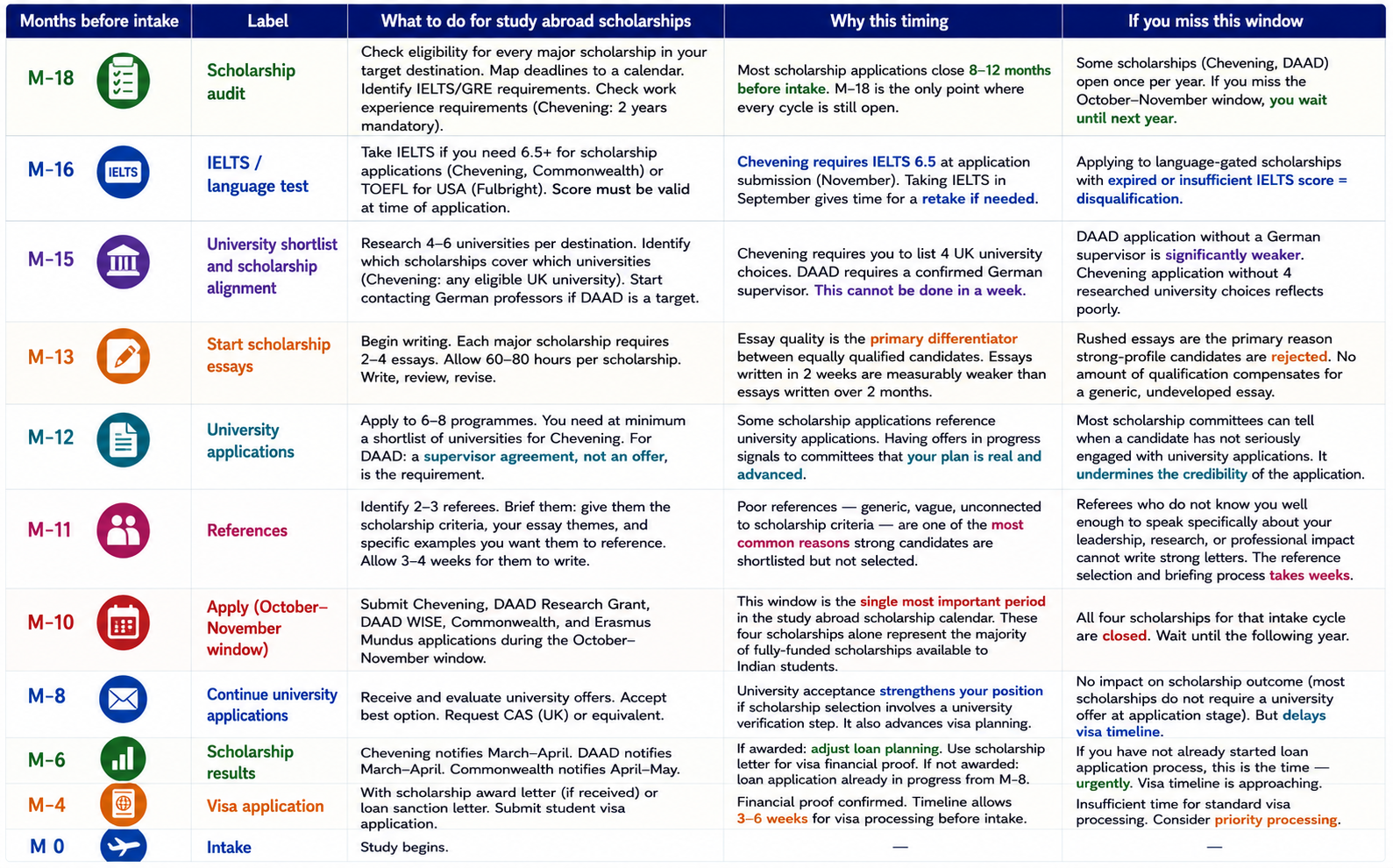
The 18-Month Scholarship Preparation Timeline
This is the planning backbone for any Indian student targeting study abroad scholarships for September 2027 intake. Each month is a milestone with specific actions, reasons, and — critically — what happens if you miss it:
💡 The single most common scholarship preparation mistake
Starting essay writing in the month the application opens. Chevening opens in August — and many students begin their essays in August, giving themselves 10–12 weeks for 4 essays. Students who started their essays in March and had 8 months of revision, reflection, and feedback produce materially better essays. The evidence is in the acceptance data: Chevening's essay prompts are published in advance. Students who have been thinking about their answers for months write essays that are specific, concrete, and personal. Students who start in August write essays that are generic.
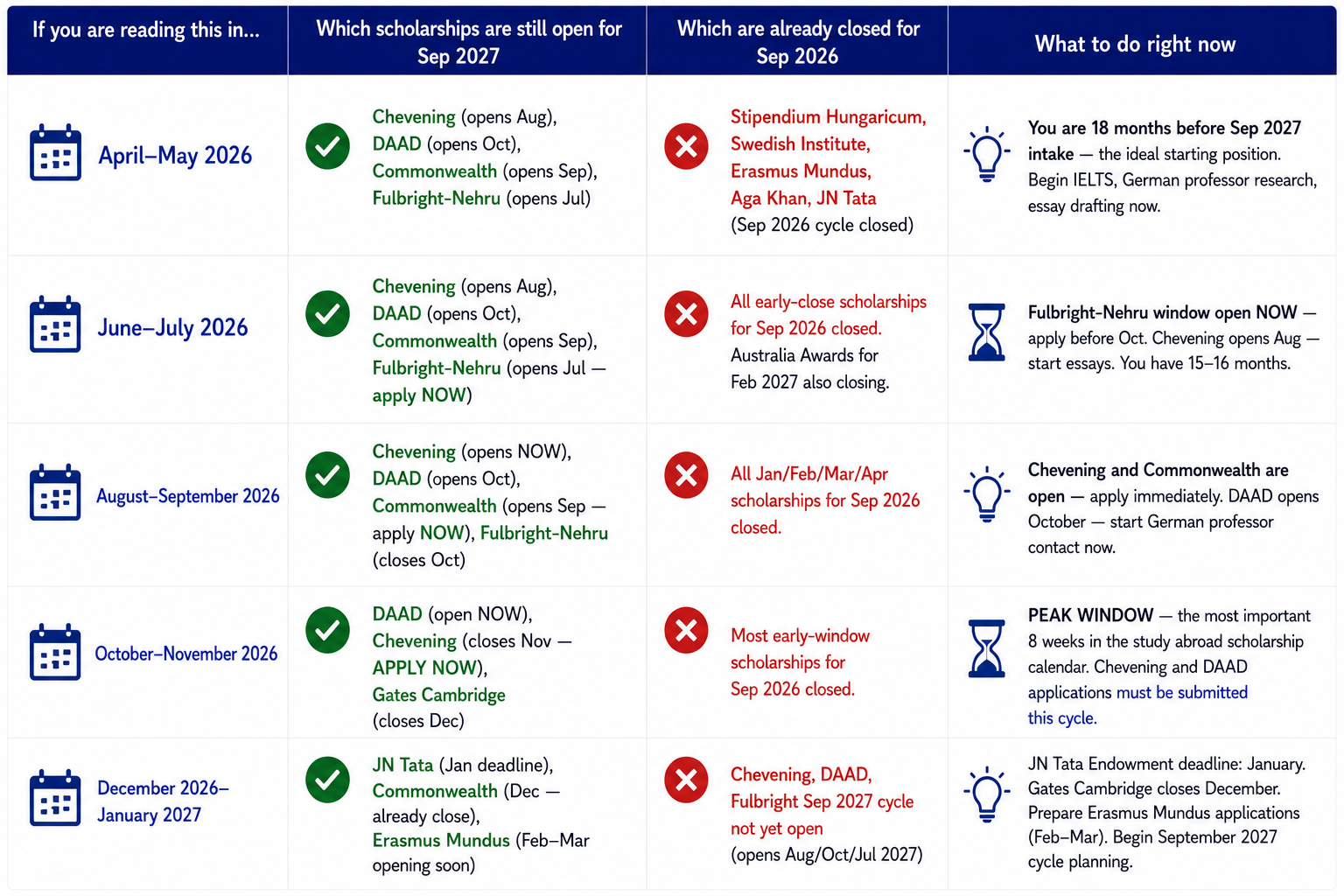
Where You Are Now — What Is Still Open
The table below maps your current month to the study abroad scholarship landscape — which applications are still open for September 2027 intake, which September 2026 windows have closed, and what action to take right now:
⚠️ If you are reading this in October or November 2026
The Chevening and DAAD application windows are open right now. This is not the time to plan — it is the time to act. If your essays are not written, start them today. If your IELTS is below 6.5, you cannot apply to Chevening this cycle (unless you have time for a retake before the November deadline). If you have not contacted a German supervisor, DAAD is weaker but still possible with a compelling research proposal. Every day in October and November that passes without a submitted application is a day you are not in the pool.
What Takes Longest — and Why You Must Start Early
Most students underestimate how long the scholarship preparation process takes. Here is the honest picture of each preparation task:
Essay writing: 60–80 hours per scholarship
Four Chevening essays × 15–20 hours each = 60–80 hours minimum for one scholarship application. This does not include revision, feedback, and rewriting — which is where the quality actually comes from. A student who gives themselves 3 weeks has, at best, 42 hours (2 hours per evening). A student who gives themselves 3 months has 120+ hours. The quality difference is visible to every Chevening reader.
The most time-consuming essay is almost always the leadership essay — because it requires identifying specific evidence from your career that you may not have consciously tracked. Most candidates discover mid-essay that they cannot describe the outcome of a leadership moment in specific, measurable terms. Finding those specifics takes weeks of reflection and research into your own professional history.
German professor contact: 4–8 weeks of uncertainty
For DAAD Research Grant applications, you need a German professor who has agreed to host you. This is not a formality — it requires identifying the right professor, reading their work, writing a compelling research interest email, and waiting for a response. Most professors receive 20–50 such emails per week. The average response time, if a response comes at all, is 2–4 weeks. Strong initial emails (specific research question, clear alignment with professor's work, evidence of your own research) get faster and better responses.
Students who begin this outreach in September for an October DAAD deadline have 4 weeks. Students who begin in April have 6 months. If one professor does not respond, there is time to try others. There is no workaround for beginning too late.
References: 3–4 weeks minimum
Most scholarships require 2–3 references. The quality of those references depends entirely on how well you brief your referees. A referee who receives the scholarship criteria, your essay themes, and specific examples you want them to highlight will write a reference letter that reinforces your application. A referee who receives a generic request a week before the deadline will write a generic letter.
Identifying the right referees, asking them (allowing time for them to agree or decline), briefing them fully, and giving them time to write a quality letter requires 4–6 weeks minimum. Many referees are academics or senior professionals with busy schedules. A week's notice is not sufficient. Ask your referees 6–8 weeks before the deadline.
IELTS preparation and testing: 4–12 weeks
Chevening requires IELTS 6.5+ overall at the time of application submission (November). If you are currently at 6.0 in one band, you need a targeted retake. IELTS test slots in major Indian cities during September–October book 3–4 weeks in advance. Results take up to 13 days for paper-based tests. If you take IELTS in September and score below 6.5 in one band, you have one retake opportunity before the November deadline — and that requires having booked it before seeing your September results.
The safe approach: take IELTS by August at the latest for a November scholarship deadline. This gives time for a September retake if needed, with results back before the window closes.
Scholarship Clusters — How to Apply to Multiple in One Cycle
Serious scholarship applicants do not apply to one scholarship. They apply to 3–5 in a single cycle, using overlapping preparation. Here is how the preparation clusters work:
Cluster 1: October–November window (highest-value cluster)
Overlapping preparation: IELTS score serves Chevening and Commonwealth. Leadership evidence used in Chevening can be adapted for Commonwealth. DAAD requires a separate research proposal. Gates Cambridge essays are separate. This cluster can be completed with 120–160 hours of essay work across October–November if preparation began in April–May.
Cluster 2: Early-year window (need + merit hybrid scholarships)
Overlapping preparation: Financial need documentation (income certificate, bank statements) can be prepared once and shared across JN Tata and Narotam Sekhsaria. Swedish Institute essays on leadership overlap with Chevening preparation from the previous cycle. This cluster works best for candidates who also applied to Cluster 1 and can refine existing essay themes for different scholarship criteria.
Cluster 3: Mid-year long-lead scholarships
These scholarships have longer lead times and different processes (USEFI for Fulbright, Australian High Commission for Australia Awards). They run somewhat independently of the October–November cluster and require separate preparation tracks.
Frequently Asked Questions
I discovered Chevening in December. Can I still apply for the September 2027 intake?
Chevening for September 2027 intake opens in August 2026 and closes in November 2026. If you are reading this in December 2025 or later, the 2026–27 cycle has closed. However, you now have 8+ months before the 2026 Chevening cycle opens for 2027–28 intake. Use this time: write your four essays in draft, get IELTS to 6.5+, identify your four university choices, and begin the 18-month preparation calendar now. You will be one of the best-prepared Chevening applicants in the 2026–27 cycle.
Can I work on scholarship applications and university applications simultaneously?
Yes — and you should. Most scholarship applications do not require a university offer at the time of submission (Chevening, Commonwealth, DAAD). University applications and scholarship applications run as parallel tracks. The scholarship application references your plan; the university application realises it. The scholarship application calendar and university application calendar should be mapped together so that neither creates a bottleneck for the other.
How many scholarships should I apply to in one cycle?
3–5 is the standard recommendation for serious scholarship applicants. More than 5 usually means essay quality suffers — you cannot give 8 scholarships the attention they each require. Fewer than 3 leaves you exposed to the 95%+ rejection rate of any single scholarship. Identify your 3–5 best-fit scholarships based on profile alignment (see the eligibility blog and merit vs. need blog in this series), and give each application the time it requires.
My work experience falls 3 months short of Chevening's 2-year requirement. What do I do?
Wait. The 2-year post-undergraduate full-time work experience requirement is a hard eligibility rule — there is no waiver, no partial credit, and no alternative pathway. If you are 3 months short in November 2026, you will meet the requirement in February 2027. Apply in the November 2027 cycle. Use the additional 12 months to strengthen your essays, build more leadership evidence, and prepare a stronger application. A stronger application submitted when you are eligible beats a non-compliant application submitted early.
The study abroad scholarship timeline is not a matter of luck or last-minute inspiration. It is a planning problem with a known solution: start 12–18 months before intake, know your deadlines, write your essays before the window opens, and have your IELTS, references, and supervisor contacts in place before October. The students who win Chevening, DAAD, and Fulbright-Nehru every year are not the most exceptional profiles in the pool. They are the most prepared profiles — and preparation is entirely in your control.