Scholarship Interview Tips and Common Mistakes to Avoid — 2026 Guide for Indian Students
Scholarship interviews are the final filter applied to candidates who have already passed every paper-based assessment. By the time you are called for a Chevening interview, the committee believes you are qualified. The interview is asking a different question entirely: are you the person your application describes? Most Indian scholarship candidates who fail at interview do not fail because they are unqualified. They fail because of a small set of identifiable, preventable preparation errors — scripted answers that collapse under follow-up questions, leadership claims that cannot be elaborated with specifics, post-scholarship plans that are vague to the point of meaninglessness, or defensive responses to questions about weaknesses in the application.

Team Vidysea
May 22, 2026

This guide covers the 8 most common scholarship interview mistakes made by Indian applicants, with specific stronger approaches for each. It then covers the interview questions specific to Chevening, Fulbright-Nehru, and DAAD Research — the three major scholarships that involve live interviews — and closes with an 8-point pre-interview preparation checklist. The common thread through all of it: specificity. Every interview principle in this guide, for every scholarship, reduces to the same instruction — be specific, or be outscored by someone who is.
🔥 The one insight that changes how you prepare
Most scholarship candidates prepare by memorising answers to anticipated questions. The problem with this approach is that interviewers ask follow-up questions. A student who has a memorised answer to 'Tell us about your leadership experience' has nothing when the follow-up is 'What would you have done differently in that situation?' Scholarship interview preparation should be built around understanding the principles behind each question — not the words. Prepare to discuss, not to recite.
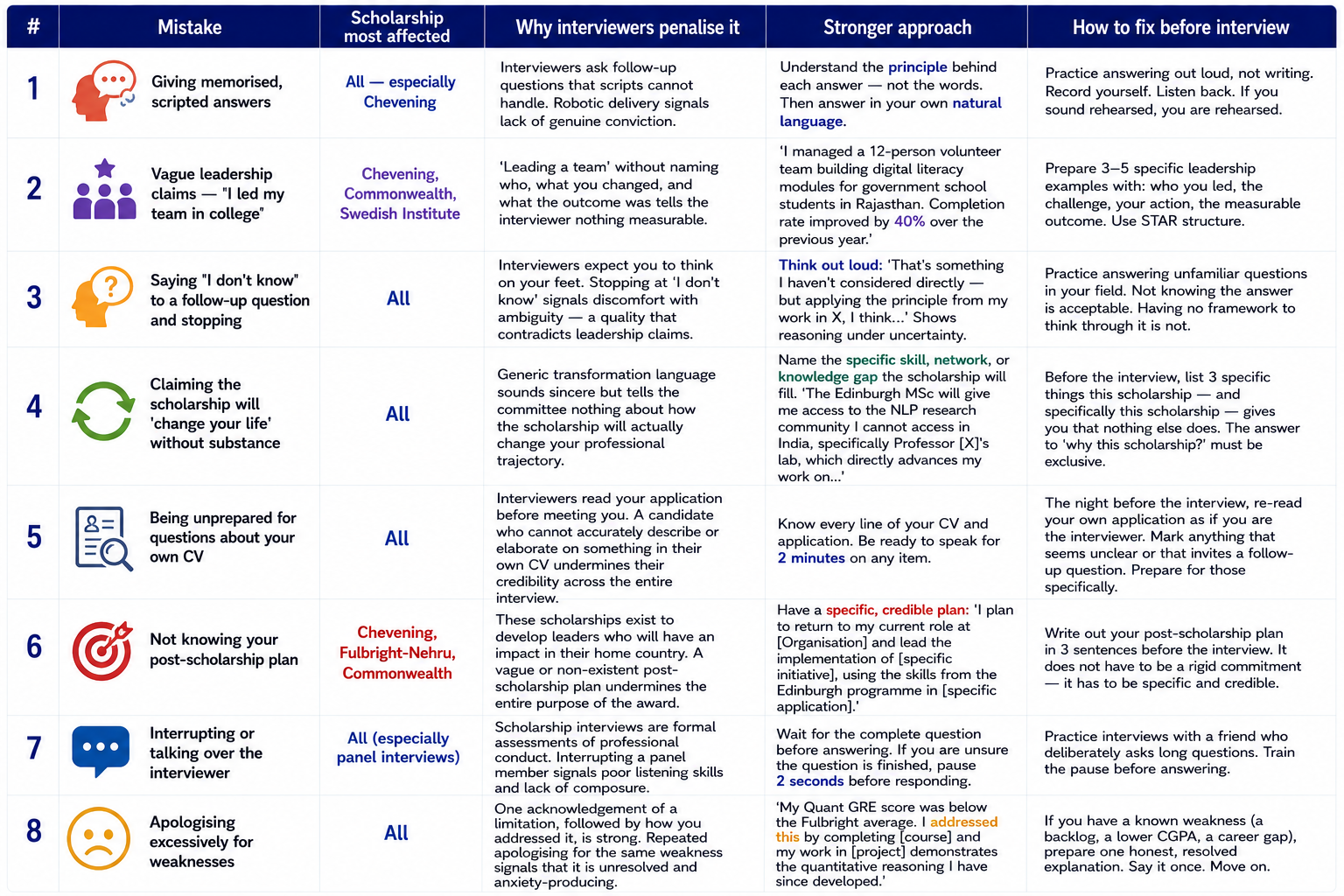
8 Common Scholarship Interview Mistakes — and How to Fix Each One
These are the errors that consistently differentiate shortlisted candidates who are not selected from those who are:
✅ The STAR framework for leadership examples
Every specific leadership example should be structured as STAR: Situation (what was the context?), Task (what was your role?), Action (what did you specifically do?), Result (what was the measurable outcome?). A leadership claim without all four elements is incomplete. A Chevening interviewer who asks 'Can you tell us more about that leadership example?' expects STAR elaboration. If you cannot provide it, the claim is unsubstantiated.
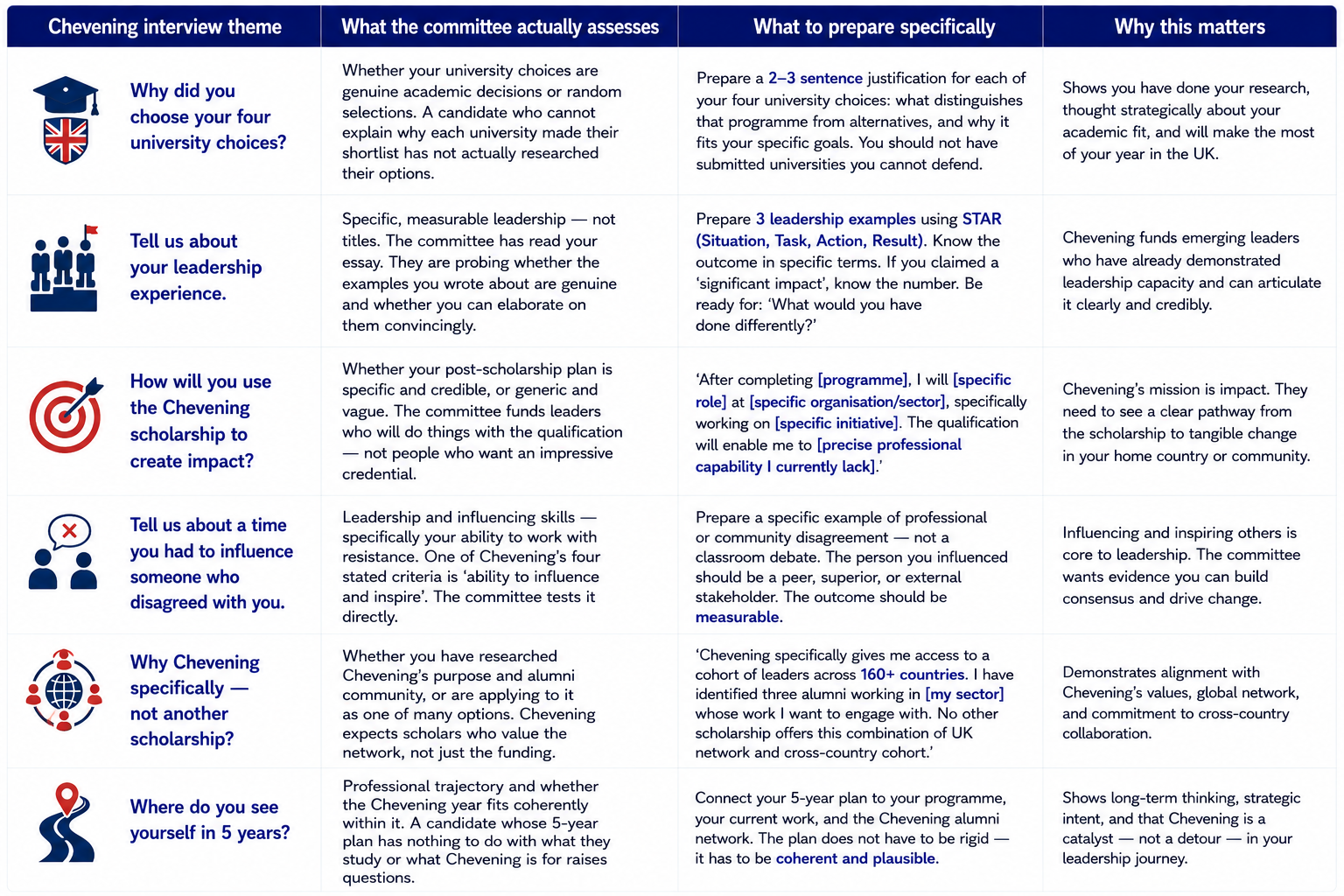
Chevening Interview — What the Committee Is Actually Assessing
The Chevening interview typically runs 30–45 minutes with a panel of 2–3 interviewers, usually including Chevening alumni and British Council representatives. The panel has read your four essays before the interview. They are not exploring your application — they are testing whether the application is genuinely you.
💡 The Chevening interview panel has seen thousands of applications
Every year, Chevening interviewers in India see the same patterns in weak interview performances: candidates who wrote about leading 'large teams' without being able to name the team members, candidates whose post-scholarship plan is 'to contribute to India's development' without specifying how, and candidates who chose their four universities based on QS ranking without being able to describe the programme. The panel can identify generic preparation in the first five minutes. The students who succeed are those who have thought about these questions in the specific context of their own career and life — not in the context of 'what a Chevening interviewer wants to hear.'
Fulbright-Nehru Interview — The Bilateral Exchange Lens
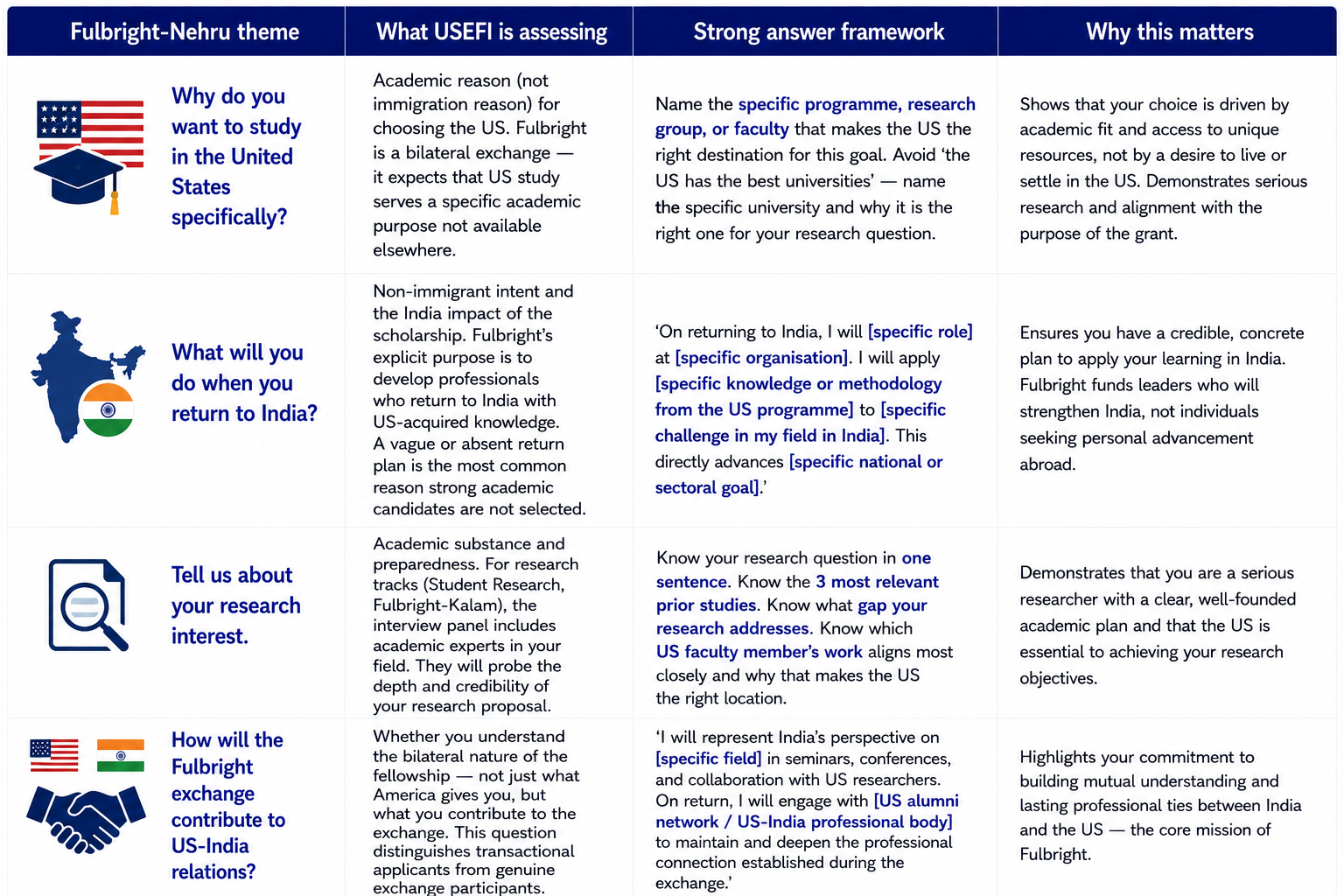
The Fulbright-Nehru interview is conducted by the United States-India Educational Foundation (USEFI). The interview panel typically includes American and Indian academics and professionals. The interview assesses academic preparation, genuine interest in the US programme, and — critically — what you will do when you return to India. This is the single most important dimension of the Fulbright-Nehru interview, and the most common weakness in Indian applicants' answers.
⚠️ The return-to-India question is not optional for Fulbright
Fulbright-Nehru is a bilateral exchange programme funded by both the US and Indian governments. Its explicit purpose is to develop US-India professional and academic connections. A candidate who cannot answer 'What will you do when you return to India?' with a specific, credible plan does not meet the programme's core purpose — regardless of academic excellence. Prepare this answer as the centrepiece of your Fulbright interview preparation, not as an afterthought.
DAAD Research Grant Interview — Academic Rigour and Supervisor Alignment
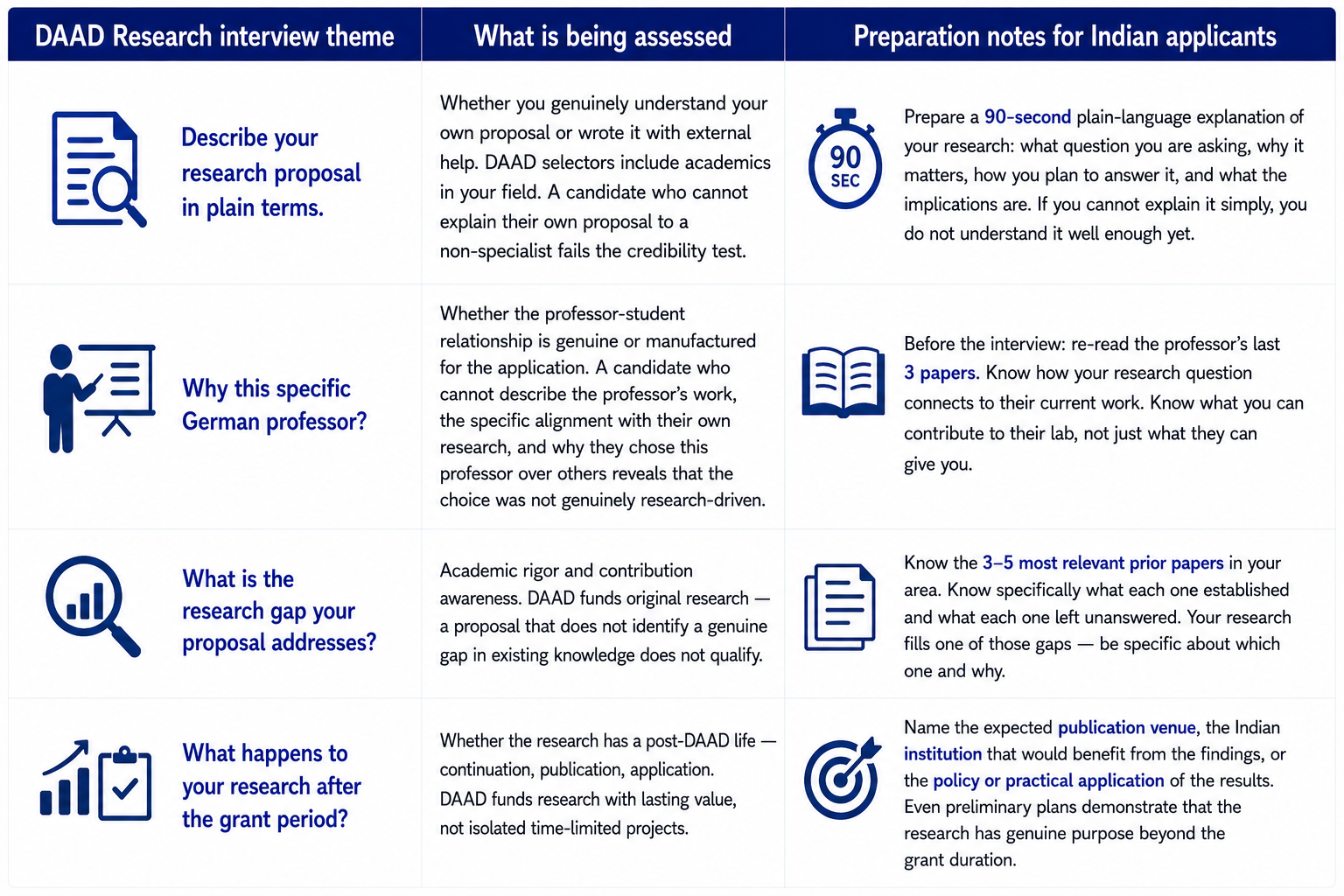
DAAD Research Grant interviews are conducted by academic panels that include subject-matter experts in your field. The interview is more academically rigorous than Chevening or Fulbright — the panel will probe the substance of your research proposal, not just your leadership narrative. A candidate who applied with a compelling proposal but does not genuinely understand it will be identified immediately.
✅ The DAAD interview is a research supervision meeting
Think of the DAAD interview as a first meeting with a potential research supervisor — because that is effectively what it is. The panel wants to know: do you understand your own research question, have you done the literature, and would working with you be productive? Candidates who have done genuine prior research and genuinely understand their proposal are typically comfortable in this setting. Candidates who wrote a polished proposal without that foundation are exposed quickly.
General Scholarship Interview Tips — Principles That Apply Everywhere
The pause before answering is professional, not hesitant
Indian interview culture sometimes creates a sense that silence is a weakness — that you should answer immediately to demonstrate confidence. In scholarship interviews, a 2–3 second pause to consider a complex question signals thoughtfulness, not hesitation. Panel interviewers are experienced readers of body language. A candidate who takes a moment, then gives a specific, well-reasoned answer, demonstrates cognitive quality. A candidate who responds immediately with a generic answer demonstrates neither.
Answer the question asked, then stop
One of the most consistent patterns in weak interview performances is over-answering — providing so much information that the original answer is buried, or continuing to talk until a good answer becomes diluted. Scholarship interview panels have 30 minutes and 6–8 questions. A candidate who takes 8 minutes on the first question is not demonstrating depth — they are demonstrating poor communication skills. Answer the question. Then stop. Let them ask the follow-up if they want more.
Disagree respectfully if the interviewer says something incorrect
Some scholarship interviewers deliberately test candidates by saying something factually incorrect or expressing an opinion that contradicts your stated position. They are testing whether you will capitulate under social pressure or maintain your position respectfully. The correct response is polite disagreement: 'With respect, I think the data shows a different picture — specifically, [evidence]. I understand why that interpretation is common, but my view is...' Agreeing with everything the interviewer says does not demonstrate leadership. Respectful, evidence-based disagreement does.
Physical presence matters
For in-person interviews: arrive 10–15 minutes early. Dress formally. Make eye contact with each panel member when answering — not just the person who asked. Do not cross your arms. Do not look down when speaking. For online interviews (now common for Chevening UK regional interviews and some Fulbright rounds): test your audio and video connection the day before. Ensure your background is neutral and well-lit. Position the camera at eye level — a laptop on a table with the camera angled up is immediately apparent and creates a poor impression. Wear the same clothes you would wear to an in-person interview.
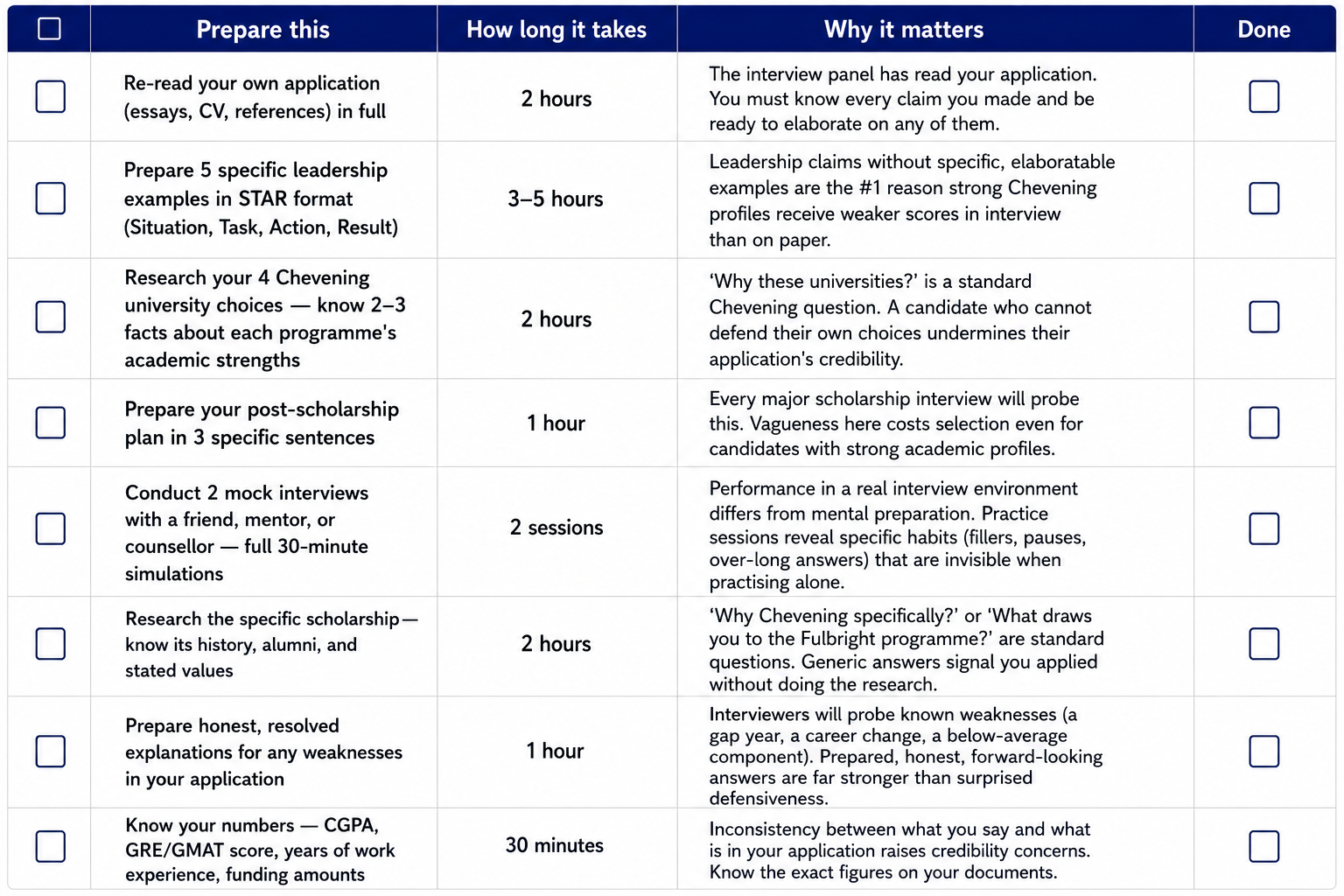
Pre-Interview Preparation Checklist
Use this checklist in the two weeks before your scholarship interview. The time estimates are realistic — do not compress this preparation into the day before.
💡 Mock interviews are the most undervalued preparation tool
Most scholarship candidates prepare for interviews by thinking about their answers, not by speaking them. The two activities produce very different results. A student who has rehearsed answers mentally and then speaks them aloud for the first time in a real interview will be surprised by how differently they come out — more hesitant, more hedged, more vague than they sounded in their head. Two full mock interviews with a qualified reviewer who gives specific feedback on answer quality, language, and presentation are worth more than 20 hours of solo mental preparation.
Frequently Asked Questions
I was told my Chevening interview went badly. Can I give feedback or appeal?
Chevening does not provide individual interview feedback to unsuccessful candidates, and there is no formal appeal process for interview-stage decisions. The decision is final for that cycle. However, Chevening actively encourages reapplication — many successful scholars applied 2–3 times before being awarded. An unsuccessful interview is a data point, not a permanent verdict. In the next cycle, request an honest debrief from whoever conducted your mock interview — not from the Chevening panel — and identify what you can specifically strengthen.
My Fulbright-Nehru interview is online. Is online harder than in-person?
Neither format is inherently harder. Online interviews remove the subtle social dynamics of a shared physical space — which some candidates find easier (less performance anxiety) and others find harder (harder to read the room). The preparation principles are identical. Additional online-specific preparation: test your audio and video quality with a friend using the exact setup you will use for the interview. Technical issues in the first 2 minutes of an online interview create a difficult recovery
The interviewer asked about something not in my application. What do I do?
Answer as fully and honestly as you can. Scholarship interviews are not exclusively about the application — the panel is assessing you as a person, not just verifying your written claims. If a question takes you genuinely off-script, that is often a positive sign: the interviewer found something interesting and wants to explore it. Answer from your actual knowledge and experience. Saying "That is a great question — I have not written about this specifically, but my thinking is..." is a completely legitimate response.
How long should my answers be?
For behavioural questions (tell me about a time when...): 90 seconds to 2 minutes per answer is the target. Enough to cover Situation, Task, Action, and Result without padding. For opinion questions (why Chevening, why UK): 60–90 seconds. For factual questions (describe your research): 2–3 minutes for a research overview. The general rule: when you have finished making your point, stop. The follow-up question will give you the opportunity to elaborate if the panel wants more.
Scholarship interviews are not primarily tests of knowledge or vocabulary. They are tests of authenticity, specificity, and preparation. The candidates who succeed are those who have thought carefully about their own career, their own leadership, their own post-scholarship plans — and who can describe all of it in specific, concrete terms to a panel who has heard a hundred vague versions of the same claims. The preparation for that is not in memorising answers. It is in living the reflection that makes specific answers possible.