Step-by-Step Counselling Process at Vidysea: From Your First Question to the Day You Board Your Flight
Most Indian students and families begin the study abroad journey in one of two ways: overwhelmed by options and unsure where to start, or confident they know what they want but unsure whether that choice is actually right for their profile and goals. Vidysea's counselling process is designed to serve both starting points — and the 12-step journey from the first free session to post-arrival check-in is the same regardless of where you begin.

Team Vidysea
June 2, 2026

This guide maps the complete Vidysea counselling process step by step: what happens at each stage, who leads each step, what you receive as a deliverable, and when in the study abroad journey each step falls. It also covers the 10 key milestones that measure progress, the timeline view of when each step should happen relative to your target intake, and the clear division of responsibilities between what Vidysea leads and what the student leads — because good counselling supports your decisions, it does not make them for you.
⭐ The process in one sentence
Vidysea's counselling process takes a student from 'I want to study abroad' to 'I have my visa and I know what to do when I land' across 12 structured steps — with a clear deliverable at each step, a specific timeline for each stage, and honest handoffs between what the counsellor provides and what the student must do themselves.
The Complete 12-Step Vidysea Counselling Process
Every step in the process below has a named deliverable — something specific you receive at the end of that stage, not a general conversation. Steps 1, 9, and 11 (first session, visa document review, and pre-departure briefing) are available as standalone sessions for students who only need specific support. Steps 2–8 form the full application preparation journey:
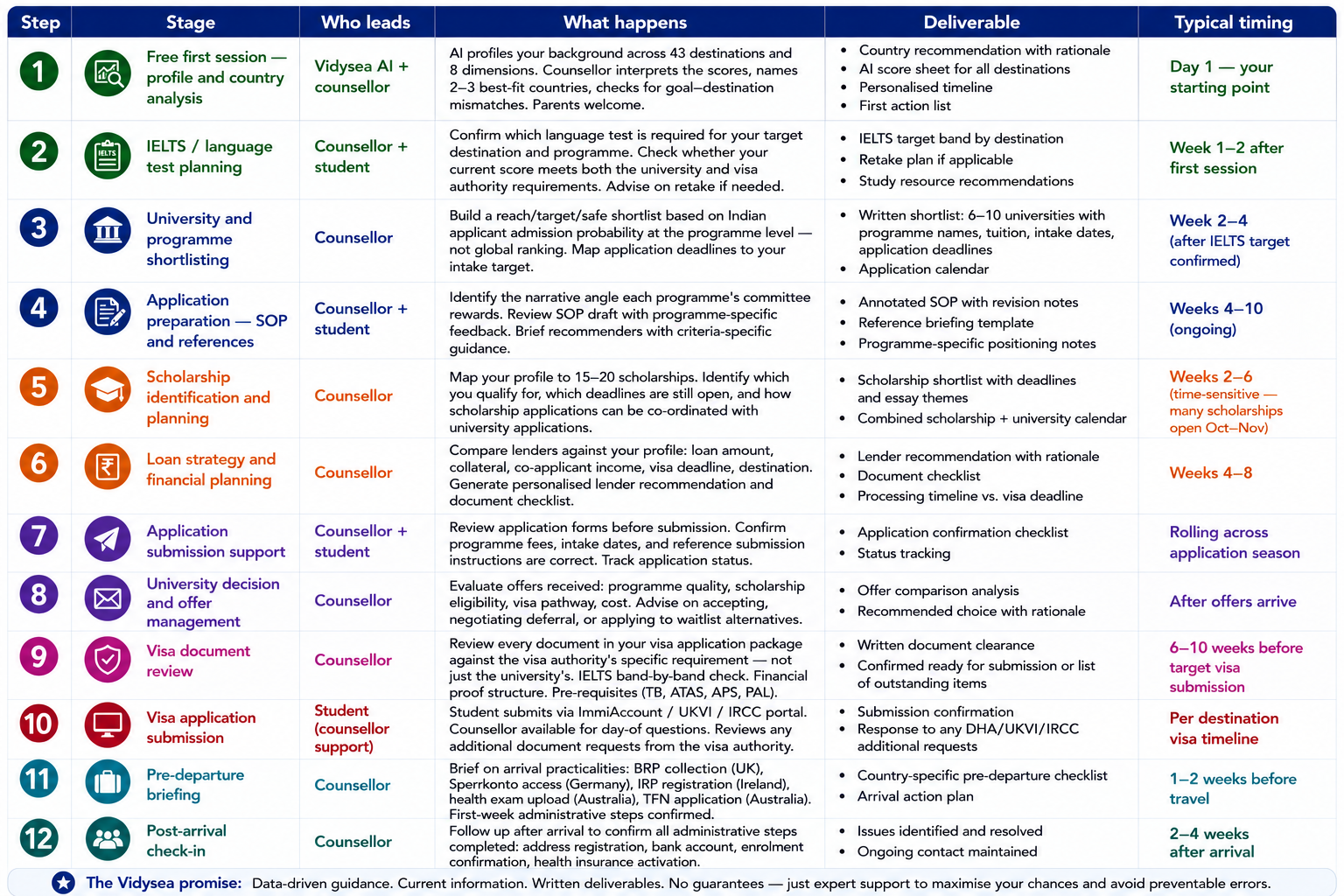
✅ You do not need to use all 12 steps
Some students engage Vidysea only for the first session and the visa document review. Others work through every step from country selection to post-arrival check-in. The right level of engagement depends on where you need guidance and where you are confident to proceed independently. No step is mandatory beyond the first session — each subsequent step can be booked individually based on where you are in your journey.
Each Step — What It Involves and Why It Matters
Step 1 — Free First Session: Profile and Country Analysis
This is where every student starts, regardless of how far along in their thinking they are. The first session uses Vidysea's AI profiling tool to score your profile across 43 destinations on 8 dimensions — admission fit, visa difficulty, PR timeline, salary potential, cost of study, policy stability, field strength, and budget fit. The counsellor interprets the scores, identifies goal–destination mismatches, and recommends 2–3 best-fit countries with specific rationale.
The session takes 30 minutes. No documents are needed. The AI score sheet and country recommendation are emailed to you after the session. This is the foundation on which every subsequent step is built — choosing the right country first prevents cascading errors in university selection, visa planning, loan structure, and scholarship targeting.
Step 2 — IELTS / Language Test Planning
Once the target destination is confirmed, the counsellor verifies the exact language test requirements: which test (IELTS Academic, PTE, TOEFL, TestDaF), what score is needed for both the university and the visa authority, whether your current score meets requirements, and whether a retake is needed before your target application deadlines.
This step is frequently underestimated. The most common avoidable visa refusal cause for Indian students is an IELTS band score that meets the university's requirement but not the visa authority's. Catching this in Step 2 — not after visa submission — protects the entire downstream timeline.
Step 3 — University and Programme Shortlisting
The counsellor builds a reach/target/safe shortlist based on Indian applicant admission probability at the programme level — not global ranking. This is the critical distinction: a top-50 globally ranked university may have a very low acceptance rate for Indian applicants in your CGPA bracket at a specific department, while a top-100 university has a higher rate. The shortlist reflects this real pattern, not the public ranking.
The shortlist includes 6–10 universities with programme names, tuition fees, intake dates, and application deadlines. An application calendar maps these deadlines to your target intake — so you know exactly which applications must be submitted first and when.
Step 4 — SOP and Application Preparation
The counsellor identifies the narrative angle each programme committee rewards based on admitted-student patterns. This is different for different programmes — an SOP for a TU Munich MSc in CS should emphasise different elements than an SOP for UNSW's Master of Data Science, even if both are engineering programmes at strong universities.
The counsellor reviews your draft SOP with specific, programme-referenced feedback. The reference briefing template tells each recommender what to cover — based on that scholarship's or programme's stated criteria — rather than leaving them to write generically.
Step 5 — Scholarship Identification and Planning
This step is the most time-sensitive in the process. Chevening, DAAD, Commonwealth, and Gates Cambridge all have October–November deadlines — requiring preparation to begin 6–8 months before. The counsellor maps your profile to 15–20 scholarships, identifies eligibility, and builds a co-ordinated scholarship + university application calendar.
A scholarship worth Rs. 50–80L in tuition and living costs, identified and applied for in time, represents a return on the counselling engagement that dwarfs every other value delivered in the process. The students who miss Chevening in November because they found out in December have lost a year — not just a deadline.
Step 6 — Loan Strategy and Financial Planning
The counsellor compares 8+ lenders against your specific profile: loan amount, collateral availability, co-applicant income type (salaried vs. self-employed), visa deadline, and destination-specific financial proof requirements. The output is a personalised lender recommendation — not a generic 'try SBI or HDFC Credila' — with a document checklist and a realistic processing timeline against your visa deadline.
Step 7 — Application Submission Support
The counsellor reviews application forms before submission: programme selection is correct, fee payment details are right, reference submission instructions are followed. For students applying to multiple universities across multiple countries, tracking deadlines and requirements across 6–10 simultaneous applications is where errors and missed deadlines most commonly occur.
Step 8 — University Decision and Offer Management
When offers arrive, the counsellor provides a structured analysis: which offer best fits your profile, scholarship eligibility, visa pathway, programme quality, and post-graduation employment market. If you have been waitlisted, the counsellor advises on whether to stay on the waitlist or proceed with an alternative. If you are considering deferring for a year, the counsellor maps the implications for visa timeline, scholarship cycles, and loan disbursement.
Step 9 — Visa Document Review
Every document in your visa application package is reviewed against the visa authority's specific requirement — not just the university's. IELTS bands checked individually against UKVI minimum. Financial proof structure confirmed for the 28-day rule (UK), Sperrkonto (Germany), or EL3-credible documentation (Australia). TB test, ATAS, APS, PAL, or OSHC confirmed as applicable. Form fields cross-checked against passport for name consistency.
This step prevents the most expensive errors in the process. A UK visa refusal due to IELTS Writing at 5.0 costs: £490 non-refundable fee + IHS repayment + 6-month intake delay. Catching it in Step 9 costs nothing.
Step 10 — Visa Application Submission
The student submits the application through the relevant portal (ImmiAccount for Australia, UKVI for UK, IRCC for Canada, German consulate appointment for Germany). The counsellor is available for day-of questions and reviews any additional document requests from the visa authority promptly — because every day of delay in an ADR response adds a day to the processing timeline.
Step 11 — Pre-Departure Briefing
Once the visa is granted and travel is confirmed, the counsellor conducts a destination-specific pre-departure briefing: what to do in the first 48 hours, the first week, and the first month. UK: BRP collection from the named post office within 10 days of arrival. Germany: Anmeldung (address registration) within 14 days. Ireland: IRP registration within 90 days. Australia: health exam upload and enrolment confirmation. Students who arrive knowing these steps handle the transition significantly more smoothly than those who discover them on landing.
Step 12 — Post-Arrival Check-In
2–4 weeks after arrival, the counsellor checks in to confirm all administrative steps have been completed: address registered, bank account open, BRP collected, Sperrkonto activated, enrolment confirmed, health insurance activated. Issues identified at this stage are still addressable — issues discovered 3 months later are often not.
10 Key Milestones — Your Progress Checklist
These 10 milestones mark the critical gates in the study abroad journey. Completing each unlocks the next stage. Missing any causes downstream delay:
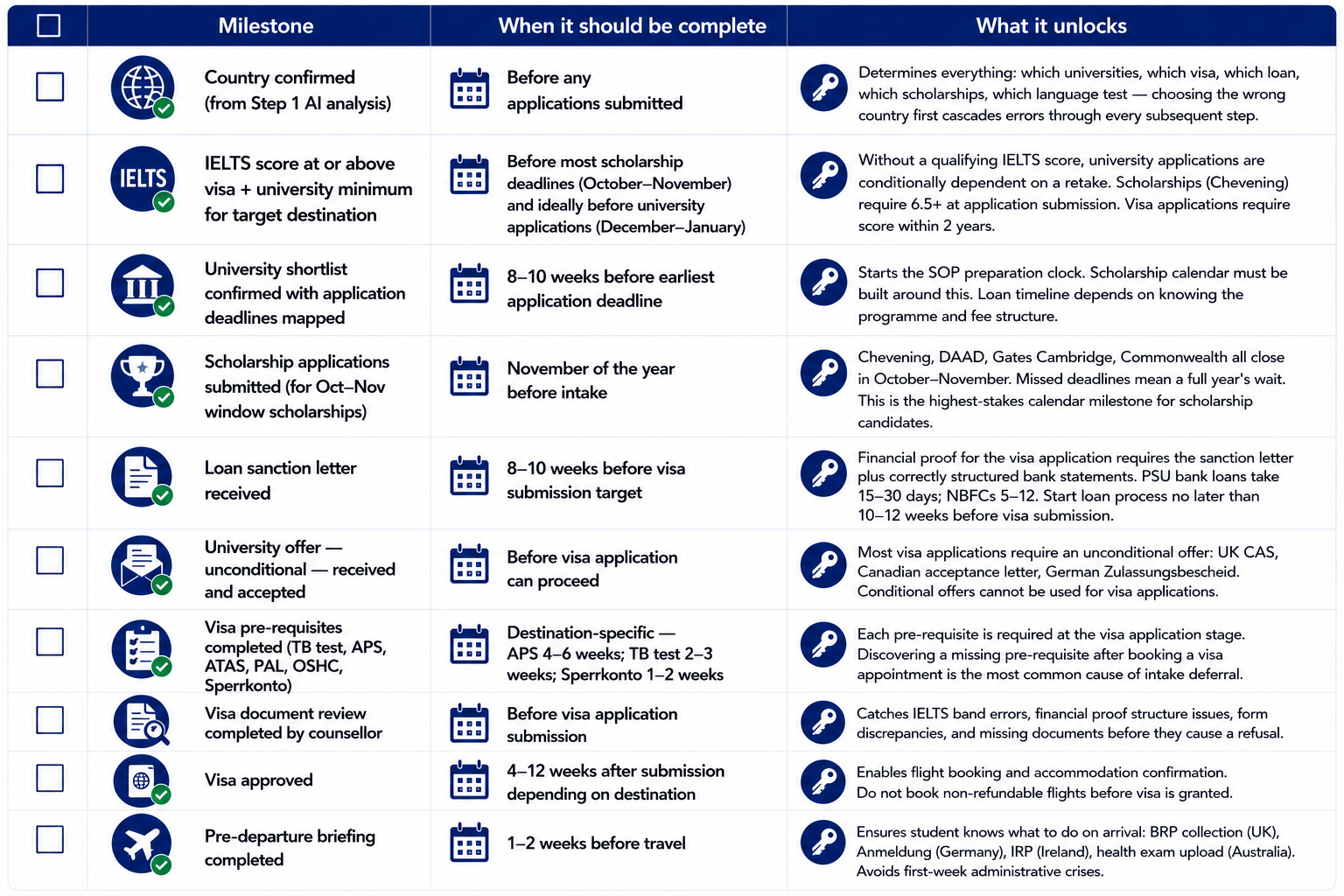
💡 The milestone that most commonly causes intake deferral
Missing the visa pre-requisites milestone (TB test, APS, ATAS, PAL, OSHC, Sperrkonto) is the single most common cause of students deferring to the next intake. Each pre-requisite has a processing time that cannot be compressed: APS (Germany) takes 4–6 weeks. TB test booking at an approved clinic takes 1–2 weeks. ATAS (UK STEM subjects) takes up to 30 business days. Students who discover these requirements after booking their VFS appointment or consulate appointment are already in a crisis timeline.
What Vidysea Leads vs. What You Lead
Clear role separation is the foundation of an effective counselling relationship. Here is exactly what Vidysea is responsible for and what the student is responsible for:
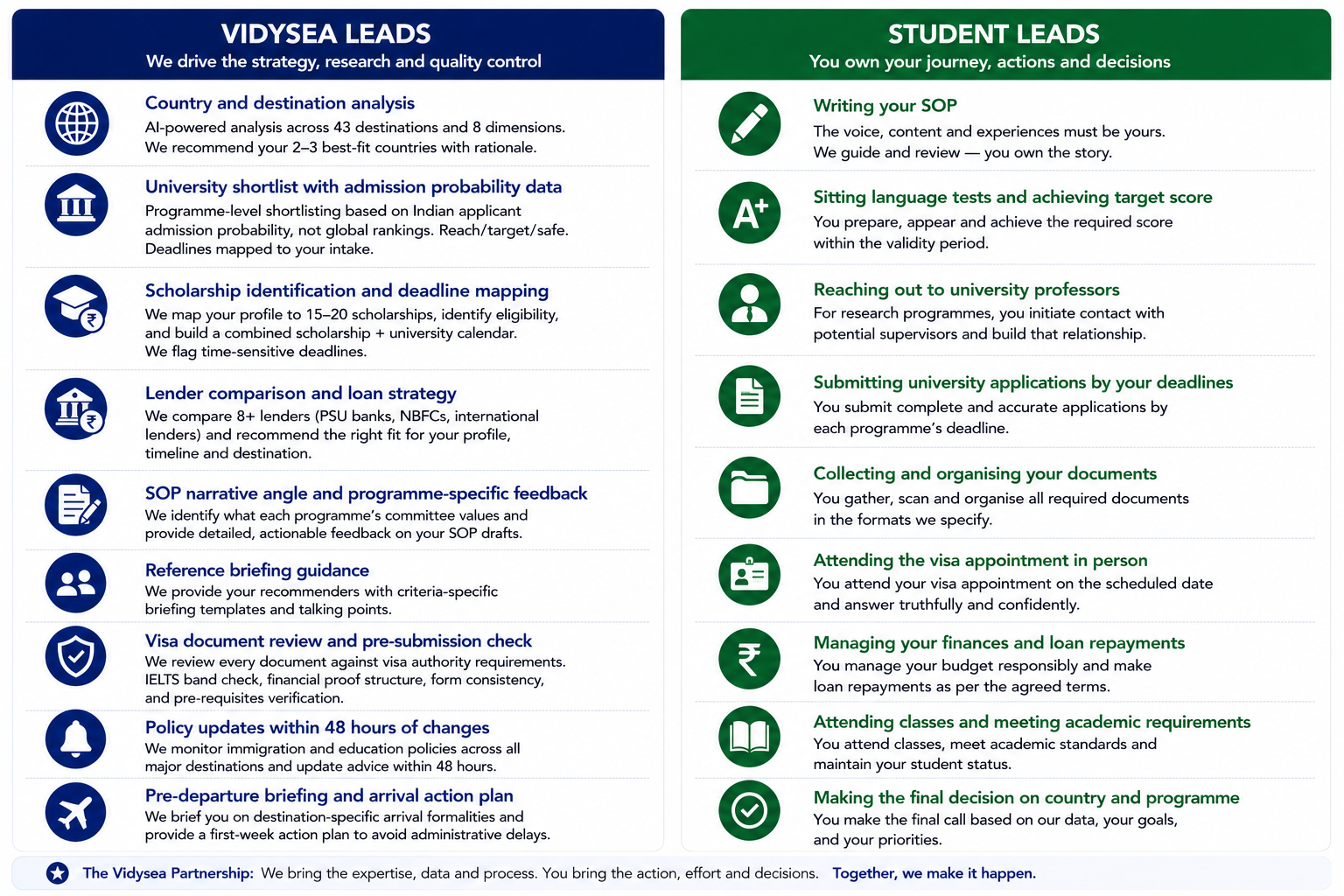
✅ The most important thing on the student side: the SOP
The SOP — Statement of Purpose — is the single most consequential document in a university application, and it must be written by the student. Not because of policy, but because an admissions committee can identify a counsellor-written SOP in the first paragraph, and the discovery is more damaging to the application than a weaker student-written essay. Vidysea's role is to tell you what angle to take, what to include, what to cut, and what the committee is looking for. Your role is to write it in your own voice, from your own experiences.
Timeline Overview — When Each Step Happens
This is the macro timeline for a student targeting September 2026 intake starting the process in early 2025. For other intake targets, compress or extend proportionally:
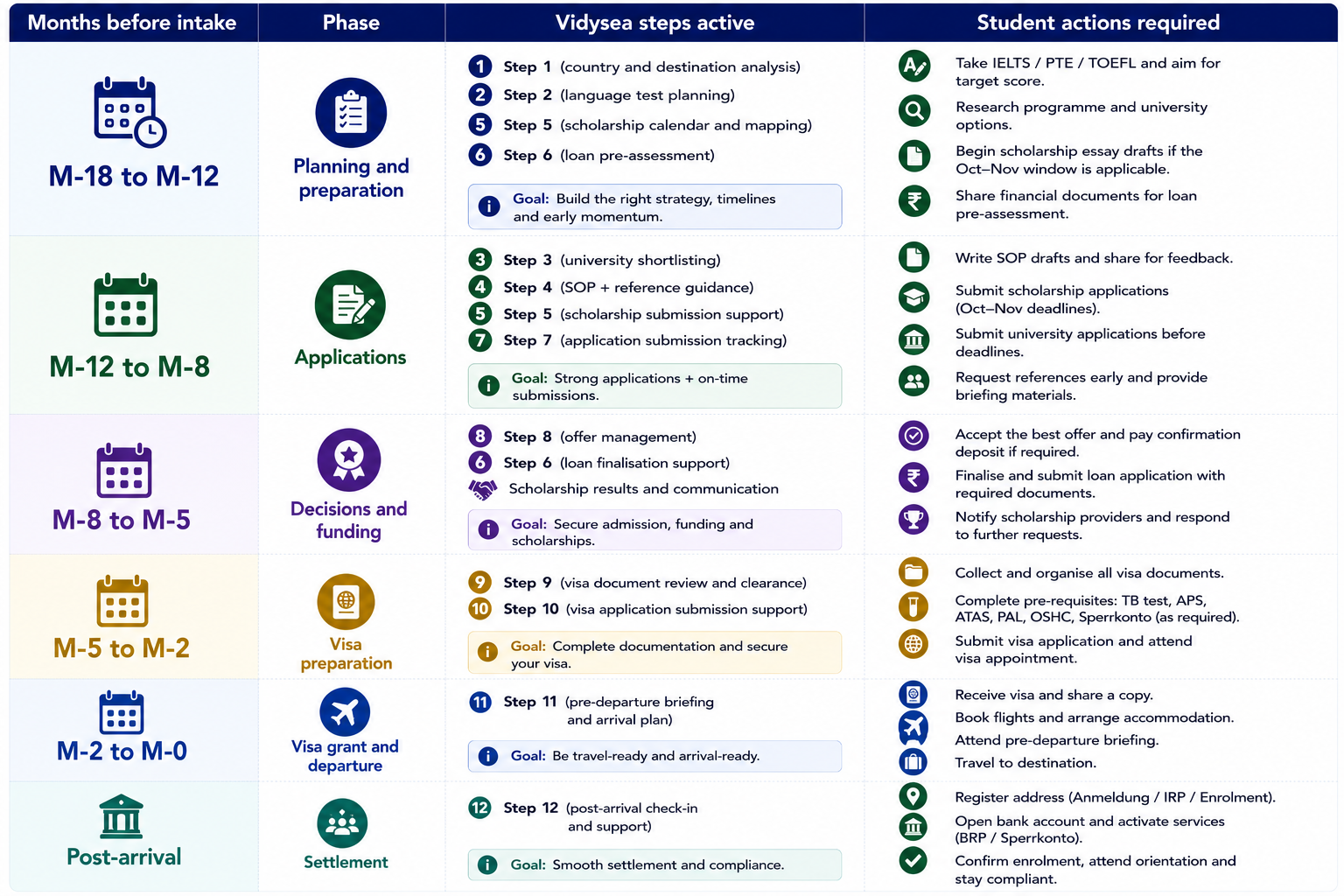
💡 Starting late — what to do if you are already inside 6 months
Students who start the counselling process less than 6 months before their target intake are in a compressed timeline — manageable but requiring immediate prioritisation. The three most urgent steps: Step 1 (country confirmation) to prevent late course corrections, Step 9 (visa document review to check nothing is missing), and Step 6 (loan strategy, since NBFC quick loans can be obtained in 5–12 days but PSU bank loans need 15–30 days). Scholarship applications for the current cycle are likely closed — but the counsellor can identify whether any rolling deadlines remain open.
Frequently Asked Questions
At what point in my planning should I start the Vidysea process?
The earlier the better — and earlier than most families think is necessary. The ideal starting point is 18 months before your target intake: enough time to prepare IELTS, identify and apply for scholarships in the October–November window, shortlist universities, write and revise SOPs over multiple drafts, and process a PSU bank loan if property is available. Students who start 6 months before their target intake can still manage the core process — but scholarship options narrow significantly, and the PSU bank rate advantage becomes harder to access if the loan timeline is too tight.
Does the counselling process change for working professionals vs. fresh graduates?
The 12 steps are the same, but the emphasis shifts for working professionals. The loan serviceability analysis (Step 6) accounts for existing income and liabilities. The SOP narrative (Step 4) emphasises career progression and professional motivation more heavily. Scholarship eligibility (Step 5) opens up for programmes like Chevening (2+ years of work experience required). The timeline may be compressed around work schedules. The counsellor adjusts the pacing and focus of each step based on whether the student is a fresh graduate or a working professional — but the deliverables are the same.
What happens if I change my mind about the country after Step 1?
It happens — and it is fine. If new information (a policy change, a scholarship outcome, a family development) causes you to reconsider your country choice after Step 1, the counsellor runs the AI analysis again for the new destination and rebuilds the plan from that point. Steps 3 onwards (university shortlisting, SOP, loan, visa) are destination-specific — a country change after Step 3 effectively restarts those steps. This is why Step 1 is the most important step to get right: it is cheaper in time and effort to change direction at Step 1 than at Step 7.
The Vidysea counselling process is a 12-step journey with a clear deliverable at every stage — not an open-ended relationship where advice flows in one direction and outcomes are uncertain. Every step has a defined purpose, a named output, and a specific position in the timeline. The students who complete this process successfully are not those with the strongest profiles or the largest budgets — they are the students who started early, followed the steps in order, and acted on the specific guidance at each stage rather than waiting until the next problem became urgent.