Student Visa Interview Questions and How to Answer Them — Guide for Indian Students 2026
The US F-1 consular interview takes 2–10 minutes. The German consulate appointment takes 10–20. In that window, a single answer — delivered with vagueness, contradiction, or the wrong intent signal — can end a study abroad plan that took 18 months to build. Student visa interviews are not testing your English, your knowledge of your subject, or your enthusiasm for study abroad. They are testing one thing: whether your stated purpose is your real purpose. The officer has read thousands of applications from Indian students who wanted to immigrate to the US, UK, or Germany under the cover of a student visa. The questions they ask are designed to identify candidates whose primary goal is residency, not education.

Team Vidysea
May 20, 2026

This guide covers every major student visa interview question asked of Indian applicants at US, German, and other consulates — with specific strong answers, specific weak answers, and the officer's actual reasoning behind each question. It also covers the seven red flag answers that trigger refusal regardless of how strong your documents are. Use it as guidance for study abroad interview preparation — not just to know the questions, but to understand the logic so you can answer any variant fluently.
💡 Which countries require an interview — and which don't
USA (F-1): interview is mandatory for almost all applicants at a US Consulate in India. Germany: consulate appointment is a brief in-person interview. UK: no standard interview — UKVI processes without one, but you must be prepared if called. Canada: IRCC assesses online, no interview except occasionally at port of entry. Australia: no interview — but the GTE statement functions as a written interview and must be prepared with the same care. Singapore: no interview — ICA processes via SOLAR.
Interview Requirements by Country
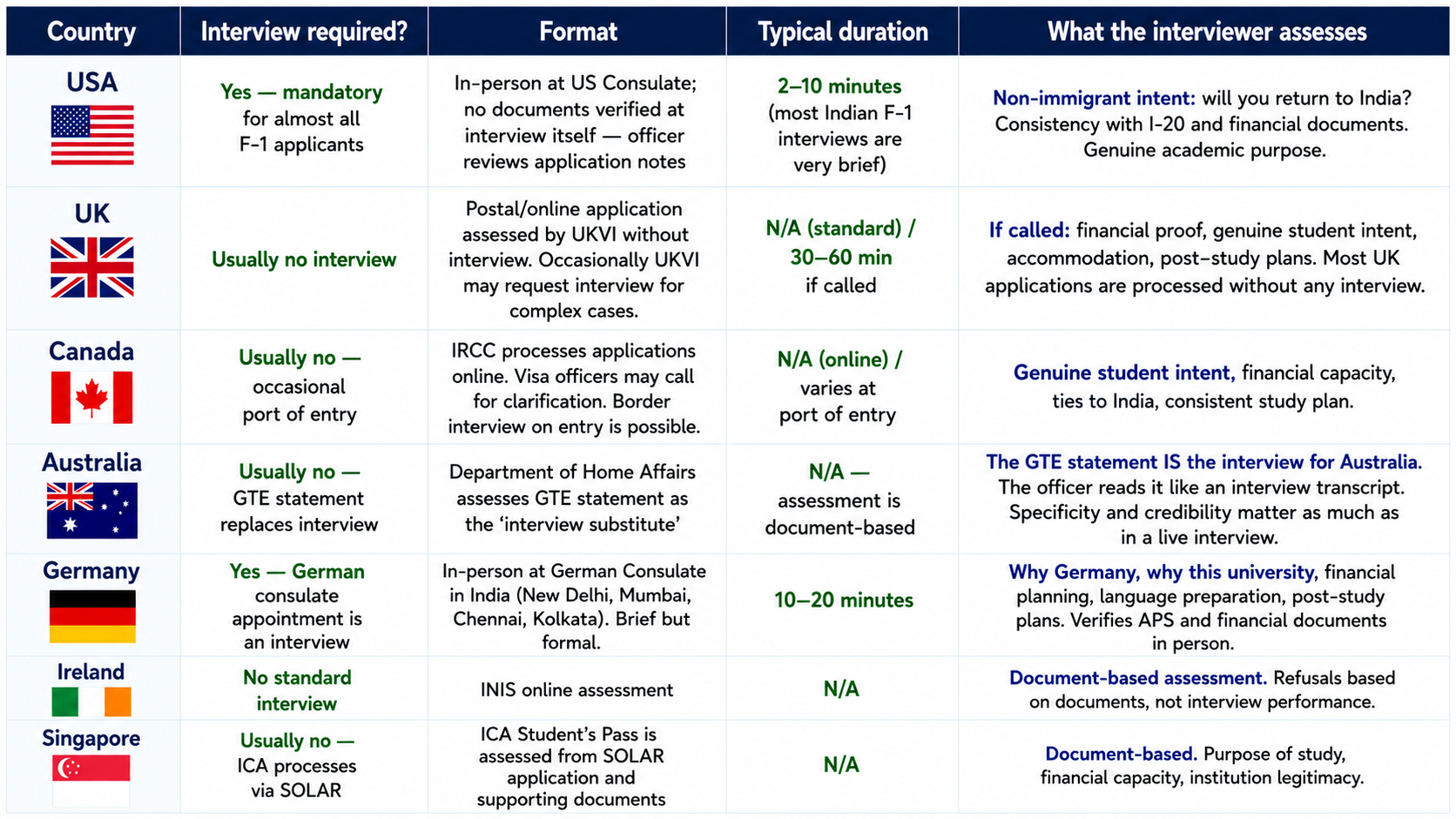
⚠️ Australia's GTE statement is a written interview — treat it as one
The Genuine Temporary Entrant (GTE) statement for Australian student visa applications is assessed by a visa officer with the same scrutiny as a live interview. Vague, generic, or inconsistent GTE statements are the primary cause of Australian student visa refusals for Indian applicants in 2026 (Evidence Level 3 post-reclassification). Every principle in this guide about strong vs. weak answers applies to the GTE. Write your GTE as if you were answering live interview questions: specific, consistent, credible, and with a clear return plan.
The Core Interview Questions — Strong Answers vs. Weak Answers
Every student visa interview, regardless of destination, covers the same six themes. Here are the most common questions within each theme — with strong answers, weak answers, and what the officer is actually assessing:
Theme 1: Why this programme and why this university?
Q: Why did you choose this specific programme at this university?
Why the officer asks this:
The officer is checking whether your choice is genuine and researched. A student who genuinely wants to study this programme can describe it specifically. A student who applied because 'it was available' cannot.
✅ Strong answer
"I chose the MSc Computer Science with Specialisation in Machine Learning at the University of Edinburgh specifically because of the School of Informatics' research strength in natural language processing — I read Professor [Name]'s work on [specific topic] and this programme includes a research project in that area. I compared several UK and European programmes and Edinburgh offered the closest alignment to my long-term goal of building NLP applications for Indian regional languages."
🔴 Weak answer
"It is a good university with a strong reputation and offers the course I want."
What the officer looks for:
Specificity about the programme curriculum, faculty, or research area. A logical connection between this programme and your previous education. Evidence that you compared options and chose this one for academic reasons, not just visa accessibility.
Q: Why this country for your studies?
Why the officer asks this:
For F-1/USA: the officer is partly testing immigrant intent. A student who says they chose the USA because of 'opportunities' is a weaker answer than one who can cite academic reasons for a specific US institution or programme. For German consulate: shows you have done research beyond just applying.
✅ Strong answer
"The UK specifically offers the 1-year MSc format, which means I can complete a postgraduate qualification in a focused year and return to India with applicable skills. Germany offers world-class engineering education at minimal tuition cost, which makes the investment proposition stronger. I researched the industry ties of this programme — [University]'s placement partnerships with [companies] are directly relevant to the work I intend to do."
🔴 Weak answer
"Because it is one of the best countries for education."
What the officer looks for:
Academic or programme-specific reasons for the destination. Awareness of the post-study plan relative to the destination country. For non-immigrant destinations (USA): evidence that academic reasons — not immigration — drive the choice.
Theme 2: Your academic background and preparation
Q: Why are you applying for a Masters / PhD when your undergraduate degree is in a different field?
Why the officer asks this:
Field changes require explanation. Without one, they suggest indecision, confusion about study goals, or that the programme is a vehicle for something else.
✅ Strong answer
"My undergraduate degree in Electronics Engineering gave me a foundation in signal processing that directly informs the computer vision work I now want to pursue. In my final year project I worked on image classification algorithms, which led me to apply for the MSc in Computer Vision. The transition is not a change of direction — it is a logical progression along the same technical axis."
🔴 Weak answer
"I want to try something new. I decided my original field was not right for me."
What the officer looks for:
A coherent academic narrative: how does previous education connect to current programme? Even a change of field should have a logical thread. For research programmes: prior research experience that connects to the proposed topic.
Q: You have a gap of [X months/years] between your degree and this application. What were you doing during that time?
Why the officer asks this:
Gap years without clear explanation signal that the study plan was not genuine from the start. For USA F-1: gaps in academic history are noted and questioned.
✅ Strong answer
"After completing my BE in June 2022, I joined [Company] as a software engineer. Those two years of professional experience working on [specific technology/domain] are directly relevant to the research methods course in my target programme. This was a deliberate plan — I wanted professional experience before undertaking a research-oriented degree."
🔴 Weak answer
"I was just trying to decide what to do next. I took some time off."
What the officer looks for:
A specific, honest account of what was done during the gap and how it connects to the study plan. Work experience, family obligations, health — all are acceptable if explained specifically and connected to the current application.
Theme 3: Financial capacity
Q: How will you fund your studies and living expenses?
Why the officer asks this:
Financial vagueness is a major concern. The officer cannot verify 'enough money' without specific documentation. A student who does not know the exact amounts from their own financial documents signals that the documents may not be theirs.
✅ Strong answer
"My tuition fees of [exact amount] are funded through an education loan from [SBI / HDFC Credila / Avanse] — I have the loan sanction letter with me. My monthly living expenses of approximately [£1,300 / €900 / CAD 1,200] will be covered from a combination of the loan disbursement and family savings. My bank statements show the required [£9,338 / €11,904] has been held for the past 28 days."
🔴 Weak answer
"My family has savings and will support me. We have enough money."
What the officer looks for:
Exact figures that match the documents. Knowledge of the specific financial requirement for the destination (UK 28-day rule, German blocked account). Named funding sources. Consistency between spoken answer and documents in the folder.
Q: Your bank statement shows a large deposit [X weeks] before this application. Where did these funds come from?
Why the officer asks this:
Sudden large deposits without documented source are a red flag for manufactured financial proof. This question directly tests whether the financial documentation is genuine.
✅ Strong answer
"That deposit is the disbursement from my education loan with [Bank/NBFC]. I have the loan sanction letter and disbursement confirmation showing the transfer from the lender. The funds were credited on [date] and have been in the account since."
🔴 Weak answer
"That is from my family. They deposited money to help me."
What the officer looks for:
Specific, verifiable explanation. A loan disbursement with supporting documentation is a clean answer. A family transfer requires the family member's bank statement showing the source of transferred funds. Vague family explanations without documentation are problematic.
Theme 4: Post-study plans and return intent
Q: What will you do after completing your studies? (USA F-1 critical question)
Why the officer asks this:
For USA F-1: this is the single most important question. Non-immigrant intent must be established. The officer is asking: will you leave when your visa expires? A vague or immigration-suggestive answer here causes refusal.
✅ Strong answer
"After completing my MSc in Data Science, I plan to return to India and join the data science team at [Company I am currently working at / in my target industry]. I have a confirmed leave of absence from my employer and they expect me to return in a senior role after graduation. I also have family obligations in India — my parents are dependent on me — and I have a property loan. My life is firmly anchored in India."
🔴 Weak answer
"I hope to find opportunities abroad and see what happens."
What the officer looks for:
For USA: specific, concrete ties to India — employment, family, financial obligations, property. For UK/Germany: a plausible post-study plan that references return or legitimate post-study work route. The more specific, the more credible. Vagueness signals that no real plan exists because the plan is to stay permanently.
Q: Do you intend to work while studying?
Why the officer asks this:
For UK: students may work up to 20 hours during term — acknowledging this shows awareness of visa rules. Saying you plan to work full-time is incorrect and signals either visa fraud intent or ignorance of conditions. For USA: F-1 students have on-campus work authorisation (20 hours); off-campus work requires CPT/OPT authorisation.
✅ Strong answer
"UK student visa permits up to 20 hours of part-time work per week during term time, and I may take advantage of that to gain UK industry experience, but I understand that this is secondary to my studies and subject to the visa conditions. My primary activity will be the programme — the part-time work limit is something I am aware of and intend to respect."
🔴 Weak answer
"Yes, I plan to work full-time alongside studying to reduce my costs."
What the officer looks for:
Awareness of the work authorisation rules for the destination country. A student who knows the limits demonstrates genuine preparation. A student who claims unlimited work rights shows they have not read the visa conditions.
Theme 5: About your application and documents
Q: Have you ever applied for a visa to any country and been refused?
Why the officer asks this:
Non-disclosure of a refusal is far more serious than the refusal itself — it is treated as deception. If a previous refusal is discovered after non-disclosure, it can result in permanent bars.
✅ Strong answer
"Yes — I was refused a US tourist visa in 2022. The refusal was under Section 214(b) — inability to demonstrate non-immigrant intent at that time. Since then, I have completed my undergraduate degree, gained two years of work experience, and am now applying with a specific academic programme, a confirmed education loan, and documented ties to India. My circumstances have changed significantly."
🔴 Weak answer
"No [when a previous refusal has not been disclosed on the form]."
What the officer looks for:
Complete disclosure. A previous tourist visa refusal is not automatically a bar to a student visa — circumstances change. The officer is testing honesty and whether the previous refusal reason has been addressed. An honest answer with a clear explanation of changed circumstances is handled appropriately.
Seven Red Flag Answers — and How to Fix Them
These are the answers that cause refusals regardless of how strong the documents are. Student visa services professionals who prepare applicants for interviews spend the most time eliminating these patterns:
| Red flag answer | Why it's dangerous | Destination it most affects | Better approach |
|---|---|---|---|
| 'I want to settle abroad after graduation.' | Demonstrates immigrant intent — fatal for F-1 (USA), problematic for UK, Australia, Canada where non-immigrant/temporary intent is required. | USA F-1 (most serious), UK, Australia, Canada | 'I plan to apply what I learn to [specific career goal] in India' — or be honest that you hope for PR and explain the legitimate pathway (UK Graduate Route, Canada study-to-work-to-PR). |
| 'I chose this university because it was the cheapest option.' | Signals poor research and potentially low-quality institution. Officers want to see that you chose based on academic fit, not cost minimisation. | All countries | 'I chose [University] because of its [specific programme strength, ranking in my field, industry connections] — which aligns with my goal of [specific goal].' |
| 'My friend / sibling is already there, so I thought I would go too.' | Suggests your primary motivation is social/family, not academic. Raises questions about whether study is the genuine purpose. | USA F-1, UK, Australia | Mention family connections if relevant but lead with academic reasons. 'My sibling studying there gave me insight into the academic environment, but the primary reason I chose it is...' |
| 'I'm not sure what I'll do after graduation.' | Demonstrates vagueness that undermines genuine student intent. Officers want to see that study serves a specific professional purpose. | All countries | Have a specific answer even if plans may change: 'After graduation, I plan to [specific role/field/industry] in India, applying the [specific skills] from this programme.' |
| 'I haven't read much about the programme yet.' | Signals that the application is not genuinely motivated by academic interest. The officer will question whether you actually want to study there. | USA F-1, UK, Australia | Research your programme before the interview. Know 2–3 specific things about the curriculum, faculty, or research focus that make it the right choice for your goals. |
| Inconsistency between interview and documents | If you say your family income is X and your bank statements show Y, or you describe your programme differently from what the offer letter states, the officer notes the discrepancy and it triggers further scrutiny. | All countries | Review all documents before the interview. Know the exact programme name, start date, duration, fees, and financial proof amounts on your documents. Your answers must be consistent with what is written. |
Pre-Interview Preparation — What to Do Before You Walk In
Interview preparation for a student visa application is not about memorising scripted answers. It is about building the clarity and consistency that allow you to answer any variant of the questions above with the same substance and conviction. These 7 preparation actions produce that clarity:
| Prepare this before your interview | Why it matters | How to prepare |
|---|---|---|
| Know your programme — name, duration, start date, specific modules you plan to take | Officer will ask why this programme and why this university. Vague answers signal lack of genuine interest. | Read your university's programme page. Know 2–3 specific modules, the programme structure, and the faculty/research area that attracted you. |
| Know your financial numbers — exact figures from your documents | Inconsistency between what you say and what is in your documents is an immediate red flag. | Review your bank statements, loan sanction, and I-20/CAS before the interview. Know the total course cost, your funding source, and the exact amount shown in financial documents. |
| Have a clear India return/career plan | USA: non-immigrant intent. UK/Australia: temporary entrant. All: genuine student. | Prepare a 2–3 sentence statement of your post-graduation plan. Be specific: 'I plan to work in [industry] in [city/region] and apply [specific skill from programme] to [specific career goal].' |
| Prepare for the family/sponsor questions | Officers assess whether stated financial sponsors are genuine and capable. | If family is sponsoring: know your parent's/sponsor's occupation, income, and why they can support your studies. Bring sponsor documents mentally reviewed. |
| Know your academic history and any gaps | Officers check for academic inconsistency or unexplained breaks. | If you have a gap year or changed fields: prepare a clear, honest explanation. 'During this period I did X, which led me to decide to study Y' is stronger than vagueness. |
| Practice speaking clearly and concisely in English | For USA: short, direct answers preferred. For Germany: polite, structured responses. | Answer practice questions out loud — not just in your head. Record yourself once. Most students are surprised by how vague their spoken answers are compared to what they meant to say. |
| Know your documents and where each one is | Officers may ask you to reference specific documents. Fumbling with your folder is not a confidence signal. | Organise your document folder in order: I-20/CAS → financial proof → academic documents → language test → passport. Know what is in each section. |
✅ The one-sentence summary that every answer should build toward
Every interview answer, across all themes, should be consistent with a single underlying narrative: 'I am a genuinely qualified student who has chosen this specific programme for specific academic reasons, who is financially prepared, and who has clear plans that involve returning to my home country.' If any answer deviates from this narrative — vague reasons, uncertain finances, unclear return plans — the officer notices. Build the narrative first, then answer the questions.
German Consulate Interview — What Is Different
The German student visa interview is different from the US F-1 in tone and content. The German consulate verifies your documents in person (APS certificate, blocked account, university admission) and asks targeted questions about your study plan. The interview is typically formal, polite, and document-focused — not the adversarial 214(b) scrutiny of an F-1 interview.
Questions specific to German consulate interviews:
- Why Germany specifically — and why this university among German universities?
- Do you speak German? What is your current German language level? (Even for English-taught programmes — demonstrates cultural preparedness)
- How did you confirm that your APS certificate was processed correctly? (Tests that you understand the APS process)
- Where will you live in Germany? Have you researched the cost of living in [city]?
- What is your plan if you cannot find employment in Germany after graduation? (Tests that you have a realistic contingency plan, not just an immigration hope)
For German consulate interviews, study visa consultants who have experience with German consulate appointments in India can provide specific preparation on the document-presentation format, the polite formal register the consulate expects, and the specific questions that have been asked in recent appointment cycles.
Frequently Asked Questions
The officer asked me a question I was not prepared for. What should I do?
Ask for clarification if you did not understand the question. Never guess at an unclear question — it produces inconsistent answers. If you do not know the answer to something specific (e.g., a module name), say so honestly: "I would need to check the exact name, but the module covers..." is better than a wrong answer. The officer is assessing your credibility, not your memory. Honest uncertainty is credible; confident wrong answers are not.
My interviewing officer seemed impatient or negative. Should I change my answers?
No. Visa officer demeanour does not signal the outcome of the interview. Some officers conduct interviews very efficiently and appear neutral or brusque — this is professional style, not a negative judgment of your application. Do not adjust your answers based on perceived officer mood. Answer each question consistently, specifically, and honestly. Students who change answers mid-interview because they think the officer is unhappy often create inconsistencies that are more problematic than the original answer.
I was refused on my first F-1 application. Can I reapply?
Yes — there is no mandatory waiting period for F-1 reapplication. The refusal letter specifies the reason (usually Section 214(b) — failure to demonstrate non-immigrant intent, or Section 221(g) — administrative processing pending). For 214(b) refusals: reapply when your circumstances have materially changed — employment, family ties, property, a different institution or programme. Do not reapply with identical documents and the same answers expecting a different result. For 221(g): follow the administrative processing instruction — your application is still under consideration.
Do I need to memorise answers to a script?
No — scripted answers are counterproductive. Officers are trained to identify rehearsed responses and often ask follow-up questions that a script cannot handle. Student visa assistance from an experienced counsellor builds interview preparation around understanding the logic of each question, not memorising an answer. An applicant who understands why the officer is asking about return intent can answer any variant of the question — whether they ask 'What are your post-graduation plans?', 'Do you intend to stay in the US after your degree?', or 'Why would you come back to India?' — because the underlying answer is the same.
A well-prepared student visa interview is not a performance — it is a consistent, honest account of a genuine study plan. The students who succeed are not those who gave the most polished answers; they are those who knew their own plan well enough to describe it accurately and specifically when asked. That clarity is built through preparation — reviewing your documents, knowing your programme, understanding your financial situation, and having articulated your post-graduation plans to yourself before you articulate them to the officer. Guidance for study abroad that prepares you for the interview is the final step before your study abroad plan becomes a study abroad reality.