

Got dreams to achieve? Hop on as we take you on your journey to success!


Services
Contact Info

Noida office
+91 7428715522Bangalore office
+91 8861432223 support [at] vidysea.com
Copyright@Vidysea
Got dreams to achieve? Hop on as we take you on your journey to success!
Noida office
+91 7428715522Bangalore office
+91 8861432223support [at] vidysea.comCopyright@Vidysea
Canada has consistently ranked as one of the top study destinations for Indian students, and for good reason. With world-class universities, a post-graduation work permit (PGWP) of up to three years, and a clear pathway to permanent residency through Express Entry, Canada offers one of the most comprehensive study-to-settlement pathways in the world. But the student visa application process — officially called the Study Permit — is detailed, document-intensive, and highly sensitive to errors. A wrong photograph specification, an incomplete Statement of Purpose, or a misunderstood IRCC financial requirement can result in refusal even when your admission is fully confirmed.

Team Vidysea
Published Updated

This guide covers the complete Canada study permit process for Indian students in 2025–2026, including every step of the application, the financial proof requirements, document checklist, SDS vs. regular stream, post-study work rights, and the most common refusal reasons — and how to avoid them. Whether you are applying for an undergraduate programme, a Master's, or a PhD, the process is the same. The students who face delays or refusals are almost always making one of a small set of preventable errors. This guide is designed to help you avoid every one of them.
If you want guidance for study abroad that reflects the current 2025–2026 IRCC rules — not outdated advice from old blog posts — this is the complete, accurate resource for Indian students applying for a Canada study permit.
🔴 2025–2026 Canada Study Permit: Key Policy Changes You Must Know. Three significant changes affect Indian students applying now: (1) IRCC has introduced a Cap on International Student Admissions — Canadian universities now operate under a province-wide allocation system, which means not all DLI (Designated Learning Institution) enrolments will automatically receive study permits. Apply as early as possible. (2) The Student Direct Stream (SDS) — the fast-track 20-day processing route — has been paused indefinitely as of November 2024; all Indian applicants are currently processed through the regular stream. (3) Cost of living amounts were updated in 2024: you must demonstrate CAD $10,000 per year (plus tuition) or more, depending on family size. The full policy section later in this guide covers each change in detail.
This is the full student visa application process for Canada. Follow every step in order — each depends on the one before it:
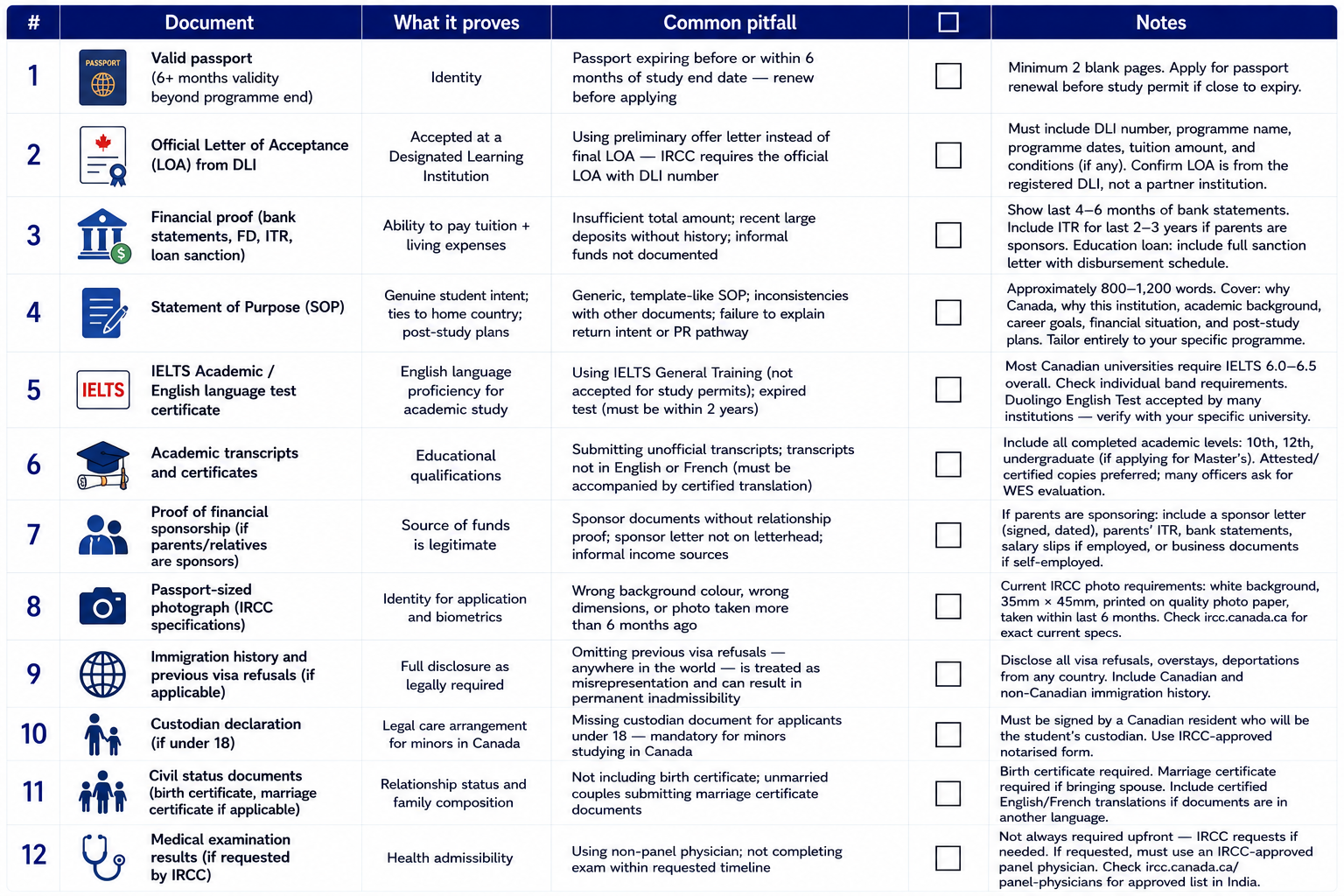
🔴 The SOP is the most underestimated document in the Canada study permit application. Unlike the UK Student visa, which is almost entirely document-verification-based, the Canada study permit involves an immigration officer making a judgment call on whether you are a genuine student who will return to India (or have a legitimate PR pathway). The SOP is where that judgment is made. A generic, template-downloaded SOP that says 'Canada is known for quality education' is the single fastest path to refusal. Your SOP must specifically explain: why this programme at this institution solves a specific career problem you have identified, why Canada (not another destination), what your financial situation is, and what you will do after your studies. Get your SOP reviewed by experienced study visa consultants before submission.
The Student Direct Stream (SDS) was previously Canada's fast-track study permit route for Indian students — offering a 20-business-day processing target versus 8–12 weeks for the regular stream. Under SDS, applicants had to meet stricter upfront requirements (IELTS 6.0 in each band, GIC of CAD $10,000 deposited with an approved Canadian bank, upfront medical exam) in exchange for faster processing.
As of November 8, 2024, IRCC has suspended the Student Direct Stream indefinitely. All Indian students currently apply through the regular stream, with typical processing times of 8–12 weeks from biometrics submission. Student visa assistance from experienced counsellors can help ensure your application is complete and well-structured to minimise processing delays even without SDS.
Canada's immigration policy for international students has changed significantly in 2024–2026. If you are relying on advice or blog posts from 2023 or earlier, you are likely applying based on outdated rules. Here is what study visa consultants and every Indian student applying in 2026 must be aware of:
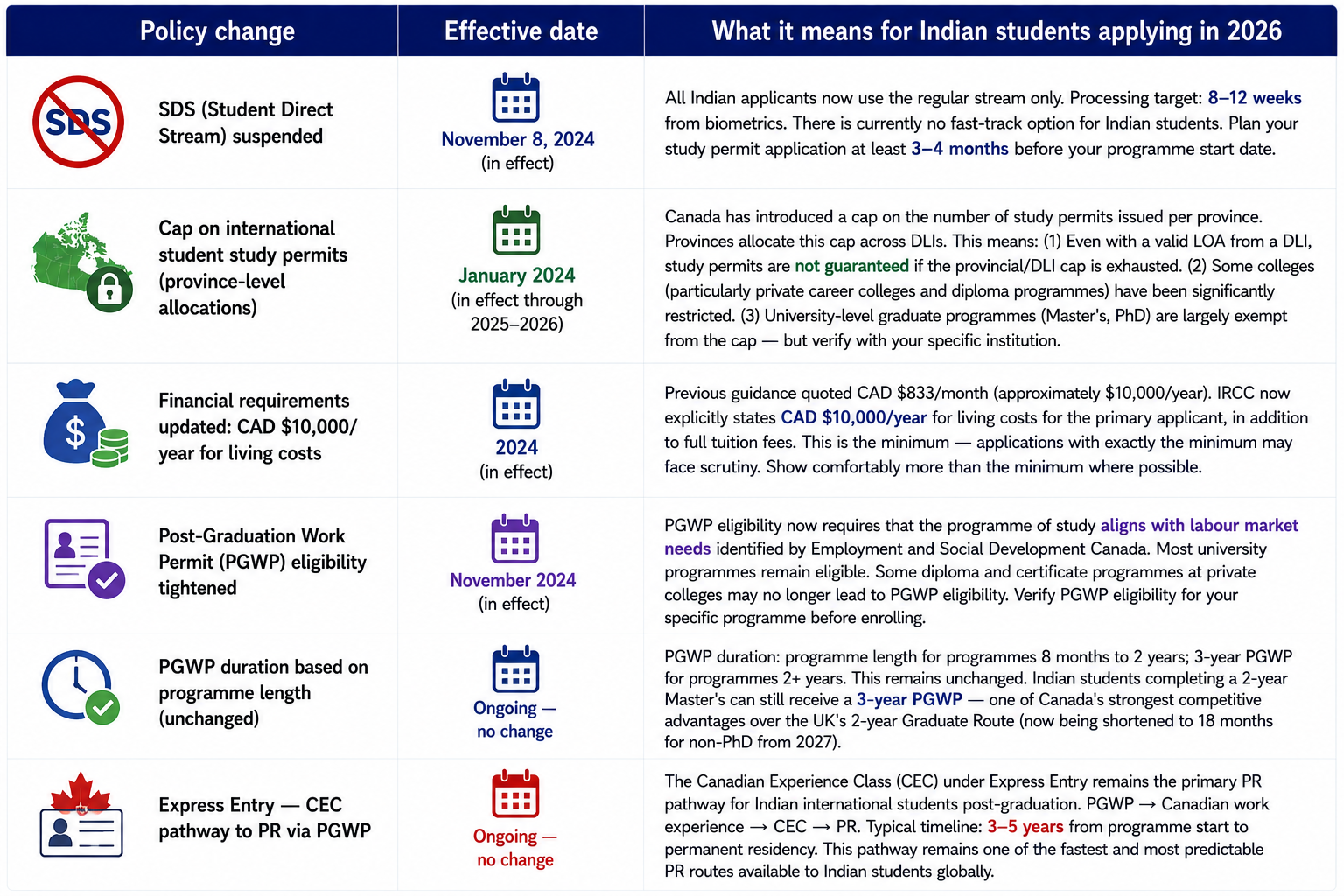
⚠️ The DLI cap and provincial allocation changes make institution selection more important than ever in 2026. Not all DLIs have the same allocation — and a popular college with a high intake of international students may have a lower approval rate as a result of cap constraints. When selecting your Canadian institution in 2026, ask specifically: What is the institution's DLI designation level? Is it a university, college, or private career college? Has the institution communicated any study permit approval challenges to admitted students? University-level Master's and PhD programmes carry significantly lower risk of cap-related refusal than diploma programmes at private colleges.
This is the recommended timeline for an Indian student targeting a September 2026 Canadian intake:
Yes — most international students on a Canadian study permit can work up to 24 hours per week off-campus during academic sessions, and full-time during scheduled breaks (summer, winter, spring break). This is one of Canada's strongest advantages over other study destinations. The work authorisation is automatic — it is printed on your study permit as a condition. Check your study permit conditions on arrival. On-campus work has no hour limit. Work rights do not require a separate work permit for most full-time students at DLIs. Seek student visa assistance if you have questions about work conditions specific to your permit.
The Post-Graduation Work Permit (PGWP) allows international students who complete an eligible programme at a Canadian DLI to work in Canada after graduation — without employer sponsorship. PGWP duration is equal to the length of your study programme (for programmes 8 months to 2 years) or 3 years (for programmes 2 years or longer). A 2-year Master's programme leads to a 3-year PGWP — the maximum. The PGWP is the gateway to the Canadian Experience Class (CEC) under Express Entry, which is the primary pathway to Canadian permanent residency for international student graduates. Verify PGWP eligibility for your specific programme before enrolling, as programme type and institution designation affect eligibility.
A study permit refusal does not permanently bar re-application. The refusal letter will state the specific officer's reasons — typically: (1) insufficient financial proof, (2) weak SOP with inadequate ties to home country, (3) doubt about genuine student intent, or (4) programme does not align with stated career goals. You can submit a new application addressing the specific refusal grounds. There is no appeal process for study permit refusals — the only option is a new application or a Federal Court judicial review (rarely practical). Address every stated reason with new or additional documentation. Vidysea's student visa services include post-refusal analysis and re-application strategy specifically for cases where the initial application failed.
You can legally apply for a Canada study permit yourself — there is no requirement to use study visa consultants. The IRCC online application is publicly accessible and the process is documented at canada.ca. The risk of self-application is the same as any complex document-and-assessment process: a weak SOP, incorrectly structured financial documents, or a misunderstood IRCC requirement can result in refusal. Experienced student visa services typically add value in three specific areas: (1) reviewing and strengthening your Statement of Purpose to address officer concerns before they arise, (2) structuring your financial documents to meet IRCC's expectations clearly, and (3) verifying DLI status and PGWP eligibility for your chosen institution and programme. These are the three most common sources of preventable refusals for Indian students.
As of 2026, with the Student Direct Stream (SDS) suspended, all Indian applicants are processed through the regular stream. Typical processing time from the date of biometrics submission: 8–12 weeks. Processing times are published and updated weekly on IRCC's website at canada.ca/immigration-processing-times. Always build a 3–4 week buffer beyond the published estimate into your planning — IRCC can request additional documents (ADR) at any point, which pauses the clock. Apply at least 4 months before your programme start date to ensure sufficient processing time.
Yes — unlike the UK, which restricts Master's students from bringing dependants, Canada allows most international students (including those on undergraduate and Master's programmes) to bring their spouse or common-law partner and dependent children. Spouses of international students at eligible DLIs can apply for an open work permit — allowing them to work for any Canadian employer without restrictions. Children can attend Canadian schools. This makes Canada significantly more family-friendly as a study destination. Families must apply for their own temporary resident visas or ETAs separately. Guidance for study abroad for families requires planning the spouse work permit and dependent school enrolment alongside the student study permit — start all applications simultaneously.
The Canada study permit process is document-intensive but completely predictable. Every student visa application follows the same structure: confirm a DLI admission, demonstrate financial capacity, write a strong SOP, submit a complete application, and attend biometrics. The students who face refusals are almost always making one of three preventable errors — weak financial documentation, a generic SOP, or failure to verify DLI/PGWP eligibility before enrolling. Start early, follow the checklist, get your SOP reviewed, and structure your financial documents carefully.
With the SDS suspended and provincial caps in place for 2026, the quality of your student visa application matters more than ever. Guidance for study abroad that reflects the current 2025–2026 IRCC rules — not advice from three years ago — is the difference between a smooth approval and an avoidable refusal. Canada's PGWP and Express Entry pathway remain among the strongest in the world for Indian students seeking both education and long-term immigration options. Apply right, and the pathway is clear.