Study Abroad Counselling for School Students in India — Class 8 to 12
Most Indian families begin thinking seriously about study abroad in the middle of Class 12 — when CBSE boards are approaching, SAT scores are already locked in, and university application deadlines are 6 weeks away. At that point, the most important decisions — which country, which subject stream, which standardised test, and how to build a profile that stands out in a competitive international applicant pool — have already been made by default rather than by design

Team Vidysea
June 2, 2026

Study abroad counselling for school students is not about making decisions prematurely. It is about making the right decisions at the right time — understanding in Class 10 which stream unlocks which international programmes, knowing in Class 11 when to begin SAT preparation and which extracurricular activities actually matter to international admissions committees, and arriving in Class 12 with a clear application strategy rather than a six-week sprint.
This guide covers what study abroad counselling for school students in India actually involves — class by class from Class 8 to post-12, the undergraduate destination landscape, the profile elements that international admissions committees evaluate, and the full Class 11–12 application calendar for US and UK undergraduate programmes. It is written for students and their families together — because the most effective study abroad planning at school level requires both the student and the family to understand what is coming and when.
⭐ The single most important insight for Indian school families
The international undergraduate admissions process rewards students who have developed a genuine, coherent profile over 3–4 years — not students who have crammed achievements into the final 6 months before applications. A robotics team founded in Class 9 and led through Class 12 is far more compelling to a US admissions committee than five clubs joined in Class 11. The earlier a school student understands what international admissions looks for, the more authentically they can develop that profile over time — as opposed to constructing it artificially at the last minute.
Why Study Abroad Counselling Should Begin at School Level
For Indian students targeting undergraduate programmes abroad — particularly in the USA, UK, Canada, Germany, and Singapore — the preparation window is significantly different from postgraduate planning. Most postgraduate applications require 3–6 months of active preparation. Most undergraduate applications to competitive programmes require 18–36 months of preparation that begins while the student is still in school.
The timeline gap that catches most families off guard
US Regular Decision applications close in January of Class 12. Meaningful SAT preparation takes 3–6 months. The most competitive extracurricular profile — the one that makes US admissions committees take notice — takes 3–4 years of sustained involvement to develop. This means that a student who decides in Class 10 that they want to study in the USA has 18–24 months to prepare. A student who decides in Class 12 October has 3 months.
UK UCAS applications close in January of Class 12, and the personal statement — 500 words on why you want to study this subject, with no retakes — must be submitted alongside subject-specific predicted grades. The predicted grades come from teachers who know the student well. Teachers who only know a student from Class 12 cannot write the same calibre of predicted grades as those who have taught them since Class 10.
Stream selection has study abroad consequences most families don't know about
The choice of subjects in Class 11 — science/commerce/arts, and which specific subjects within each stream — affects which undergraduate programmes are accessible internationally. A student who wants to study Engineering at a UK university must demonstrate A-Level equivalent Maths and Physics proficiency — CBSE Class 12 Maths and Physics are accepted, but only if the student performs at a high level. A student who drops Mathematics in Class 11 cannot credibly apply to CS or Engineering programmes at most global universities, regardless of overall CGPA.
Class-by-Class Counselling Roadmap — Class 8 to Gap Year
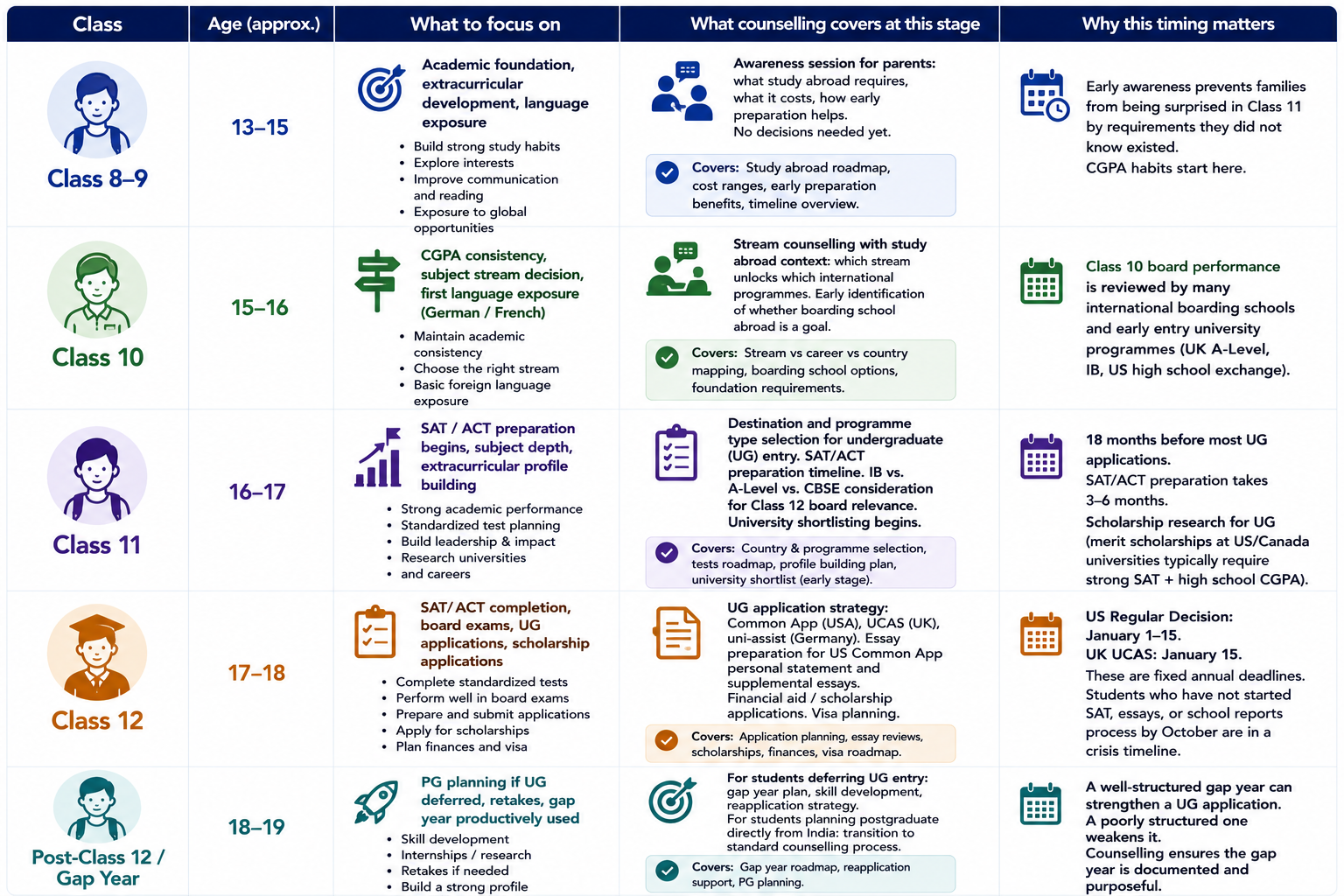
✅ The most valuable session for Class 8–9 families: the awareness session
The Vidysea awareness session for families with a student in Class 8 or 9 is not a commitment to study abroad — it is a 30-minute briefing on what international undergraduate study requires, what it costs, and what preparations would be useful starting now regardless of whether the family ultimately decides on a domestic or international path. The CGPA habits, extracurricular investment, and language exposure that benefit international applications are the same ones that benefit IIT/NIT preparation and Indian university applications. Nothing is wasted.
Undergraduate Study Abroad Destinations — Which Fits Your Profile?
The right undergraduate destination for an Indian school student depends on academic profile, financial budget, language ability, career goal, and PR ambitions if any. Here is the landscape in 2026:
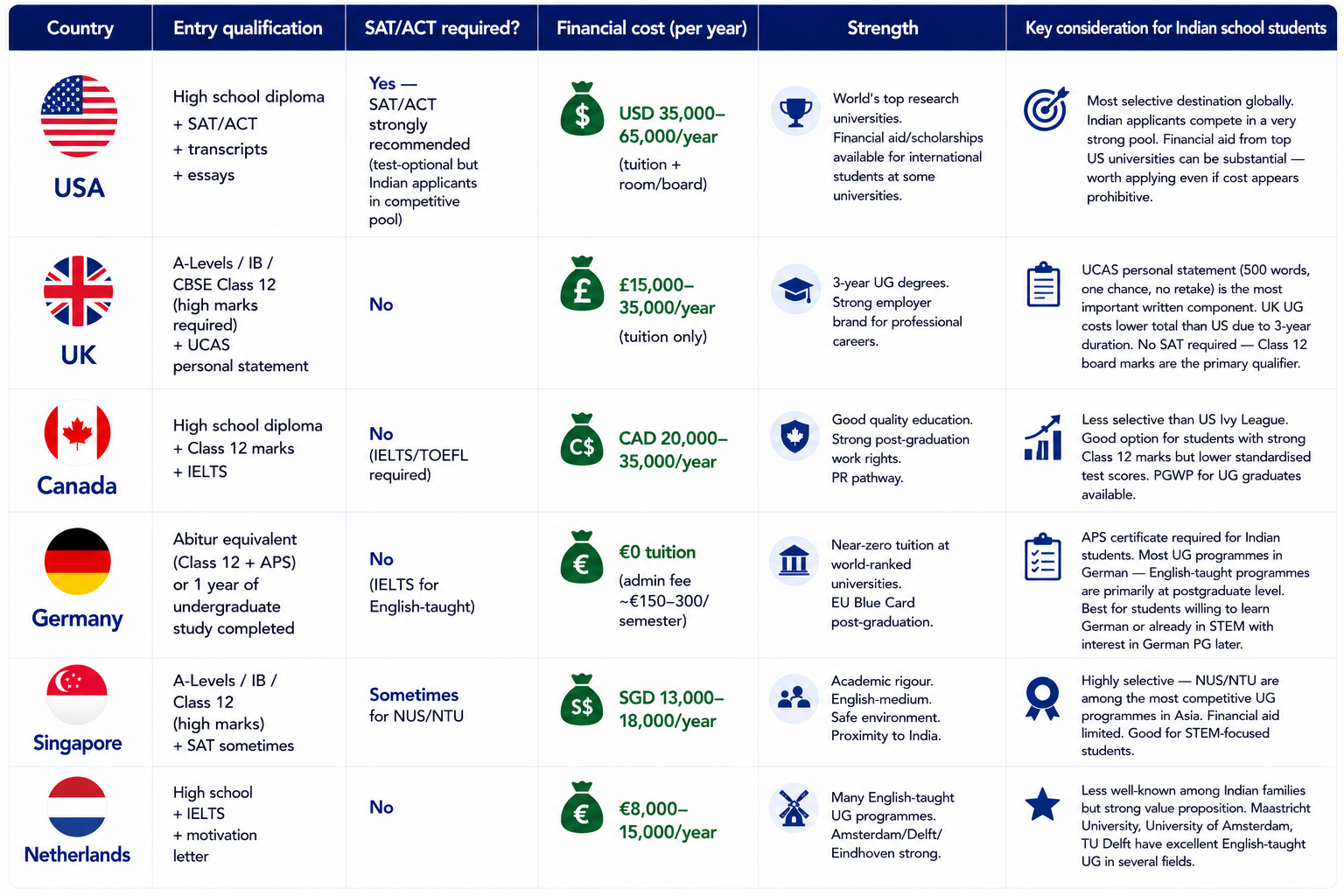
💡 Germany for undergraduates — a less known but compelling option
Most Indian school counsellors default to UK, USA, or Canada for undergraduate guidance. Germany is significantly less discussed — but for students willing to learn German (B2 level for most UG programmes) or interested in STEM with a long-term European career goal, Germany's zero-tuition public universities (TU Munich, TU Berlin, KIT) represent remarkable value. The APS certificate requirement and German language barrier are real obstacles — but students who start German in Class 9–10 reach B2 by Class 12 comfortably.
Building an International UG Profile — What Actually Matters
International undergraduate admissions — particularly at US liberal arts and research universities — evaluate a student's profile across dimensions that are very different from Indian competitive exam preparation. CGPA, standardised tests, and board marks matter — but so does the story of who you are outside the classroom. Here is what a strong profile looks like at each component:
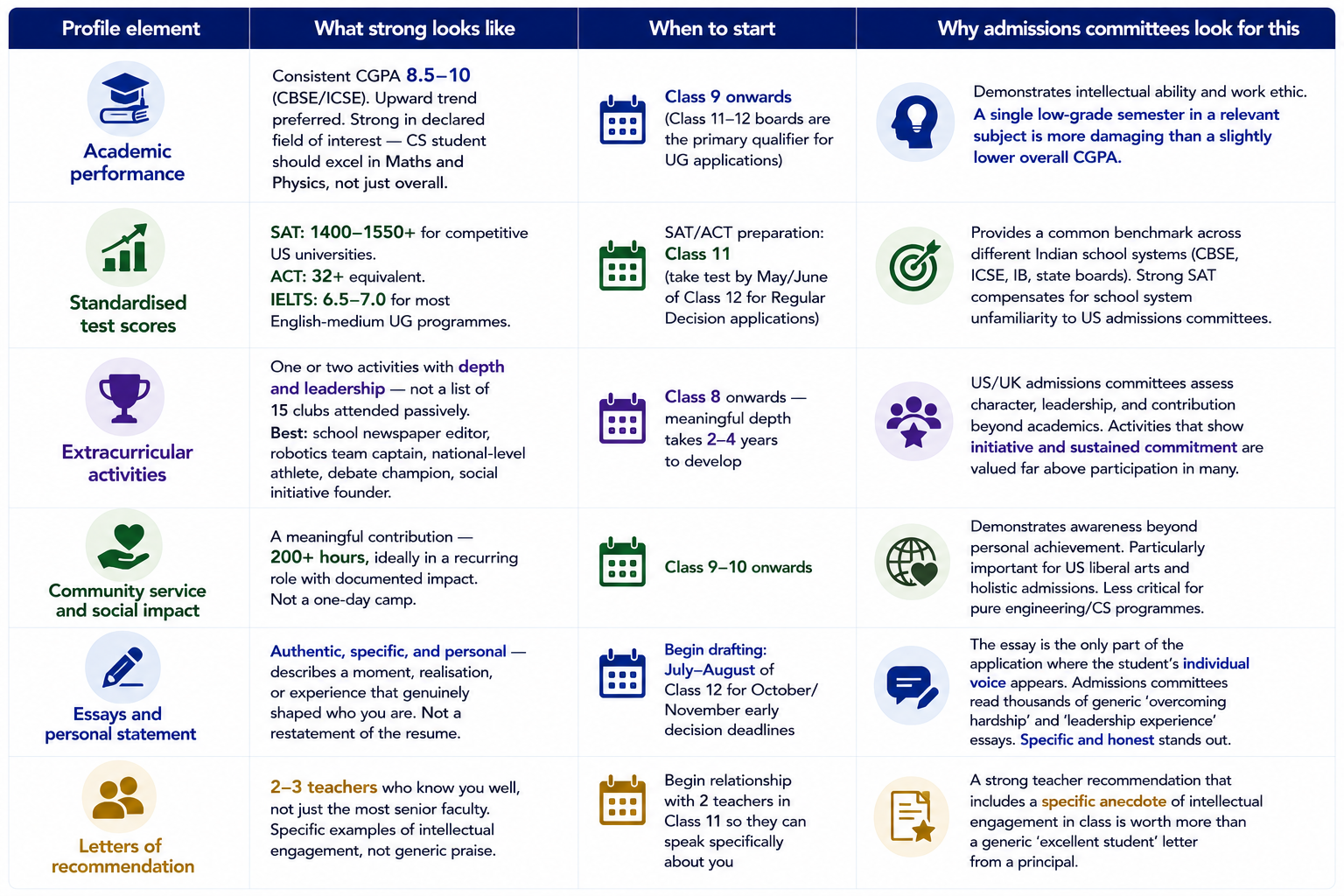
🎯 The depth vs. breadth principle for extracurriculars
US admissions committees consistently say the same thing: they prefer a student who has spent 4 years seriously engaged in one or two activities over a student who has attended 15 clubs for 6 months each. 'Spike' profiles — students who are genuinely exceptional in one area — are often more compelling than 'well-rounded' profiles where everything is moderate. A student who is a state-level chess champion, or who has published a research paper, or who has led a social initiative that demonstrably helped 50 families, stands out. A student who has 12 clubs on their resume but no leadership or depth in any of them does not.
Class 11 Subject Selection — How It Affects International Applications
The Class 11 stream and subject choices have direct consequences for which international undergraduate programmes are accessible. Here is what counselling covers:
Science stream students (CBSE/ICSE)
Maths, Physics, Chemistry, CS/Biology: access to Engineering, CS, Sciences, Medicine (subject to additional requirements), Business. Maths + Physics are non-negotiable for Engineering and CS at most global universities. Students dropping Maths for Biology close themselves out of all Engineering pathways internationally — a decision that seems small in Class 11 and is very difficult to reverse in Class 12.
Commerce stream students
Strong for Business, Economics, Finance undergraduate programmes. US business schools (NYU Stern, UMich Ross as UG programmes) and UK Economics/Management programmes are accessible. CBSE Class 12 Economics and Maths at high marks (90%+) are the primary qualifiers. Commerce students targeting Economics at top UK universities (Oxford PPE, LSE Economics) need very strong Class 12 board performance — these are some of the most competitive UG programmes in the world.
Arts/Humanities stream students
US liberal arts colleges and UK humanities programmes are strong options. The personal statement becomes even more important for humanities applicants — admissions committees want to see genuine intellectual engagement with the subject, not just subject selection. Students who can articulate why they are passionate about English Literature, History, or Political Science in a way that demonstrates actual engagement with the field perform significantly better than those who chose humanities by elimination.
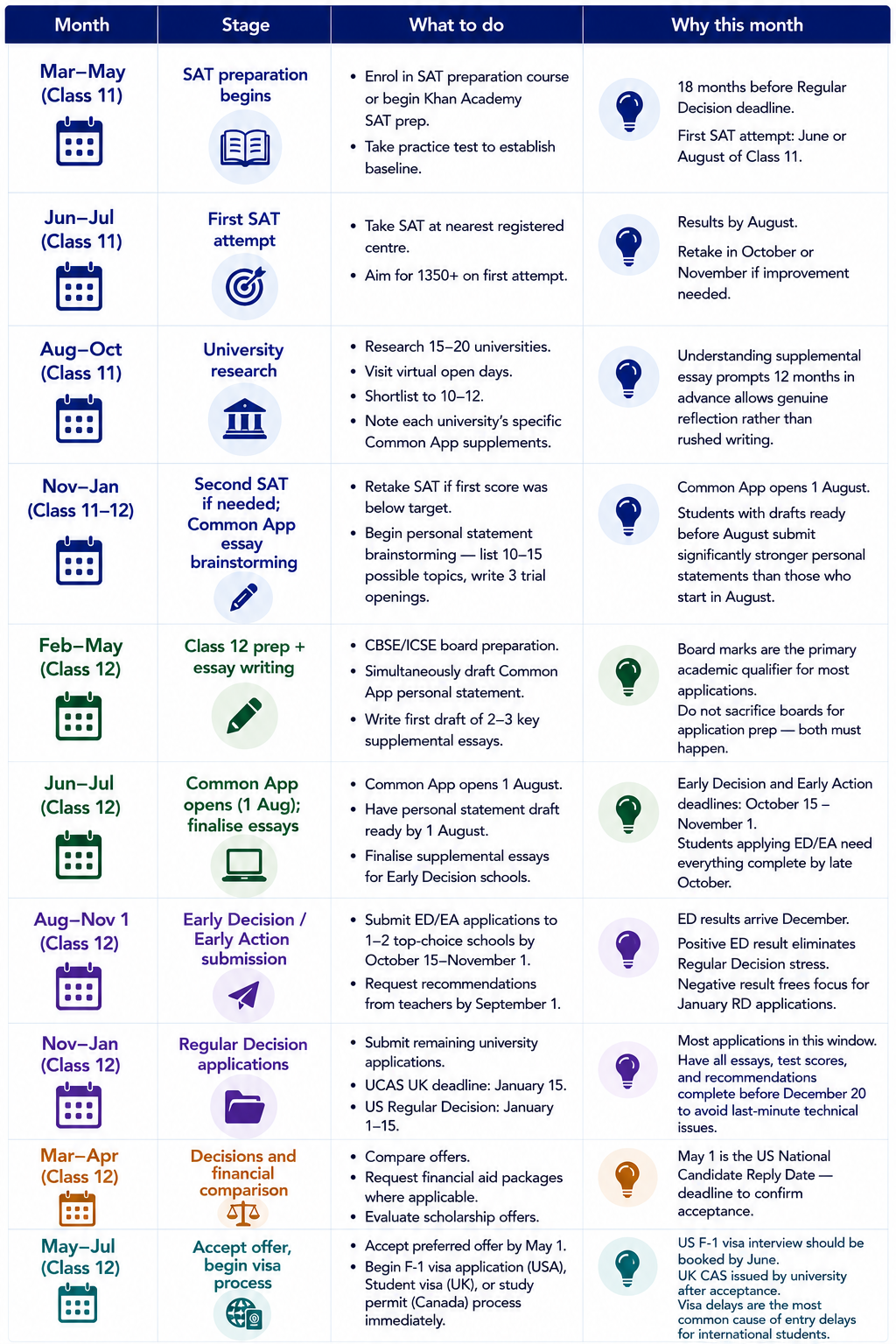
US University Application Calendar — Class 11 to Acceptance
For students targeting US undergraduate programmes, this is the complete application calendar. Missing any stage creates a compounding delay that is difficult to recover:
💡 UK UCAS — one application, five choices, one personal statement
UCAS works very differently from US Common App. The student submits one personal statement (4,000 characters — approximately 500–600 words) that goes to all five universities simultaneously. There are no supplemental essays per university. The personal statement must address: why this subject (not 'why this university'), what academic and wider engagement has shaped that interest, and any relevant work experience or independent study. UK personal statements that read like US essays (personal narrative) are penalised — the UK expects an academic focus, not a personal story.
Financial Planning for Undergraduate Study Abroad
Undergraduate study abroad is typically more expensive than postgraduate because of longer duration (3–4 years vs. 1–2 years). Here is the realistic financial landscape and planning framework:
US financial aid — do not assume you cannot afford it
Many Indian families dismiss US universities as unaffordable without knowing that several top US universities provide need-blind, full-cost financial aid to international students — Harvard, Princeton, Yale, MIT, and several others. A family with limited income may receive an aid package that makes a top US university cheaper than a UK or Canadian programme. The financial aid application (CSS Profile) must be submitted with or shortly after the university application — it is not a separate process that happens later.
UK scholarships for Indian undergraduates
UK undergraduate scholarships for Indian students are more limited than postgraduate scholarships. The Chevening scholarship is for postgraduate — not available to undergraduates. Several UK universities offer merit-based bursaries (£1,000–5,000/year) that partially offset costs. The most significant financial aid available for UK UG is from universities directly — worth researching at shortlisting stage.
Education loans for undergraduate study
Indian education loans are available for undergraduate study abroad, subject to the same lender criteria as postgraduate loans: co-applicant income, collateral if required, university on lender's approved list. Most major global undergraduate universities are on HDFC Credila, SBI, and NBFC approved lists. The financial planning session in the counselling process maps the expected cost of each shortlisted programme against loan eligibility and family budget — before applications are submitted, not after offers arrive.
Frequently Asked Questions
Is it too late to start in Class 12?
For US applications: if it is before August of Class 12, you can still submit a competitive Regular Decision application if SAT is already complete or can be taken in October, and if you have genuine extracurricular involvement to write about. If SAT has not been started and it is October of Class 12, US applications this cycle are not realistic — plan for the following year or target UK/Canada/Germany where SAT is not required. For UK UCAS: the deadline is January 15. If it is September–October of Class 12, a UCAS application is still viable — the personal statement takes 3–4 weeks to write well, and Class 12 mock results provide predicted grades.
My child is in Class 9 and wants to study in the US. What should we do right now?
Three things, in order: (1) Book a Vidysea awareness session for the family — 30 minutes to understand the full US application landscape and what preparation over the next 3 years involves. (2) Focus on CGPA consistency — Class 9–10 marks form part of the transcript submitted in Class 12. Uneven CGPA with a recovery story is less convincing than consistent high performance. (3) Identify 1–2 extracurricular activities to invest in seriously — not 10 clubs to join, but 1–2 where genuine depth and leadership can be developed over 3 years. These three actions, started now, produce a fundamentally stronger Class 12 application than any preparation that begins at Class 11 or 12.
Should my child take CBSE, ICSE, or IB for the best overseas university outcomes?
There is no universally correct answer — all three are accepted at major global universities. The key differences: IB Diploma is widely recognised internationally and its 7-point scale translates clearly for UK/US admissions committees, but it is demanding and available primarily at private schools in metro cities. CBSE is the most common Indian curriculum and is accepted globally — high marks (90%+) in relevant subjects are the primary qualifier. ICSE is similarly accepted but slightly less common internationally. Counselling helps families understand which curriculum their school offers, whether switching is realistic, and whether the marginal admissions advantage of IB justifies the additional cost and difficulty.
The families whose children study at international universities are not always those with the highest income or the most prestigious school background. They are often the families who understood the process early enough to prepare for it — who knew in Class 9 that SAT preparation begins in Class 11, that extracurricular depth matters more than breadth, that financial aid at top US universities is available and must be applied for, and that stream selection in Class 10 has international consequences. Study abroad counselling for school students in India is not about pressure — it is about replacing last-minute panic with deliberate, timely preparation.