Study Visa for Germany: Requirements, Process, and Complete Checklist for Indian Students 2026
Germany offers Indian students something no other major study destination currently does: world-class university education at near-zero tuition, combined with the fastest path to permanent residency of any destination in the world — 21 months from EU Blue Card employment to PR. TU Munich, RWTH Aachen, TU Berlin, and LMU Munich are globally ranked universities where an engineering or computer science MSc costs €0 in tuition and roughly €800–€1,100 per month in living costs.

Team Vidysea
June 4, 2026
The reason more Indian students do not take this route is not a lack of qualification — it is a lack of structured guidance through Germany's visa process, which has two requirements that are genuinely unfamiliar to most Indian families: the APS certificate (academic credential verification by the German Embassy's academic evaluation centre in India) and the Sperrkonto (blocked bank account proving financial capacity). Both are mandatory. Both have lead times that most students miss when they discover them late.
This guide covers the complete Germany study visa process for Indian students in 2026 — from university application to Anmeldung (address registration on arrival). It includes the 9-step sequential process, a complete document checklist with format requirements and common Indian applicant errors, guidance on APS and blocked account, major German universities, and the post-study work and PR pathway that makes Germany the most strategically valuable study destination for Indian STEM graduates in 2026.
Why Germany is the most underrated destination for Indian students in 2026
Germany receives a fraction of the Indian student applications that the UK or Canada receives — despite offering advantages that exceed both in several dimensions. Zero tuition at QS top-100 universities. EU Blue Card PR in 21 months. Shortage occupation Blue Card salary threshold for STEM: €45,552 (achievable for most CS and engineering graduates). EU freedom of movement once German PR is obtained. The barrier is the APS process and the Sperrkonto — both manageable with good guidance for study abroad. Once these are understood, the Germany pathway is clear.
Why Germany for Indian Students — Key Advantages
- Zero tuition at public universities. Germany's state universities charge no tuition fees — only a semester administration fee of €150–€350, which often includes a free public transport semester ticket.
- World-class rankings. TU Munich: QS top 30 globally. RWTH Aachen: globally ranked for engineering. LMU Munich, Heidelberg, TU Berlin: all in QS top 150.
- EU Blue Card and fastest PR pathway. After graduation and employment: 21 months to permanent residency with B1 German, or 33 months without German. No other major destination offers this timeline.
- Shortage occupation advantage. STEM fields (computer science, engineering, data science, healthcare) qualify for the lower Blue Card salary threshold (€45,552 vs. €58,400 general) — achievable for most graduates within 1–2 years.
- Strong STEM employment market. Germany has a documented shortage of 500,000+ STEM workers. Demand is particularly high in automotive engineering, software engineering, data science, and mechanical engineering.
- EU freedom of movement. Once German PR or EU Blue Card long-term residency is obtained, the holder can work and live across EU member states.
Germany Study Visa — 9-Step Process for Indian Students
The Germany student visa application has a specific sequential logic — each step must happen in the right order. The most common error is starting Step 7 (consulate appointment) before completing Step 2 (APS). Here is the complete process:
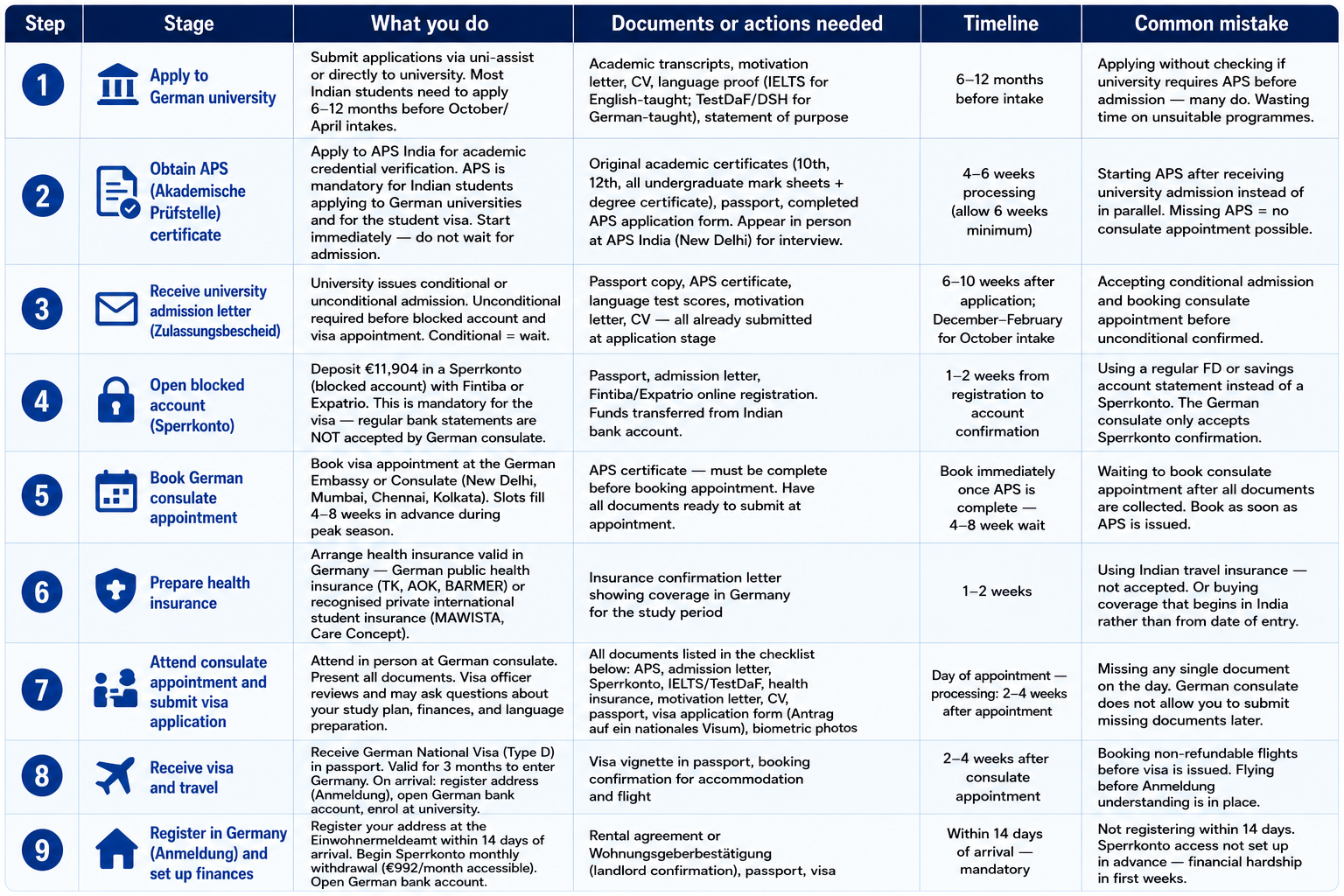
The APS is mandatory and takes 4–6 weeks — start it first, not last
APS (Akademische Prüfstelle) certificate is required for the German consulate appointment. You cannot book a consulate appointment without it. APS India is located in New Delhi and requires in-person attendance for the verification interview. Indian students who discover the APS requirement after receiving university admission face a 4–6 week delay added to an already-tight timeline. Start APS immediately on deciding to apply to Germany — not after admission.
APS Certificate — The Most Important Requirement Indian Students Miss
The APS (Akademische Prüfstelle) is the German Embassy's academic credential evaluation centre for Indian students. It verifies that your Indian academic documents are genuine and that your qualifications are equivalent to German educational standards. APS certificate is mandatory for all Indian nationals applying to German universities and for the German National Visa (Type D).
What APS involves:
- Online application via aps-india.de — create an account and upload scanned documents initially.
- Appointment at APS India (New Delhi) for in-person interview and original document submission.
- Documents required: all original academic certificates and mark sheets (10th, 12th, all years of undergraduate and any postgraduate study), passport, completed APS form.
- Interview: approximately 20–30 minutes discussing your academic background, study gap if any, and reasons for choosing Germany. Conducted in German or English.
- Processing time: 4–6 weeks from appointment. APS certificate posted to your address.
- Cost: approximately €100–€150.
Common APS mistakes for Indian students:
- Applying for APS after receiving university admission — this adds 4–6 weeks to an already constrained timeline. APS and university application should run in parallel.
- Missing mark sheets for any individual semester or year — APS requires complete academic documentation, not just final certificates.
- Not having originals — APS requires original documents, not photocopies, at the in-person appointment.
- Applicants outside New Delhi: APS is only in New Delhi. Allow for travel. Contact APS India to check if any outstation arrangements are available.
Blocked Account (Sperrkonto) — The Financial Proof Germany Requires
Germany's financial proof requirement is unlike every other study destination. A regular bank statement or FD certificate is not accepted by the German consulate. You must open a Sperrkonto (blocked account) with a recognised provider and deposit exactly €11,904 before your consulate appointment.
How the Sperrkonto works:
The €11,904 (equivalent to €992 per month × 12 months) is deposited in a blocked account with Fintiba (fintiba.com) or Expatrio (expatrio.com). The account is 'blocked' in the sense that you cannot withdraw the full amount at once — after you arrive in Germany, €992 per month is released to your German bank account automatically. This structure proves to the consulate that you have the funds and that they will be used systematically for living expenses, not withdrawn and spent before you arrive.
Setting up the Sperrkonto:
- Register online with Fintiba or Expatrio (both are recognised by German consulates).
- Complete identity verification (KYC) — typically takes 3–5 business days.
- Transfer €11,904 from your Indian bank account to the Sperrkonto. International transfer — allow 3–7 business days for funds to clear.
- Receive confirmation document from Fintiba/Expatrio confirming account is funded — this is submitted at the consulate appointment.
- Total time from registration to confirmation: 1–2 weeks. Start this process immediately after unconditional admission is confirmed.
Sperrkonto funds are returned if your visa is refused
If your German student visa is refused or you decide not to travel, Fintiba and Expatrio allow you to withdraw the blocked account funds. The process takes a few weeks. There is no permanent financial commitment at risk — the Sperrkonto is a proof mechanism, not a payment to the German government. This removes the financial risk concern that some families have about opening a blocked account.
Complete Germany Study Visa Document Checklist
Print this checklist and tick off each document as it is collected. Every document must be present at the consulate appointment — German consulates do not accept later supplementary submissions:
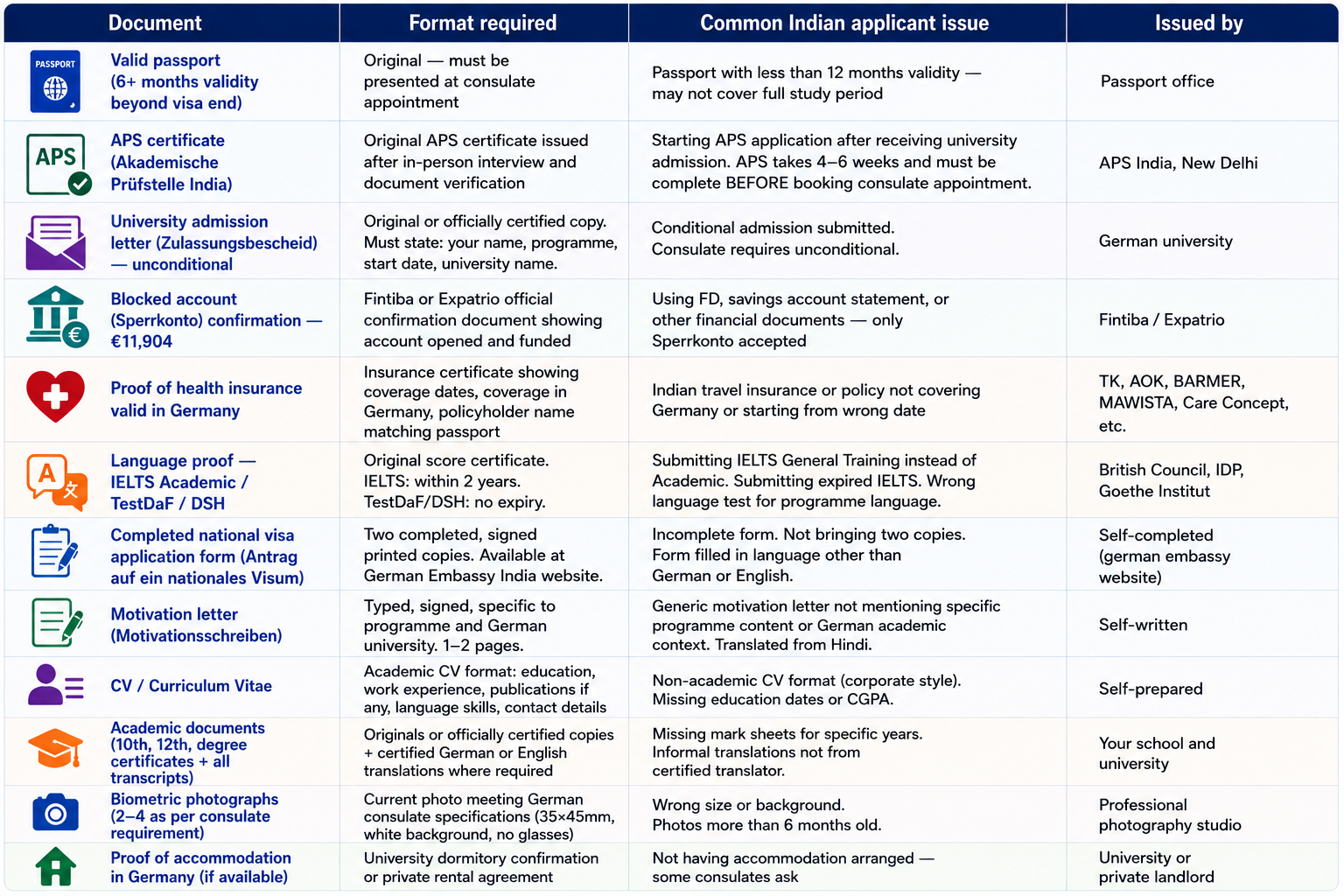
Translation requirements — a detail Indian applicants often miss
Any academic document that is not in German or English must be accompanied by a certified translation. For Indian academic documents issued in regional languages or with Hindi-language elements, certified translations into German or English by a recognised translator are required. 'Certified' means a qualified translator (vereidigter Übersetzer for German courts) certifies the accuracy. Self-translations are not accepted. Allow 1–2 weeks for certified translations.
Major German Universities — What Indian Students Should Know
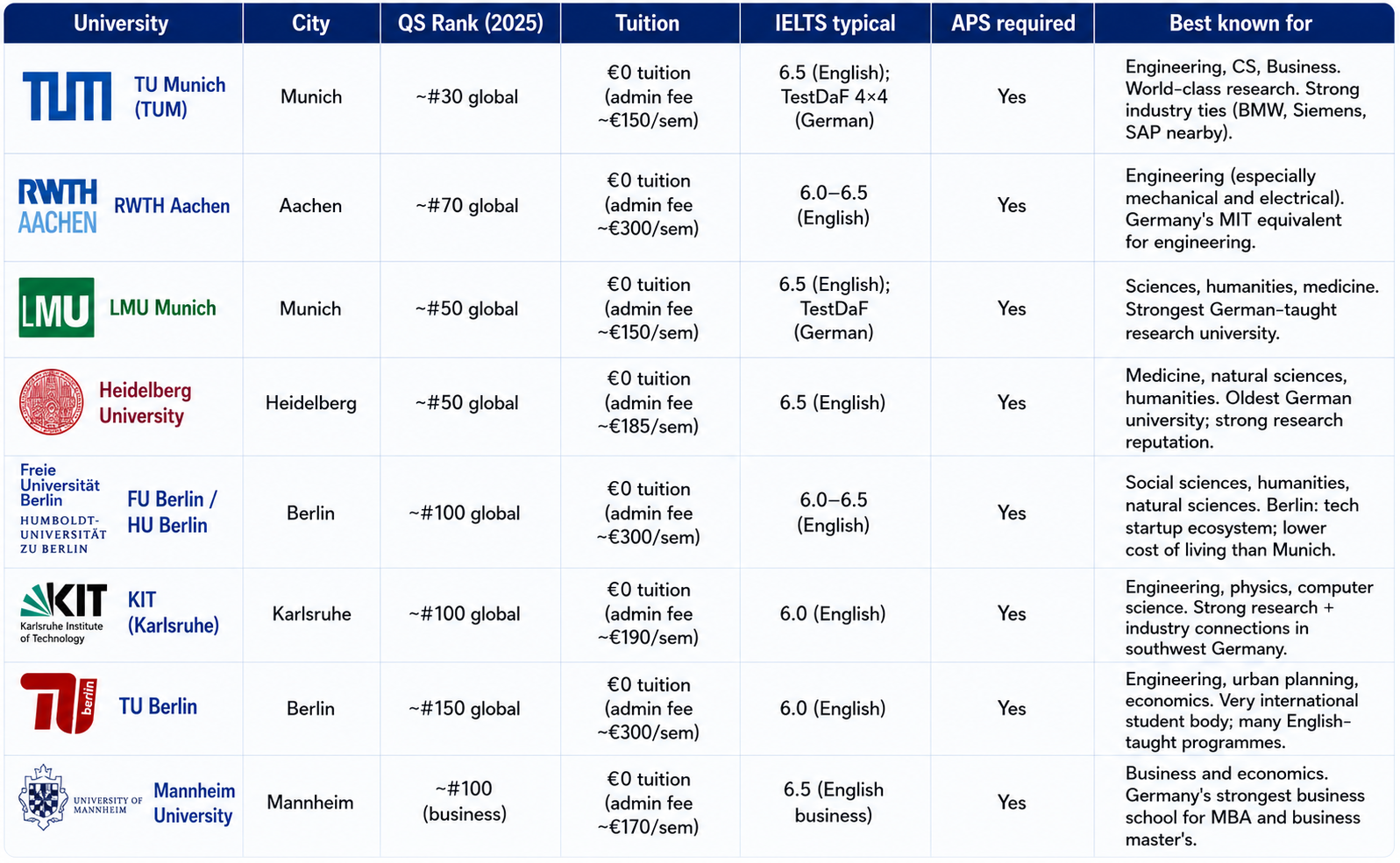
Most top German universities have English-taught postgraduate programmes
The majority of Indian students who study in Germany choose English-taught Master's programmes — particularly in engineering, computer science, and business. You do not need to speak German to study at TU Munich or RWTH Aachen if your programme is English-taught. However, learning German (at least B1 level) significantly improves your employment prospects, speeds your PR pathway (21 months vs. 33 months), and opens your access to the full German job market beyond English-language roles in multinational companies.
Cost of Living in Germany — What to Expect
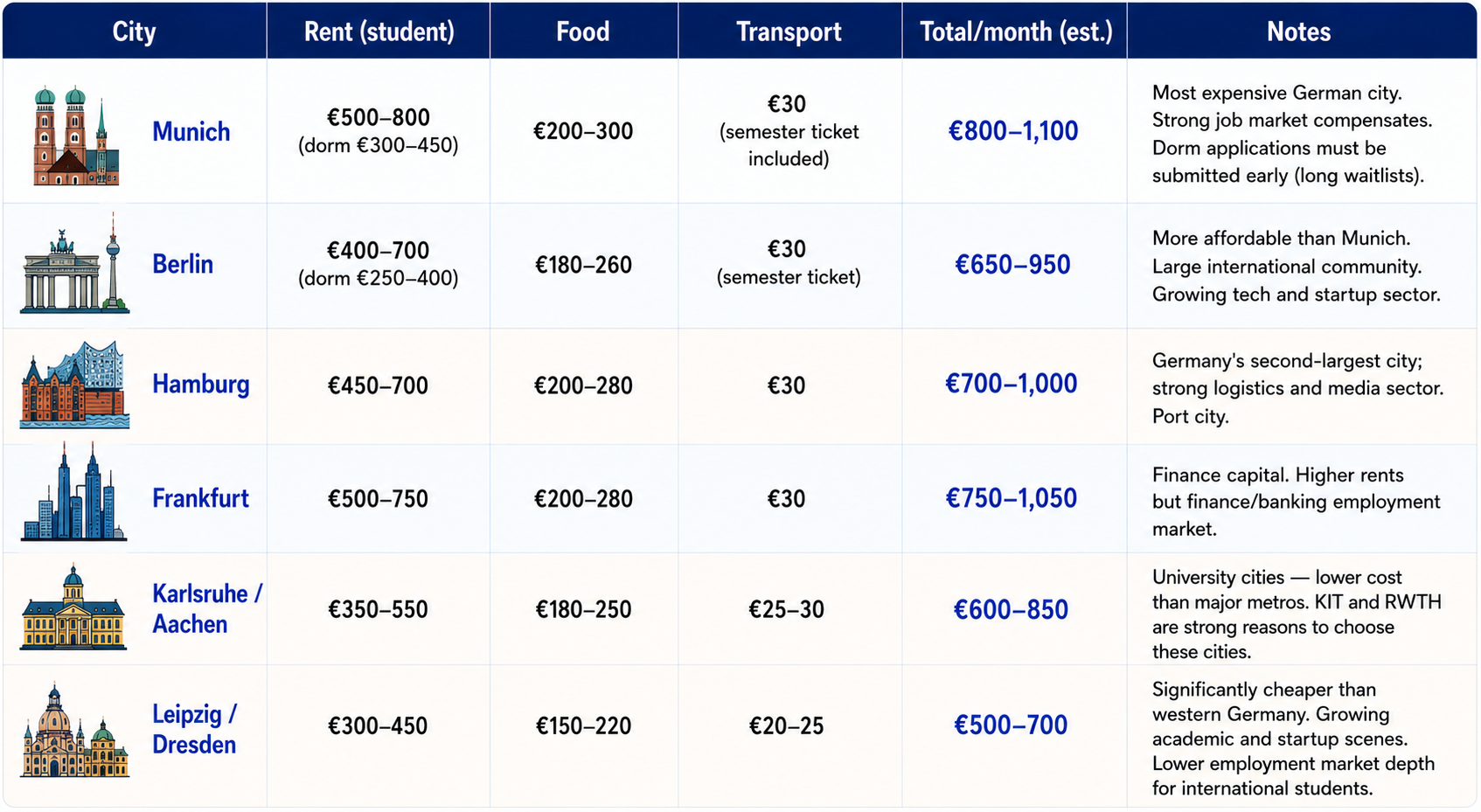
Germany's cost of living varies significantly by city. Munich is the most expensive; smaller university cities like Aachen, Karlsruhe, Leipzig, and Dresden are significantly more affordable. The Sperrkonto amount (€992/month) is calibrated to cover basic student living costs in most German cities — but in Munich, it will need supplementing, particularly with rent.
Student work rights in Germany
International students on a German student visa are permitted to work 120 full days or 240 half days per year without a work permit. This is equivalent to 20 hours per week during academic terms. Student part-time work rates in Germany: €13–€18/hour in most cities (minimum wage: €12.41/hour from January 2024). At 20 hours per week, a student can earn €800–€1,200/month — enough to supplement Sperrkonto funds significantly in most cities outside Munich.
German Language — Do You Need It and When to Start
For English-taught programmes: IELTS Academic 6.0–6.5 is typically required. German language is not required for admission or the visa. However, learning German has a direct impact on three outcomes that matter to Indian students:
- Employment in Germany: most German companies — including multinationals with German operations — expect at least B1 German for permanent roles. English-only candidates are limited to multinational tech companies and specific international departments.
- PR timeline: Blue Card holders with B1 German reach PR in 21 months. Without B1 German: 33 months. A 12-month difference that is directly driven by language level.
- Quality of life: Germany is not an English-speaking country. Daily life — banking, healthcare, housing, bureaucracy — is conducted in German. B1 level is achievable in 12–18 months of consistent study.
For German-taught programmes: TestDaF TDN 4×4 (equivalent to B2/C1) or DSH 2 is required. German-taught programmes typically offer broader access to German companies and academic environments — but require significant language investment before applying.
Recommendation for most Indian students: begin German language (A1) alongside your undergraduate final year or gap year. Reaching B1 by the time you complete your German master's degree (2 years) is an achievable target that directly improves both employment prospects and PR timeline.
Post-Study Work and PR Pathway — The German Advantage
After completing a degree from a German university, Indian graduates have access to Germany's most direct study-to-PR pathway:
- 18-month job seeker visa: after graduation, apply for a job seeker visa to stay in Germany and search for employment. Full work rights during this period.
- EU Blue Card: once employed with a salary above €45,552 (shortage occupations: CS, engineering, healthcare, science) or €58,400 (general), apply for an EU Blue Card.
- Permanent Residency: 21 months on EU Blue Card with B1 German (or 33 months without German).
- EU mobility: after 2 years on EU Blue Card, apply for long-term residence in any other EU member state — opening the entire European employment market.
For Indian students, this pathway — zero-tuition degree + EU Blue Card employment + 21-month PR — represents the most efficient study-to-settlement route available anywhere in the world in 2026. The UK comparison (10+ years ILR from April 2026) and Canada comparison (3–5 years) highlight the German advantage clearly for students whose long-term goal is European permanent residency.
Frequently Asked Questions
Can I start the APS process without a university admission offer?
Yes — and this is the recommended approach. APS application does not require a university admission. You can apply for APS using your academic documents before any university offer is received. Starting APS 6–8 months before your target intake, in parallel with university applications, ensures the certificate is in hand before the consulate appointment window. Students who wait for admission before starting APS typically add 4–6 weeks of unnecessary delay to their timeline.
Is German language knowledge required for the visa interview at the consulate?
No — the German consulate visa interview can be conducted in English. For English-taught programme applicants, English is sufficient for the consulate appointment. However, the consulate officer may ask basic questions about your programme, your reason for choosing Germany, and your plans after graduation. Being able to name your programme, its content, and why you chose that specific German university in specific terms strengthens the application, regardless of language.
What if my Sperrkonto funds come from an education loan disbursement?
Sperrkonto funds can originate from an education loan — this is accepted. The German consulate does not require the funds to be personal savings. If your Sperrkonto is funded by an Indian education loan (SBI, HDFC Credila, Avanse), include the loan sanction letter and disbursement confirmation alongside the Sperrkonto statement at your consulate appointment. This documents the legitimate source of the funds. Student visa assistance from Vidysea specifically reviews how loan-funded Sperrkonto documentation should be presented to avoid questions at the consulate.
How does Germany's study visa compare to the UK and Canada?
The German study visa process is more document-intensive than the UK (no APS, no Sperrkonto required in UK) and longer (4–6 months total vs. 3–5 weeks for UK priority). However, what follows a German degree is significantly more attractive for Indian students whose goal is European permanent residency: 21 months to German PR vs. 10+ years to UK ILR (from April 2026) and 3–5 years to Canadian PR. The investment in the longer German visa process is justified by the post-graduation pathway advantage. Study visa consultants who advise on Germany vs. UK vs. Canada comparisons should present this full picture — not just the visa process, but the 5–10 year trajectory that follows.
Germany in 2026 is one of the best-value, highest-return study destinations available to Indian students — and one of the most systematically under-utilised. The student visa application process is longer and more specific than other destinations, but every step is documented, manageable, and predictable. APS and Sperrkonto are the two requirements most Indian students miss — both are avoidable with correct guidance for study abroad. A student who starts APS in parallel with university applications, opens a Sperrkonto as soon as unconditional admission arrives, and books the consulate appointment the week APS is issued will complete the entire process on time for every major German university intake.