

Got dreams to achieve? Hop on as we take you on your journey to success!


Services
Contact Info

Noida office
+91 7428715522Bangalore office
+91 8861432223 support [at] vidysea.com
Copyright@Vidysea
Got dreams to achieve? Hop on as we take you on your journey to success!
Noida office
+91 7428715522Bangalore office
+91 8861432223support [at] vidysea.comCopyright@Vidysea
TOEFL is the test of choice for US university admissions — the format that most American graduate programmes know best, the test that MIT, Harvard, Stanford, and most of the top 100 US universities use as their benchmark. If the United States is your primary destination, TOEFL is the test you should invest in preparing for.

Team Vidysea
But TOEFL prepares you for more than the exam. The Integrated tasks — where you read an academic passage, listen to a lecture, and then write or speak in response — are a rehearsal for what graduate study in the United States actually looks like: processing dense academic material under time pressure and responding to it with organised, evidence-based argument. Learning how to prepare for abroad studies through TOEFL is, in the most direct sense, learning how to function as a US graduate student before you arrive.
This guide covers the complete TOEFL iBT: format, scoring, section-by-section strategy, the Integrated tasks that most Indian students underestimate, the 2023 Academic Discussion task that replaced the old Independent Essay, and a 6-month test preparation to study abroad timeline that works for students currently scoring 75–85 who want to break 100+.
TOEFL and Canada PR — what you must know before you prepare
TOEFL iBT is NOT accepted by Immigration, Refugees and Citizenship Canada (IRCC) for Express Entry, Provincial Nominee Programme, or any permanent residence pathway. If Canada PR is part of your long-term plan, you will need IELTS Academic/General Training or PTE Academic/Core separately. TOEFL covers US university admissions and most other English-speaking university admissions — but it does not substitute for IELTS or PTE in the Canadian immigration system. See Vidysea's IELTS vs PTE vs TOEFL guide for the complete comparison.
TOEFL iBT — Test Format, Scoring, and Structure (2026 Edition)
The TOEFL iBT was significantly revised in 2023. The test is now shorter (approximately 2 hours versus 3+ hours previously), the old Integrated Speaking tasks were reduced, and the Writing section replaced the old Independent Essay with an Academic Discussion task. If you are using pre-2023 preparation materials, some content will be outdated.
| Section | Score |
|---|
| Questions |
|---|
| Format |
|---|
| Scored by |
|---|
| What it tests |
|---|
| Reading | 0–30 | 35 min | 20 questions | 2 academic passages, ~700 words each | AI (automated) | Understanding of academic texts: main idea, detail, inference, rhetorical purpose, vocabulary in context |
| Listening | 0–30 | 36 min | 28 questions | 2 lectures (~5 min each) + 3 conversations (~3 min each) | AI (automated) | Understanding of academic lectures and campus conversations: main idea, detail, attitude, purpose, connecting information |
| Speaking | 0–30 | 16 min | 4 tasks | Task 1: Independent (personal opinion). Tasks 2–4: Integrated (respond to reading/listening) | AI (SpeechRater) | Delivery (pace, clarity), language use (vocabulary, grammar), topic development |
| Writing | 0–30 | 29 min | 2 tasks | Task 1: Integrated (read + listen + write 150–225 words). Task 2: Academic Discussion (100+ words) | Human + AI (e-rater) | Task 2 (Academic Discussion) introduced in 2023. Tests academic writing, argumentation, and language accuracy |
The 2023 format change that caught many Indian students off guard
The old TOEFL Writing Task 2 was a 250–300-word argumentative essay (30 minutes). The new Academic Discussion task (introduced July 2023) asks you to write 100+ words contributing to an online academic discussion — responding to a professor's prompt and two student contributions. It is shorter, more conversational in register, and rewards direct opinion-stating with specific reasoning. Many students still preparing with pre-2023 materials are practising the wrong task format. Always verify you are using materials from July 2023 or later.
TOEFL Score Requirements for Study Abroad — 2026 Reference
What score do you actually need? The answer depends on your target institution tier, your target programme, and whether TOEFL is accepted at all at your destination.
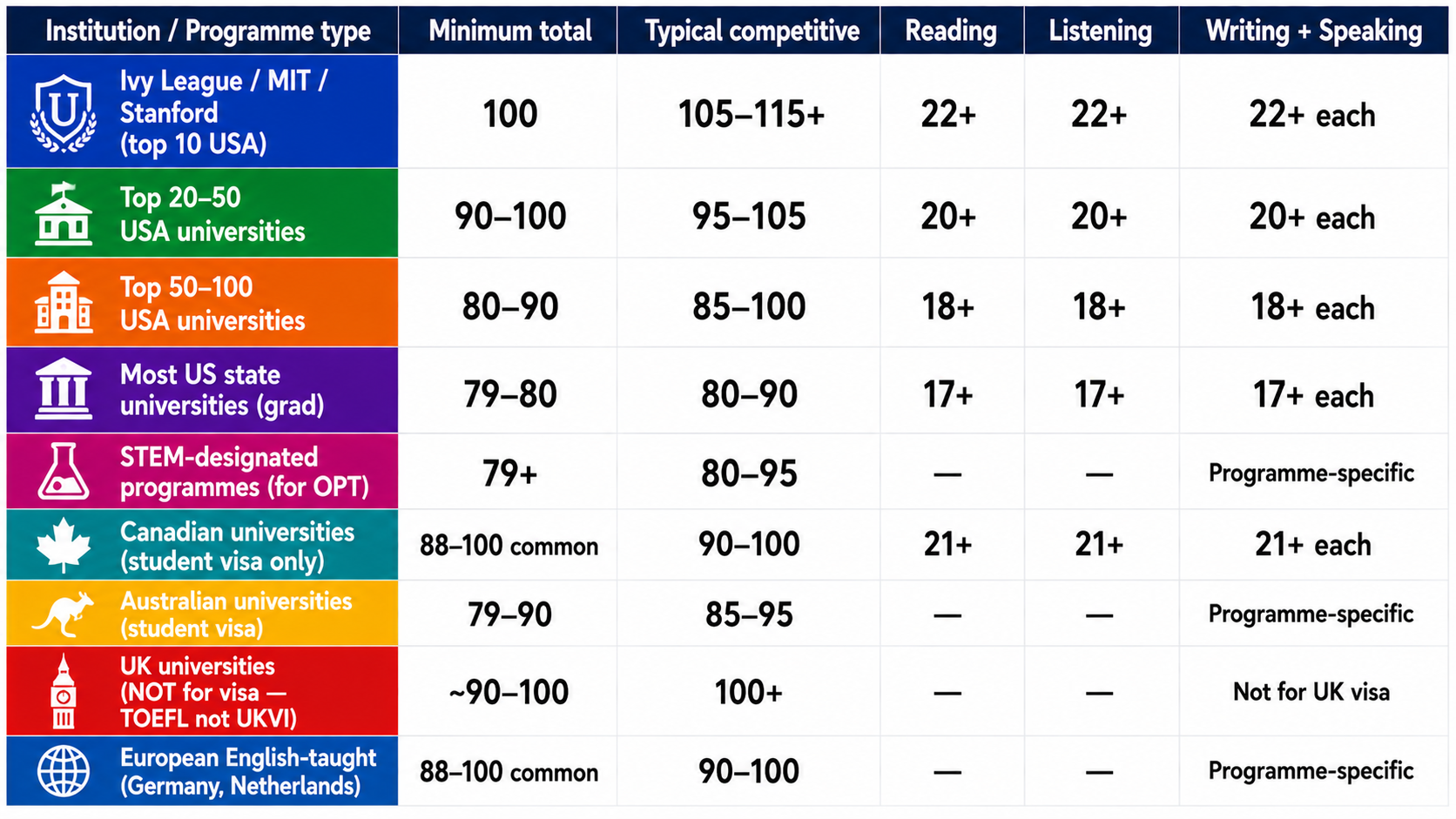
TOEFL is NOT on the UK Visa and Immigration (UKVI) approved list
As of 2026, TOEFL iBT is not accepted for UK student visas or UK skilled worker visas. If you are applying to UK universities, you must use IELTS (UKVI or standard), PTE Academic, Cambridge C1 Advanced, or another UKVI-approved test. TOEFL scores may satisfy the university's own English proficiency requirement (some UK universities accept it for admissions), but you will still need a separate UKVI-approved test for the visa. Applying to UK universities with TOEFL and then needing a second test is a common and avoidable complication.
Mastering the Integrated Tasks — TOEFL's Most Distinctive Challenge
The Integrated tasks — in both Writing and Speaking — are the most distinctive feature of TOEFL compared to IELTS. In IELTS, every task is based on a single source. In TOEFL, three of the six tasks require you to process multiple sources simultaneously (reading + listening), take organised notes on both, and then produce a coherent response that accurately represents what you read and heard. This is a different cognitive skill from anything tested by IELTS or PTE — and it requires specific preparation.
| Task | Section | Time | What you do | What high scorers do differently |
|---|---|---|---|---|
| Integrated Writing (Task 1) | Writing | 20 min | Read a 280-word academic passage (3 min). Listen to a 2-min lecture that challenges or contradicts it. Write 150–225 words explaining how the lecture relates to the reading. | Take structured notes during both reading AND listening. Use 'According to the reading...' / 'However, the professor argues...' sentence frames. Never state your own opinion — only report and contrast. Cover all 3 points from the lecture. |
| Academic Discussion (Task 2) | Writing | 10 min | Read a 100-word professor's prompt + 2 student responses. Write 100+ words contributing your own original opinion to the discussion. | State your position clearly in sentence 1. Give one strong reason with a specific example. Acknowledge one of the student posts naturally. Avoid simple repetition of what others said. |
| Speaking Task 1 (Independent) | Speaking | 15 sec prep + 45 sec response | Express and defend a personal preference, choice, or opinion on a familiar topic. | State opinion in 5 words. Give 1 main reason. Give 1 specific example (a person, a time, a place). Conclude in 1 sentence. Do not give two equal reasons — commit to one and develop it. |
The note-taking system that changes everything for Integrated tasks
The single highest-leverage improvement for TOEFL Integrated tasks is a consistent, structured note-taking system. Divide your scratch paper into two columns before the audio begins: left column for reading points, right column for listening points. Number each point (R1, R2, R3 / L1, L2, L3). In your response, go point-by-point: R1 → L1, R2 → L2, R3 → L3. This structure prevents the most common error — accurately reporting one source but losing track of the other. Practise this system until it is automatic before attempting timed mock tests.
Section-by-Section Strategy for Indian Test-Takers
Each TOEFL section has specific patterns for Indian students — areas of strength from Indian academic backgrounds and areas that require targeted preparation. This section covers the highest-ROI preparation for each.
Reading: Academic Density Is the Challenge
TOEFL Reading uses passages from university-level textbooks on natural sciences, social sciences, arts, and humanities. The vocabulary is academic and technical. Questions test inference and author purpose, not just literal comprehension — which means reading every word carefully and then trying to find the answer is too slow. A student who reads at fewer than 250 words per minute will run out of time in TOEFL Reading.
What improves your Reading score fastest:
Listening: Attitude and Purpose Are the Hard Questions
TOEFL Listening passages are significantly longer than IELTS — lectures are 4–6 minutes of continuous academic speech. Most Indian students who have prepared for IELTS Listening find TOEFL Listening harder, because TOEFL questions test attitude (does the speaker agree, disagree, or express doubt?), purpose (why does the professor mention X?), and connecting information — all of which require understanding subtext, not just facts.
What improves your Listening score fastest:
Speaking: Four Tasks, Four Different Skills
The 4 TOEFL Speaking tasks each test something different, and your score on each is independent. A strong Independent task score will not compensate for weak Integrated tasks. Most Indian students perform best on Task 1 (familiar topic, personal opinion) and worst on Task 4 (summarising an academic lecture with no reading support). Invest preparation time in proportion to this difficulty distribution.
The three Speaking criteria — and what they actually mean:
Topic Development (50%): completeness, coherence, and relevance of content. This is the highest-weighted criterion. A coherent, complete response that covers the required points will outscore a fluent but incomplete one.
Writing Task 1 (Integrated): Accuracy of Reporting Is Everything
The Integrated Writing task does not ask for your opinion. It asks you to explain how the listening material relates to (challenges, casts doubt on, contradicts) the reading material. The most common error among Indian test-takers: expressing their own view on the topic, or writing a general discussion instead of a precise, point-by-point contrast.
Template that works for the Integrated Writing task:
Writing Task 2 (Academic Discussion): Be Direct, Not Generic
The Academic Discussion task replaced the old Independent Essay in 2023. The format looks informal (you are contributing to an online class discussion), but the scoring is still academic — your post is evaluated on the quality of your reasoning and the relevance of your contribution, not just your language.
What makes a high-scoring Academic Discussion post:
The 6-Month TOEFL Preparation Timeline — How to Prepare for Abroad Studies
This timeline is designed for an Indian student currently scoring 75–85 on TOEFL (estimated), targeting 100+ for US university admissions. Both keywords from this blog — 'how to prepare for abroad studies' and 'test preparation to study abroad' — are answered here in a concrete, month-by-month plan. The most important principle: TOEFL preparation that builds genuine academic English skill is more durable and more transferable than preparation that memorises task templates alone.
| Month | Stage | What to do | Primary resources | Weekly hours |
|---|---|---|---|---|
| 1 | Diagnostic + format mastery | Take a full timed TOEFL mock. Score each section. Map weaknesses. Study all 6 task types — many Indian students have never seen Integrated Writing or Speaking Tasks 2–4. | ETS Official TOEFL iBT Tests Vol. 1 (mandatory). TOEFL.org free practice test. Magoosh TOEFL free trial. | 10–12 hrs (mock + review + task format study) |
| 2 | Academic reading speed + vocabulary | Read one academic article daily (20 min, timed). Answer 10 TOEFL-style questions. Build academic collocations list — 200 words minimum. Focus on understanding author purpose, not just facts. | Official TOEFL iBT Tests Vol. 1 & 2. The Economist / Nature for daily reading. Magoosh TOEFL vocab flashcards. | 8–10 hrs/week |
| 3 | Listening + note-taking | Train active listening with structured notes. Practise summary recall of 5-minute lectures. Work on understanding academic attitude (agree/disagree/uncertain) and purpose questions. | TOEFL official practice sets (ETS). TED-Ed and MIT OpenCourseWare lectures. Official TOEFL Listening section from mock tests. |
✅ The official ETS practice tests are the only truly representative preparation
TOEFL's question style, difficulty calibration, and scoring are unique to ETS. Third-party practice tests — from Magoosh, Kaplan, Manhattan, or others — provide useful practice but do not replicate the actual test experience as precisely as official materials. Budget at least 4 of your timed mock tests for Official ETS TOEFL iBT Tests (Volumes 1 and 2), which contain real previously administered test questions. Use third-party materials for additional volume practice and specific skill building.
TOEFL and the Broader Study Abroad Preparation Picture
TOEFL preparation — done at depth, not just for test tactics — is one of the most genuinely useful forms of preparation for abroad studies available to Indian students. The specific skills TOEFL develops translate directly to academic success in US (and other English-medium) universities:
Beyond language skill, the TOEFL preparation experience — learning to manage academic information under time pressure — is a rehearsal for the cognitive demands of overseas study itself. Students who have prepared seriously for TOEFL typically find the transition to an American academic environment smoother than those who have not, even when their TOEFL scores are similar. The test is a proxy for the skill. The skill is what matters.
Frequently Asked Questions
What is a good TOEFL score for Indian students in 2026?
'Good' depends entirely on your target institution. For most US state university graduate programmes: 79–80 minimum. For top 50 universities: 90–100+. For Ivy League and MIT/Stanford: 100–115+. For scholarship competition and full-funding fellowships like Fulbright-Nehru, 105+ is competitive. Indian students on average score in the 90–100 range — above the global average, primarily because of strong Reading and Listening performance from English-medium schooling.
How many times can I take TOEFL?
TOEFL iBT can be taken as many times as needed, but there must be at least 3 days between test attempts. ETS sends all scores to institutions unless you use the My Best Scores feature, which reports the highest score achieved in each section across all attempts within the last 2 years. Most institutions accept My Best Scores, which means a student who scored 25 in Reading on one attempt and 27 in Listening on another attempt can report 25+27 combined from different sittings.
Is TOEFL at Home the same as the test centre version?
TOEFL iBT Home Edition is identical in content, format, and scoring to the test-centre version. It is administered by a live proctor via webcam and requires a quiet, private space, a webcam, and a reliable internet connection. Your score report will not indicate whether you took the home or centre version. Both formats are accepted equally by all institutions that accept TOEFL. Choose based on your access to a suitable testing environment at home versus availability of test-centre slots in your city.
My Speaking score is always lower than my other three sections. What should I do?
This is the most common TOEFL difficulty pattern for Indian test-takers — strong Reading and Listening, weaker Speaking. The issue is almost always delivery and task completion, not English ability. Two targeted actions: (1) Record yourself completing 2 Speaking tasks every day for 4 weeks and listen back critically — identify specific patterns: starting too slowly, running out of time in Task 4, speaking too fast in Task 1. (2) Use the ETS Speaking rubric to self-score your recordings — it is free on the ETS website and identifies the exact dimension dragging your score down.
Should I take TOEFL or IELTS if I want to go to the USA?
For US university admissions specifically: either test is accepted at most institutions, but TOEFL is more familiar to US admissions committees and many programmes explicitly prefer it or set higher IELTS thresholds to equalise the two. If USA is your primary target, TOEFL is the natural choice. If you are also applying to UK or Australian universities, IELTS (accepted universally) gives you one test that covers all destinations. If Canada PR is part of your long-term plan, IELTS or PTE is required — TOEFL will not substitute.
TOEFL at 100+ is not primarily a test score — it is evidence that you can function at the level of academic English that a top US graduate programme operates at. The preparation to reach 100+ is, in the most direct sense, preparation for the academic life you will lead abroad. The two are not separable. The students who score 105+ are not just better test-takers. They are students who have built genuine academic English competence — and who will find the transition to an American university significantly easier for having done it.
| Total | 0–120 | ~2 hrs | — | — | Mix of AI and human | Composite score used for university admissions; Reading + Listening more heavily weighted in total than many realise |
| Speaking Task 2 (Integrated: Campus) | Speaking | 30 sec prep + 60 sec response | Read a campus announcement (45 sec). Listen to a student's reaction. Explain the announcement and the student's opinion. | Note: announcement topic + 2 stated reasons. Note: student opinion (agree/disagree) + 2 specific reasons. Report both clearly — do not give your own opinion. Use 'The announcement states that... The student believes that...' |
| Speaking Task 3 (Integrated: Academic) | Speaking | 30 sec prep + 60 sec response | Read an academic definition or concept (45 sec). Listen to a professor give an example. Explain the concept using the professor's example. | Define the concept in 1 sentence. Say: 'The professor illustrates this with...' Describe the example in detail. Connect back to the concept definition. Use precise vocabulary from the reading. |
| Speaking Task 4 (Integrated: Academic Lecture) | Speaking | 20 sec prep + 60 sec response | Listen to a 90-sec academic lecture on one topic with two examples or aspects. Explain what was discussed. | Note the main topic + 2 sub-points or examples during listening. Structure: main topic → first point/example → second point/example. Every second counts — start speaking immediately after prep time. |
| 4 | Integrated Speaking (Tasks 2–4) | Study the 3 integrated task structures until automatic. Record 2 responses daily. Aim for 60 seconds of organised speech with no more than 1–2 hesitations. Self-evaluate against ETS rubric. | ETS Speaking rubric (free, download from ETS site). Magoosh TOEFL Speaking videos. E2 Language TOEFL Speaking templates. | 10 hrs/week |
| 5 | Writing — both task types | Practise 1 Integrated Writing and 1 Academic Discussion per week (timed). Get Integrated Writing marked by a qualified evaluator. Build template for Academic Discussion that adapts to any prompt. | ETS Official TOEFL iBT Tests Vol. 2. Target Score: Writing for the TOEFL iBT (Heinle). Online TOEFL writing evaluator services. | 10 hrs/week |
| 6 | Full mock integration + test booking | Take 1 full mock every 5 days. Review all sections after each mock. Identify persistent error patterns. Book test when averaging target score −3 to −5 points consistently. | ETS Official TOEFL iBT Tests (Vols. 1 & 2). TOEFL Prep App (ETS free mobile). toeflresources.com for section analysis. | 12 hrs/week |