

Got dreams to achieve? Hop on as we take you on your journey to success!


Services
Contact Info

Noida office
+91 7428715522Bangalore office
+91 8861432223 support [at] vidysea.com
Copyright@Vidysea
Got dreams to achieve? Hop on as we take you on your journey to success!
Noida office
+91 7428715522Bangalore office
+91 8861432223support [at] vidysea.comCopyright@Vidysea
The UK Student visa (formerly Tier 4) is one of the most document-intensive student visa applications in the world. It requires a CAS number from your university, a specific financial proof structure (funds held for exactly 28 consecutive days), IELTS that meets both the university and the UK government's minimum thresholds, a TB test from an approved clinic, and — for certain subjects — an ATAS security clearance that takes 20+ business days to process.

Team Vidysea
Published Updated

The good news: the process is completely predictable. Every student visa application for UK follows the same 10 steps, requires the same core documents, and is assessed against the same published criteria. The students who face refusals or delays are almost always making one of a small set of identifiable, preventable errors — using the wrong IELTS test type, not holding funds for the full 28 days, missing the TB test, or not checking ATAS requirements.
This guide covers every step of the UK student visa process for Indian applicants in 2026 — including the significant policy changes that took effect in April 2026 (ILR extended to 10 years) and what is changing in January 2027 (Graduate Route shortened to 18 months for non-PhD students). If you want guidance for study abroad that reflects the actual current rules rather than outdated blog posts, this is it.
🔴 2026 is a year of significant UK immigration policy changes — read this before applying
Three major changes affect Indian students in 2026: (1) English language requirement for Skilled Worker visa raised to B2 from January 8 — affects your post-graduation employment visa planning, not your student visa. (2) ILR qualifying period extended from 5 to 10 years from April 2026 — affects long-term settlement plans. (3) Graduate Route shortens from 2 years to 18 months for non-PhD students from January 1, 2027 — affects students starting in September 2027 or later. The full policy change section later in this guide covers each in detail.
The 10-Step UK Student Visa Process for Indian Applicants
This is the complete, sequential student visa application process. Do not skip steps or change the order — each step depends on the one before it:
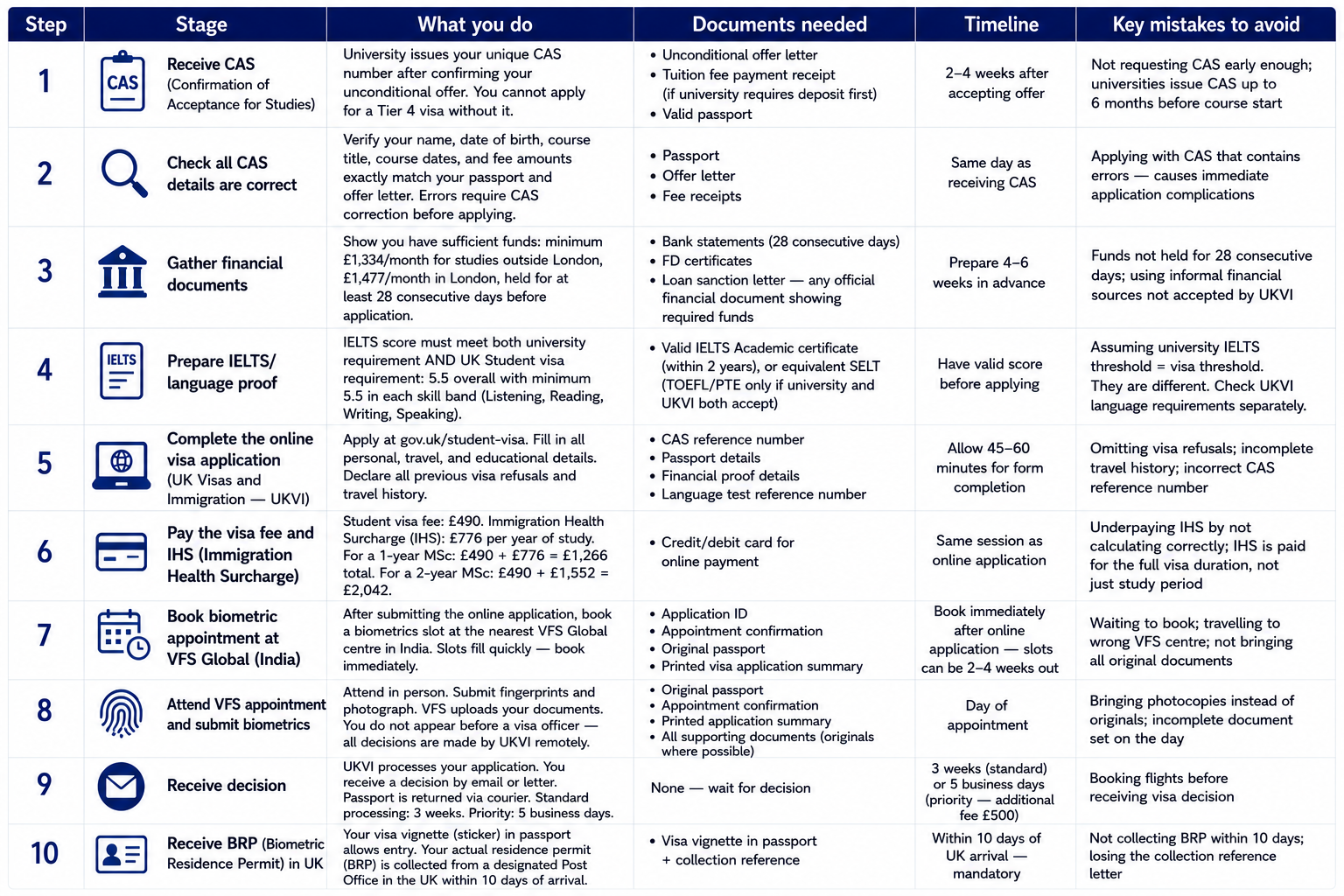
✅ Book your VFS appointment the day you submit your online application
VFS Global visa appointment slots in India (Mumbai, Delhi, Chennai, Kolkata, Hyderabad, Ahmedabad) fill 2–4 weeks in advance during peak intake seasons (April–August for September intake). Do not submit your online application and assume you can book a VFS slot the following week. Open the VFS booking portal in a second browser window simultaneously. The online application does not expire, but every day without a VFS appointment is a day of processing delay.
Financial Proof Requirements — The 28-Day Rule Explained
The UK Student visa financial requirement is one of the most misunderstood elements of the application. Funds must be held for 28 consecutive days ending no more than 31 days before your visa application date. The amount depends on whether your university is in London or outside London:
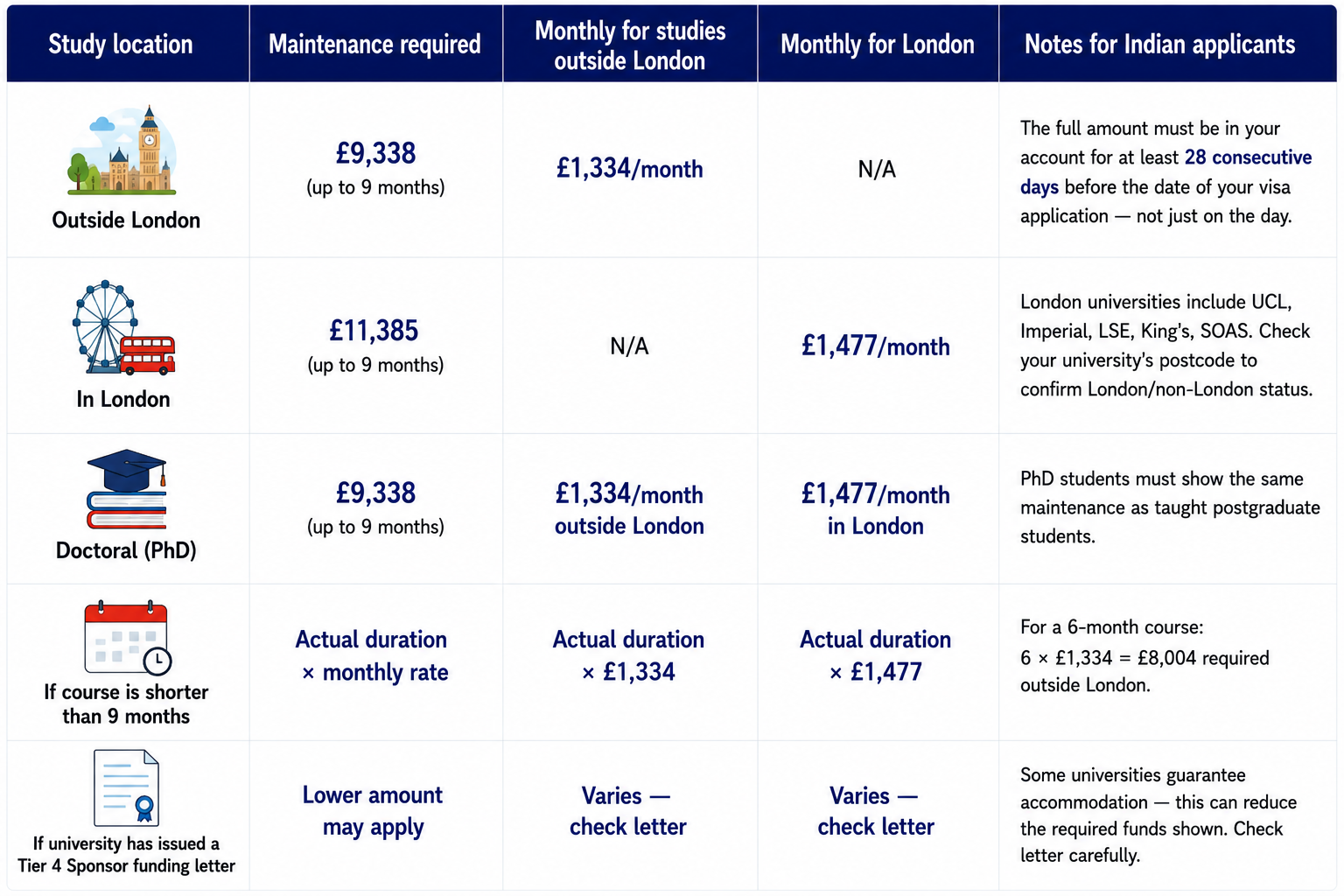
⚠️ The most common financial proof rejection cause
Sudden large deposits within the 28-day window are flagged as 'funds not genuinely available.' A student who receives an education loan disbursement and immediately shows it as their financial proof may face scrutiny if the bank statement shows a large transfer-in within the window. This is manageable — a loan sanction letter from a recognised lender (SBI, HDFC Credila, Avanse) is accepted as standalone financial proof by UKVI. If using a loan, the sanction letter may be more straightforward than showing 28 days of balance with a recent large deposit.
Complete UK Student Visa Document Checklist
This is the definitive document checklist for Indian students applying for a UK Student visa in 2026. Print this and tick off each document before your VFS appointment: a missing document on the day cannot be submitted later.
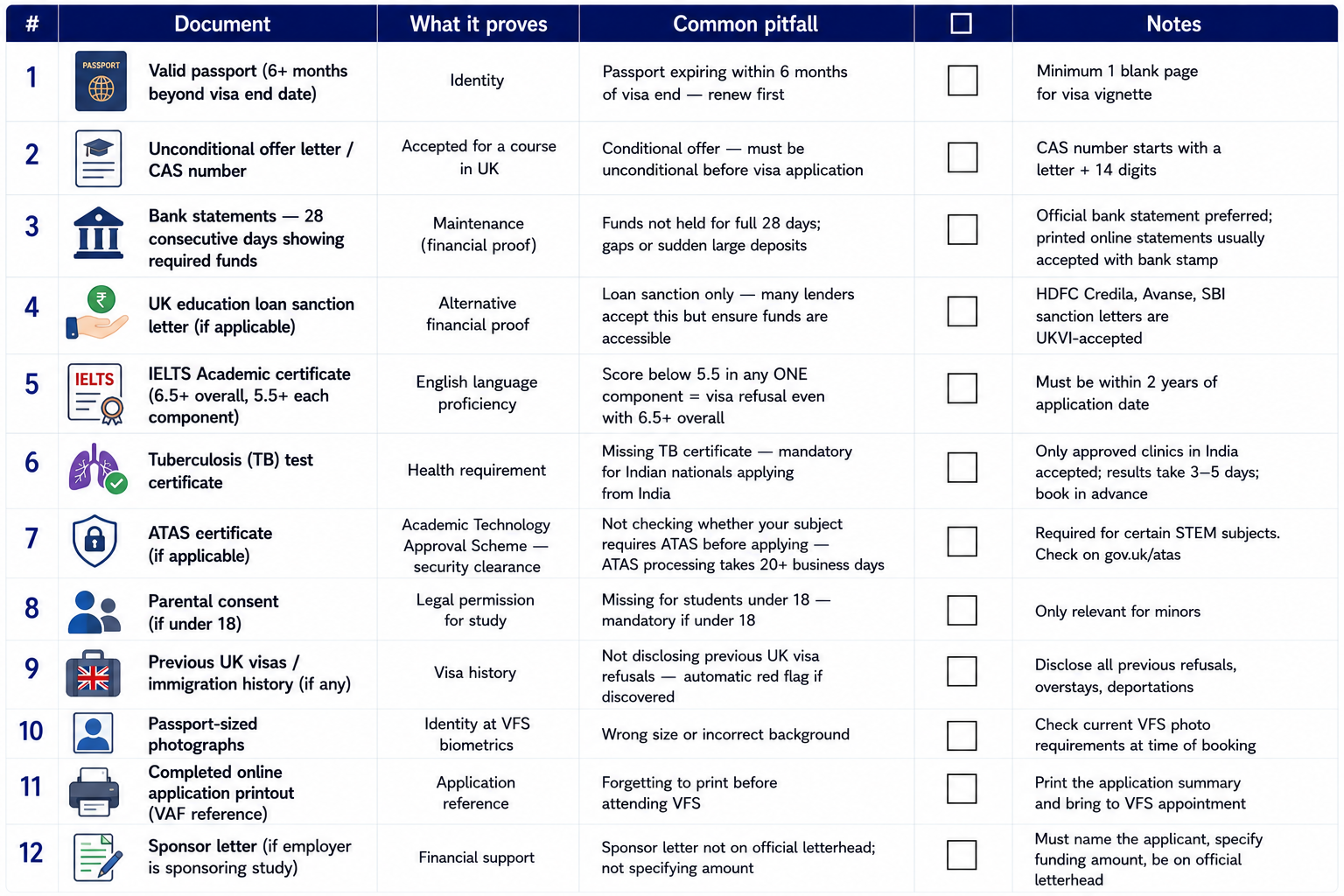
🔴 TB test — the document most Indian applicants forget
Tuberculosis (TB) test is mandatory for Indian nationals applying for a UK visa for more than 6 months. You must use a UK Visas and Immigration-approved clinic — not your local doctor, not a government hospital unless specifically approved. A list of approved clinics is on gov.uk. Allow 3–5 business days for results. Test validity: 6 months from the date of test. Book your TB test 4–6 weeks before your VFS appointment date to ensure your results are in hand.
ATAS — The Hidden Requirement for Many STEM Subjects
ATAS (Academic Technology Approval Scheme) is a UK government security check required for certain postgraduate and research-level courses in STEM subjects that could have dual-use defence applications. If your subject requires ATAS, you cannot apply for a UK Student visa without an ATAS certificate — and ATAS processing takes 20+ working days (sometimes longer).
Subjects that typically require ATAS:
Check whether your specific course title and topic requires ATAS at gov.uk/guidance/atas. The check is free. If ATAS is required, apply immediately on receiving your offer letter — do not wait until the visa application stage. A student who discovers they need ATAS two weeks before their VFS appointment will miss their intake.
💡 Not all STEM subjects require ATAS
Computer science, software engineering, data science, and most applied technology subjects do NOT require ATAS. Mechanical engineering (most applications) does not require ATAS. Aerospace engineering (some specialist research areas) may. The ATAS requirement is topic-specific, not subject-category-specific. Use the gov.uk checker with your specific course name before assuming either way.
IELTS Requirements — University vs Visa: The Critical Difference
This is the most consequential misunderstanding in UK student visa applications for Indian students. The IELTS minimum for the UK Student visa is not the same as the IELTS minimum your university requires for admission. They are set independently, and failing either one results in visa refusal or rejected application.
UK Student visa IELTS requirements (UKVI):
Your university may require IELTS 6.5 or 7.0 for admission. The visa requires 5.5 in all bands. Both requirements must be met — the higher of the two university requirements does not automatically satisfy the visa requirement, because the visa checks band-by-band minimums that the university may not. Check your individual band scores, not just overall.
2026 UK Immigration Policy Changes — What Indian Students Must Know
The UK immigration landscape changed significantly in 2025–26. The policy changes below affect every Indian student applying in 2026 and planning to study in the UK. Read this section before making any UK study decision based on an older blog post or counsellor advice from 2024.
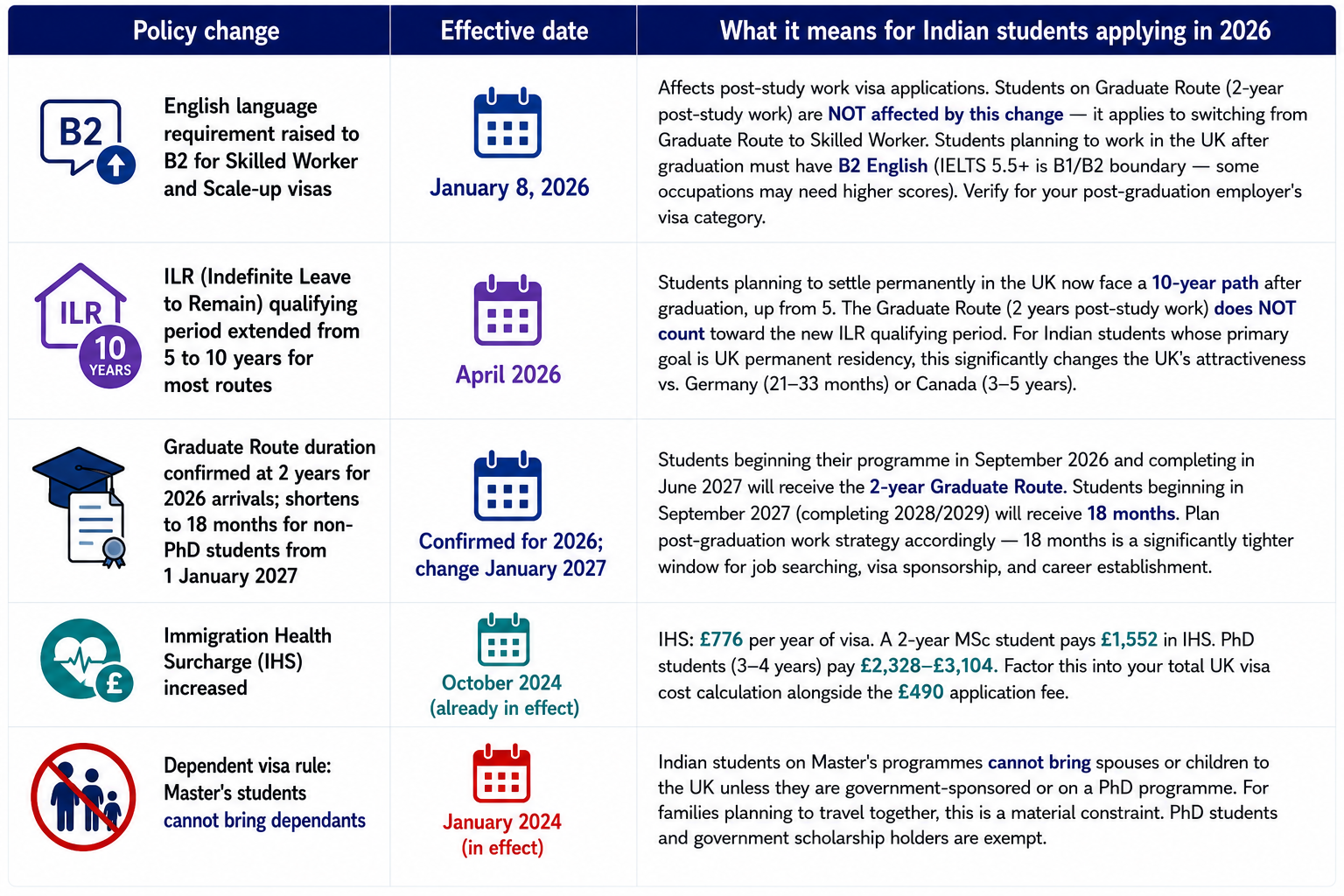
⚠️ ILR extension changes the UK's PR calculation permanently
For Indian students whose long-term goal is permanent residency, the ILR extension from 5 to 10 years fundamentally changes the comparison between UK and other destinations. A student who arrives in the UK in 2026 and follows the Graduate Route (2 years) + Skilled Worker visa (5+ years) path now faces settlement in 2038+ at the earliest — approximately 12–13 years from arrival. Germany's EU Blue Card PR pathway (21–33 months) and Canada's Express Entry CEC pathway (3–5 years from graduation) are dramatically faster. UK remains excellent for career and salary — but the 'UK as PR destination' argument is materially weakened by this change.
UK Student Visa Timeline — When to Do What
This is the recommended timeline for an Indian student targeting a September 2026 UK intake:
Frequently Asked Questions
Can I apply for a UK Student visa with a conditional offer?
No — you must have an unconditional offer before the university can issue your CAS, and your visa application requires the CAS. If you have a conditional offer (typically conditional on IELTS score or final exam results), you must satisfy the conditions and receive an unconditional offer before applying. Allow 2–4 weeks for the university to convert a conditional offer to unconditional and issue the CAS once conditions are met.
What happens if my UK Student visa is refused?
A refusal does not permanently bar you from reapplying. The refusal notice will state the specific reason — usually documentation gaps (financial proof, IELTS, TB test) or concerns about genuineness of study. You can submit a new application addressing the specific refusal reason, or appeal the decision if you believe it was made in error. Both options require you to address the specific reason stated in the refusal. Vidysea's student visa assistance includes pre-application document review specifically to prevent common refusal reasons — and post-refusal strategy if needed.
Do I need a study visa consultant or can I apply myself?
You can legally apply yourself — there is no requirement to use study visa consultants. The UKVI online application is publicly accessible, and the process is documented on gov.uk. The risk of self-application is the same as any complex document process: a missed detail, an incorrect form field, or a misunderstood requirement can result in refusal or processing delay. Student visa services from an experienced counsellor typically add value in three areas: ensuring financial documentation is structured correctly, verifying ATAS requirements, and double-checking IELTS band scores against visa (not just university) thresholds. These are the three most common sources of preventable refusals.
How long does the UK Student visa take to process from India?
Standard processing: 3 weeks from the date your biometrics are submitted at VFS. Priority processing (additional £500): 5 business days. Super priority (additional £1,000, available at select locations): 1 business day. Actual processing times can vary — UKVI publishes current processing time estimates at gov.uk/visa-processing-times. Always build a buffer of 2–4 weeks beyond the published estimate to account for any document verification or additional queries.
Can my parents visit me in the UK on a visitor visa while I study?
Yes — Indian parents can apply for a UK Standard Visitor visa (up to 6 months) to visit a child studying in the UK. A student's university enrolment letter, accommodation address, and proof of study are useful supporting documents for the visitor visa application to demonstrate the genuine purpose of the visit. Parents must show they intend to return to India and have sufficient funds for the visit. A student visa assistance counsellor can guide on the supporting documentation.
The UK Student visa process is detailed, sequential, and unforgiving of documentation errors. Every step depends on the step before it — a missing TB test discovered on the day of the VFS appointment cannot be remedied in time. The students who navigate it smoothly are those who start early, follow the checklist, check ATAS and IELTS band scores specifically, and have their financial documentation structured correctly before submitting the online application. Guidance for study abroad that accounts for the 2026 policy changes — ILR extension, Graduate Route timeline, English language B2 requirement for post-study employment — is the difference between applying correctly and applying on outdated assumptions.