

Got dreams to achieve? Hop on as we take you on your journey to success!


Services
Contact Info

Noida office
+91 7428715522Bangalore office
+91 8861432223 support [at] vidysea.com
Copyright@Vidysea
Got dreams to achieve? Hop on as we take you on your journey to success!
Noida office
+91 7428715522Bangalore office
+91 8861432223support [at] vidysea.comCopyright@Vidysea
Australia's Student Visa Subclass 500 is one of the most accessible student visas available to Indian students — a single visa subclass that covers all levels of study from diploma to doctoral programmes, issued online through ImmiAccount, and typically processed in 4–10 weeks. It offers full work rights during study (48 hours per fortnight during term, unlimited during holidays), a post-study work visa (Subclass 485) of 2–4 years after graduation, and access to Australia's strong healthcare and tech employment markets.

Team Vidysea
Published Updated

However, for Indian students applying in 2026, the Australian Department of Home Affairs (DHA) changed the assessment framework materially. India was reclassified to Evidence Level 3 (EL3) — the highest scrutiny tier. This means every Indian student's application is assessed more carefully, particularly the Genuine Temporary Entrant (GTE) statement — the document that explains why you are genuinely coming to Australia to study and genuinely intending to return to India afterwards. A generic GTE that might have passed in 2022 is now routinely queried or refused at EL3.
This guide covers the complete Australia Subclass 500 visa process for Indian students in 2026: the 10-step application process, the document checklist with EL3-specific preparation notes, the GTE statement quality framework, visa conditions, and how to prepare for study in Australia as an Indian applicant in the current environment. All 5 keywords in this guide reflect actual student visa assistance content that Vidysea provides as study visa consultants for Australian applications.
India at Evidence Level 3 — what this means for every Indian applicant in 2026
DHA's Evidence Level framework classifies countries by the assessed risk of visa fraud and non-genuine student intent. India was reclassified to EL3 (the highest scrutiny level) in 2025. Practically, this means: (1) Every Indian student's GTE statement is read by an officer who has been trained to identify non-genuine intent. Generic GTEs are rejected. (2) Financial documentation is reviewed more carefully — recent large deposits without source documentation raise flags. (3) Applications from Indian students receive more scrutiny than they did before EL3. This is not a ban — it is heightened assessment. Strong, specific, genuine applications from Indian students continue to be approved.
Australia Subclass 500 — 10-Step Application Process
This is the complete sequential process for Indian students applying for the Australia Student Visa Subclass 500. Steps must happen in this order — each depends on the previous:
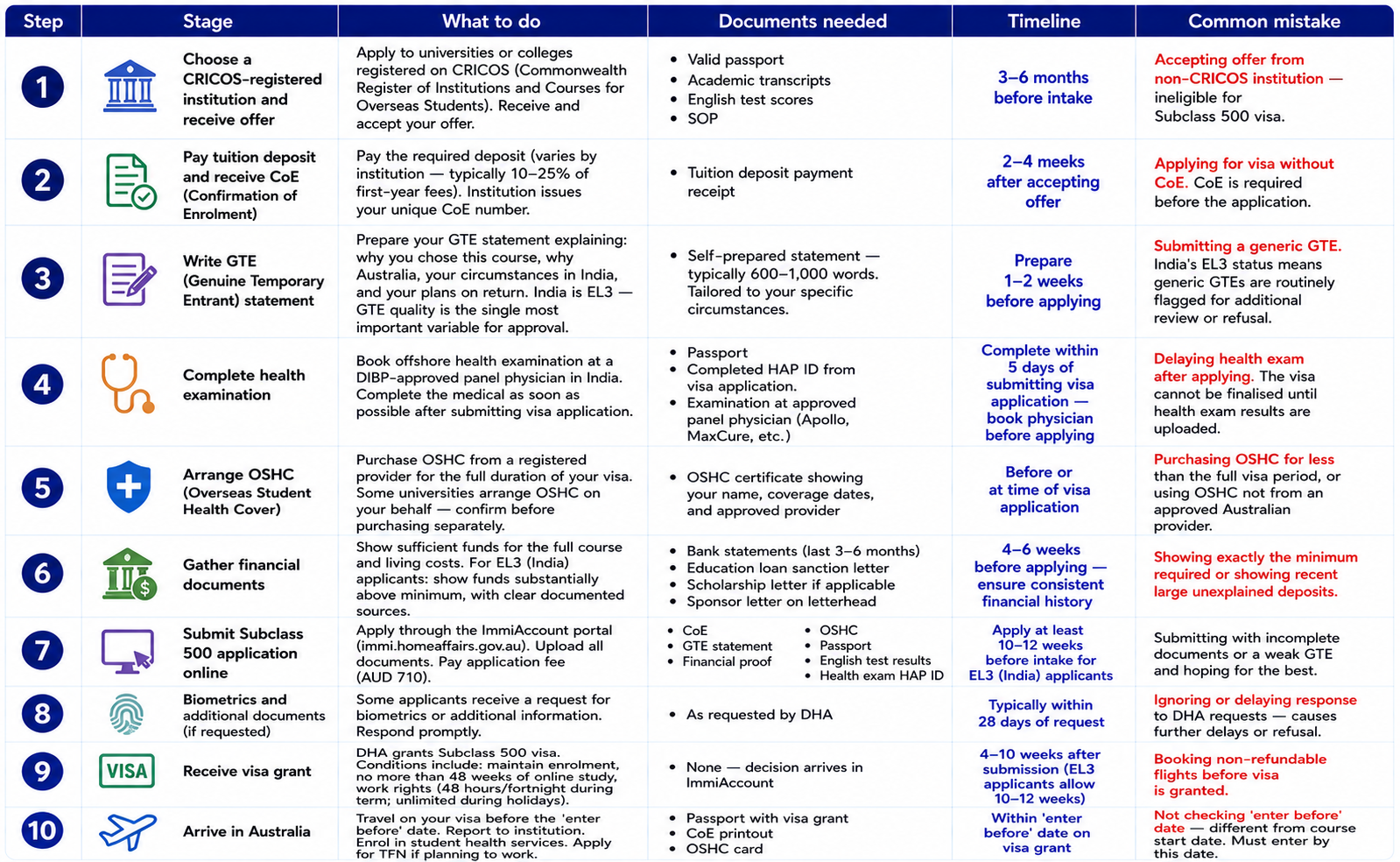
Apply 10–12 weeks before intake for EL3 (Indian) applicants
Pre-EL3 (before 2025), most Indian students could apply 6–8 weeks before intake and receive a decision in time. Post-EL3, processing times for Indian applications have increased. Vidysea recommends applying 10–12 weeks before your intended intake date. The health examination must also be completed within 5 days of application — book your panel physician appointment before submitting so you can attend immediately.
The GTE Statement — The Most Important Document for EL3 Applicants
The Genuine Temporary Entrant (GTE) statement is the assessment framework DHA uses to determine whether your primary motivation for coming to Australia is study, or whether it might be immigration. For Indian students at EL3, the GTE statement is the single most important document in your Subclass 500 application — more important than any financial document or academic record.
The GTE assessment evaluates six dimensions. Here is the difference between a weak response (which flags refusal risk at EL3) and a strong response (which demonstrates genuine intent):
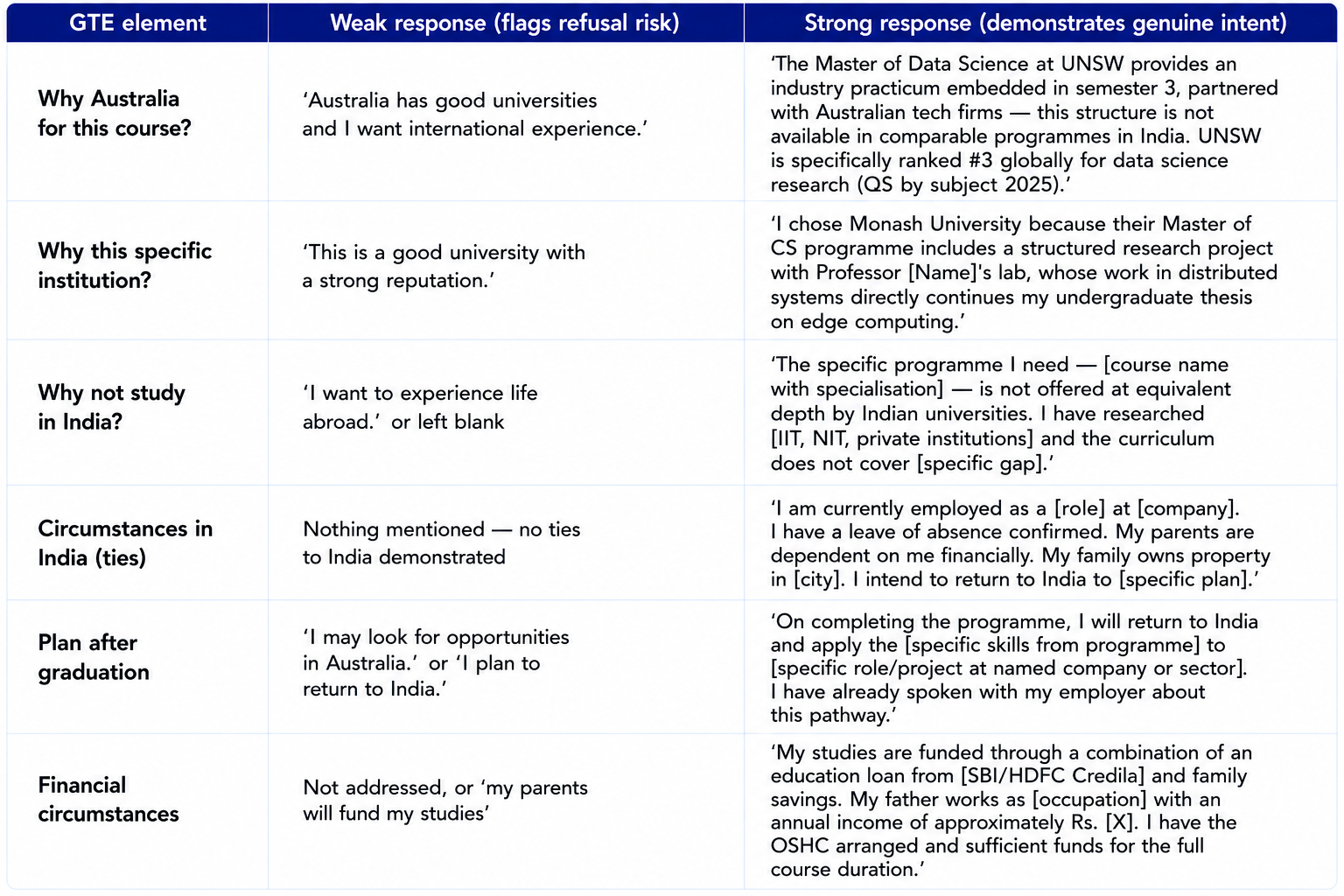
The most common GTE mistake for Indian students at EL3
The most common GTE failure pattern for Indian applicants is a statement that is: (1) Generic — could apply to any student from any country. (2) Vague about Australia specifically — does not name the specific advantage of the Australian programme vs. alternatives. (3) Silent on ties to India — does not mention employment, family, property, or any specific plan for return. A DHA officer reading 200 EL3 applications per week recognises a template GTE in the first two sentences. Write your GTE as a specific, factual account of your individual circumstances — not as a persuasive essay.
Complete Subclass 500 Document Checklist — EL3 (India) 2026
Print and use this checklist before submitting your application. The 'Common Indian applicant issue' column is the most important column — it identifies the specific preparation errors that cause refusals or additional document requests for Indian applicants at EL3:
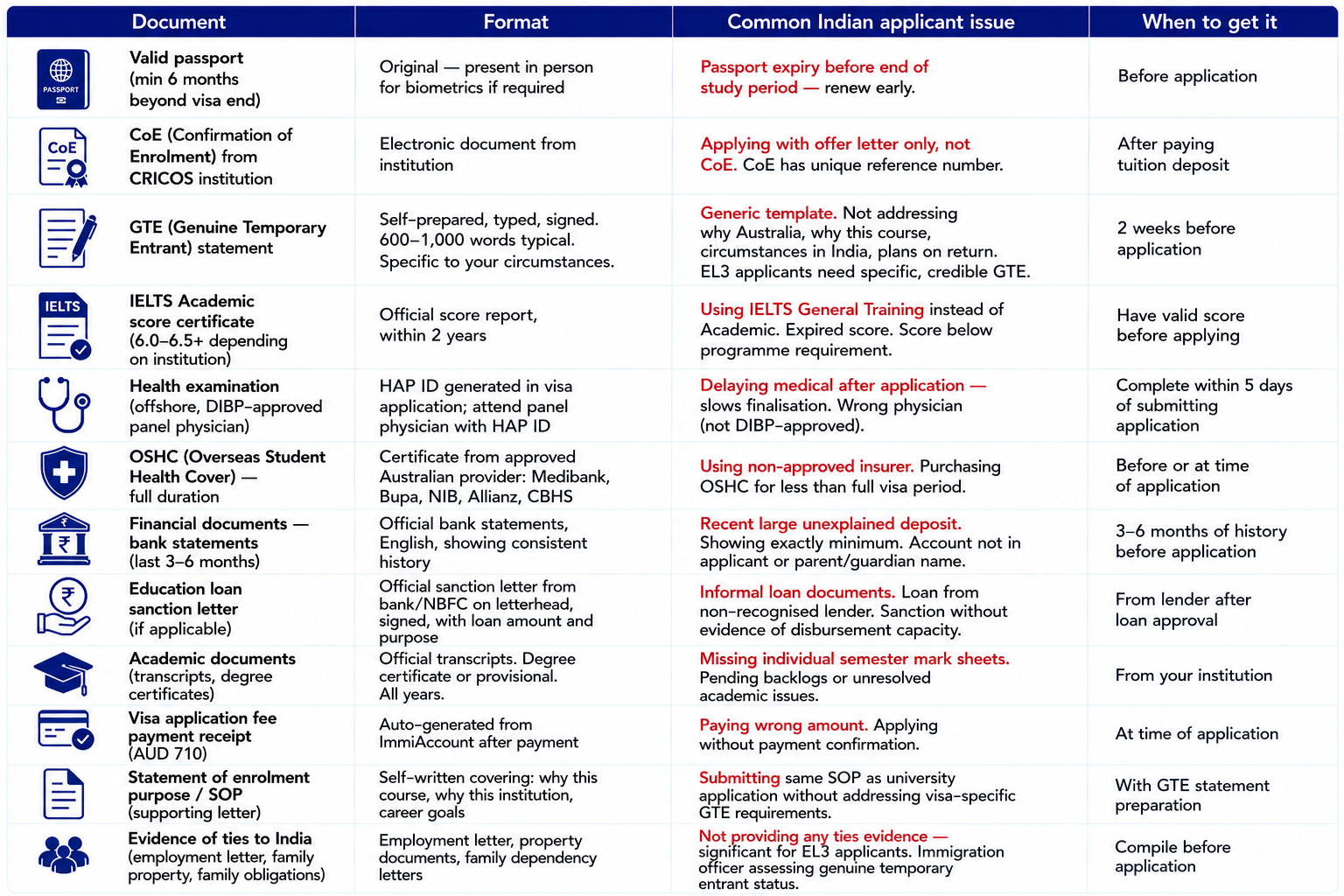
The ties-to-India evidence row is critical for EL3 applicants
The 'evidence of ties to India' requirement does not have a single prescribed document — it is assessed holistically across your whole application. For Indian students at EL3, this means: mention your employment, your employer's leave-of-absence confirmation, your family's circumstances, any property your family owns, and any specific plan for your return. These do not have to be separate formal documents — they can be integrated into a well-constructed GTE statement. But leaving ties to India entirely unaddressed in an EL3 application is a material weakness.
Financial Proof for Australia — What EL3 Means for Indian Applicants
The financial proof requirement for Australia Subclass 500 is broadly stated as 'sufficient funds for tuition + living + travel.' For EL3 (Indian) applicants in 2026, showing exactly the minimum is a weaker application position than showing comfortably above the minimum with a consistent, well-documented financial history.
What DHA looks for in financial documents from India:
Subclass 500 Visa Conditions — What You Must Do After Grant
Understanding your visa conditions before you travel is part of how to prepare for study abroad correctly. Breaching visa conditions can result in visa cancellation — which has more serious consequences than a visa refusal:
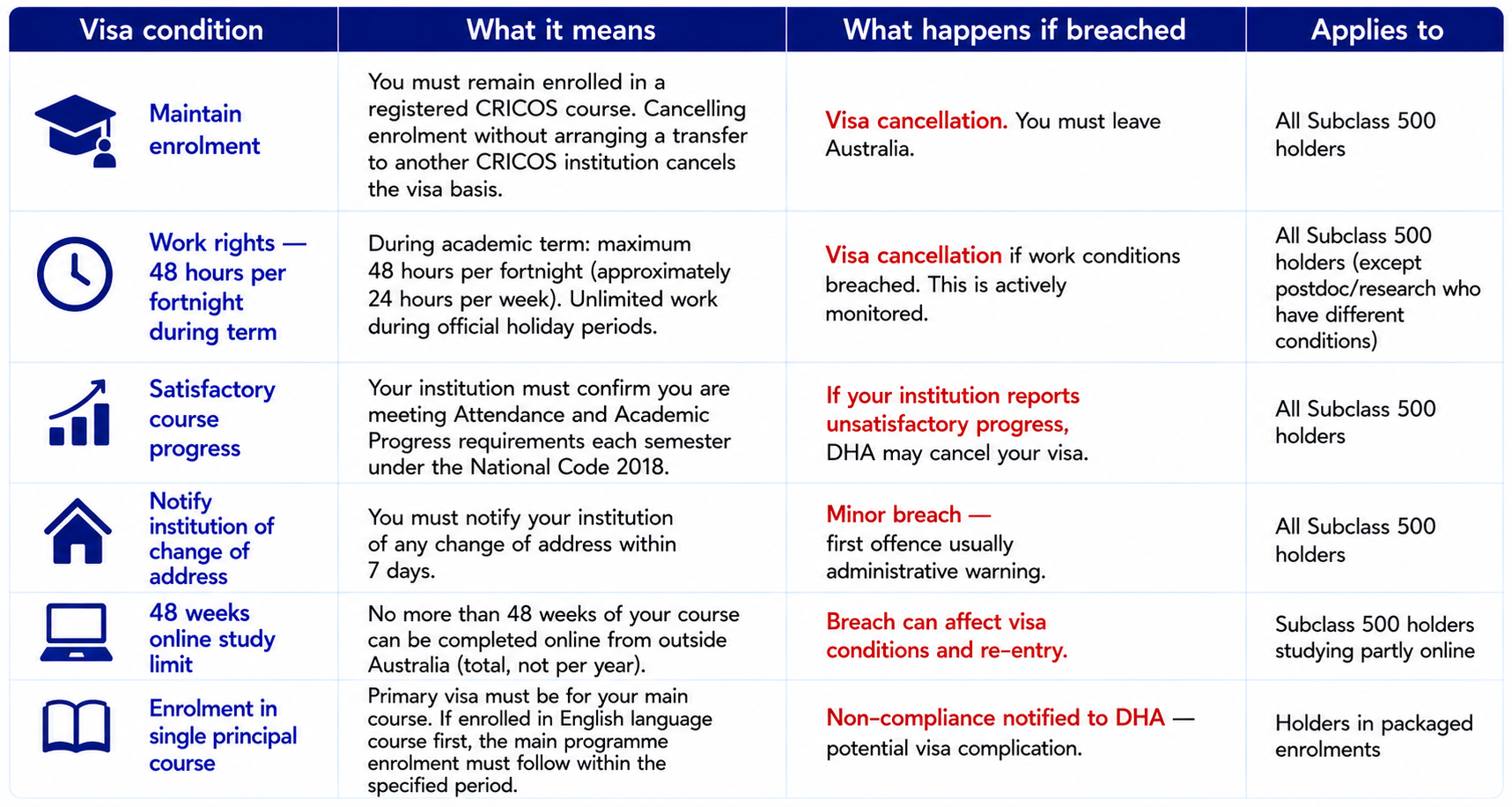
The 48-hour work limit is per fortnight, not per week
Many Indian students read '48 hours per fortnight' as '48 hours per week.' The correct calculation: 48 hours per two-week period = 24 hours per week during academic term. During official institution holiday periods (typically December–February and June–July), there is no work limit. Indian students planning to work while studying should understand this limit clearly — working more than 48 hours in a fortnight, even once, constitutes a visa breach that can be monitored and acted upon.
After Graduation — Subclass 485 Post-Study Work Visa
After completing a degree at an Australian institution, Indian graduates can apply for the Temporary Graduate Visa (Subclass 485) — a post-study work visa that provides full work rights in Australia:
For Indian students, the Australian PR pathway typically takes 3–5 years from graduation — longer than Germany (21 months) but faster than the UK post-ILR extension (10+ years). State nomination (Subclass 190) can accelerate the process for high-demand occupations in specific states.
Frequently Asked Questions
Can I bring family members (spouse, children) to Australia on a Subclass 500 visa?
For Indian students on Master's programmes: no — the dependent visa rule change (effective 2024) means most international Master's students cannot bring spouses or children to Australia. Exceptions apply to government-sponsored students and PhD students, who may bring dependants. This is a material change from pre-2024 policy and affects families planning to move together for a Master's degree. PhD students considering Australia should verify their dependent eligibility with a student visa assistance counsellor before confirming their programme choice.
Is a GTE statement the same as a Statement of Purpose (SOP)?
No — they serve different purposes. Your SOP is written for the university admissions committee to assess your academic fit for the programme. Your GTE statement is written for the DHA visa officer to assess whether you are a genuine temporary entrant who intends to return to India. The GTE should address the visa-specific dimensions: ties to India, why Australia specifically (not just why this university), financial circumstances, and return plans. A SOP that focuses only on academic interests and career goals without addressing immigration intent dimensions is not sufficient as a GTE. Most students need to write a separate document — or significantly revise their SOP — to meet GTE requirements for EL3 assessment.
My Australian student visa application was refused — what can I do?
A refusal notice from DHA will specify the basis. For GTE refusals: the most common path is to reapply with a substantially revised and more specific GTE that addresses the exact deficiency noted. You can also seek Administrative Appeals Tribunal (AAT) review if you believe the officer's decision was in error — though AAT review takes time and involves an additional fee. If your refusal was based on financial proof: restructure your financial documentation to address the specific concern. Student visa assistance from a counsellor who has handled Australian EL3 refusals specifically is the most valuable resource at this stage — pattern knowledge of what revised GTEs and financial presentations have succeeded after refusal is not publicly available.
Does the health examination need to be done before the visa application?
No — you submit your application first and receive a Health Assessment Priority (HAP) ID number. You then attend a DIBP-approved panel physician with your HAP ID for the examination. DHA recommends completing the examination within 5 days of submitting your application to avoid delays. Book your panel physician appointment before you submit so you can attend immediately after receiving your HAP ID. Panel physicians in India: Apollo Hospitals (Delhi, Mumbai, Chennai), MaxCure, and other approved providers listed on the Australian Embassy website.
The Australia Subclass 500 visa process is well-documented and entirely predictable for Indian students who understand the EL3 framework and its specific implications. The GTE statement is not an afterthought — it is the document that determines approval or refusal for most Indian applicants in 2026. Guidance for study abroad that prepares you to write a specific, factual, ties-inclusive GTE before your application goes in is the single most valuable preparation investment for an Australian student visa application. A strong GTE — specific about why Australia, specific about the programme, specific about circumstances in India, specific about return plans — succeeds at EL3. A generic one does not.