What Happens During a Study Abroad Counselling Session?
Most families who book a study abroad counselling session for the first time do not know what to expect. Some bring a folder of academic certificates thinking documents will be reviewed immediately. Others come expecting to be talked through a ranked list of universities. A few have read so many blogs that they arrive wanting to confirm a decision they have already made. None of these is quite right — and the gap between what families expect and what actually happens in a good counselling session is worth explaining clearly, because the session delivers more value when you understand what it is built to do.

Team Vidysea
June 2, 2026

A study abroad counselling session at Vidysea is not a consultation where a counsellor reads from a list of universities and confirms your instincts. It is a structured analysis of the gap between where you are (academic profile, financial position, career goal, timeline) and where you need to be (the right programme, in the right country, with the right funding, on a realistic visa pathway) — with a specific, personalised recommendation at the end that you can act on the same day.
This guide explains exactly what happens — before, during, and after a Vidysea guidance for study abroad session. It covers the first session (country selection), all other session types, what the AI profiling tool actually measures, and what counselling honestly cannot do for you.
🎯 What makes Vidysea's approach different from a traditional consultation
Most overseas education consultants begin with a conversation and end with a university list. Vidysea begins with an AI profile analysis — 43 destinations scored across 8 dimensions, updated within 48 hours of any policy change — and the counsellor's role is to interpret the data, not generate it intuitively. The AI handles what can be systematised (destination scoring, policy currency, admission probability data). The counsellor handles what cannot: reading unstated goals, navigating family dynamics, applying pattern knowledge from hundreds of prior applications, and making final recommendations with genuine accountability.
Before the Session — What to Think About, Not What to Bring
You do not need to bring any documents to your first counselling session. No academic transcripts, no bank statements, no offer letters. The first session works with information you carry in your head. What is worth thinking about before you arrive:
- What is your actual goal — career quality, specific salary, permanent residency, a particular country for family reasons, or academic prestige? Being honest about which of these matters most will make the session more useful.
- What is your timeline — are you targeting September 2026, January 2027, or further out? A tighter timeline changes the recommendations significantly.
- What financial resources are available — rough family savings, whether property exists for collateral, expected loan amount? You do not need exact figures; approximate is enough for the first session.
- Have you already decided on a country — or are you genuinely open? If you have already decided, it is worth knowing why, so the counsellor can tell you whether the reasons are solid or based on assumptions that may be outdated.
- Is this session for you alone, or is a parent or family member involved in the decision? Both are welcome — and knowing who the decision-makers are helps the counsellor direct the most important information appropriately.
That is the full preparation list. Five questions to think through. No documents, no preparation materials, no reading required. The session works from wherever you currently are.
The First Session — What Happens in 30 Minutes
The Vidysea first session follows a consistent structure. Here is what happens at each stage:
Minutes 0–2: Introduction and goal clarification
The counsellor opens with a structured set of questions about your academic background, field, career goal, and timeline. This is not small talk — it is the input data for the AI profiling tool. The counsellor types your answers into the system in real time. The questions cover: current academic status (CGPA, degree, year of graduation), field of study, target academic level (master's, PhD, MBA), work experience if any, career goal in one sentence, and approximate budget.
Minutes 2–15: AI profile analysis and country scoring
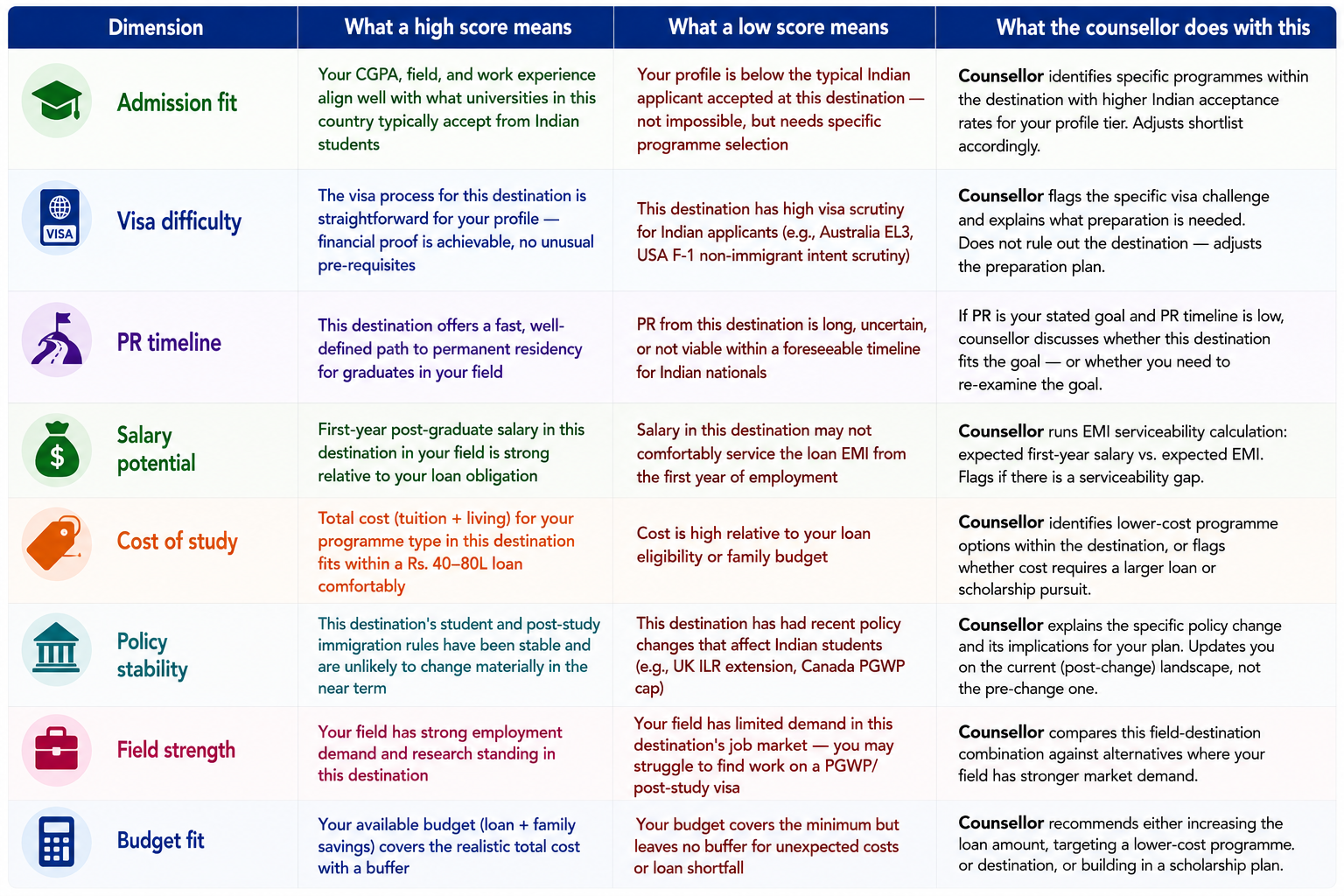
With your input data entered, the AI system runs the profile analysis. The output: your profile scored across 43 destinations and 8 dimensions — admission fit, visa difficulty, PR timeline, salary potential, cost of study, policy stability, field strength, and budget fit. The results appear as a country ranking with scores. The counsellor shares this with you immediately — you see the same data the counsellor sees.
This is often the most surprising moment in the first session. The AI ranking frequently produces a different top-3 from the student's stated preference. A student who said 'I want to go to the UK' may see Germany or Canada scoring higher on their stated goal (PR) because the UK's ILR extension in April 2026 has lengthened the PR pathway to 10+ years. A student who said 'I'm open to any English-speaking country' may see Ireland or Singapore scoring unexpectedly high for their specific field. The data is the starting point for a conversation — not a final answer.
Minutes 15–25: Counsellor interpretation and exception discussion
The counsellor spends the middle section explaining the AI's output: why specific countries scored high or low, which scores reflect 2026 policy changes versus stable long-term patterns, and where the AI's recommendation might need to be overridden based on context the algorithm cannot capture.
The most common override situations: a student has family already living in a specific country (the AI cannot weight this). A student has a specific supervisor relationship in Germany (the algorithm does not know). A student's family strongly prefers a particular country for cultural reasons. The counsellor's job is to confirm whether the algorithm is right and explain why, or to identify where the student's specific situation is an exception to the general pattern.
Minutes 25–30: Next steps and action plan
The session closes with a specific action plan: the recommended top-2 destinations with rationale, the IELTS target score for those destinations, a rough loan eligibility check (the counsellor asks about co-applicant income and collateral to confirm whether the required loan is achievable), and the three most important actions to take in the next 2 weeks.
You leave the first session with: a written country recommendation (emailed after the session), your AI score sheet for all 43 destinations, a personalised timeline showing key milestones for your target intake, and a clear first action — IELTS preparation, programme research, or loan pre-assessment depending on your current position. No generic brochure. No 'we'll send you a proposal in a few days.'
The 8 AI Dimensions — What Each Score Actually Means
Every destination in the Vidysea system is scored on 8 dimensions. Here is what each dimension measures and how the counsellor uses it:
✅ The single most important dimension for most Indian students: PR timeline
For most Indian students who state that long-term settlement abroad is their goal, the PR timeline dimension is the most critical score in the analysis. Germany scores highest on this dimension (21 months to PR via EU Blue Card) — and most Indian students are not aware of this. Canada scores second (3–5 years via Express Entry CEC). The UK, post-April 2026 ILR extension, now scores significantly lower than it did in 2023–2024 analysis. The AI's PR timeline score is updated within 48 hours of official policy changes — so it reflects the current landscape, not the landscape from 18 months ago when most available blogs were written.
All Vidysea Session Types — When to Book Each One
The first session is one of seven study abroad counselling session types at Vidysea. Each serves a specific purpose at a specific stage of the application journey:
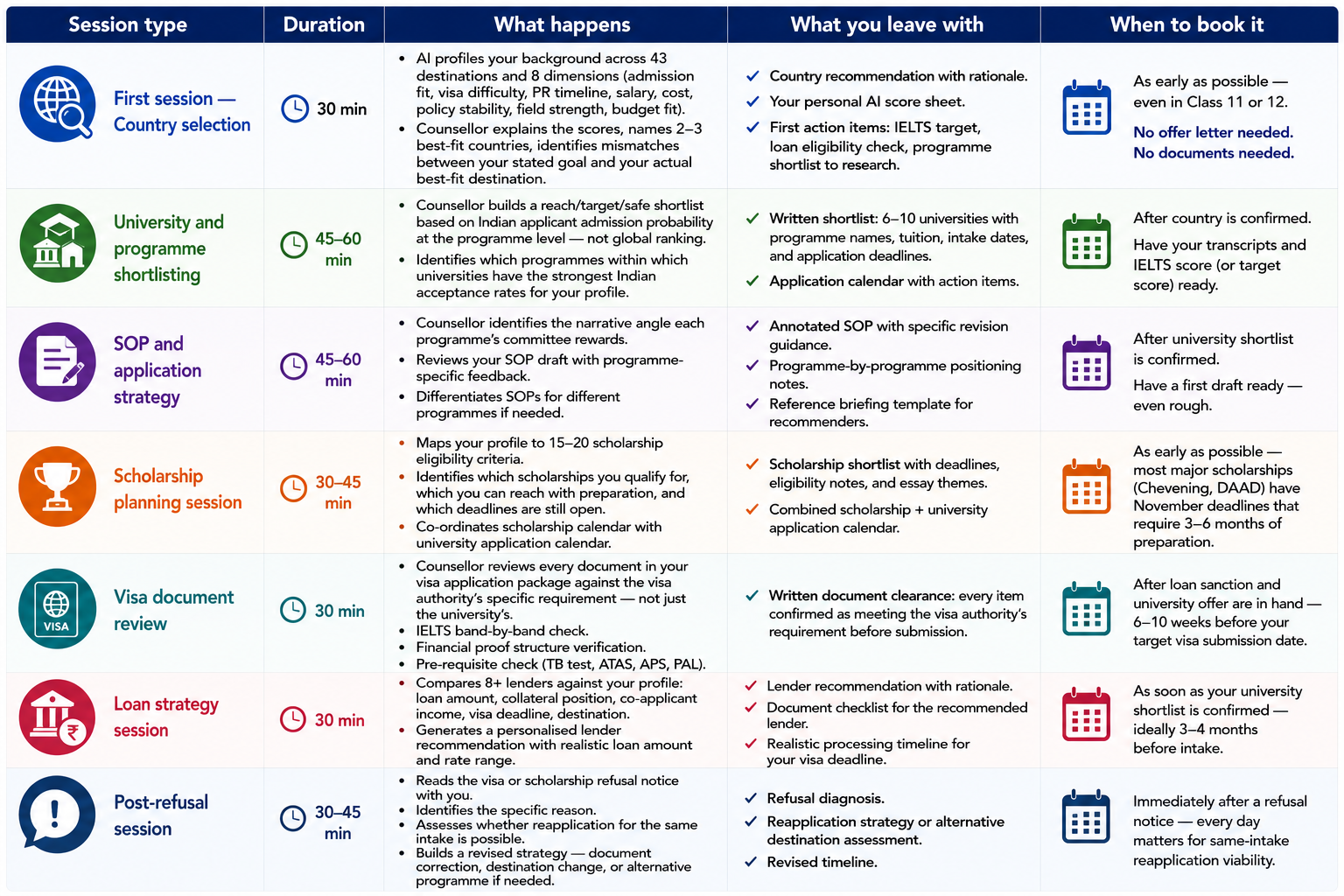
💡 You do not need to use all seven session types
Some students use only the first session and the visa document review. Others work through the full sequence from country selection to pre-departure briefing. The right combination depends on where you need guidance and where you are confident proceeding independently. Vidysea does not require a long-term engagement — each session can be booked individually, and there is no obligation to continue after any session.
Online vs In-Person — How Both Work at Vidysea
Online sessions are conducted via Google Meet or Zoom, with screen sharing so you see the AI profile analysis in real time as the counsellor builds it. The experience is equivalent to an in-person session for every session type except those involving physical document review (visa document review sessions, where physical originals need to be checked, are better conducted in person when geography allows).
In-person sessions are available at Vidysea centres. In-person is preferred for the visa document review session, first sessions where parents are attending (the shared physical presence often makes the conversation more productive for families navigating a significant financial decision together), and post-refusal sessions where emotional context is present.
For students in tier-2 and tier-3 cities across India where in-person access is not viable: online sessions deliver the same AI analysis, the same counsellor expertise, and the same written deliverables. The geographical barrier to quality study abroad counselling has been eliminated by online delivery.
What Study Abroad Counselling Cannot Do — Honest Limits
Good counselling is honest about what it does not provide. These are the things a study abroad counselling session at Vidysea cannot do, and what you should do instead:
We do not write your essays for you
SOP and scholarship essays are written by you, not by us. The counsellor's role is to identify the narrative angle, provide specific feedback on drafts, and ensure the essay addresses what the committee is actually evaluating. The voice, the content, and the experiences in your essay must be yours. An essay written by a counsellor and submitted in your name is academic dishonesty and is increasingly detectable by admissions committees. We brief, review, and revise — we do not write.
We cannot guarantee admissions or visa approvals
No study visa consultant or overseas education counsellor can guarantee that a university will offer you admission or that a visa authority will approve your application. Our role is to maximise the quality of your application and minimise preventable errors. The final decisions rest with universities and visa authorities — institutions with their own criteria, their own cohort considerations, and their own discretion. Counsellors who guarantee outcomes are making promises they cannot keep.
We cannot override visa refusal decisions
If a visa is refused, the correct response is diagnosis and reapplication — not an appeal that overturns the decision. In the UK, applicants can request Administrative Review for certain refusal types. For study permit refusals in Canada, applicants can reapply or apply for reconsideration. In Australia, Administrative Appeals Tribunal review is available. These are legitimate processes. What counselling provides in these situations is specific diagnosis of the refusal reason and the best strategy for a revised application — not the ability to reverse the decision.
We cannot make the process faster than the visa authority allows
UKVI processes UK student visas in 3 weeks standard. IRCC processes Canadian study permits in 8–12 weeks. These are government processing timelines. No amount of student visa assistance from any consultant speeds up the government's processing — our role is to ensure your application is complete and correct before it goes in, so it is not delayed by avoidable errors or additional document requests.
Frequently Asked Questions
Do I need to have a university offer letter before booking a counselling session?
No. The first session specifically does not require an offer letter — it works at the planning stage, before any applications have been submitted. In fact, the first session is most valuable before you apply, because it shapes which universities you apply to and in which country. Students who come with an offer letter already in hand can still benefit from counselling — the session shifts to confirming whether the offer is from the right institution, advising on the visa process, and ensuring the financial structure is correct. But the most strategic time to start is before any applications are submitted.
Can my parents attend the counselling session?
Yes — and for first sessions involving significant financial decisions, parent attendance is actively encouraged. Study abroad is typically a Rs. 40–80L family investment, and the country recommendation, loan discussion, and visa implications are more productive when the full decision-making unit is present. For online sessions, parents can attend via the same video call. For in-person sessions, we allocate sufficient space. The counsellor is used to addressing both the student's academic and career goals and the family's financial and practical questions simultaneously.
What if I disagree with the AI's country recommendation?
The AI recommendation is the starting point, not the final word. You are explicitly invited to disagree with it — and if you do, the counsellor's job is to understand why you disagree and assess whether your reasoning is based on sound information or on an assumption that may be outdated. 'I want to go to the UK' is a legitimate preference. If the counsellor shows you that the UK's ILR extension means your PR goal takes 10+ years vs. Germany's 21 months, and you still choose the UK for career or network reasons, that is an informed decision. The AI creates the basis for an honest conversation — not a constraint on your choice.
How is a Vidysea session different from reading blogs and watching YouTube videos?
Blog posts and YouTube videos provide general information — they cannot apply it to your specific profile, your specific financial situation, your specific co-applicant income, your specific visa deadline, or the policy changes that happened last month. The Vidysea AI scores your profile against current policy data. The counsellor brings pattern knowledge from hundreds of prior students with similar profiles — knowledge of which programmes have historically accepted students from your institution tier, which SOP approaches have worked for career-changers in your field, which visa errors have caught Indian applicants at specific destinations. That combination of personalised data and pattern knowledge is the guidance for study abroad that blogs and videos cannot replicate.
A study abroad counselling session is not a service that replaces your effort — it is a service that directs it productively. The students who get the most from counselling are those who come with honest questions, genuine openness to recommendations that differ from their initial assumptions, and the willingness to act on the specific next steps identified. The session generates clarity. What you do with that clarity determines the outcome.