When Should You Start Study Abroad Counselling?
Most students begin looking for study abroad counselling after they have already made critical decisions — chosen a country, shortlisted universities, or in some cases, after they have already received an offer letter. This is almost always too late. The decisions made in the months before you ever speak with a counsellor — your subject choices, your exam preparation, your academic record, your extracurricular profile — are often the very decisions that determine which universities you are realistically eligible for.

Team Vidysea
May 26, 2026

This guide is built for students who want to get study abroad right from the start. It covers exactly when to begin counselling for study abroad, what happens at each stage of the process, how study abroad scholarships fit into the timeline, and what changes depending on whether you are applying for an undergraduate, postgraduate, or PhD programme. If you are reading this and you are already behind, there is a section for that too.
The short answer: for most students targeting a September intake, overseas education counselling should begin 18–24 months before your intended programme start date. For students targeting competitive universities or major scholarships, 24–30 months is the appropriate lead time. But the right time to start is always earlier than you think — and earlier than most counsellors will tell you.
Why the Timing of Study Abroad Counselling Matters More Than Most Students Realise
There is a widespread misconception that overseas education counselling is primarily about paperwork — filling out application forms, preparing documents, and submitting visa applications. In reality, the most impactful part of the counselling process happens long before any application opens. A counsellor who meets you six weeks before an application deadline can help you with your statement of purpose and your document checklist. A counsellor who meets you 18 months before the deadline can help you build the profile that makes your application competitive in the first place.
The difference between these two types of engagement is not marginal. It is the difference between applying with the profile you happen to have and applying with the profile you deliberately built for the universities you are targeting.
Here is what early counselling can actually change:
- Subject and stream selection in Class 11 or 12 that aligns with intended undergraduate programmes abroad
- Timing and strategy for standardised tests — IELTS, TOEFL, GRE, GMAT, SAT — including multiple attempts where needed
- Academic preparation that targets specific GPA or percentage benchmarks required by target universities
- Identification of study abroad scholarships with early deadlines that most students miss entirely
- Selection of extracurricular activities, research projects, or work experience that strengthens specific applications
- Country and university shortlisting based on realistic eligibility, not aspirational assumptions
None of these decisions can be reversed or fixed at the application stage. Once your grades are what they are and your test scores are set, a counsellor can only work with what exists. Starting early means having the ability to build what you need.
The Right Timeline: When to Start Based on Your Programme Level
The appropriate starting point for study abroad counselling varies depending on whether you are applying for an undergraduate, postgraduate, or doctoral programme. Here is the full breakdown:
Undergraduate Programmes — Start in Class 10 or Early Class 11
Undergraduate study abroad applications are among the most complex because they require the longest lead time. Many of the decisions that determine your eligibility and competitiveness are made in Class 10 and 11 — years before you ever submit an application.
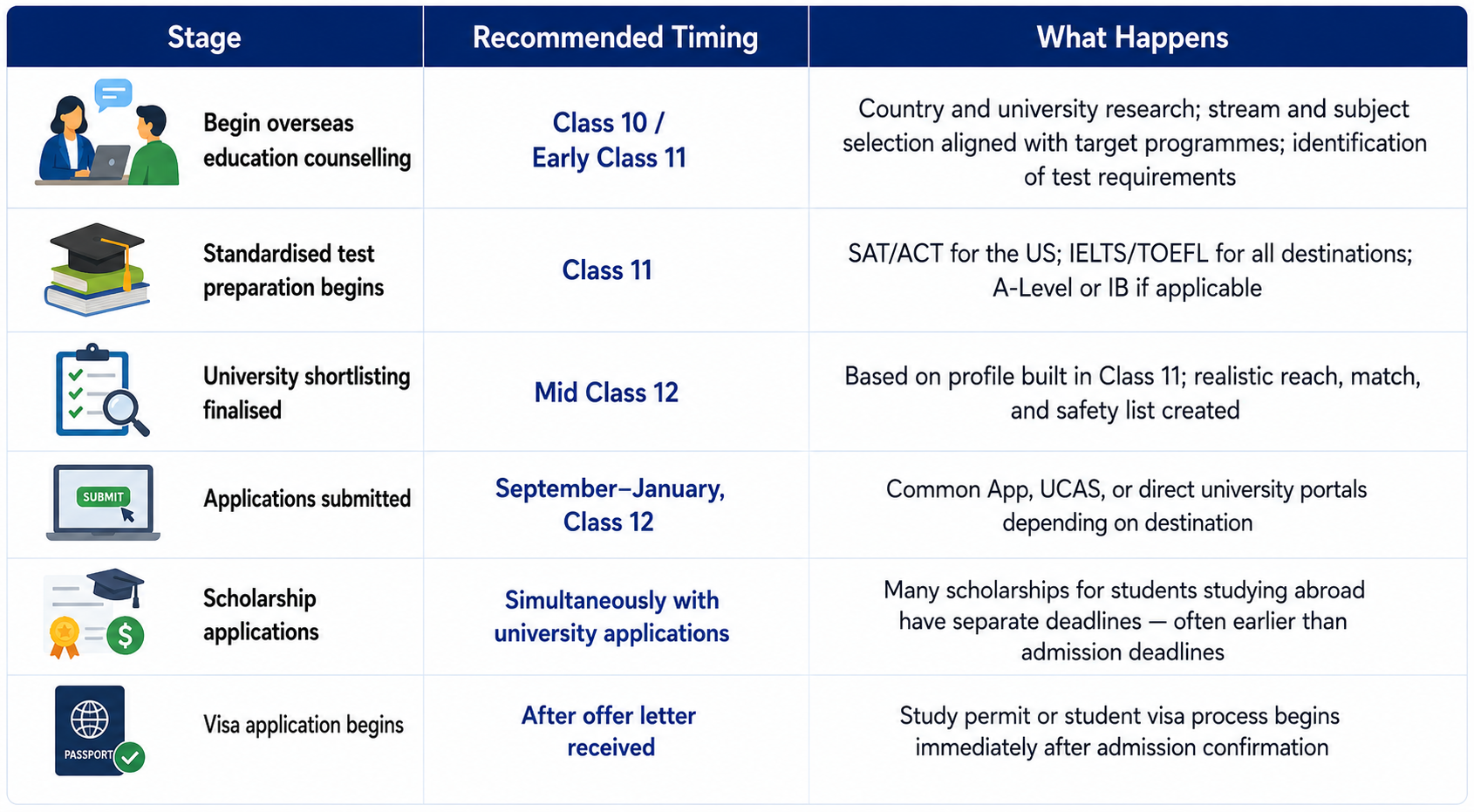
The most common mistake for undergraduate applicants: starting counselling in Class 12 after results are out. At this point, the academic record is fixed, test preparation has often been rushed, and the window for major study abroad scholarships has closed. Counselling in Class 12 is not useless, but it is reactive rather than strategic.
Postgraduate Programmes — Start 18 Months Before Intended Intake
For Master's and MBA applicants, the recommended start point for study abroad counselling is 18 months before the intake you are targeting. For a September 2026 intake, that means beginning in March 2025 at the latest — and ideally earlier.
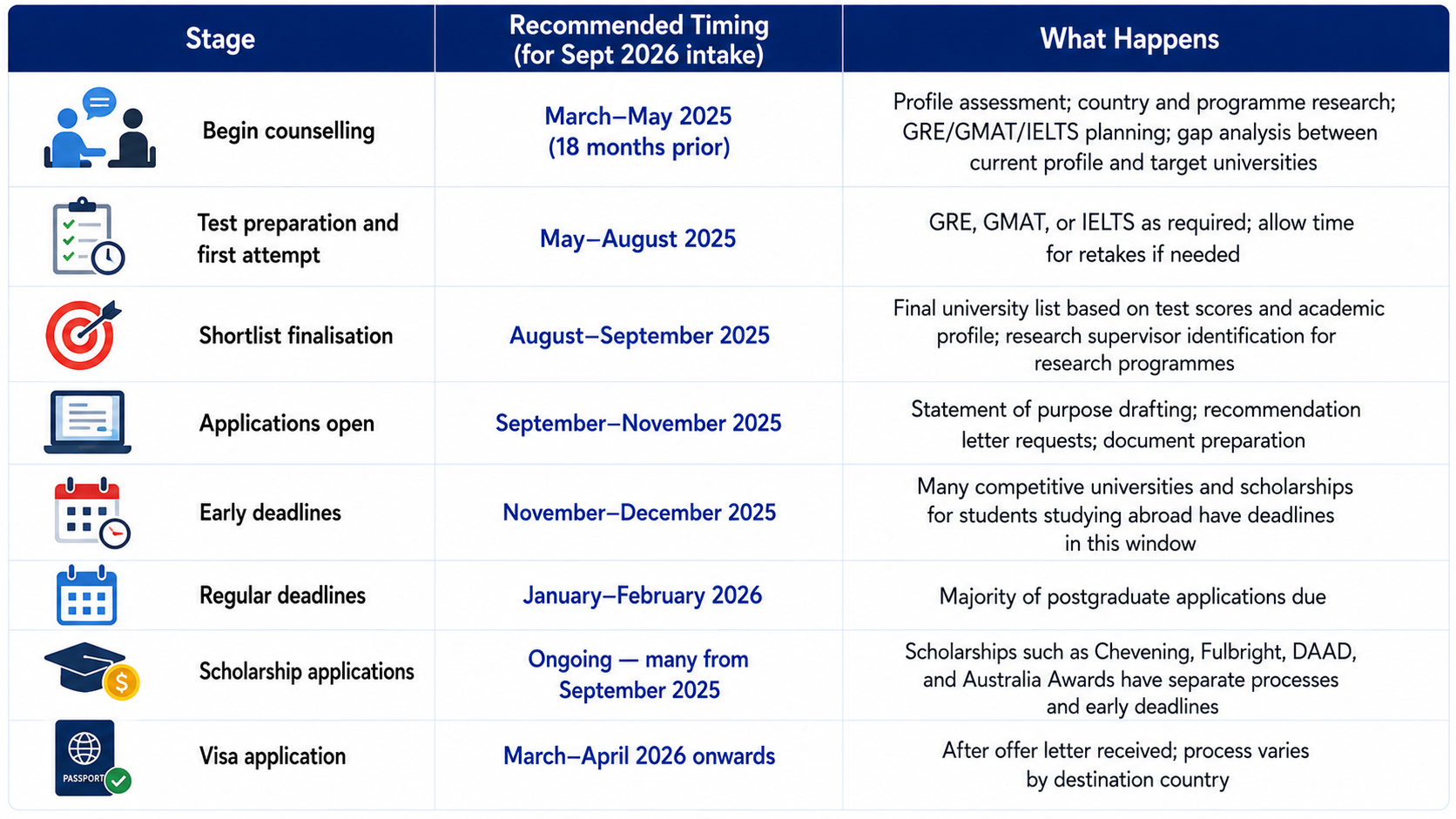
For MBA applicants specifically: most top business schools have Round 1 deadlines in September–October, Round 2 in January, and Round 3 in March–April. Applying in Round 1 significantly improves both admission and study abroad scholarships outcomes at most schools. Round 1 requires that counselling begins no later than 12 months before the intake — and preferably 18 months.
PhD Programmes — Start 24 Months Before Intended Intake
Doctoral applications have a different structure from undergraduate and postgraduate programmes. Rather than applying through a centralised portal to a department, PhD applicants often need to identify and contact specific supervisors before submitting a formal application. This process takes time — and it is one of the most important parts of counselling for study abroad at the doctoral level.
- Identify potential research supervisors 18–24 months before intended start: this involves reading recent publications, identifying alignment with your own research interests, and making initial contact
- Develop or refine your research proposal 12–18 months before start: a strong research proposal is the single most important document in a PhD application
- Apply for scholarships for students studying abroad 12–18 months before start: fully-funded PhD positions and major doctoral scholarships (Commonwealth, Rhodes, Gates Cambridge) have early deadlines and highly competitive processes
- Submit formal applications 9–12 months before start: after supervisor interest is established
PhD applicants who have not yet identified supervisors and are applying six months before their intended start are typically applying blind — without the relationship-building that significantly increases success rates at competitive research universities. The 24-month recommendation for doctoral counselling is not conservative; it reflects the actual timeline of successful PhD applications to research-intensive institutions.
Study Abroad Scholarships — Why Early Counselling Is Non-Negotiable
One of the most consequential reasons to begin overseas education counselling early is the scholarship timeline. The largest and most valuable study abroad scholarships — the ones that can fund your entire programme — almost always close earlier than university admission deadlines, require separate applications, and reward students who have built a specific profile over time, not students who discovered them at the last moment.
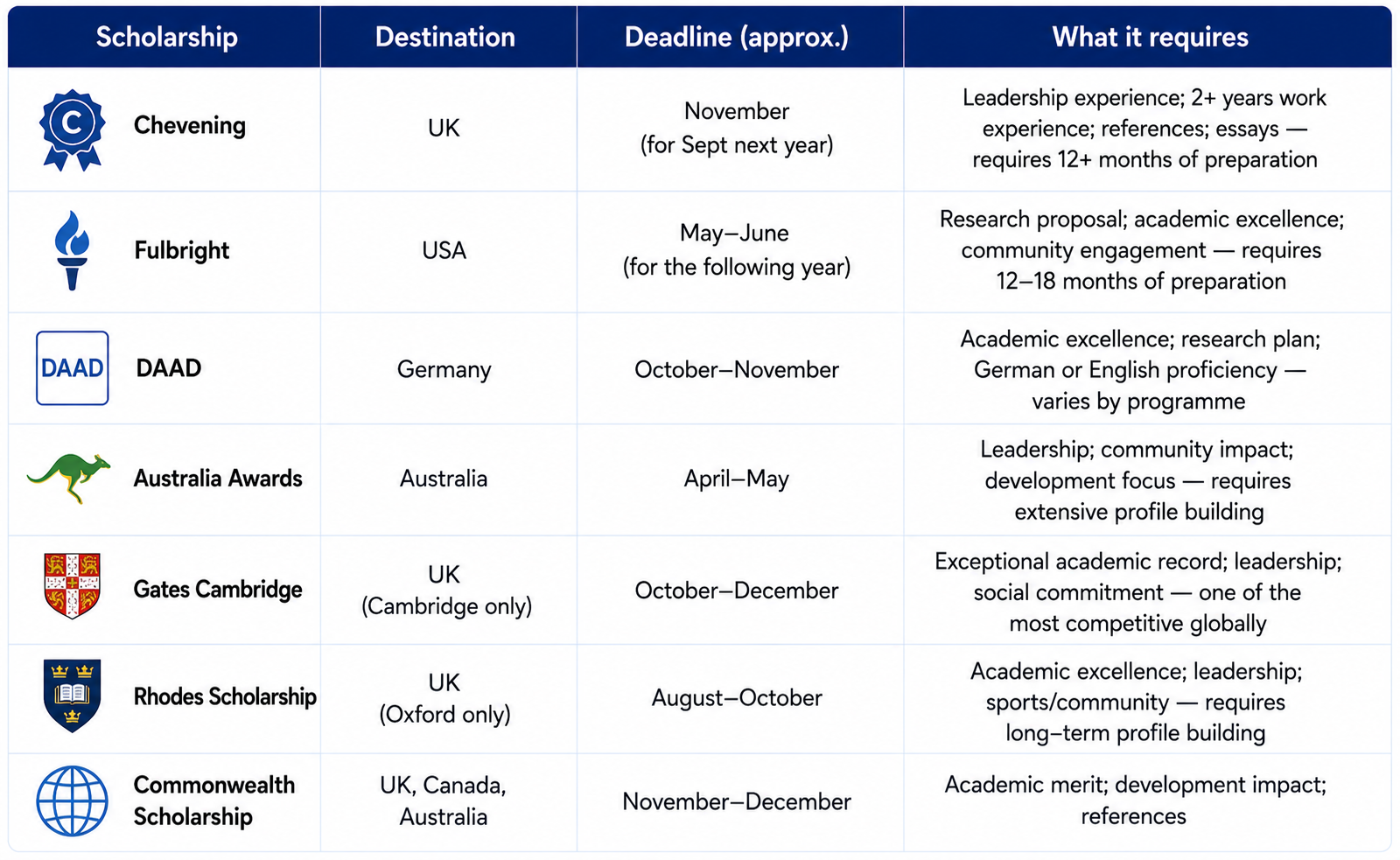
Most students who miss out on scholarships for students studying abroad do not miss out because they were ineligible. They miss out because they discovered the scholarship after the deadline had passed, or they applied without adequate preparation because they did not have enough lead time to build the required profile and materials.
Early study abroad counselling identifies the scholarships you are eligible for — or could become eligible for — and builds your preparation around their requirements and timelines. This is not something that can be done reactively in the weeks before a deadline.
Scholarship counselling is not the same as admission counselling. A counsellor who helps you get into a university is not automatically equipped to help you win a scholarship. Ask specifically about scholarship strategy and track record when selecting a counselling service. Vidysea's overseas education counselling includes scholarship identification and application support as a core part of the process — not an add-on.
Signs You Should Start Overseas Education Counselling Right Now
Regardless of where you are in the process, the following situations are clear signals that counselling for study abroad should begin immediately:
- You are in Class 10 or 11 and considering studying abroad for your undergraduate degree — stream and subject choices made now will directly affect your eligibility
- You are in your final year of graduation and planning a Master's abroad — applications open in 6–8 months and test preparation should already be underway
- You have a target country but no clarity on which universities are realistic for your profile
- You are interested in study abroad scholarships but have not yet identified which ones you are eligible for or what their deadlines are
- You have already appeared for IELTS or TOEFL but are unsure if your scores are sufficient for your target universities
- You have received an offer letter but are uncertain about the visa process, financial requirements, or whether the programme is the right fit
- You applied last cycle and were either rejected or did not receive the scholarship you were hoping for
In every one of these situations, waiting is not neutral — it costs you options. The earlier you begin, the wider the range of universities, countries, programmes, and scholarships available to you.
What Study Abroad Counselling Actually Covers — And What It Should Cover
There is significant variation in what different providers offer under the label of study abroad counselling. Some providers focus exclusively on the application process — helping you fill forms and prepare documents. Others offer a more comprehensive engagement that begins with your profile and continues through to your visa and pre-departure preparation. Here is what a complete counselling process should include:
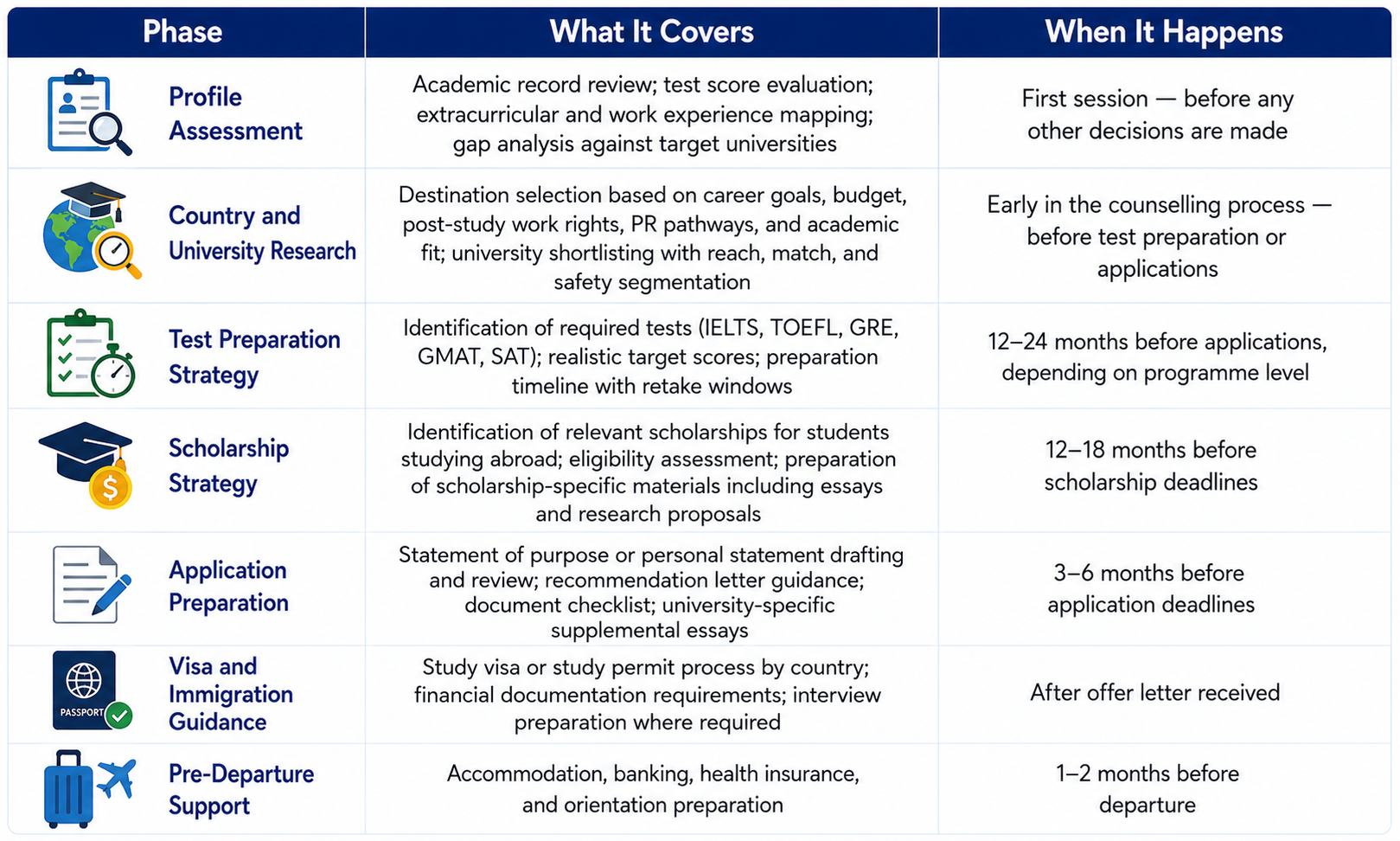
If a counselling service is only engaging with you at the application preparation stage — or only handling visa paperwork — you are not receiving the full value that overseas education counselling should provide. The earlier stages of profile building, test strategy, and scholarship planning are where the most significant outcomes are shaped.
What If You Are Starting Late? What You Can Still Do
Not every student has the option of starting 18–24 months before their intended intake. If you are already inside that window, the question is not whether to begin study abroad counselling — the answer is always yes — but what to prioritise given the time available.
If You Have 12 Months
This is still a workable window for most postgraduate applications. Prioritise: completing and if necessary retaking your English proficiency test; finalising your university shortlist; beginning your statement of purpose with adequate revision time; and identifying scholarships with deadlines in this window. Some major scholarship deadlines will have passed, but many — including destination-specific and university scholarships — will still be accessible.
If You Have 6 Months
Six months is a tight but usable window for the current intake cycle. At this stage, the focus shifts entirely to what is achievable now: test scores you currently have, a shortlist of universities with deadlines still open, and visa preparation. A realistic assessment of your profile against genuinely accessible universities — rather than aspirational targets — is essential. A strong study abroad counselling engagement at this stage will be honest about where you stand and what is achievable in the current cycle versus what might be better targeted in the next one.
If You Have 3 Months or Less
At three months or less before an intake, the current cycle may or may not be realistic depending on your destination and programme. For countries with extended visa processing times — Canada (8–12 weeks regular stream), Australia (4–8 weeks), UK (3 weeks) — three months from application to departure is compressed but possible for students whose documents and test scores are already in order. If your profile is not yet complete, targeting the following intake cycle with a strong preparation plan is often the better decision.
Starting late does not mean starting wrong. A counsellor who tells you everything is fine and rushes you into applications you are not ready for is not serving your interests. The right counselling at any stage includes an honest assessment of what is realistic for the current cycle and what a stronger plan for the next cycle would look like.
How to Choose the Right Study Abroad Counselling Service
The quality of counselling services varies enormously, and the wrong choice — particularly one that leads to a weak application, a missed scholarship, or an avoidable visa refusal — can cost you a year or more. Here is what to look for:
- Transparent track record: the counselling service should be able to show you specific outcomes — admission rates, scholarship wins, visa success rates — not just testimonials
- Destination expertise: counsellors who cover all destinations equally rarely have the depth of knowledge for any one country that a specialist provides; ask specifically about their expertise in your target destination
- Scholarship coverage: confirm whether scholarship counselling is included, how many scholarship applications they assist with, and what their success rate is for the specific scholarships relevant to your profile
- Process coverage: a full-service provider should cover every stage from profile assessment to pre-departure, not just applications or just visas
- Honest assessment: the first session should include a realistic evaluation of your profile against your target universities — not reassurance designed to convert you into a paying client
Vidysea's approach to counselling for study abroad is built around early engagement, honest profile assessment, and outcomes-driven preparation. If you are at any stage of the study abroad planning process — from initial research to final visa application — the right time to begin is now.
Frequently Asked Questions
Is there a specific age or year when study abroad counselling should begin?
There is no fixed age, but there are programme-specific windows that reflect how the application process actually works. For undergraduate programmes, Class 10 or early Class 11 is the ideal starting point. For postgraduate programmes, 18 months before the intended intake. For doctoral programmes, 24 months. The underlying principle is the same across all levels: overseas education counselling is most valuable when it begins before the decisions that shape your application are made — not after they are already fixed.
Can I start study abroad counselling before I know which country I want to study in?
Yes — and this is often the best starting point. Country selection is one of the first things a comprehensive study abroad counselling engagement should address, based on your academic profile, career goals, budget, preferred post-study work rights, and long-term immigration interests. Starting without a country in mind is not a problem; it is an opportunity for the counselling process to help you make that decision correctly rather than by default.
Do I need to complete my undergraduate degree before seeking counselling for a Master's abroad?
No. For a Master's programme, the ideal time to begin counselling is during the penultimate year of your undergraduate degree — when you still have time to improve your academic record if needed, and when test preparation can happen without the pressure of final examinations. Beginning in your final year is acceptable but compressed; beginning after graduation is possible but means you are working with a fixed profile.
Are study abroad scholarships only for academically exceptional students?
No. While academic merit is a factor in most scholarships for students studying abroad, many major scholarships weight leadership, community impact, professional experience, research potential, and development focus as heavily as academic scores. Chevening, for example, requires two years of work experience and emphasises leadership above grades. Australia Awards focuses strongly on development impact. There are also destination-specific, university-funded, and programme-specific scholarships with a much wider range of eligibility criteria. A comprehensive study abroad counselling engagement will identify the scholarships you are realistically competitive for — not just the ones with the highest name recognition.
What is the difference between study abroad counselling and a visa consultant?
A visa consultant focuses exclusively on the visa or study permit application process — document preparation, financial proof, and submission. Study abroad counselling is a broader engagement that covers every stage from profile assessment and country selection through to visa and pre-departure preparation. A complete counselling service includes visa guidance as one component, not as the entirety of what it offers. If a provider describes itself as offering overseas education counselling but only engages with you at the visa stage, it is functioning as a visa consultant under a broader label.
How long does the complete study abroad process take from counselling to arrival?
For a September intake, the full process — from first counselling session to arrival in the destination country — typically spans 18–24 months for students beginning at the recommended stage. This includes profile building, test preparation, application submission, offer receipt, scholarship applications, visa processing, and pre-departure preparation. Students who compress this timeline to 6–12 months are working through the same stages but with less time to build their profile, retake tests, or prepare scholarship applications — which directly affects outcomes.