10 Questions to Ask Your Study Abroad Consultant Before Signing Up — and What the Answers Tell You
A study abroad consultant is asking you to trust them with a decision worth Rs. 30–80 lakh, two years of your life, and — if the goal is permanent residency — the next two decades. Before you sign anything, you should interview them as carefully as they interview you. The study abroad consulting industry in India is large, fast-growing, and unregulated. The best counsellors in it are genuinely expert — current on policy, honest about admission probabilities, and transparent about their commercial relationships with universities. The worst are running a volume business, recommending universities they have partnerships with, and giving advice that has not been updated since 2023. The ten questions below are designed to tell you which kind you are sitting across from. They are not aggressive questions — a good counsellor will welcome every one of them. If a counsellor becomes defensive, deflects, or gives vague answers to any of these, that is the answer.

Team Vidysea
May 16, 2026

How to use this guide
Print this list or save it on your phone before your first session with any counsellor. Ask each question directly. The answers — and particularly the non-answers — will tell you more about the counsellor's quality than any testimonial on their website. The table below shows you what a good answer sounds like and what a bad one sounds like, for each question.
The 10 questions — with good and bad answer benchmarks.
| NO | The question to ask | A good answer sounds like… | A bad answer sounds like… |
|---|---|---|---|
| 1 | How do you choose which countries to recommend — and how recent is that information? | "We start from your profile, not from a default list. Our country recommendations are updated every intake cycle — our counsellors track policy changes in real time." | "We recommend the USA, UK, Canada, and Australia primarily." (If they lead with a destination list before knowing your profile, the process is backwards.) |
| 2 | Can you show me the admission probability data you use — not overall university rankings, but specifically for Indian applicants to my target programmes? | "Yes — here is how Indian applicants performed in the last two intakes at your shortlisted universities, by department and intake round." | "The QS ranking shows this university is top 100, so your chances are good." (Rankings tell you nothing about your profile's admission probability.) |
| 3 | What is your counsellor's personal experience with my specific target country — how many students have they placed there in the last 12 months? | "I have placed 18 students in Germany in the last year. Here are the common challenges at the APS stage and how we managed them." | "We have placed thousands of students across many destinations." (Vague volume claims reveal nothing about specific expertise.) |
| 4 | Do you charge a fee for the first session, and what exactly does it cover? | "The first session is free. It covers a profile assessment, a country shortlist, and a clear next-steps plan. You pay nothing until you decide you want to continue." | "We charge a registration fee of Rs. 10,000 to begin the process." (Any pre-session fee before you have received value should prompt scrutiny.) |
| 5 | How do you keep your policy information current — and can you tell me about a major policy change that happened in the last 6 months? | "UK's ILR qualifying period extended from 5 to 10 years in April 2026. Canada's 50% study permit cap exempts Master's and PhD students. Australia reclassified India to Evidence Level 3." (Any of these, stated correctly, signals live knowledge.) | "We stay up to date with all changes." (If they cannot name a specific recent policy change, they are not actually tracking them.) |
| 6 | What is your process if a visa is refused — are there additional fees, and will you support an appeal? | "If a visa is refused due to documentation reasons, we support the appeal or reapplication at no additional fee. If it is refused due to a factor outside our control, we will discuss options and pricing transparently." | "Visa refusal is outside our scope." (A counsellor who washes their hands of visa refusals was not really reviewing your documentation carefully in the first place.) |
| 7 | Will my SOP and application be reviewed by a person — and who specifically? | "Your SOP is reviewed by your assigned counsellor, who has read at least 50 successful SOPs for your target university and field. You will have at least two revision rounds." | "Our team reviews all applications." (Vague team attribution without a named counsellor means no accountability for quality.) |
| 8 | Can you show me a real outcome — a student similar to my profile, and what happened to them? | "A student from a similar background with a similar CGPA applied to RWTH Aachen. Here is their timeline, APS experience, and where they are now. We can connect you if you'd like." | "We have many success stories on our website." (Generic success stories without specifics are marketing, not evidence.) |
| 9 | Do you receive university referral commissions — and does that affect which universities you recommend? | "Yes, we receive commissions from partner universities, and we will tell you which ones. We also recommend non-partner universities when they are the right fit for your profile. Here is how we distinguish between the two." | "We are completely independent." (Almost no consultant is truly commission-free. The honest answer acknowledges the structure and explains how it is managed.) |
| 10 | What happens if I am unhappy with the counselling — is there a refund or escalation process? | "If you are unsatisfied before we submit any applications, we will refund any fees paid beyond the first session, or we will reassign you to a different counsellor at no additional charge." | "All fees are non-refundable after signing." (No accountability mechanism is a red flag for any service relationship of this magnitude.) |
The commission question is the most important one
Most study abroad consultants in India receive referral commissions from partner universities — typically 10–20% of the first year's tuition fee. This is legal, common, and not inherently a problem. It becomes a problem when it is undisclosed and when it shapes which universities are recommended. A counsellor who does not disclose their university partnerships when asked directly is either unaware of the conflict of interest or choosing not to address it. Neither is acceptable for a decision of this size.
Three questions that deserve more than a one-sentence answer.
Most of the ten questions above can be answered in a sentence or two. Three of them reveal much more when examined in depth.
Question 5: Current policy knowledge.
This is the single fastest way to assess whether a counsellor is genuinely up to date. The study abroad landscape in 2026 has changed significantly in the past 12 months across multiple major destinations:
- UK: ILR qualifying period extended from 5 to 10 years under the April 2026 earned settlement reform. Graduate Route confirmed at 2 years for 2026 arrivals but shortens to 18 months from 1 January 2027. English requirement raised to B2 for Skilled Worker, Scale-up, and HPI visas from January 2026.
- Canada: 50% study permit cap applies to undergraduate and diploma programmes but explicitly exempts Master's and PhD students. Express Entry CEC draws are active — March 2026 draw issued 4,000 ITAs at CRS 508. PNP allocation increased to 91,500 for 2026.
- Australia: India reclassified to Evidence Level 3 (highest scrutiny tier) in 2026. 485 visa now requires 85–95+ points in practice despite a 65-point minimum on paper. New 4-tier priority system active.
- Germany: EU Blue Card salary thresholds updated for 2026 — €50,700 general, €45,934 for shortage occupations and recent graduates. PR timeline: 21 months with B1 German, 33 months without.
A counsellor who can address at least two of these in specific detail, unprompted, when asked about current policy changes is demonstrably current. A counsellor who says 'we stay up to date' without citing specifics is not.
Question 9: The commission structure.
The honest version of this answer has three parts: which universities are partners, what the commission structure is, and how the counsellor handles the potential conflict of interest in their recommendations.
The best counsellors handle this by maintaining two distinct lists: partner universities (where they receive commissions) and non-partner universities (where they do not), and being explicit about which category any recommendation falls into. They recommend from both lists based on fit, and they tell you when a recommended university is a partner.
The question to ask as a follow-up: "Can you give me an example of a student you counselled away from a partner university towards a non-partner one, because the non-partner was a better fit?" A counsellor who cannot provide an example of this has never actually chosen fit over commission.
Question 8: The similar student outcome.
This question separates pattern-based counselling from genuine expertise. A counsellor who has placed 20 students in your target university and field will be able to give you a specific account of what that application process involved, where the challenges arose, and what the student is doing now.
What makes the answer credible: specificity of field and intake year, honest account of what was difficult (not just the success), and an offer to connect you with the former student if you want to verify. What makes it a marketing answer: a general statement about success rates, a reference to testimonials on the website, or a description of a student with a completely different profile from yours.
The follow-up that separates the two: "What was the hardest part of that particular application, and what would you do differently now?" A counsellor with genuine experience will have a specific answer. A counsellor reading from a script will not.
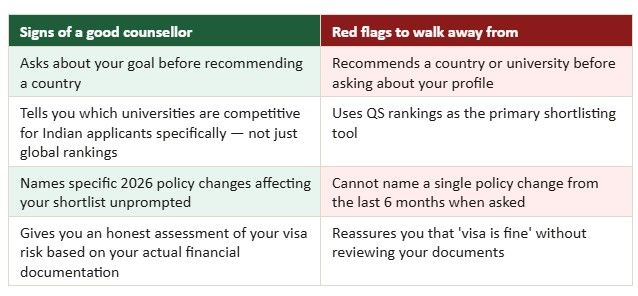
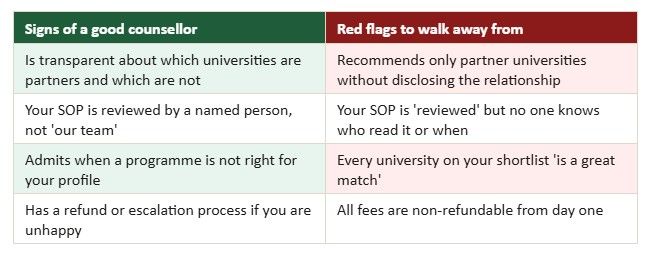
The quick-reference version: green flags and red flags.
If you are in the middle of a session and need a fast way to assess what you are hearing, this table maps the most diagnostic signals:
The single most reliable signal
A counsellor who tells you that a destination or programme is NOT right for your profile — unprompted, when they could have kept you on a path that generates fees — is demonstrating the quality of judgment that makes everything else trustworthy. Honest narrowing of options is more valuable than an enthusiastic shortlist of everything.
What happens if you choose the wrong consultant.
It is worth naming the concrete consequences, not to alarm, but to clarify why this decision deserves the same due diligence as the university shortlist it produces.
- A counsellor whose country recommendations are driven by commission rather than fit may send you to a destination with no viable PR pathway, poor salary prospects for your field, or stricter visa scrutiny than your profile can handle.
- A counsellor whose policy knowledge is a year out of date may advise you to build a post-study plan around a visa duration or PR timeline that has already changed.
- A counsellor whose SOP process is a template may produce an application that reads as generic — which is the fastest way for a strong academic profile to be rejected by a good programme.
- A counsellor who does not review your financial documentation may let a visa-refusal-causing inconsistency go unnoticed until the appointment, at which point it is irrecoverable for that intake.
The phrase 'we don't guarantee outcomes' is used by poor consultants as a defence against accountability. It is technically true — no consultant can guarantee admission or visa approval. But a consultant who prepared your documentation carefully, matched your profile to genuinely appropriate programmes, and stayed current on policy changes does not need this defence. The outcomes are better.
Frequently asked questions.
Is it safe to use a free counselling service, or do you get what you pay for?
The first session being free is standard in the industry — the revenue model is either a flat counselling fee, a per-application fee, or university commissions (or a combination). Free first sessions are not a sign of low quality; they are how good counsellors build trust before asking for a financial commitment. What matters is what happens in that session: if the first session produces a specific, profile-matched output (a country shortlist, a risk assessment, a next-step plan), the service is likely structured around genuine counselling rather than volume application processing.
How many counsellors should I speak to before choosing one?
Two to three is a reasonable number. The first session reveals how each counsellor thinks, what questions they ask, and whether their recommendations feel profile-specific or generic. Speaking to more than three usually produces diminishing returns — and creates decision paralysis when every counsellor's shortlist overlaps. The ten questions above are designed to help you make a confident decision in one or two sessions rather than needing five.
What if I have already signed with a consultant and I am unhappy?
Review your contract for the refund or escalation clause first. Most reputable consultants have one. If no applications have been submitted, the financial exposure is usually limited to an initial registration or retainer fee — not the full service cost. If you are mid-process, the most practical question is: at what stage is it still possible to course-correct? Switching counsellors before a visa application goes in is far less disruptive than switching after.
The ten questions in this guide are not adversarial. They are the questions that any counsellor who is genuinely good at their job will answer confidently, specifically, and without defensiveness. They are also the questions that will tell you, within 30 minutes, whether the person across from you has earned the trust that this decision requires.