Merit-Based vs Need-Based Scholarships: What's the Difference and Which Should You Apply For?
Two students apply for study abroad scholarships in the same year. One has a 9.0 CGPA, ran the student council, and worked at a startup. The other has a 7.2 CGPA, grew up in a town with limited resources, and genuinely cannot fund a foreign degree without outside help. Which one gets the scholarship? The answer is: it depends entirely on which scholarship. Chevening goes to the first student — it is merit-based and measures leadership and professional accomplishment. The Aga Khan Foundation goes to the second — it is need-adjacent and explicitly designed for high-potential students who face financial barriers. Apply the first student to the Aga Khan and the second to Chevening, and both probably fail.

Team Vidysea
May 19, 2026

The distinction between merit-based and need-based scholarships is the most misunderstood difference in Indian study abroad scholarship planning. Most families treat all scholarships as the same type of competition and apply their best student to the most prestigious names. This is correct for some scholarships and actively wrong for others. This guide clarifies the difference, maps every major scholarship to the right category, and helps you identify which type your profile is genuinely competitive for.
💡 The third category: merit + need combined
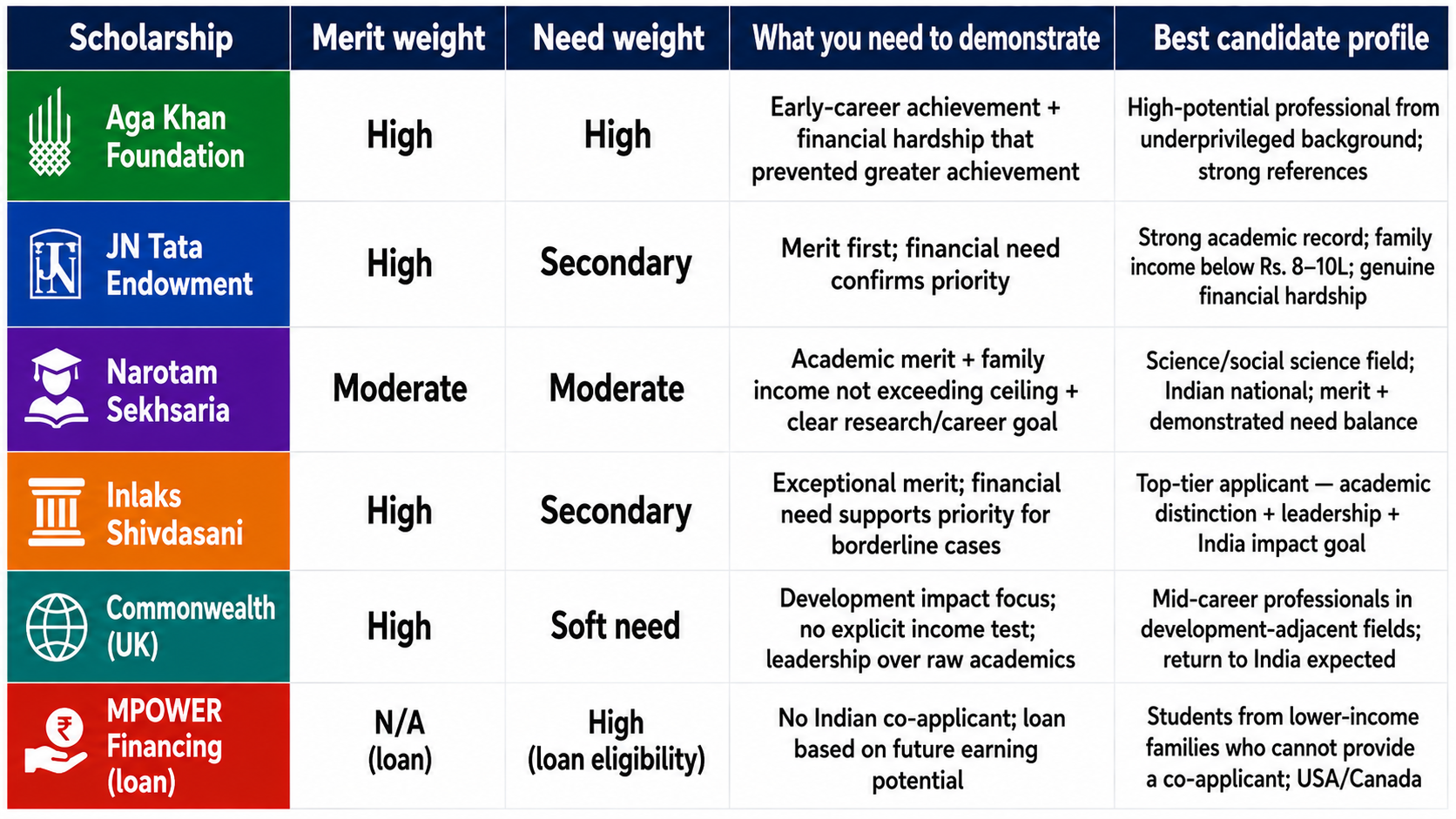
Many of the most accessible scholarships for Indian students — including Inlaks, JN Tata Endowment, Narotam Sekhsaria, and Aga Khan Foundation — use both criteria simultaneously. They require a baseline level of merit to be eligible, and then weight financial need as a differentiator among equally meritorious candidates. These hybrid scholarships are often overlooked because students assume they are either 'merit-only' (and don't disclose need) or 'need-only' (and undersell their achievements).
The Core Difference — What Each Type Rewards
Merit-based scholarships reward what you have already achieved. CGPA, test scores, research output, leadership positions, professional accomplishment, and the quality of your application essays. The committee asks: 'Is this the most outstanding candidate we could select?' Financial background is irrelevant — a wealthy student and a student from a modest background are evaluated equally if their achievement is equal.
Need-based scholarships reward the combination of potential and financial barrier. The committee asks: 'Is this a student who could achieve more if they had access to funding?' A student who achieved a 7.0 CGPA while working part-time to support their family may be a stronger need-based candidate than one who achieved 8.5 with full parental support and private tutoring. Context is the evaluation.
The practical implication for scholarships for students studying abroad: you need to know what the committee is measuring before you write a single word of your application. A merit-based application that focuses on financial hardship is off-target. A need-based application that leads with CGPA without explaining the context of that achievement is also off-target.
Merit vs Need — Complete Comparison
| Dimension | Merit-based scholarship (awarded for academic or other excellence) | Need-based scholarship (awarded to students who cannot self-fund) |
|---|---|---|
| Primary selection criterion | Academic achievement, leadership record, research output, professional accomplishment, test scores. | Demonstrated financial need — family income, assets, existing financial obligations. In some cases, specific socioeconomic background. |
| Does CGPA matter? | Yes — heavily. Most merit scholarships require a minimum of 75–80% or CGPA 7.5–8.0+. Some (Gates Cambridge, Rhodes) require near-perfect academic records. | CGPA matters for programme admission, but a student with 65% who demonstrates significant financial need and strong personal goals may receive a need-based award while a student with 85% does not. |
| Does family income matter? | Not primarily — though some merit scholarships also have a secondary need component. Chevening does not require financial need; DAAD does not require financial need. | Yes — centrally. Most need-based scholarships require disclosure of family income, parental occupation, assets, and existing liabilities. Often requires income certificates. |
| Competitiveness | Extremely competitive. Chevening: ~3–5% acceptance. Gates Cambridge: <1%. DAAD: 5–15%. | Also competitive, but competition is among a narrower eligible pool. Students who meet the income criteria compete against each other — not against all applicants. |
| What it covers | Usually full or partial: tuition + living allowance + travel + health insurance (varies widely by scholarship). | Usually full or partial tuition subsidy, sometimes living allowance. Coverage varies — some provide full funding, others only reduce the tuition amount. |
| Can I combine with an education loan? | Yes — if scholarship covers tuition but not living costs, an international student loan or study abroad loan for the gap is common. | Yes — if partial, an education loan for abroad fills the remainder. Most lenders will adjust the loan amount when a scholarship is confirmed. |
| Indian government scholarships | None major — most flagship government scholarships are merit-based (Fulbright-Nehru, DAAD, Commonwealth, Chevening are host government scholarships for Indians). | Ishan Uday, PMS SC/ST scholarships (domestic). Central Sector Scholarship (income ceiling). These are domestic — most international scholarships are offered by destination countries. |
| Most relevant for Indian students | Students with strong academic records, clear leadership histories, and ability to write compelling application essays. | Students from lower-income families whose academic record is strong enough for programme admission but whose family cannot self-fund the education without significant hardship. |
Major Study Abroad Scholarships for Indian Students — by Type
Here is how the most significant scholarships for students studying abroad map to the merit vs need distinction. The 'Type' column uses: Merit = primarily merit-based, Need = primarily need-based, Merit* = merit with secondary need consideration, Need+Merit = equal weighting of both:
Merit-based scholarships for Indian students studying abroad
| Scholarship | Type | Country | Value | Indian students | Key criteria for Indians |
|---|---|---|---|---|---|
| Chevening (UK) | Merit | UK | Full | Open | Leadership + networking + professional impact. No income test. |
| DAAD Research Grant | Merit | Germany | Full | Open | Strong academics + research proposal + German supervisor contact. |
| Fulbright-Nehru (USA) | Merit | USA | Full | Open | Academic excellence + India reintegration plan + community leadership. |
| Commonwealth (UK) | Merit* | UK | Full | Open | Merit + development focus. No explicit income test but development impact weighted. |
| Erasmus Mundus | Merit | EU multi | Full | Open | Academic merit. EU consortium programme application required. |
| Gates Cambridge | Merit | UK | Full | Open | Academic distinction + intellectual ability + commitment to improving lives. |
| Rhodes Scholarship | Merit | UK | Full | Open | Outstanding academics + character + leadership. Age 19–25. |
| Swedish Institute | Merit | Sweden | Full | Open | Professional experience + leadership + commitment to change. |
Need-based and merit+need scholarships for students studying abroad
| Scholarship | Type | Country | Value | Indian students | Key criteria for Indians |
|---|---|---|---|---|---|
| Aga Khan Foundation | Need+Merit | UK/CA/FR | Full/Partial | Open | Outstanding early-career professionals from developing countries incl. India |
| NORPART/Quota (Norway) | Need-adjacent | Norway | Full | Open | Developing country students; Norway–India academic partnership. |
| Inlaks Foundation | Merit+Need | Global | Up to $100K | India-only | Indian nationals with exceptional merit; financial need considered. |
| JN Tata Endowment | Need+Merit | Global | Loan-scholarship | India-only | Indian nationals; merit + financial need; interest-free repayable. |
| Narotam Sekhsaria | Merit+Need | Global | Rs. 20L | India-only | Indian nationals in specific fields; merit + need criteria both applied. |
| Stipendium Hungaricum | Merit | Hungary | Full | Open (nomination) | Indian government nomination; academic merit; broad field coverage. |
| Australia Awards | Need-adjacent | Australia | Full | Open | Development impact + contribution to India on return. Income not primary. |
⭐ Most flagship government scholarships available to Indian students are merit-based
Chevening (UK government), Fulbright-Nehru (US government), DAAD (German government), Commonwealth (UK government), and Australia Awards are all merit-based or development-impact-based — they do not primarily filter on family income. This means a student from a middle-class Indian family earning Rs. 12–15L annually is fully eligible for all of them based on merit alone. The barrier to these scholarships is not financial — it is academic and professional achievement.
Hybrid Scholarships — Where Merit and Need Both Count
The scholarships below are specifically valuable for Indian students who are academically strong but face financial barriers — the merit + need combination that both describes a significant proportion of India's talented students and is explicitly what these awards target:
🤝 JN Tata Endowment — the most overlooked scholarship for Indian students
The JN Tata Endowment is specifically for Indian nationals, is interest-free (repayable but without interest — the closest a loan gets to a grant), and considers both merit and need. It is significantly less competitive than Chevening or DAAD because its pool is restricted to Indian nationals. Most Indian students who would qualify are simply unaware it exists. If your family income is below Rs. 10L annually and you have a strong academic record, apply before any other scholarship.
What Merit Scholarship Committees Actually Look For
The word 'merit' in merit-based scholarships is frequently misunderstood as 'the highest CGPA wins.' This is wrong for every major scholarship available to Indian students. Here is what the major merit-based study abroad scholarships actually evaluate:
Chevening (UK): Leadership and Networking Potential
Chevening explicitly states that it funds future leaders. The selection criteria are: (1) leadership and influencing skills, (2) strong academic ability, (3) a clear plan for how the UK qualification will be used, and (4) networking potential. CGPA matters but is a threshold — applicants who meet the academic baseline are then evaluated primarily on leadership evidence and career trajectory. A student with 7.5 CGPA and 5 years of measurable leadership achievement will often beat a 9.0 student with no leadership record.
DAAD Research Grant (Germany): Research Depth and German Alignment
DAAD evaluates the research proposal, the academic record, and the connection between the research topic and German academic expertise. A generic interest in 'studying in Germany' is insufficient. The strongest DAAD applications name a specific German professor whose lab work aligns with the applicant's previous research, reference German academic literature, and propose a clear research question. The merit being measured is research merit — not general academic performance.
Fulbright-Nehru (USA): Academic Excellence + India Reintegration
Fulbright-Nehru is a bilateral exchange programme. The merit it measures includes academic achievement, but the evaluation explicitly includes a plan for returning to India and applying the US education to a specific professional challenge or research contribution. A Fulbright application that does not address India reintegration is incomplete, regardless of CGPA or test scores. The merit being measured is professional merit with bilateral value — not purely academic.
What Need-Based Scholarship Committees Look For
Need-based study abroad scholarships require financial documentation — but they are not simply income verification exercises. The most sophisticated need-based committees evaluate the relationship between financial circumstances and achievement: what did this student accomplish despite limited resources? What could they accomplish with full support?
Income documentation requirements
- Income certificate from competent authority (typically District Magistrate or Sub-Divisional Magistrate) for most Indian-origin need-based scholarships
- ITR of parents/guardians for the last 2–3 years
- Bank statements showing absence of significant assets or savings
- Description of financial obligations (other dependents, medical expenses, existing debts)
- For scholarships like Inlaks and JN Tata: a personal statement that honestly explains the financial context without making it the primary narrative
The contextual achievement framing
The most effective need-based application essays do not lead with hardship — they lead with achievement and then contextualise what that achievement required. 'I scored 7.5 CGPA while working 20 hours per week to support my family's income' is a stronger statement than 'My family is poor and I need financial help.' The committee already knows you need financial help — you applied to them. What they want to know is: is the need real, and does the profile justify the investment?
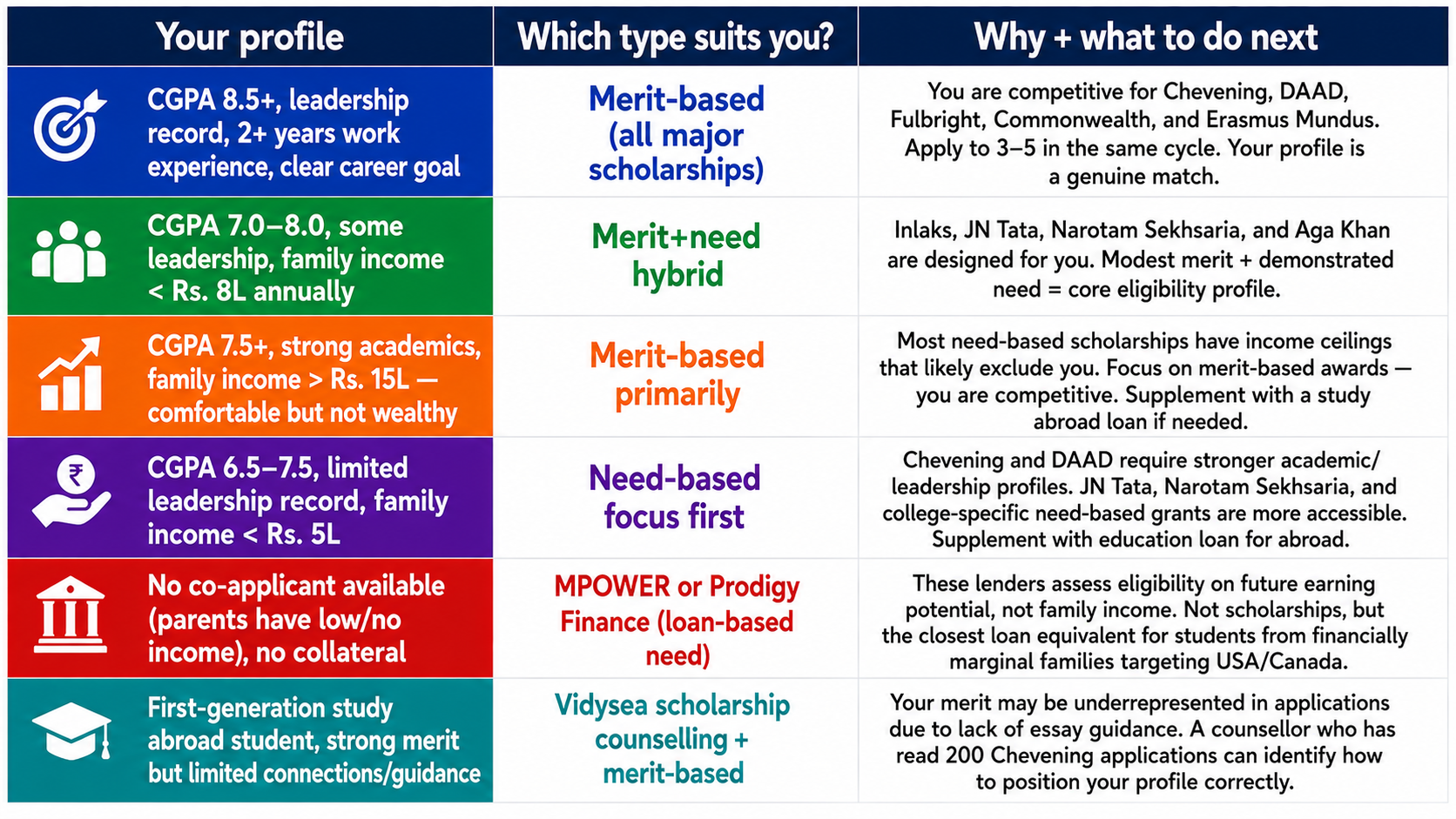
Which Should You Apply For? Decision by Profile
✅ Apply to both types if your profile sits in the middle
A student with CGPA 7.8, moderate leadership, and family income Rs. 6L annually sits in the overlap zone. They should apply to merit-based scholarships (Chevening, Commonwealth) on the strength of their overall profile, AND to merit+need hybrid scholarships (JN Tata, Narotam Sekhsaria, Inlaks) that explicitly weight need as a differentiator. There is no penalty for applying to both types — the essays are different, but the scholarship calendars often overlap, and an awards from either type fully funds the degree.
Practical Tips for Each Type
For merit-based scholarship applications
- The leadership essay is the most important document. Be specific: name the people you led, the context, and the measurable outcome. 'I led the college cultural committee' is vague. 'I managed a 40-person volunteer team across 3 states, producing a festival that generated Rs. 8L for a local NGO' is a leadership statement.
- Research the scholarship's stated values and use their language in your essay — without being transparently formulaic. Chevening talks about 'connecting and networking across the world.' Fulbright talks about 'mutual understanding.' DAAD talks about 'research excellence.' These are not accidents — mirror them honestly.
- Every merit-based scholarship expects a clear post-scholarship plan. Not vague ambition — a specific, credible account of how the UK/US/German qualification will be applied to a named professional challenge in India or the global development space.
- References matter as much as essays. A generic reference ('she is a good student') is a rejection. A reference that describes a specific project outcome and explicitly endorses the applicant's leadership is a selection advantage. Brief your referees with the scholarship criteria before they write.
For need-based scholarship applications
- Gather income documentation early — income certificates from government authorities can take 2–4 weeks. JN Tata and Inlaks applications close in March–April; start the documentation process in January at the latest.
- The financial hardship statement is not a complaint — it is evidence. Write factually and specifically: family income, number of dependents, existing financial obligations, and the specific funding gap the scholarship would close.
- Do not undersell your achievements when applying to need-based scholarships. The committee is looking for merit + need together. A need-only application without strong academic and professional content fails the same way a merit application without income documentation does.
- If the scholarship is India-specific (JN Tata, Narotam Sekhsaria), apply even if you believe there are stronger candidates. The Indian-national restriction significantly narrows the pool.
Frequently Asked Questions
Can I apply to merit-based scholarships even if my family is wealthy?
Yes — for most merit-based scholarships, family income is simply not a criterion. Chevening, DAAD, Fulbright, and Gates Cambridge do not have income ceilings. A student from a high-income family who is genuinely outstanding can win these scholarships without any disadvantage from their financial background. Need-based scholarships, by contrast, may explicitly disqualify applicants above an income threshold.
Is CGPA the most important factor in merit-based study abroad scholarships?
No — for most flagship study abroad scholarships. Academic achievement is a qualifying criterion (you need a minimum threshold) but is rarely the primary differentiator above that threshold. For Chevening, DAAD, Commonwealth, and Fulbright-Nehru, the primary differentiators are leadership evidence, career narrative, post-scholarship plans, and essay quality. Between two applicants both meeting the academic threshold, the one with the stronger leadership story and clearer post-scholarship plan wins — regardless of whether their CGPA is 7.8 or 8.9.
What if I qualify for need-based criteria but find it embarrassing to disclose income?
This is a common psychological barrier, particularly in Indian families where financial difficulty is not discussed openly. The practical answer: scholarship committees are experienced, respectful evaluators, not social judgment bodies. They read hundreds of need-based applications and have a professional, neutral perspective on income disclosure. The information is confidential within the selection process. The cost of not disclosing is missing a scholarship you would have won. The cost of disclosing is temporary vulnerability in a private application.
Can the JN Tata Endowment be combined with a study abroad loan?
Yes — the JN Tata Endowment is structured as an interest-free loan-scholarship, not a grant. You can hold it alongside a conventional study abroad student loan from a bank or NBFC. If the Tata Endowment covers Rs. 15–20L of a Rs. 50L programme cost, your conventional loan requirement drops to Rs. 30–35L — reducing your interest-bearing debt significantly. Most lenders are familiar with this structure and will adjust the loan amount when you present the Endowment letter.
The decision between merit-based and need-based scholarships for study abroad is not about which is better — it is about which your profile is genuinely competitive for. Apply to the wrong type and you invest 60+ hours on applications that fail not because of your profile but because of misalignment. Apply to the right type and those 60 hours become the most financially impactful investment of your pre-departure preparation.