More reminders

Got dreams to achieve? Hop on as we take you on your journey to success!


Services
Contact Info

Noida office
+91 7428715522Bangalore office
+91 8861432223 support [at] vidysea.com
Copyright@Vidysea
More reminders
Got dreams to achieve? Hop on as we take you on your journey to success!
Noida office
+91 7428715522Bangalore office
+91 8861432223support [at] vidysea.comCopyright@Vidysea
25% Surge in Global Talent Mobility: Why Vidysea Founder Karunn Says Indian Professionals Are Entering a New Golden Era

Team Vidysea
Published Updated
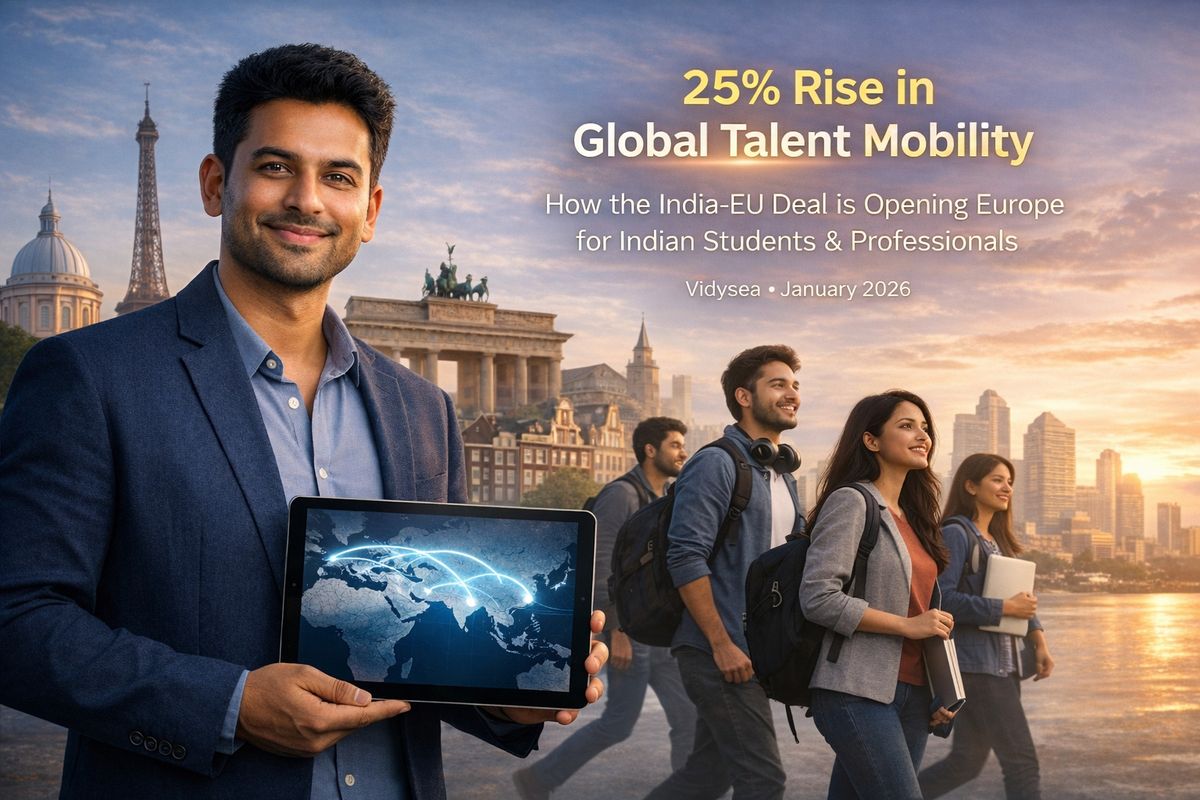
A quiet but historic shift is taking place in global talent movement — and Indian professionals are at the centre of it.
The recently concluded India–EU Free Trade Agreement (FTA) is expected to unlock one of the largest expansions of high-skilled professional mobility between India and Europe in modern history. Industry experts project a 20–25% rise in cross-border movement of high-skilled workers over the next five years, spanning technology, finance, education, manufacturing, and emerging innovation sectors.
According to Karunn, Founder of Vidysea, this is not just a policy shift — it’s a career-defining moment for Indian students and professionals planning international futures.
“For the first time, Indian talent is being welcomed into Europe through structured, predictable, and skills-driven pathways. This changes how students plan their education and how professionals build global careers,” Karunn explains.
The agreement introduces a formal mobility framework covering:
Indian companies operating in Europe can now deploy talent far more easily across 27 EU countries — a major upgrade from today’s fragmented visa regimes.
The EU has opened 144 service sub-sectors to Indian professionals including:
India, in turn, has opened 102 sectors to European firms, creating a balanced two-way talent ecosystem.
One of the most powerful features of the FTA is its student-to-work pipeline.
Under the new framework:
Karunn believes this transforms how students should approach international education.
“Earlier, students chose universities. Now they should choose migration pathways. Europe has become a career launchpad, not just a study destination.”
A major hidden benefit of the agreement is the 5-year roadmap for Social Security Agreements (SSA) between India and EU countries.
This solves one of the biggest global mobility problems: double social-security taxation.
Soon, Indian professionals working in Europe will:
This removes a massive financial barrier to working abroad.
Experts expect the fastest growth in cross-border hiring in:
European companies are now actively building cross-border teams rather than relying on permanent migration — creating more flexible, faster, and skills-driven hiring.
At Vidysea, Karunn has been tracking this shift for years.
“The future belongs to globally mobile professionals. Our job at Vidysea is to map the world’s best education-to-career pathways before they become crowded.”
With Europe opening its doors in an unprecedented way, Vidysea is now helping students and professionals:
If you are:
Then this agreement has just reshaped your future options.
The next five years will define a new generation of globally mobile Indian professionals — and Europe is now one of the most powerful gateways.
As Karunn puts it:
“This is not migration. This is global career freedom.”