SOP review (you write it, we advise) · Every deadline tracked · UCAS, Common App and direct portals
University Application Support: How to Apply to Universities Abroad
Last reviewed: October 2026 · Reviewed by: Vidysea counselling team
You have a shortlist. Now you need to apply well, and on time. Our university application support covers how to apply to universities abroad from start to finish: we plan, review and track every application so nothing is missed, from your first form to your final offer.
Application support is part of paid Vidysea plans. If you're applying to one of our partner universities, we support your application free of charge.
15,000+ applications submitted · 9,000+ offers received
We count an application as submitted only when the university confirms it's complete. Figures as of July 2026. Universities make every admission decision. We help you send complete, strong applications on time.
At a glance
- We help you finalise your list, plan target dates, check documents, review your SOP and LOR drafts, and track every application until offers arrive.
- Start 9 to 12 months before your course begins.
- UK undergraduate (UCAS) deadlines for 2027 entry: 15 October 2026 for Oxford, Cambridge and most medicine courses; 13 January 2027 for most others. The UCAS fee is £34.50 for up to five courses.
- uni-assist (Germany) charges €75 for the first application and €30 for each extra one in the same semester. US colleges set their own fees.
- You write your SOP in your own words. We review it and suggest corrections. Application support is part of paid plans, and free for applications to our partner universities.
Choose your final application list
Before you apply, turn your shortlist into a final list you're happy to commit to. Check that each programme still fits your profile and budget, that you can meet its requirements and tests in time, and that your list has a sensible mix of ambitious, target and safer options. Then drop anything you wouldn't accept if it were your only offer. Check the application fees at this stage too: if you're paying for several applications, make sure each one is worth it. A counsellor can help you decide what stays and what goes, based on your profile and plans.
Don't have a shortlist yet? Start with university shortlisting, where we match you to programmes and build a balanced list. This page picks up from there and covers the application itself.
How to apply to universities abroad: the steps
Every country and university has its own process, but most applications follow these steps. Work through them in order, and start at least 9 to 12 months before your course begins:
- 1Confirm the programme and intake. Check the course, start date and application deadline on the university's website. Note whether the course has more than one application round.
- 2Check the entry requirements. Note the minimum marks, required subjects, tests and any work experience. If you're unsure whether you qualify, ask the admissions office before you pay a fee.
- 3Book your tests. Most universities ask for an English test such as IELTS, TOEFL or PTE. Many master's courses ask for the GRE or GMAT, and some US undergraduate courses accept the SAT or ACT. See our test preparation for IELTS, GRE, GMAT.
- 4Prepare your documents, using the checklist below. Order transcripts early, because some colleges take weeks to issue them.
- 5Write your SOP or essays and ask for recommendations. Give your recommenders at least a few weeks, and tell them about the course and deadline.
- 6Submit and pay the application fee through the right portal for each country, and save the confirmation email.
- 7Attend interviews if the programme asks for one. Many are online, so test your camera and connection beforehand.
- 8Track your offers and reply before each deadline, especially if you're waiting on a scholarship result.
- 9Plan your budget and visa appointment as soon as you accept an offer. Visa appointments can book up quickly before the main intakes, so don't leave it late.
Study abroad application process: routes by country
The study abroad application process depends on where and what you study. These are the main routes:
| Country | How you apply | What to know |
|---|---|---|
| Study in the UK | Undergraduate: UCAS. Postgraduate: each university's own portal. | One UCAS application covers up to five courses and uses one personal statement. Postgraduate applications are separate for each university. |
| Study in the USA | Undergraduate: Common App or the college's own portal. Graduate: each university's portal. | Each college sets its own fee, essays and requirements, even on Common App. Graduate programmes often need the GRE. |
| Study in Canada | Ontario undergraduate: OUAC. Most others: directly to the university. | Check whether your province needs a provincial attestation letter after you accept. |
| Study in Australia | Directly to the university. | Many universities assess applications on a rolling basis, so applying early helps you secure a place and your visa document in time. |
| Study in Germany | uni-assist for many universities, or the university's own portal. | uni-assist checks your documents before the university decides, so apply well before the university's own deadline. |
| Study in Ireland | Directly to the university for students from outside the EU. | Deadlines vary by university and course. |
Routes change from year to year, so always confirm on the university's admissions page.
Documents required to study abroad
The documents required to study abroad vary by course, but most applications ask for:
- Transcripts and certificates: Class 10 and 12 mark sheets, and degree transcripts for postgraduate study.
- SOP or personal statement: why you want this course and what you'll bring to it.
- Letters of recommendation (LORs): usually two or three, from teachers or employers.
- CV or résumé: your education, work, projects and achievements.
- Passport: valid for your full course, with clear copies.
- Test scores: English tests, and the GRE, GMAT, SAT or ACT where required.
- Financial documents: bank statements or loan letters, if the university asks at this stage.
- Portfolio: for design, art, architecture and some media courses.
We check that names, dates and grades match across every document before you submit.
Your application, in your own words: SOP and LOR review
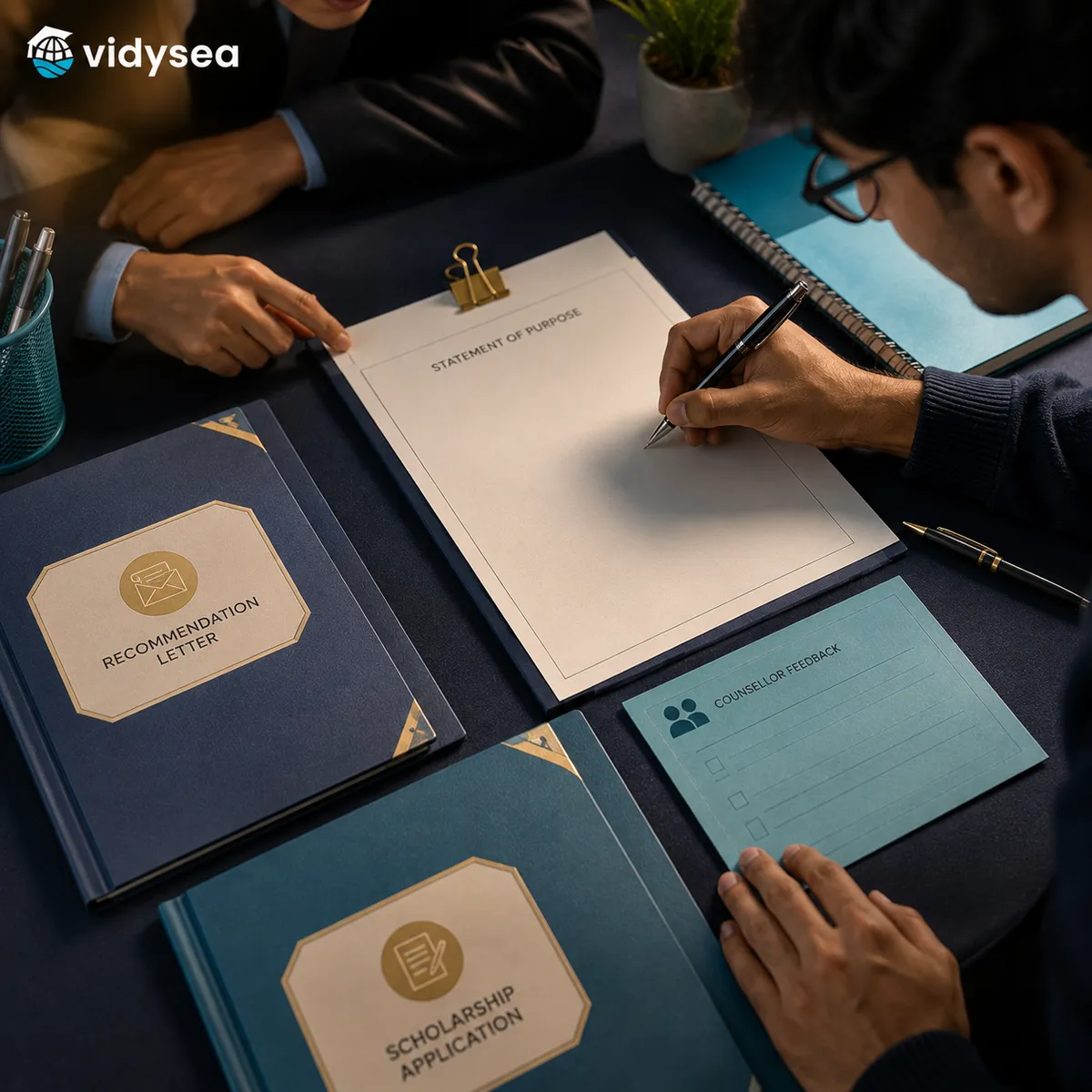
We never write your application for you. You write your SOP; we review your drafts, suggest corrections and advise you on structure and content, usually over two or three rounds. Our SOP and LOR review covers:
- Purpose: does your SOP explain why you chose this subject, programme and university, and where you want it to lead?
- Evidence: do your examples support your claims, or do they just repeat your CV?
- Fit: does each version speak to that specific programme?
- Clarity: is it easy to read, within the word limit and free of errors? We point out sentences to cut, change or keep, so you know exactly what to fix.
- Recommenders: have you chosen people who know your work, and briefed them early? Recommendation letters remain your recommender's own work.
Applying for funding too? Our scholarship assistance team helps with scholarship essays, which have a different job from your SOP.
Deadlines, intakes and fees: the best time to apply to universities abroad
The best time to apply to universities abroad is usually 9 to 12 months before your course starts.
| Country | Main intakes | Typical deadlines |
|---|---|---|
| UK | September (some January) | UCAS: 15 October 2026 for Oxford, Cambridge and most medicine; 13 January 2027 for most other courses. |
| USA | August/September, some January | Early rounds in November; many regular deadlines in January. |
| Canada | September, January, May | Often January to March for September entry. |
| Australia | February, July | Often a few months before the start date. |
| Germany | October, April | Many universities: 15 July and 15 January for international applicants. |
Application fees: UCAS charges £34.50 for 2027 entry; uni-assist charges €75 for the first application and €30 for each extra one in the same semester; US colleges set their own fees, and some offer fee waivers. Once offers arrive, see what to do after your offers arrive.
How it works
- 1Finalise your list with a counsellor, starting from your shortlist and checking fees, requirements and timing.
- 2Get your application plan: every requirement, test and deadline, with your own target date set before each official deadline, so delays with documents, recommenders or test scores don't cost you a place.
- 3Prepare each application: we check your documents and review your SOP and LOR drafts until they're ready to submit.
- 4Submit and double-check that every form, fee and document has gone through, and that the university has marked it complete on its portal.
- 5Track everything in your Journey Map until your offers arrive. Your Journey Map is your personal plan on Vidysea: it lists every task and deadline, from application to arrival.
FAQs: how to apply to universities abroad
How do I apply to universities abroad from India?
Finalise your list, check each programme's requirements, book your tests and prepare your documents. Then write your SOP, ask for recommendations and submit through the right portal for each country, such as UCAS for UK undergraduate courses or the university's own portal. Track every deadline until you reply to offers.
What is the study abroad application process, step by step?
Confirm the programme and intake, check the entry requirements, take the tests you need and prepare your documents. Write your SOP or essays, get your recommendations, then submit and pay the fee. Attend any interviews, track your offers, and plan your budget and visa once you accept.
What documents are required?
Most applications need transcripts and certificates, an SOP or personal statement, two or three letters of recommendation, a CV, your passport and test scores. Some ask for financial documents now, and creative courses need a portfolio. Check each university's list, and make sure names and dates match.
When is the best time to apply?
Usually 9 to 12 months before your course starts. UK undergraduate applications through UCAS close on 13 January 2027 for most courses starting in 2027. Many US and Canadian deadlines fall between November and March. Applying early also gives you more time for scholarships.
What university application support does Vidysea provide?
We help you finalise your list, plan target dates, check your documents, review your SOP and LOR drafts, and track every application until offers arrive. You write your own SOP; we review it and suggest corrections. Personalised support is part of paid Vidysea plans, and it's free when you apply to one of our partner universities.
Will Vidysea write my SOP?
No. You write your SOP in your own words. We review your drafts, suggest corrections and advise you on structure and content, so your application sounds like you. Recommendation letters are written by your recommenders, though we help you choose and brief them.
Do I need IELTS or TOEFL?
Most universities ask for an English test such as IELTS, TOEFL or PTE. Some accept other proof, such as a medium-of-instruction certificate, but rules vary by university and course. Check the requirement for each programme, and book your test early so your score arrives in time.
What are application fees, and can they be waived?
Fees depend on the route. UCAS charges £34.50 for 2027 entry, covering up to five courses. uni-assist charges €75 for your first application and €30 for each extra one in the same semester. US colleges set their own fees, and some offer waivers.
What if I miss a deadline?
Check whether the university has a later round, a later intake or a similar programme still open. Some universities accept late applications if places remain, but never assume they will. Contact the admissions office directly and politely, and set earlier target dates for the rest of your applications.
How to apply to universities abroad for a master's vs a bachelor's?
Bachelor's applications differ by country: UK courses go through UCAS, and many US colleges use the Common App. Master's applications usually go directly to each university, often need the GRE or GMAT, and ask for a separate SOP and recommendations for each programme. Many accept predicted or provisional results.
How to apply to universities abroad as a working professional?
The steps are the same, but your work experience becomes a strength. Use your SOP to link your job to the course, ask a manager for one recommendation, and include employment letters. Some programmes, such as many MBAs, require work experience and may interview you.
What happens after I submit my application?
The university checks your application and may ask for more documents or an interview. Decisions can take a few weeks or several months. Track each application's status and reply to any requests quickly. Once offers arrive, compare them before you accept or pay a deposit.
Ready to plan your applications?
Tell us where you're applying and when your course starts. We'll build your application plan and keep every deadline on track.
Talk to a counsellorPersonalised SOP review and application support are available on paid Vidysea plans, and free for applications to our partner universities. For users under 18, personal data is used only with consent from a parent or lawful guardian. See our Privacy Policy.
Prefer to talk? Call +91 74287 15522Contact: support@vidysea.com · Privacy Policy


