Asia's Education Capital: The Ultimate Guide to Pursuing an MS in Singapore [2025]
For decades, Singapore has stood as a beacon of modernization and economic success. It has rapidly evolved into the premier study destination in Asia, rivaling traditional Western hubs like the US and UK. Every year, ambitious students from around the world travel to pursue an MS in Singapore, seeking its elite universities, futuristic infrastructure, and gateway access to the booming Asian markets. But what makes this "Asian Tiger" such a powerhouse for higher education? Is the investment worth it? In this detailed blog, we’ll explore the top reasons to pursue an MS in Singapore, the best universities, eligibility requirements, costs, and the unique "Service Obligation" scheme — everything you need to know.

Team Vidysea
March 23, 2026
![Asia's Education Capital: The Ultimate Guide to Pursuing an MS in Singapore [2025]](https://cdn.sanity.io/images/5b5wdesf/production/b12c7eb1e9f851ed1d5f3db2360db2f219ef0ad2-1536x1024.png?rect=0,0,1536,710&fit=max&auto=format)
1. Global Reputation & Elite Universities
Singapore is home to some of the highest-ranked universities on the planet. Institutions like the National University of Singapore (NUS) and Nanyang Technological University (NTU) consistently rank in the global top 20 (often outranking Ivy League schools).
When you pursue an MS in Singapore, you are entering an education system known for rigorous academic standards and massive government investment in research. A Singaporean degree is a badge of excellence recognized by employers worldwide.
2. A Hub for Future-Ready Specializations
The best part about studying an MS in Singapore is the alignment with the government’s "Smart Nation" initiative. The economy is driven by innovation, and course offerings reflect this.
Specializations are heavily focused on:
- Technology: Artificial Intelligence, Data Science, Cybersecurity, and Smart Systems.
- Finance & Fintech: Singapore is one of the world's top financial centers, making it ideal for Quantitative Finance and Wealth Management.
- Logistics & Supply Chain: As a global trade hub, supply chain degrees here are world-leading.
- Biomedical Sciences: The Biopolis hub drives demand for research in Bio-engineering and Life Sciences.
3. Unmatched Research and Innovation
A major reason students choose an MS in Singapore is the presence of global giants.
- Asian HQ for Tech & Finance: Singapore hosts the Asian headquarters for tech titans (Google, Meta, Microsoft, Razer, Grab, Sea Group) and major banks (DBS, Standard Chartered).
- Industry-Led Research: Your MS in Singapore will often involve projects in hubs like Fusionopolis and Biopolis, offering direct exposure to multinational corporations.
4. High Wages & Low Taxes
Earning an MS in Singapore places you in one of the wealthiest nations per capita.
- High Salaries: Graduates with an MS in Singapore can expect competitive starting salaries, often ranging from SGD $4,500 to SGD $6,500 per month (approx. SGD $54k - $78k annually) for tech and finance roles.
- Low Tax Regime: Singapore has one of the lowest personal income tax rates in the world, meaning you take home more of what you earn.
5. Safe, Modern & English-Speaking
Studying an MS in Singapore means living in arguably the safest city in the world. It is a melting pot of Chinese, Malay, Indian, and Western cultures.
- English-Speaking Environment: English is the main language of instruction and business, making it incredibly easy for international students to adapt.
- Quality of Life: With world-class public transport (MRT), lush greenery, and incredible food, the quality of life is exceptional.
6. Work Rights: LTVP & The Tuition Grant Scheme
Unlike other countries, Singapore offers a unique proposition for post-study work, primarily through the Tuition Grant Scheme.
- Service Obligation (The Tuition Grant): International students can often apply for a "Tuition Grant" from the Ministry of Education (MOE) to subsidize their fees. In exchange, you sign a bond to work in a Singapore-based company for 3 years after graduation. This significantly helps in reducing costs and signals to employers that you are committed to staying.
- Long Term Visit Pass (LTVP): If you do not opt for the bond, graduates from top Institutes of Higher Learning (IHLs) can apply for an LTVP to stay in Singapore for 1 year to search for employment.
7. Scholarships and Financial Assistance
While an MS in Singapore can be expensive, financial aid is available.
- MOE Tuition Grant: As mentioned above, this subsidizes a large portion of your tuition in exchange for a 3-year work commitment.
- University Scholarships: NUS, NTU, and SMU offer merit-based awards like the "ASEAN Scholarship" or specific faculty scholarships that can cover full tuition and living allowances.
- Service Obligation: This is the most common way students make their MS in Singapore affordable.
8. A Pathway to Employment Pass (EP) & PR
For many, an MS in Singapore is a gateway to a global career.
- Employment Pass (EP): High-earning professionals (earning above SGD $5,000/month) are eligible for the Employment Pass.
- Permanent Residency (PR): After working in Singapore on an EP or S Pass for a few years, you can apply for Permanent Residency. While competitive, graduates from top local universities with a stable job history are viewed favorably.
9. Top Universities for MS in Singapore
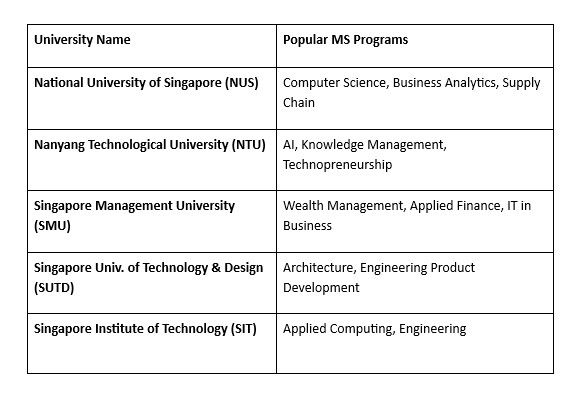
Here are the elite institutions for MS in Singapore programs:
10. Admission Requirements and Eligibility
To apply for an MS in Singapore, the competition is high:
- Academic: A 4-year Bachelor’s degree is preferred. Good grades (First Class / >65%) are essential.
- Tests: Top business and some technical courses at NUS/NTU often require GMAT or GRE scores.
- English: Proficiency via IELTS or TOEFL is mandatory.
- Experience: Some specialized Master's programs (like MBAs) prefer 2+ years of work experience, though many MSc programs are open to freshers.
11. Application Process for MS in Singapore
Applying for an MS in Singapore requires careful planning:
- Research universities (intakes are usually August and January).
- Check if your course requires GRE/GMAT and take the tests early.
- Submit applications directly through the university portals (e.g., NUS Graduate Admission System).
- Apply for the Tuition Grant (if eligible and interested).
- Receive your offer and apply for the Student's Pass (STP) via the SOLAR system (ICA).
- Complete your medical check-up upon arrival in Singapore.
- Attend Vidysea’s pre-departure briefing.
12. How Vidysea Can Help You
Navigating the MS in Singapore process involves understanding the Service Obligation bond, the competitive GMAT/GRE requirements, and the Student's Pass application (SOLAR). That’s where Vidysea comes in.
We offer end-to-end guidance — from profiling your eligibility for NUS/NTU to handling your visa filing. Our experts ensure you choose the right course that aligns with Singapore's high-demand industries.
Popular FAQs About MS in Singapore
1. What is the eligibility for MS in Singapore?
You generally need a good 4-year Bachelor’s degree. For top universities like NUS/NTU, a high GPA is crucial. GRE/GMAT is often required for competitive courses.
2. What is the cost of studying MS in Singapore?
Tuition fees vary widely. Without the Tuition Grant, fees can range from SGD $30,000 to SGD $50,000+. With the grant, they are significantly lower. Living costs are approx SGD $1,500 - $2,500 per month.
3. How long does an MS in Singapore take?
Most MS in Singapore programs are 1 to 1.5 years long, allowing for a quick entry into the workforce.
4. Is GRE mandatory for MS in Singapore?
It depends. For Management, MBA, and some competitive CS courses at NUS/NTU, GRE/GMAT is highly recommended or mandatory. For other private or technical universities, it may be waived.
5. What are the best courses for MS in Singapore?
Data Analytics, FinTech, Supply Chain Management, and Computer Science are the most sought-after degrees.
6. Can I work while studying MS in Singapore?
Yes, full-time matriculated students at approved universities (like NUS, NTU, SMU) can work up to 16 hours per week during term time and unlimited hours during vacation.
7. What is the Service Obligation scheme?
It is a scheme where international students pay reduced tuition fees in exchange for working in a Singapore entity for 3 years after graduation.
8. Are scholarships available?
Yes. Aside from the Tuition Grant, there are prestigious awards like the "Singapore International Graduate Award (SINGA)" for research students.
Conclusion
Choosing to pursue an MS in Singapore is a strategic investment in a high-growth future. With elite universities, a fast-paced 1-year degree format, and the opportunity to work in the heart of Asia's economy, Singapore offers an exceptional ROI.
Whether you aim for a career in high finance or deep-tech, the benefits of studying for your MS in Singapore are undeniable.
Start your journey today with Vidysea. Let our experts guide you through every step — from securing your admission to navigating the Service Obligation — and help you turn your dream of an MS in Singapore into reality