
Got dreams to achieve? Hop on as we take you on your journey to success!


Services
Contact Info

Noida office
+91 7428715522Bangalore office
+91 8861432223 support [at] vidysea.com
Copyright@Vidysea
Got dreams to achieve? Hop on as we take you on your journey to success!
Noida office
+91 7428715522Bangalore office
+91 8861432223support [at] vidysea.comCopyright@Vidysea
For countless international students, pursuing a Master’s degree (MS) in Singapore is a strategic, life-changing decision. As the premier financial and technology hub of Asia and the regional headquarters for the world's biggest tech and finance giants, the island nation offers a futuristic lifestyle and an economy hungry for high-level talent. But the real question arises once the degree is in hand: what comes next? Understanding the landscape of after MS jobs in Singapore is crucial for planning your career pathway and ensuring a high Return on Investment (ROI). This comprehensive guide explores the top industries, salary expectations in SGD, strict visa pathways (including the new COMPASS framework), and FAQs regarding after MS jobs in Singapore—so you can confidently step into the Singaporean workforce.

Team Vidysea
Published Updated
Singapore has firmly established itself as a premier destination for postgraduates, offering a unique blend of Eastern heritage and Western corporate efficiency. It offers safety, high wages, and low tax rates.
Key reasons why after MS jobs in Singapore appeal to international students include:
These advantages make finding after MS jobs in Singapore a highly attractive prospect for ambitious graduates.
Upon completing your MS, the scope of after MS jobs in Singapore is vast. Singapore’s economy is knowledge-based, focusing on high-tech, finance, and advanced manufacturing.
Singapore’s "Smart Nation" initiative drives massive demand for tech talent. The country is a playground for testing new technologies in real-world environments.
Singaporean banks, e-commerce giants (like Shopee and Lazada), and logistics firms are heavily invested in AI and big data.
Singapore rivals Hong Kong and London as a global financial centre. It is a world leader in Wealth Management and FinTech.
Unlike diverse manufacturing hubs, Singapore specializes in high-value engineering, particularly semiconductors and biomedical manufacturing.
To secure after MS jobs in Singapore, you must navigate a stricter visa system than in Europe.
The Goal: Your goal is to secure a high-paying role that meets the EP salary threshold (minimum SGD 5,600/month as of 2025, higher for Finance roles) to ensure your visa is approved.
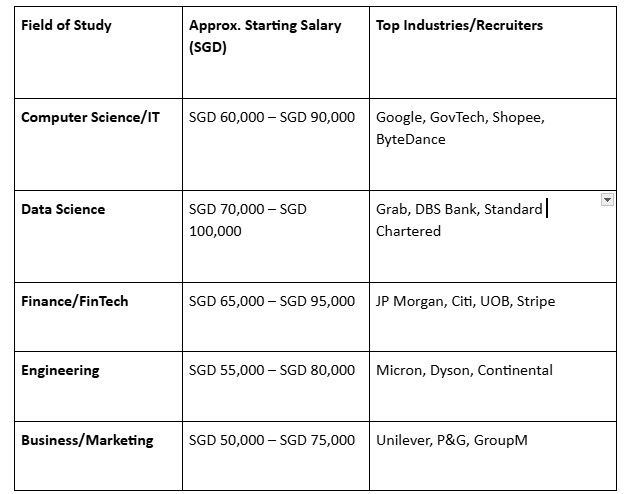
Salaries in Singapore are among the highest in Asia. Below are the approximate annual packages (in Singapore Dollars - SGD):
Since Singapore is a city-state, "cities" don't apply. Instead, jobs are clustered in business parks:
The Singaporean job market is efficient but competitive.
While the opportunities for after MS jobs in Singapore are plentiful, hurdles exist:
Agencies can help you navigate the complex MOM (Ministry of Manpower) rules.
The landscape for after MS jobs in Singapore is shifting towards sustainability and deep tech.
1. What are the most in-demand jobs after MS in Singapore?
Roles in Software Engineering, AI/Machine Learning, Wealth Management, Cybersecurity, and Semiconductor Engineering are in highest demand.
2. What salary can I expect for after MS jobs in Singapore?
Fresh graduates can expect between SGD 4,500 and SGD 7,000 per month depending on the industry. Tech and Finance roles pay the highest.
3. Can I stay in Singapore after completing my MS?
Yes, but only if you study at specific approved institutions (like NUS, NTU, SMU). You can apply for a Long Term Visit Pass (LTVP) for 1 year to find a job. Private university graduates may not have this option and must find a job immediately.
4. How do I find a job in Singapore after my MS?
Focus on JobStreet, LinkedIn, and university career fairs. Networking is essential.
5. Is it difficult for international students to get jobs?
It is competitive due to the Employment Pass salary requirements. However, students with niche skills (Tech, Data, Engineering) who score well on the COMPASS framework have a high success rate in securing after MS jobs in Singapore.
6. Does the university brand matter for jobs in Singapore?
Yes, significantly. Under the COMPASS framework, degrees from "Top-Tier" universities earn you more points towards your visa application.
Pursuing an MS in Singapore is a strategic move towards a high-quality global career in Asia. The market for after MS jobs in Singapore is high-paying and efficient, especially in the Finance and Tech sectors.
With the right understanding of the COMPASS visa framework, a polished resume, and strategic networking, you can secure one of the many rewarding after MS jobs in Singapore and build your future in Asia's premier business hub.