

Got dreams to achieve? Hop on as we take you on your journey to success!


Services
Contact Info

Noida office
+91 7428715522Bangalore office
+91 8861432223 support [at] vidysea.com
Copyright@Vidysea
Got dreams to achieve? Hop on as we take you on your journey to success!
Noida office
+91 7428715522Bangalore office
+91 8861432223support [at] vidysea.comCopyright@Vidysea
France is one of the most popular study-abroad destinations for international students, attracting thousands of students every year with its world-class universities, rich cultural heritage, globally recognized degrees, and affordable education system. Home to prestigious institutions such as Sorbonne University, HEC Paris, Sciences Po, and École Polytechnique, France offers exceptional opportunities across business, engineering, data science, fashion, hospitality, and social sciences.

Team Vidysea
Published Updated

However, before starting your study abroad journey, understanding the Cost of Study in France is crucial. While France is often considered more affordable than destinations like the UK, USA, or Australia, students still need to carefully plan their finances to cover tuition fees, accommodation, daily living expenses, health insurance, transportation, and other miscellaneous costs.
In this comprehensive guide, we'll break down the Cost of Study in France, including tuition fees, accommodation costs, living expenses, visa-related expenses, and practical budgeting tips to help you prepare effectively.
France consistently ranks among the world's top destinations for international education.
Some of the key benefits include:
These advantages make France an attractive destination for students seeking quality education and international exposure.
The Cost of Study in France includes several components beyond tuition fees.
Students should budget for:
The total cost varies depending on:
On average, international students should budget between €900 and €1,800 per month for living expenses in France.
Tuition fees form a significant portion of the Cost of Study in France, although they are generally lower than in many other popular study destinations.
France is known for its affordable public higher education system.
Average tuition fees:
Average tuition fees:
Average tuition fees:
Public universities offer excellent value while maintaining high academic standards.
France's elite institutions and business schools generally charge higher tuition fees.
Average tuition fees:
Average tuition fees:
Programs in fashion, hospitality, luxury management, and design may have higher fees.
While tuition may be higher, graduates often benefit from strong industry connections and employment opportunities.
The overall Cost of Study in France varies depending on the chosen course.
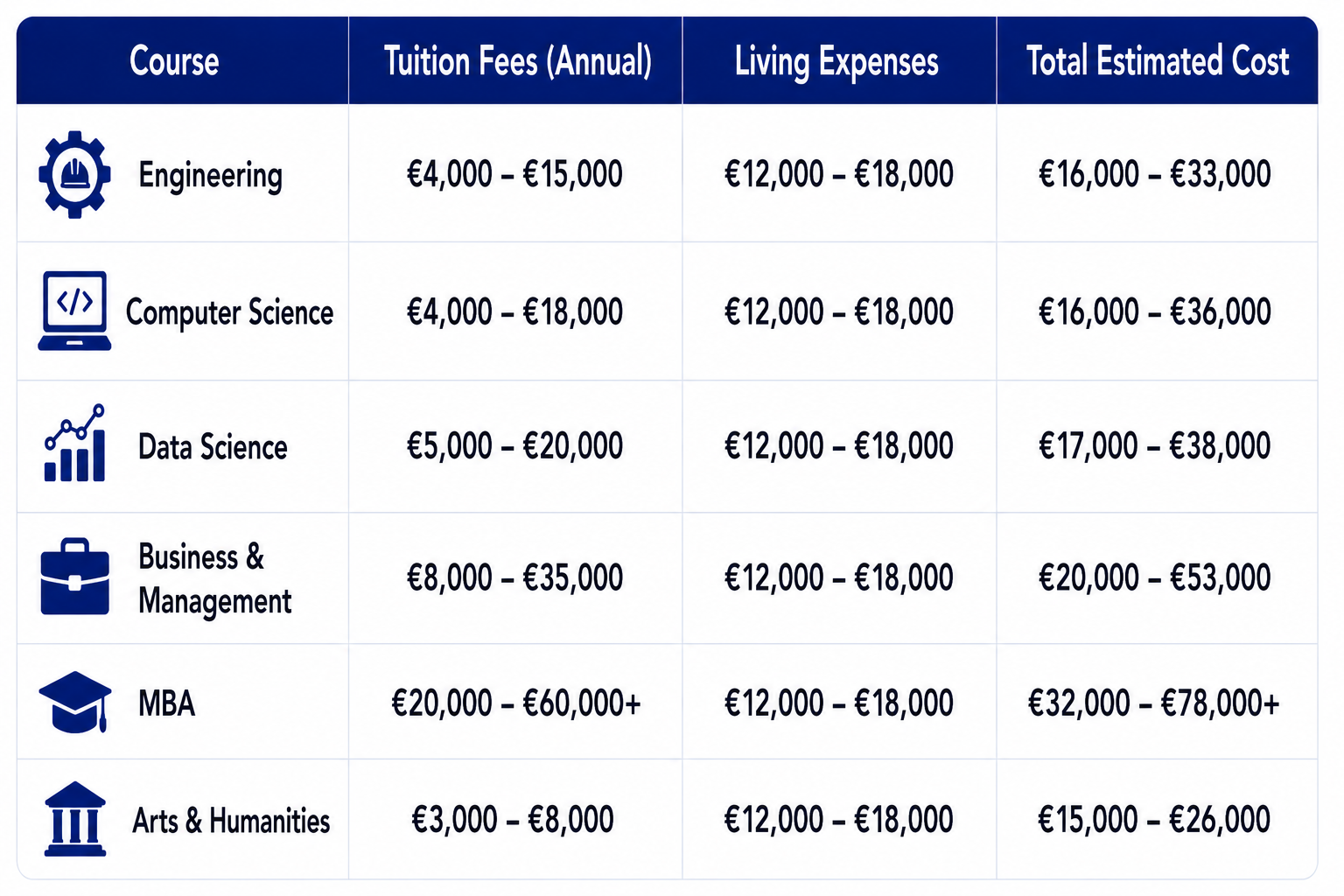
Living expenses make up a major portion of the Cost of Study in France.
Your expenses will largely depend on where you choose to live.
Paris is the most expensive city in France.
Average monthly expenses:
Average monthly expenses:
Average monthly expenses:
Average monthly expenses:
Average monthly expenses:
Students studying outside Paris can significantly reduce their overall cost of living.
Accommodation is often the largest living expense.
Monthly cost:
These are often the most affordable options for international students.
Monthly cost:
Sharing accommodation with roommates is a popular budget-friendly choice.
Monthly cost:
Costs vary greatly depending on city and location.
Monthly cost:
Some students prefer homestays for cultural immersion and convenience.
Students generally spend:
on:
Preparing meals at home can significantly reduce expenses.
France offers excellent public transportation systems.
Student discounts are widely available.
Many cities offer reduced-cost travel passes for students.
Health coverage is an important part of the Cost of Study in France.
International students typically benefit from France's healthcare system.
Additional private insurance may cost:
depending on coverage levels.
Students planning to study in France must obtain a student visa.
Typical costs include:
Varies by country.
Additional charges may apply.
Always verify current fees before applying.
Students should budget approximately:
for:
Many universities provide access to extensive digital libraries.
When calculating the Cost of Study in France, students often overlook:
Housing deposits can equal one or two months' rent.
Additional administrative fees may apply.
Students from warmer climates often need to purchase:
Monthly costs:
Many students choose to explore Europe during holidays.
These expenses should be included in your overall budget.
Several scholarships can significantly lower expenses.
One of France's most prestigious scholarships.
Offers information about numerous funding opportunities.
Provides financial support for eligible international students.
Many universities offer:
Vidysea helps students identify and apply for suitable scholarship opportunities.
International students can often work while studying.
Benefits include:
Typical student jobs include:
Part-time work can help offset the Cost of Study in France.
Here are some practical budgeting strategies:
Reduce tuition and living expenses through available funding opportunities.
Studying outside Paris can significantly lower costs.
Students receive discounts on:
Living with roommates reduces housing expenses.
Preparing meals can save hundreds of euros each month.
Earn supplemental income while studying.
Compared to other popular study destinations, France offers:
For many students, France provides one of the best returns on investment among major study-abroad destinations.
Understanding the Cost of Study in France can be challenging without proper guidance.
Vidysea helps students with:
Our AI-powered platform helps students make informed financial decisions before beginning their study abroad journey.
The average annual cost typically ranges from €15,000 to €40,000+, depending on tuition fees, city, and lifestyle.
Yes. Public universities in France are generally much more affordable than universities in the UK or USA.
Students typically spend between €900 and €1,800 per month depending on location and lifestyle.
Yes. Scholarships such as the Eiffel Excellence Scholarship and university-specific awards can significantly reduce expenses.
Yes. International students are generally allowed to work part-time while pursuing their studies.
Understanding the Cost of Study in France is essential for successful financial planning and a stress-free study abroad experience. While tuition fees, accommodation, and daily expenses vary depending on your university and location, France remains one of the most affordable destinations for international students seeking a globally recognized education.
By choosing the right city, applying for scholarships, utilizing student discounts, and managing expenses wisely, students can make studying in France both affordable and rewarding. With expert guidance from Vidysea, you can confidently plan your finances, select the best universities, and take the next step toward achieving your international education goals.