Fully Funded Scholarships for Indian Students Studying Abroad
There are fully funded scholarships available to Indian students right now that cover 100% of tuition fees, living expenses, flights, and health insurance — at universities including Oxford, Cambridge, MIT, TU Munich, University of Tokyo, and Melbourne. Most Indian students who are eligible for these scholarships never apply for them. Not because they are unaware scholarships exist, but because they do not know which ones they are actually eligible for, what the application requires, and how far in advance the process needs to start. This guide covers 20 major fully funded scholarships available to Indian students for 2026 and beyond — government bilateral scholarships, foundation awards, and university-specific fellowships. For each one, we tell you what it covers, what the eligibility requirements are, when the deadline falls, and what the application actually involves. The calendar at the end of this guide is the most practically useful section. Scholarship applications fail not because candidates are under-qualified, but because they begin 3 months before the deadline instead of 12. The window to apply for Chevening 2026–27 is already open. The window for DAAD 2026–27 opens in October. Knowing this now is the difference between applying and missing the cycle entirely.

Team Vidysea
May 15, 2026

The most common misconception about fully funded scholarships
Most families assume fully funded scholarships are only for exceptional students — toppers, IIT graduates, research prodigies. This is wrong. Chevening weighs leadership and professional potential more than CGPA. DAAD's WISE scholarship is for undergraduates in any STEM field, not just top rankers. Australia Awards explicitly targets candidates from outside elite institutions who demonstrate development impact potential. The scholarship you qualify for depends on the alignment between your profile and the scholarship's stated selection criteria — not on a single metric.
20 Fully Funded Scholarships for Indian Students — 2026 Reference Table
This table covers the most significant fully funded scholarship opportunities available to Indian students. Deadlines are approximate and should be verified against official scholarship websites before applying, as they can shift by a few weeks between cycles
| SCHOLORSHIP | COUNTRY | LEVEL | VALUE | DEADLINE | ELIGIBILITY | WHAT IT COVERS |
|---|---|---|---|---|---|---|
| Chevening | UK | Masters | Full | Nov (Annual) | Any field; work exp 2+ yrs | Tuition (any UK uni) + living £1,173/mo + flights + arrival allowance |
| Fulbright-Nehru | USA | Master's / Research | Full | Jul-Oct | Academic excellence; leadership; India ties | Tuition + J-1 visa + living + health insurance + travel |
| DAAD Research Grant | Germany | Master's / PhD | Oct–Nov | STEM or humanities; strong academics | Monthly stipend €850–1,200 + travel + health insurance + language course | |
| Commonwealth | UK | Masters | Full | Dec | Commonwealth citizen; development focus | Tuition + living £1,326/mo + flights + arrival grant |
| Australia Awards | Australia | Master's / PhD | Full | Apr–Jun | Developing countries; Indian nationals eligible | Tuition + living AUD 33,000/yr + flights + health cover + establishment allowance |
| MEXT | Japan | Bachelor's / Master's / PhD | Full | May–Jun (Embassy) | Academic merit; age eligibility varies | Tuition + living ¥117,000–143,000/mo + flights + Japanese language training |
| Stipendium Hungaricum | Hungary | Bachelor's / Master's / PhD | Full | Jan (bilateral) | Indian government nomination required | Tuition + dorm + monthly stipend HUF 40,700–43,700 |
| NORPART / Quota | Norway | Bachelor's / Master's / PhD | Full (select) | University-specific | Norway–India partnership programmes | Tuition-free + living allowance (Quota Scheme for developing countries) |
| Swedish Institute | Sweden | Master's | Full | Feb | Work exp 1–3 yrs; leadership focus | Tuition + living SEK 11,000/mo + travel grant + insurance |
| Foundation, University & Private Scholarships | ||||||
| DAAD WISE Internship | Germany | Undergraduate | Partial | Oct–Nov | STEM undergrads; minimum 5th semester | Monthly stipend €650 + travel + insurance (2–3 month research internship) |
| Erasmus Mundus JM | EU (multi) | Master's | Full | Jan–Feb | Academic merit; varies by programme | Tuition-free (EU unis) + €1,400/mo living + travel allowance |
| Gates Cambridge | UK | Master's / PhD | Full | Oct (US) / Dec (global) | Exceptional academics + leadership | Full Cambridge fees + maintenance + return flights + extras |
| Rhodes Scholarship | UK (Oxford) | Postgraduate | Full | Aug–Oct | Age 19–25; academics + character | Oxford fees + living + travel |
| Heinrich Böll Foundation | Germany | Master's / PhD | Full | Mar / Sep | Socially conscious; progressive values | Monthly stipend €850 + social allowance + travel |
| Konrad Adenauer Foundation | Germany | Master's / PhD | Full | Ongoing | Academic merit; values alignment | Monthly stipend €850 + health insurance |
| NUS Research Scholarship | Singapore | PhD | Full | Rolling | Research excellence | Tuition + SGD 2,700/mo stipend |
| Rotary Foundation | Global | Vocational / Graduate | Full/Partial | Mar | Community leadership; Rotary connection | Variable — vocational training and graduate study |
| Aga Khan Foundation | UK/Canada/France | Master's | Full | Mar–Apr | Outstanding early career professionals | Tuition + living expenses + travel |
| Inlaks Foundation | USA/UK/EU | Master's / PhD | Partial (up to USD 100K) | Mar–Apr | Indian nationals; exceptional merit | Up to USD 100,000 spread over the programme duration |
| JN Tata Endowment | Global | Postgraduate | Partial (loan-scholarship) | Mar | Indian nationals; merit; financial need | Loan-scholarship; interest-free repayment post-graduation |
Read the table in two tiers
The green rows (top section) are government bilateral scholarships — the highest funding, the most competitive, and the most respected by employers. The blue rows (bottom section) are foundation and university scholarships — still fully funded, often more accessible, and frequently overlooked. Many strong applicants apply only to the first tier and miss excellent opportunities in the second.
The five most applied-for scholarships — what Indian applicants get wrong.
These five scholarships receive the most applications from Indian students. They also have the most avoidable failure patterns. Understanding what the selection committee is actually looking for is the difference between a strong application and a recycled one.
Chevening Scholarship (UK)
Chevening is the UK government's flagship international scholarship, run through the Foreign, Commonwealth and Development Office. It funds any Master's programme at any eligible UK university — giving scholars the unusual freedom to choose their institution after selection.
What most Indian applicants get wrong:
- The application has four essays. Most applicants write the same generic content across all four — 'I want to develop my leadership skills and contribute to India.' Chevening reads 50,000+ applications. Generic essays are rejected at first review.
- The leadership essay requires specific, demonstrable evidence of leading others. An essay about 'leading my life' or 'leading myself through challenges' does not meet this criterion. Name the people you led, the context, and the measurable outcome.
- Chevening requires 2 years of post-undergraduate work experience before applying. This is a hard eligibility requirement. Many strong applicants apply without meeting it and are rejected before their essays are read.
- The networking essay is often treated as secondary. It should not be — Chevening's explicit purpose is to build international networks. An essay about how you will build and use a global network during and after the scholarship is what the committee wants.
The profile Chevening is built for:
Mid-career professional (27–35 years old), 3–7 years of work experience, clear leadership history in a professional or community context, and a post-scholarship goal that has obvious benefit to India's development or international engagement. Field is almost irrelevant — Chevening funds law, journalism, public health, engineering, policy, and finance with equal weight.
DAAD Research Grant (Germany)
What most Indian applicants get wrong:
- The research proposal is the application. An applicant who sends a well-formatted CV and a generic 'I want to study in Germany' motivation letter has not made a DAAD application. The research proposal should be 3–5 pages, cite German academic literature, and name a specific German supervisor at a specific German institution who has agreed to host you.
- The German supervisor contact comes before the application, not after. DAAD strongly expects you to have established a relationship with a German professor before submitting. Cold applications without a named supervisor are significantly weaker.
- DAAD applications are opened in October–November for the following year. Most Indian applicants who miss the cycle do so because they discover DAAD in January and assume they can still apply. They cannot.
The profile DAAD is built for:
Research-oriented postgraduate or PhD student with a clearly defined research question, strong academic record (minimum 70% or equivalent), and a demonstrable connection between the research topic and German academic expertise in that field.
Fulbright-Nehru Fellowship (USA)
What most Indian applicants get wrong:
- Fulbright-Nehru expects a clear India reintegration plan. It is a bilateral exchange programme, not an immigration pathway. An application that reads as a route to staying in the USA is a weak application. The statement of purpose should articulate how the US education will be applied to a specific professional challenge or research contribution in India.
- The application requires three strong academic or professional references. Fulbright applications with references from people who do not know the candidate's work well are systematically weaker — 'she was a good student' is not a reference that moves an application forward.
- USEFI (US-India Educational Foundation) administers Fulbright-Nehru in India. Applications open in July and close in October. Many applicants discover this in November, after the window has closed.
Commonwealth Scholarship (UK)
What most Indian applicants get wrong:
- The development impact statement is the most underweighted element. Commonwealth scholarships are funded by the UK government to produce professionals who return to their home countries and contribute to development. An application that does not make this connection explicitly — and with specifics — will not succeed regardless of academic strength.
- Commonwealth scholarship holders are not automatically at elite UK universities. They must apply separately to universities and achieve conditional offers. The scholarship is awarded independently of university acceptance. Many applicants confuse the order of operations.
- CGPA is assessed but not decisive. A candidate with 70% and a compelling development impact story will frequently beat a candidate with 85% and a generic application.
Erasmus Mundus Joint Master's (EU)
What most Indian applicants get wrong:
- Erasmus Mundus is not a single scholarship — it is a family of specific Joint Master's programmes, each with its own application portal, deadline, and academic focus. An applicant needs to identify the specific programme (e.g., EMMC in Cultural Studies, or Erasmus Mundus in Geospatial Technologies) and apply to that programme's own call for applications.
- The stipend is €1,400/month for non-EU students — higher than most other European scholarships. It is also one of the most competitive. Strong academic records (above 75%), a compelling research/career statement, and strong references are all required.
- Deadlines vary by programme — typically January to February. Some programmes have earlier deadlines. The search tool at erasmus.eacea.ec.europa.eu should be the starting point for identifying relevant programmes.
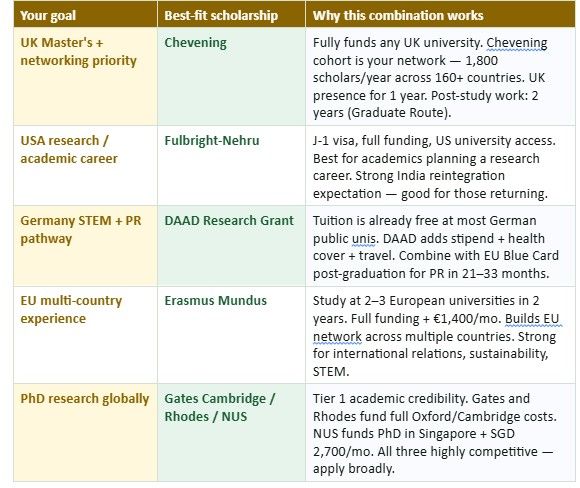
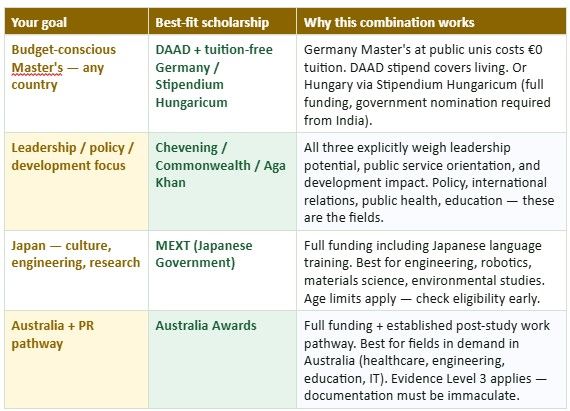
Match your goal to the right scholarship.
The best scholarship is not the most prestigious one — it is the one most aligned with your field, career goal, and application profile. Use this table to identify your best fits:
The October–November window is the highest-value moment in the scholarship calendar
Chevening, DAAD Research Grant, DAAD WISE, and Gates Cambridge (Global) all have deadlines in October–November. This means the October–November window is the most important two-month period in any Indian scholarship applicant's year. If you are planning to apply for scholarships for September 2027 intake, your preparation should begin now — in April 2026 — with research proposal development, supervisor contact (for DAAD), and reference cultivation. Waiting until September 2026 to start is already too late for DAAD.
How Vidysea helps with scholarship applications.
A scholarship application is not just a form — it is a portfolio of documents (essays, proposals, references, academic transcripts) that need to tell a coherent, compelling story about who you are, what you will do with the funding, and why you over the other 40,000 people who applied. Each scholarship committee looks for a different story. The Chevening committee wants a leader with a network plan. The DAAD committee wants a researcher with a defined question and a German professor who has agreed to work with them. The Commonwealth committee wants a development professional who will return to India and apply what they learned. Writing the same personal statement for all three is the fastest way to receive three rejections.
What Vidysea's scholarship counselling covers:
- Profile matching: identifying which 3–5 scholarships have the strongest alignment with your academic background, professional experience, field, and career goal
- Application calendar management: building a month-by-month action plan that ensures no deadline is missed and each application receives adequate preparation time
- Essay strategy: developing a differentiated narrative for each scholarship that addresses the specific selection criteria — not a general personal statement applied to every portal
- Reference briefing: preparing the background materials your referees need to write strong, specific letters rather than generic endorsements
- Research proposal support (for DAAD / research scholarships): developing the research question, literature review structure, and supervisor contact strategy
- German professor outreach (for DAAD): identifying the right German professor and drafting the initial contact email
- Mock interview preparation (for Chevening and Fulbright, which include interview stages)
Scholarships and university applications are not separate processes
Many students treat scholarship applications as a separate track from university applications. This is a mistake. Chevening requires a university offer. DAAD requires a supervisor commitment. Erasmus Mundus requires application to the specific joint programme. A well-integrated application strategy sequences university applications and scholarship applications correctly — which requires knowing which scholarships need which university actions completed first, and when.
Frequently asked questions.
Can a student with a backlog apply for these scholarships?
It depends on the scholarship. DAAD and Erasmus Mundus assess academic trajectory and research strength — one backlog in a non-core subject is unlikely to disqualify a strong candidate. Chevening and Commonwealth weight professional achievement and leadership over academic metrics. Fulbright is holistic. The scholarship you should avoid with a backlog: the Gates Cambridge and Rhodes, which apply a very high academic bar. The answer is profile-specific, not categorical.
Do I need to have a university offer before applying for most scholarships?
Most government bilateral scholarships — Chevening, Commonwealth, DAAD — do not require a conditional university offer at the time of application. You apply to the scholarship and then complete the university application simultaneously or after receiving scholarship shortlisting. A few scholarships (some Erasmus Mundus programmes, Gates Cambridge) are embedded within university applications and require simultaneous submission. The calendar table above indicates which require prior university offers.
Can I apply for more than one scholarship simultaneously?
Yes — and you should. Most scholarship conditions state that you must inform them if you receive another award and cannot defer — they do not prevent simultaneous applications. Applying to 3–5 scholarships in the same cycle is standard practice for serious candidates. Building a shortlist across government, foundation, and university scholarship categories gives you the best odds of funding at least one application cycle.
Is the JN Tata Endowment really a scholarship if it has to be repaid?
The JN Tata Endowment is structured as an interest-free loan-scholarship — the recipient repays when financially able, and many recipients do not repay until several years post-graduation. The practical effect for most candidates is equivalent to a full grant, as the interest-free structure means there is no cost of capital. It is one of India's most respected private education awards and carries significant professional recognition independent of its financial structure.
Fully funded scholarships are awarded to people who invested in their applications early, understood what each committee was looking for, and built a coherent case across every element of the portfolio. They are not lottery prizes. They are the result of strategic preparation that begins 12–18 months before the deadline — and is much easier to build correctly with a counsellor who has read winning and losing applications across multiple cycles.