GRE Preparation Tips for Indian Students: How to Score 320+ — 2026 Complete Guide
For most Indian students targeting US graduate programmes, 320 is the threshold that changes what is possible. Below 320, many top-50 programmes are competitive long-shots. At 320+, the shortlist opens materially — and at 325+, you are competitive for top-20 programmes in most STEM and business fields.

Team Vidysea
May 19, 2026

The 320 target breaks down into approximately 165+ in Quant and 155+ in Verbal. For Indian engineering and STEM graduates, 165–170 Quant is achievable with structured preparation — it is not a ceiling but a floor for most. The limiting factor is almost always Verbal, where the combination of low-frequency academic vocabulary and subtle inference questions creates a score plateau that most Indian students hit between 148 and 155.
This guide tells you how to break through that plateau. It covers the GRE format, what how to prepare for abroad studies means through the GRE lens, section-by-section strategy for Indian test-takers specifically, a 4-month test preparation to study abroad timeline, and the exact preparation habits that separate 315 scorers from 325 scorers.
GRE vs. GMAT — which does your target programme require?
Most US STEM Master's and PhD programmes accept GRE. Most MBA programmes accept both GMAT and GRE — with no formal preference, though individual adcom readers may have informal biases. If your target is an MBA, check whether the specific programme publishes average GRE scores (most now do) and whether GMAT or GRE is more commonly submitted by admitted students. For STEM MS and PhD, GRE is the standard. For joint programmes (MBA+engineering, MBA+public policy), GRE is often preferred.
GRE General Test — Format and Scoring (2026)
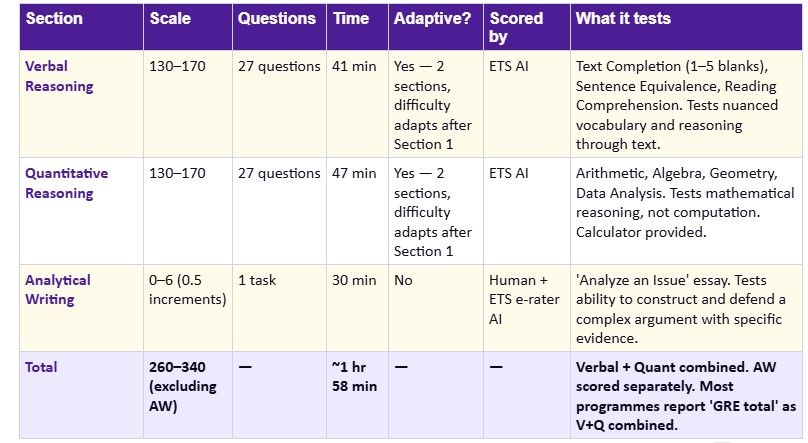
The GRE General Test went through a major format change in September 2023. The test is now shorter (approximately 2 hours instead of 3.5 hours), with one fewer section in both Verbal and Quant. The analytical writing section now has one task instead of two (the Argument essay was removed, only Issue remains).
| Section | Scale | Questions | Time | Adaptive? | Scored by | What it tests |
|---|---|---|---|---|---|---|
| Verbal Reasoning | 130–170 | 27 questions | 41 min | Yes — 2 sections, difficulty adapts after Section 1 | ETS AI | Text Completion (1–5 blanks), Sentence Equivalence, Reading Comprehension. Tests nuanced vocabulary and reasoning through text. |
| Quantitative Reasoning | 130–170 | 27 questions | 47 min | Yes — 2 sections, difficulty adapts after Section 1 | ETS AI | Arithmetic, Algebra, Geometry, Data Analysis. Tests mathematical reasoning, not computation. Calculator provided. |
| Analytical Writing | 0–6 (0.5 increments) | 1 task | 30 min | No | Human + ETS e-rater AI | 'Analyze an Issue' essay. Tests ability to construct and defend a complex argument with specific evidence. |
| Total | 260–340 (excluding AW) | — | ~1 hr 58 min | — | — | Verbal + Quant combined. AW scored separately. Most programmes report 'GRE total' as V+Q combined. |
Pre-2023 preparation materials are partially outdated
Materials from before September 2023 include an Argument essay task, three Verbal sections, and three Quant sections. The current test has two Verbal sections, two Quant sections, and one Writing task (Issue only). Older materials are still useful for question practice — the question types and content are unchanged — but any mock test from an older book will have the wrong format and wrong timing. Always use ETS official practice tests (available at ets.org) to simulate the actual test experience.
GRE Score Targets by Programme and Destination
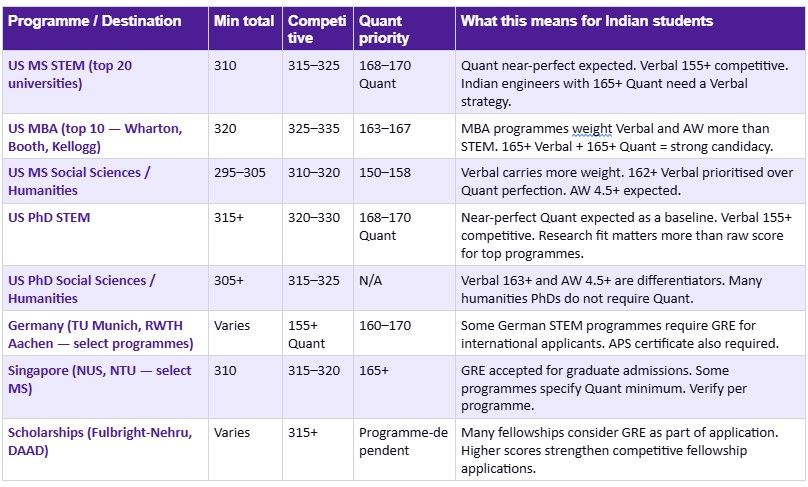
Before designing your preparation plan, know what score you need for your specific target. 'I want 320' is a goal. 'I need 165 Quant and 155 Verbal for a competitive application to MS CS at Georgia Tech' is a plan.
Pre-2023 preparation materials are partially outdated
Materials from before September 2023 include an Argument essay task, three Verbal sections, and three Quant sections. The current test has two Verbal sections, two Quant sections, and one Writing task (Issue only). Older materials are still useful for question practice — the question types and content are unchanged — but any mock test from an older book will have the wrong format and wrong timing. Always use ETS official practice tests (available at ets.org) to simulate the actual test experience.
GRE Score Targets by Programme and Destination
Before designing your preparation plan, know what score you need for your specific target. 'I want 320' is a goal. 'I need 165 Quant and 155 Verbal for a competitive application to MS CS at Georgia Tech' is a plan.
✅ The Indian STEM applicant's Quant reality
Indian engineers and STEM graduates consistently score in the 165–170 Quant range with 6–8 weeks of targeted preparation. A score below 165 in Quant is a significant disadvantage for STEM programmes — it signals to US programmes that an Indian engineering graduate underperformed in the section they are expected to dominate. Treat 168+ Quant as the floor, not the ceiling, if you have an engineering or science background. Invest your preparation time in Verbal, where the marginal return on effort is much higher for most Indian students.
Quantitative Reasoning — Getting to 165+
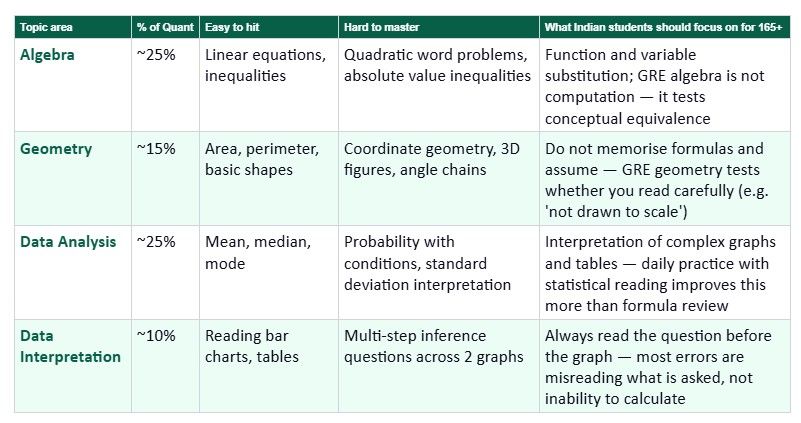
For most Indian engineering and science graduates, the path to 165+ Quant is not about learning new mathematics — it is about not losing marks on questions you know how to solve. GRE Quant tests mathematical reasoning and trap-avoidance, not computational ability. The most common reason a student who understands the mathematics scores 158–162 is falling for the question-design traps that the test is built on.
The five trap patterns that cost Indian students the most Quant marks
- The 'Not Drawn to Scale' trap: GRE geometry figures are explicitly not drawn to scale. A line that looks longer is not necessarily longer. A triangle that looks right-angled is not necessarily right-angled. Always work from given information, never from visual appearance.
- The Quantitative Comparison mismatch: QC questions ask which quantity is greater, or if they are equal. The answer 'relationship cannot be determined' is correct more often than most students expect — when a value depends on a variable that could take multiple values.
- The Hidden Constraint trap: integer vs. non-integer, positive vs. negative, zero as a possible value. GRE problems that seem to have a single answer often have two valid answers when zero or negative numbers are substituted. Always test the edge cases.
- The Percent Change chain error: increasing by 20% and then decreasing by 20% does not return to the original value. GRE percent problems exploit this systematically.
- Data Interpretation misread: two graphs are presented and a multi-step question asks you to combine data from both. The most common error is answering from only one graph. Always check which graph each part of the question requires.
Verbal Reasoning — Breaking Through the 155 Plateau
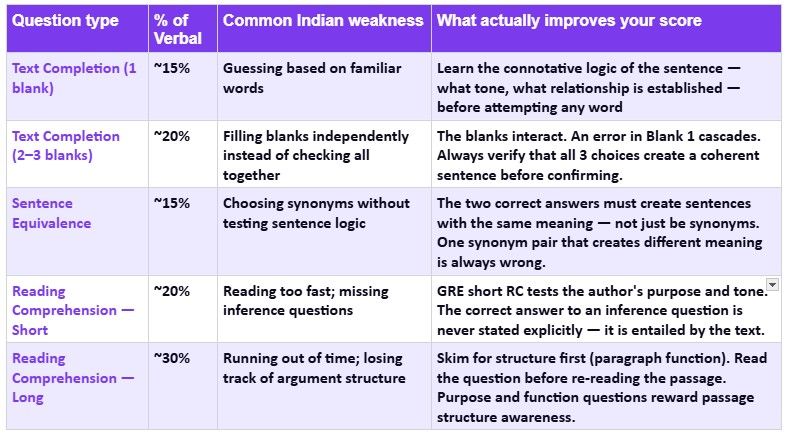
The Verbal plateau at 148–155 is the single most common GRE preparation challenge for Indian students. The root cause is a combination of vocabulary depth and inference accuracy. Both require sustained, structured preparation — not a last-minute word list.
The vocabulary strategy for Indian GRE students
GRE vocabulary is not common English — it is the academic-literary register of 19th and 20th century American writing. Words like 'tendentious', 'sanguine', 'obsequious', 'pellucid', 'laconic' appear regularly. Most Indian students recognise fewer than 20% of high-frequency GRE words at the start of preparation. Building to 500–700 words in active recall is what separates Verbal 148 from Verbal 158.
What works — and what does not:
- Works: Spaced repetition flashcards (Magoosh GRE, Barron's 333 words) reviewed daily. 20 new words per day + review of previous 40. Maintain consistently for 60 days.
- Works: Learning words in sentence context, not isolation. 'Sanguine' memorised as a standalone word will not help you recognise 'sanguine about the prospects' in a text completion.
- Works: Grouping words by connotation family — positive/negative, active/passive, increase/decrease, certainty/doubt. GRE text completions test the logical relationship between clauses, and connotation families make this pattern-matching faster.
- Does not work: Reading word lists without active recall testing. Passive exposure does not build the retrieval speed needed for 27 Verbal questions in 41 minutes.
- Does not work: Memorising definitions without understanding connotative tone. 'Garrulous' and 'loquacious' both mean talkative — but their connotative tones differ, and GRE Text Completion exploits this.
The reading comprehension strategy for 160+ Verbal
GRE Reading Comprehension is different from IELTS or TOEFL reading in one critical way: it specifically tests author purpose, logical structure, and inference more heavily than factual recall. A student who reads the passage carefully and can recall the facts will still miss inference questions if they are not trained to identify what is logically entailed versus what is explicitly stated.
The three RC skills that drive scores above 155:
- Identify the passage's central purpose in one sentence before reading the questions — not what it says, but why it was written. This reframes all subsequent questions.
- For inference questions: the correct answer is the one that must be true if the passage is true. Anything that could be true, might be true, or is probably true is wrong. Only 'must be true' is right.
- For 'strengthen/weaken' questions (rare in GRE but present): identify the precise claim being tested, not the general topic. A piece of evidence that strengthens the general topic but does not address the specific claim is always a distractor.
Analytical Writing — The Section Most Indian Students Underestimate
AW is scored 0–6 on a 0.5-point scale by a human rater supplemented by ETS's e-rater AI. Most top programmes expect AW 4.0–4.5 as a minimum, and AW 5.0+ signals strong writing ability. A low AW score (below 3.5) at a 325+ total GRE can raise concerns about writing ability in graduate-level coursework. AW preparation is often deprioritised by Indian students who focus on Quant — this is a mistake if your target includes writing-intensive programmes.
The Issue task — what the rater is looking for
The Analyse an Issue task presents a complex claim and asks you to discuss the extent to which you agree or disagree. The most common mistake: taking an extreme position ('I completely agree' or 'I completely disagree'). The GRE raters reward nuance — the ability to acknowledge the strongest version of the other side while clearly defending your own position.
Structure that consistently scores 4.5–5.0:
- Introduction (3–4 sentences): state your nuanced position. Not 'I agree' but 'I agree insofar as X, but this agreement breaks down when Y.' The qualification is not weakness — it is what the rater wants.
- Body paragraph 1 (6–8 sentences): your strongest argument for your position. Open with the argument. Support with a specific, concrete example — historical, scientific, or from a named field. Explain how the example supports your argument.
- Body paragraph 2 (6–8 sentences): a second distinct argument, or a development of a different aspect. Avoid repeating the same point.
- Concession paragraph (4–5 sentences): 'A proponent of the opposing view would argue that...' State the best counterargument. Then rebut it specifically. This paragraph is what separates 4.0 from 4.5+.
- Conclusion (2–3 sentences): restate your nuanced position. Do not introduce new arguments. End cleanly.
The 4-Month GRE Preparation Timeline — How to Prepare for Abroad Studies
This timeline is designed for an Indian student with an estimated baseline of 305–315 who wants to reach 320+ for US graduate admissions. Adjust upward by 4–6 weeks if your baseline is below 300. Both target keywords are embedded in this timeline: 'how to prepare for abroad studies' through the GRE means building the academic reasoning skills that US graduate programmes assess, and 'test preparation to study abroad' means treating this as the foundational language and reasoning investment it is — not just a score to be optimised.
| Month | Stage | What to do | Primary resources | Weekly hours |
|---|---|---|---|---|
| 1 | Diagnostic + Foundation | Take a full ETS official timed mock. Score Verbal and Quant separately. Identify which Quant topic areas and which Verbal question types are weakest. Begin vocabulary building from Day 1 — this cannot be rushed. | ETS Official GRE Practice Tests 1 & 2 (free on ets.org). Magoosh GRE Vocabulary Flashcards (1,000 words). Manhattan Prep GRE 5 lb. Book for topic identification. | 12 hrs (mock + review + vocab start) |
| 2 | Quant mastery — weakest topics first | Work through each weak Quant topic systematically. Solve 30 questions per topic before moving to the next. Timed practice within each section type. Note and revisit every missed question after 72 hours. | Manhattan Prep GRE Strategy Guides (Algebra, Geometry, Number Properties — individual volumes). ETS Official GRE Quantitative Reasoning Practice Questions. | 10 hrs/week (8 Quant + 2 Verbal vocab) |
| 3 | Verbal intensive + Writing | 500 vocabulary words minimum acquired and tested. Work through Text Completion and Sentence Equivalence with process — no guessing. Write 3 Issue essays (timed 30 min each). Get at least 1 essay scored by an evaluator. | The GRE Vocabulary Flashcard + Word Power Made Easy (N. Lewis). Manhattan Prep RC guide. ETS Issue pool (pool.ets.org/gre — practise from the actual pool). PowerPrep Writing Scorer. | 10 hrs/week (5 Verbal + 3 Writing + 2 Vocab) |
| 4 | Full integration + test booking | Take 1 full timed mock every 5 days. Review all errors — categorise by type, not just mark wrong. Drill persistent Quant error patterns. Book test when average V+Q is within 3–5 points of target across 3 consecutive mocks. | ETS Official GRE Practice Tests 3–6 (paid, from ETS). Magoosh GRE full mocks. Greg Mat (free YouTube — best Verbal RC explanations for high scorers). | 12 hrs/week |
The error log — the single most important preparation habit
Every question you answer incorrectly should go into a structured error log: the question source, the question type, the error you made (misread, calculation, wrong strategy, vocabulary gap), and the correct approach. Review the log weekly. Most students make the same 5–7 types of errors repeatedly — identifying the pattern is what enables targeted improvement. Students who maintain an error log consistently improve faster than those who simply do more practice problems.
The Best GRE Preparation Resources for Indian Students — 2026
GRE preparation resources vary widely in quality. The most important principle: ETS official materials are the ground truth. Any third-party material that claims to predict exactly what GRE questions will look like is overstating its accuracy — but some third-party materials are excellent for specific purposes.
Official resources — use these as your foundation
- ETS Official GRE Practice Tests 1 & 2 (free at ets.org): the most accurate simulation of actual GRE questions and timing. Take at least 2 before your test date.
- ETS Official GRE Practice Tests 3–6 (paid, ~$45 each): essential if you are targeting 325+. Each contains a full set of official questions not available elsewhere.
- ETS Official Verbal Reasoning and Quantitative Reasoning Practice Questions (books): additional official question sets organised by type, useful for targeted section practice.
- ETS Issue pool (at ets.org/gre): the complete list of all Analyse an Issue prompts that will appear on the GRE. Practice from the actual pool — the exact question you get on test day is on this list.
Third-party resources — use for supplementary volume and explanation
- Manhattan Prep 5 lb. Book of GRE Practice Problems: the best single volume for Quant practice volume. Questions are slightly harder than actual GRE — which is deliberate for preparation purposes.
- Magoosh GRE: strong for Verbal — particularly video explanations of Text Completion and RC reasoning. The vocabulary flashcard app is one of the best tools for the 500-word target. Quant explanations are adequate but less thorough than Manhattan.
- Greg Mat (YouTube — free): the best free Verbal explanations available for GRE. Greg Mat's RC methodology — particularly for high-difficulty questions above 160 — is more rigorous than most paid resources.
- Word Power Made Easy (Norman Lewis): the best book for understanding vocabulary roots and connotative families for Indian students. Not a GRE-specific resource, but one of the most effective for building genuine vocabulary depth rather than definition memorisation.
GRE as Test Preparation to Study Abroad — The Broader Picture
The GRE is not only an admissions credential. The skills it develops — precise reasoning through text, abstract mathematical logic, structured argumentation — are the cognitive foundations of US graduate study. Preparing seriously for the GRE is preparing for the academic life you will live abroad, in a way that is more directly useful than any other pre-departure preparation.
- Text Completion and RC preparation builds the academic English reading comprehension that seminar papers, research articles, and thesis chapters require
- Quant preparation builds the precise, trap-aware mathematical reasoning that quantitative research methods, statistics courses, and technical communication in US academia demand
- AW Issue preparation is the most direct rehearsal for the persuasive academic writing that every US graduate programme grades — it trains you to make a specific, nuanced, well-evidenced argument in a constrained time
- The vocabulary depth required for Verbal 155+ is approximately the academic register expected of a first-year US graduate student — building it before arrival accelerates your adaptation to American academic culture
Students who have prepared seriously for the GRE — not just practised but genuinely engaged with the reasoning each section tests — consistently find the transition to US graduate study smoother. The test preparation is the study abroad preparation. The two are not separate tasks.
Frequently Asked Questions
How long does it take to go from 300 to 320+ on the GRE?
With structured preparation at 10–12 hours per week, most Indian students move from 300–305 to 320–325 in 4–5 months. The rate of improvement is not linear — Quant gains typically come faster (6–8 weeks for a 10-point improvement) than Verbal gains (vocabulary depth takes 8–12 weeks of consistent daily work to materially affect RC and Text Completion performance). Plan for a 4-month minimum; 5–6 months if starting below 300.
Does GRE Quant require advanced mathematics?
No. The highest level of mathematics tested in GRE Quant is high-school mathematics: arithmetic, algebra, basic geometry, and introductory statistics. There is no calculus, no trigonometry, and no advanced algebra. A calculator is available for Quant (on-screen). The challenge is not the mathematics — it is the reasoning and trap-avoidance. An Indian engineering graduate who scores 155 in Quant has almost certainly made reasoning errors on mathematics they know, not missed mathematical concepts they haven't studied.
Can I take the GRE from home?
Yes — the GRE at Home option is available and identical in content, scoring, and acceptance to the test-centre version. It requires a stable internet connection, a webcam, and a quiet, private room. A live proctor monitors via webcam throughout the test. Score reports do not indicate whether the test was taken at home or at a centre. Both are accepted equally by all programmes that accept GRE. Book via ets.org regardless of format choice.
Is GRE required for all US MS programmes?
No — and this has changed significantly since COVID. Many US STEM programmes waived the GRE requirement in 2020–2022 and have not reinstated it. Some have made GRE permanently optional. Before spending 4 months preparing, verify whether your specific target programmes require GRE, make it optional, or have removed it entirely. A strong application without GRE is accepted by many programmes that were previously considered competitive. Check the admissions page of each target programme for the current 2025–26 requirement, not the historical one.
My GRE score is 318. Should I retake?
The decision depends on which programmes you are targeting and which section is holding you back. If your target programmes have average admitted GREs of 320–322 and your score is 318 with a strong application otherwise, the ROI on a retake is low — spend that time on your SOP and research statement. If you scored 318 with 148 Verbal and 170 Quant, and your target programmes are Verbal-intensive (social sciences, humanities, or MBA), a targeted Verbal retake may meaningfully strengthen your application. A Vidysea counsellor can assess this against your specific programme shortlist.
The 320 threshold is achievable for most Indian students who prepare with the right materials, the right strategy, and the right time allocation between sections. The Quant ceiling is higher than most Indian students think it is. The Verbal ceiling is higher than most Indian students have reached. The 4-month timeline in this guide, followed consistently, builds the academic reasoning depth that both the GRE and US graduate study actually require.