IELTS vs PTE vs TOEFL: Which Is Better for Canada PR in 2026?
The short answer is: IELTS Academic or PTE Academic. TOEFL is not accepted for Express Entry, the Canadian Experience Class, the Provincial Nominee Programme, or any of Canada's primary permanent residence pathways. If your goal includes Canada PR, taking TOEFL alone is a costly mistake — you will still need to retake IELTS or PTE before you can submit an immigration application.

Team Vidysea
May 19, 2026

But the comparison between IELTS and PTE — which both work for Canada PR — is genuinely worth understanding. They produce identical CLB scores for the same English proficiency level, but they are very different tests in format, scoring methodology, preparation strategy, and result delivery time. Depending on your profile, your timeline, and your specific weaknesses, one may be significantly more advantageous than the other.
This guide covers the complete comparison: what each test is, how it maps to Canada's CLB system, how it affects your CRS score, and how to prepare for each one specifically. It also explains where TOEFL fits in the picture — because while TOEFL will not help your Canada PR, it is still relevant if you are applying to US universities as a parallel track.
The one rule that matters most for Canada PR
Immigration, Refugees and Citizenship Canada (IRCC) publishes an official list of approved English language tests for immigration purposes. As of 2026, IELTS Academic, IELTS General Training, and PTE Core (for PR) / PTE Academic (for student visas) are on this list. TOEFL iBT is NOT on this list. Using TOEFL for a Canada Express Entry or PR application is not possible. Always verify the current IRCC-approved test list at ircc.gc.ca before booking any test.
IELTS vs PTE vs TOEFL — Complete 2026 Comparison
Every dimension that matters for an Indian student targeting Canada (and other destinations):
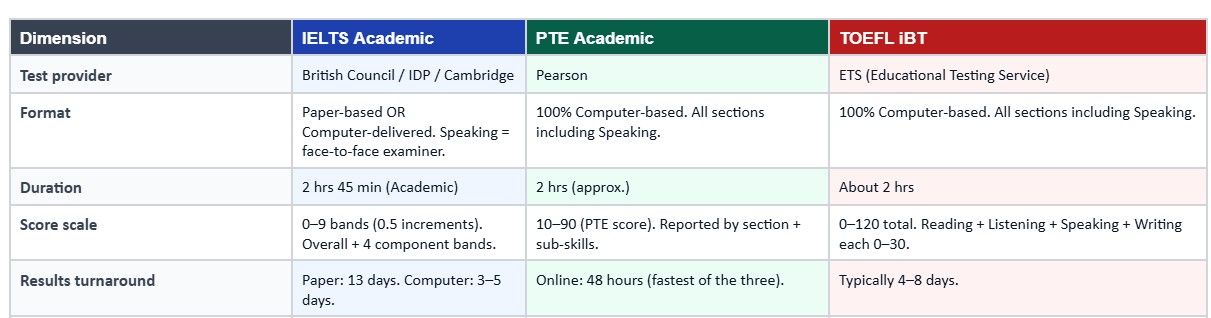
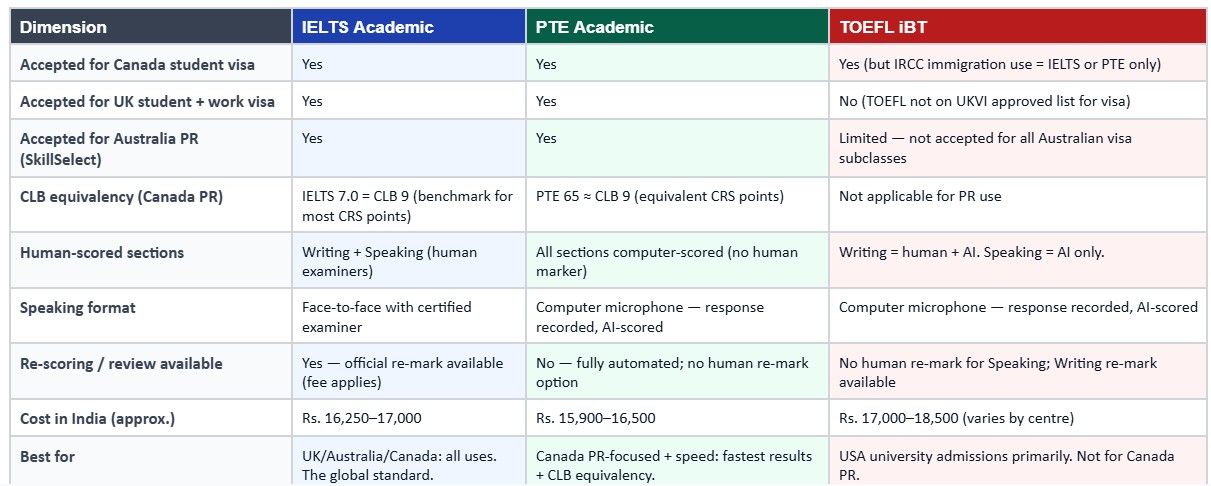
PTE Core vs PTE Academic — know the difference
PTE Academic is the test for university admissions and student visas. PTE Core is a newer test (launched 2023) specifically designed for Canadian permanent residence applications — it replaces IELTS General Training in the immigration context. For Canada PR via Express Entry, you can use PTE Core (immigration) or IELTS General Training. For Canada student visa + later Express Entry, many Indian students take PTE Academic (admitted by universities) and then PTE Core (for PR) — two separate tests. Confirm which PTE version your specific use case requires before booking.
Canada CLB Equivalency: IELTS and PTE Score Mapping
Canada's immigration system uses the Canadian Language Benchmarks (CLB) to measure English proficiency for all immigration applications. Every IELTS and PTE score maps to a CLB level. The higher your CLB, the more CRS points you earn. This table shows the official equivalencies published by IRCC (simplified — verify at ircc.gc.ca for complete table):
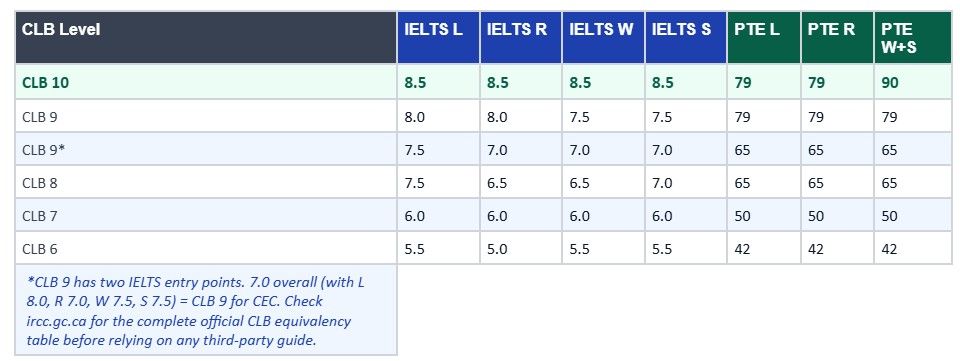
✅ CLB 9 is the target most Indian Express Entry applicants should aim for
CLB 9 (equivalent to IELTS 7.0 across all four bands, or PTE 65 across all skill areas) is the threshold that maximises language CRS points for most Indian applicants in the Federal Skilled Worker and Canadian Experience Class programs. Moving from CLB 8 to CLB 9 adds approximately 32 CRS points — often the difference between receiving an ITA in a competitive draw and waiting another 6–12 months. Invest the preparation time to hit CLB 9 before submitting your Express Entry profile.
How Your Test Score Affects Your CRS Points — The Numbers That Matter
Language proficiency is worth up to 160 CRS points for first official language (English) and up to 24 additional points for second official language (French). Understanding the exact CRS impact of each score tier determines whether to retake a test or accept your current profile:
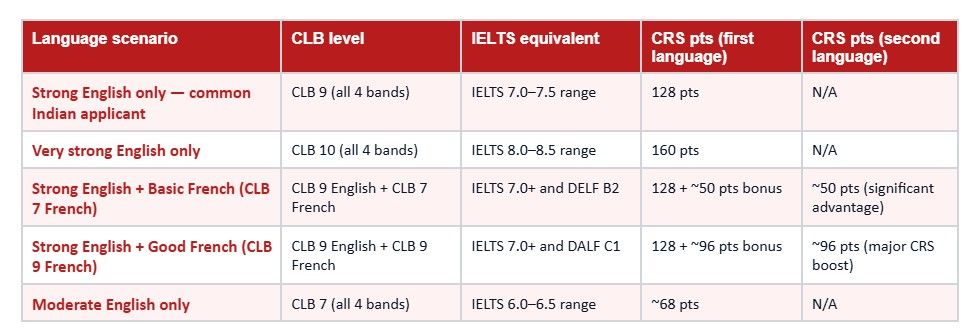
The French language bonus is one of the most underutilised CRS strategies for Indian students
Adding CLB 7 French (approximately DELF B2 level) to a CLB 9 English profile can add 50+ CRS points — more than a Canadian job offer adds in many scenarios. Category-based draws for French speakers have had cut-off CRS scores as low as 379 (compared to 508+ for Canadian Experience Class general draws). Indian students who are willing to learn intermediate French have a structural CRS advantage that cannot be replicated by any other preparatory action. The test required is TEF Canada or TCF Canada (not IELTS or PTE).
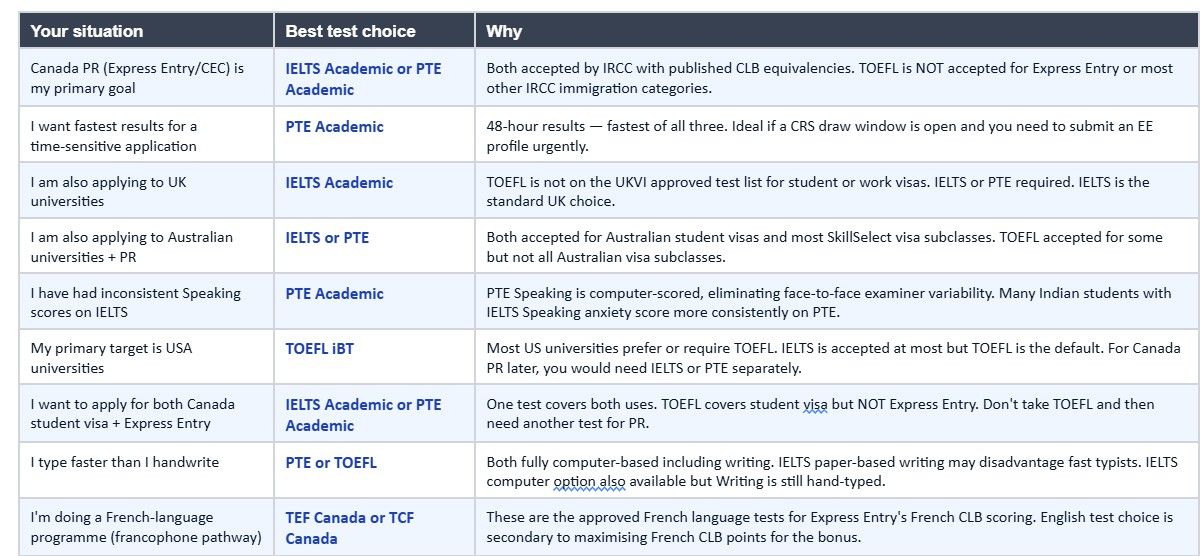
Which Test Should You Take? The Decision Framework
The right test depends on your specific situation — not a generic preference. Use this table to identify your best choice:
How to Prepare — Test-Specific Strategies for Study Abroad
Both IELTS and PTE require test-specific preparation. A student who has prepared for IELTS and then takes PTE without specific preparation will often underperform, even with identical English proficiency. The task formats are fundamentally different. This section covers how to prepare for abroad studies through the lens of each test — what to study, what resources to use, and where to focus your preparation time for each format.
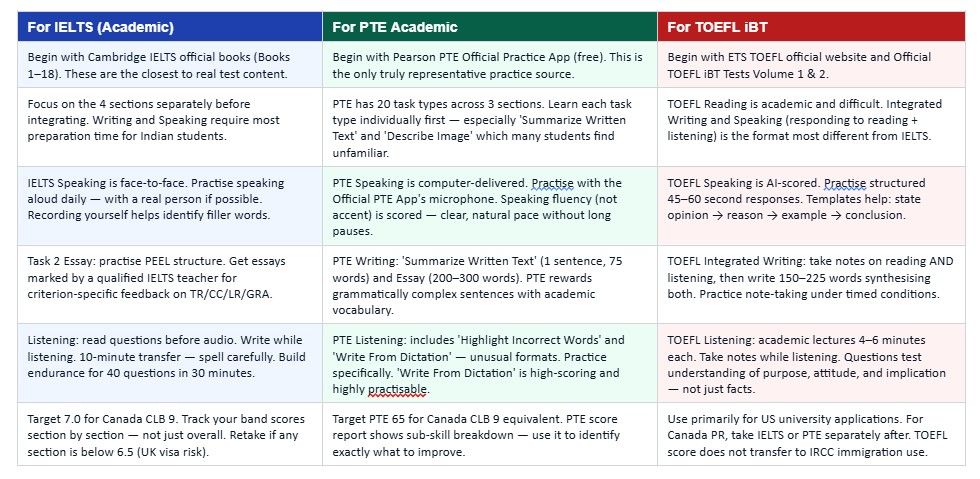
Preparation for one test partially transfers — but not fully
Academic English vocabulary, reading comprehension speed, and writing coherence developed for IELTS will help you in PTE and vice versa. The foundational English skills transfer. The task-specific formats do not. If you switch from IELTS to PTE (or vice versa), budget 4–6 weeks of format-specific practice before attempting the new test. The scoring methodology, time pressure, and response formats are sufficiently different that format-naive attempts consistently underperform a candidate's true English level.
Canada's 2026 Language Policy Context — What Has Changed
Understanding the test comparison in isolation is not enough — you need to understand it in the context of Canada's 2026 immigration landscape:
Express Entry draws are active in 2026
- March 2026: CEC draw issued 4,000 ITAs at CRS 508. Category-based draws (healthcare, STEM, French, trades) are running alongside general draws.
- Language CRS points are unchanged — CLB 9 in all four English bands = 128 points for first official language (single applicant)
- French category-based draws have had cut-offs as low as CRS 379 — significantly below general CEC draws. French CLB 7 is a major CRS advantage for Indian applicants who are willing to invest in French preparation.
Master's and PhD students are cap-exempt in 2026
- Canada's 50% study permit cap applies to undergraduate and diploma programmes only. Master's and PhD students are explicitly exempt.
- A 2-year Master's at a Canadian public university qualifies for a 3-year PGWP post-graduation — which directly feeds into CEC eligibility after 1 year of Canadian work experience
- The study-to-PR pathway for Indian Master's students in Canada remains intact and is the most structured PR pathway of any destination
Which test to use for the Canada study-to-PR pathway
For Indian students targeting the study → work → Express Entry pathway:
- Student visa: IELTS Academic (6.0+) or PTE Academic (accepted). Your test choice for the student visa does not limit your immigration test choice later.
- Express Entry (post-graduation): IELTS General Training or PTE Core. You may take a different test variant for immigration than you used for your student visa.
- Optimal strategy: take IELTS Academic for university admissions (globally recognised, accepted everywhere). After graduation and 1 year of work, take IELTS General Training or PTE Core for your Express Entry profile — aiming for CLB 9.
IELTS vs PTE Head-to-Head — For Indian Test-Takers Specifically
Given that TOEFL is out of contention for Canada PR, the real decision for most Indian students is between IELTS and PTE. Here is the honest comparison for Indian test-takers:
Choose IELTS if:
- You need the score for both university admission and Canada PR — IELTS Academic is universally accepted everywhere globally
- You also plan to apply to UK universities or eventually seek UK employment — IELTS is on the UKVI approved list, PTE is also accepted but IELTS is more familiar to UK institutions
- You are not under time pressure — you can wait 3–5 days for computer IELTS results or 13 days for paper
- You prefer speaking with a real human examiner — some students perform better with face-to-face interaction than with a computer microphone
- You want the option of an official re-mark (IELTS Enquiry on Results) if you believe your Speaking or Writing was underscored
Choose PTE if:
- You need results within 48 hours — for a time-sensitive Express Entry profile submission or scholarship deadline
- You have had inconsistent IELTS Speaking scores — PTE's AI-scored Speaking eliminates examiner variability and day-to-day performance anxiety
- You are a confident typer — PTE Writing is fully computer-based and rewards fast, accurate typing
- You have previously attempted IELTS multiple times without breaking through a Speaking ceiling — PTE's automated scoring may suit your natural speaking style better
- You want a detailed sub-skill score breakdown — PTE's score report shows 16 enabling skills, helping you identify exactly which sub-skills to improve
Frequently Asked Questions
Can I use TOEFL for Canada PR at all?
No. TOEFL iBT is not accepted by IRCC for any permanent residence pathway — not for Express Entry, not for the Provincial Nominee Programme, not for the Canadian Experience Class. If you have only a TOEFL score and you want to apply for Canada PR, you must take IELTS Academic/General Training or PTE Academic/Core separately. Do not book TOEFL with Canada PR as your goal.
My IELTS score is 6.5. Will this affect my Canada PR CRS score significantly?
IELTS 6.5 maps to approximately CLB 8 in most skill bands. CLB 8 earns approximately 96 language points (single applicant) vs. 128 for CLB 9. That is a 32-point difference — which in competitive Express Entry draws can mean 6–18 months of additional waiting time. If your overall is 6.5 and any single band is below 6.5, your CLB mapping may drop further. Investing in a retake to reach 7.0 in all bands (CLB 9) is almost always worth it for Canada PR-focused applicants.
Which is easier to prepare for — IELTS or PTE?
Neither is objectively easier. IELTS is more familiar because it has been the global standard for longer — most test-preparation resources, coaching classes, and peer networks are oriented toward IELTS. PTE has fewer official preparation resources but its computer-scored format means less human variability. Indian students who have struggled with IELTS Speaking scores often find PTE more predictable and achievable. Students who are not comfortable with computer-based speaking often find IELTS Speaking more natural. The best choice is the one you can prepare most effectively for given your specific profile.
How long should I prepare for IELTS or PTE to reach CLB 9?
If your current estimated level is 6.0–6.5 (below CLB 9), plan 4–6 months of dedicated preparation at 8–12 hours per week. If you are at 7.0 but need to push to 7.5 in a weak section, plan 6–8 weeks of targeted section-specific work. The 8-month preparation timeline in Vidysea's IELTS Preparation Guide (linked below) maps this in detail. The key principle for Canada PR: do not submit your Express Entry profile with a score that falls below CLB 9 if CLB 9 is achievable within 3–6 months of preparation — the CRS point difference materially impacts your wait time.
Can I take both IELTS and PTE and use the better score?
Yes. IRCC allows you to submit whichever approved English test score you choose. If you have both a strong IELTS score and a strong PTE score, you may submit either. If one gives you a higher CLB level (and therefore more CRS points), use that one. There is no restriction on holding both test scores — though practically, students who prepare for both simultaneously often underperform on both. It is generally more effective to prepare thoroughly for one test and consider the other only if the first attempt does not reach your CLB target.
The test you choose for Canada PR is not a permanent decision — you can retake, switch between IELTS and PTE, or add French proficiency at any point before submitting your Express Entry profile. What matters is arriving at CLB 9 (or above) before you enter the pool, because every point of CRS below your potential score is time in the queue. Invest in the preparation. The timeline difference at CLB 8 vs. CLB 9 is not weeks — it is often years.