Online vs In-Person Counselling: Which Is Better for Study Abroad?
The honest answer is: it depends on who you are — not on which format is objectively superior. Online counselling is not a compromise. In-person counselling is not always better just because it involves a physical chair. Both formats deliver the same core service — expert guidance on country selection, university applications, visas, and strategy. The format is a delivery mechanism, not the product. This is true across all types of study abroad counselling and modern overseas education counselling services.

Team Vidysea
May 16, 2026

That said, the format does matter for specific profiles and specific situations. The goal of this guide is simple: by the end, you should know exactly which format — or combination of both — fits you. This is an important part of choosing the right counselling for study abroad.
First: what is identical regardless of format.
Before comparing, it helps to establish what does not change between online and in-person sessions. These are the things that determine whether a counsellor is actually good at their job — and neither format has an inherent advantage here.
• The counsellor's knowledge of 2026 policy changes (UK ILR, Canada cap exemptions, Australia Evidence Level 3)• The quality of country matching, university shortlisting, and profile analysis• The SOP and LOR strategy — this is entirely document-based regardless of where the conversation happens• Visa file review and financial documentation preparation• Post-offer ROI comparison — which offer to accept and why
These outcomes depend on the counsellor's expertise and the depth of the session — not on whether you are in the same room. A mediocre in-person counsellor will serve you worse than an excellent online one, and vice versa. Format is secondary. Expertise is primary in study abroad counselling and overseas education counselling.
Where the formats actually differ.
The differences are real — they just apply differently to different people. Here is the honest breakdown:
| What matters | Online counselling (video call / chat / async) | In-person counselling (centre visit / home visit) |
|---|---|---|
| Access & geography | Available from any city, town, or tier-3 location. No travel needed. | Requires proximity to a counselling centre. Better served in metros. |
| Scheduling flexibility | Evening, weekend, or early-morning slots common. Works around school/work. | Office hours apply. Harder to reschedule last-minute. |
| Speed of first contact | Same-day or next-day appointment. Ideal for urgent deadlines. | May take 2–5 days for a first slot, especially at peak intake season. |
| Document review & SOP feedback | Shared via Google Drive or email. Works well; minor friction on revisions. | Physical documents reviewed together — clearer for parents who prefer paper. |
| Reading non-verbal cues | Partial — video picks up some; chat-only misses tone and hesitation. | Full. Counsellor reads anxiety, confusion, and disagreement in the room. |
| Family participation | Parents can join from a different city. Multiple stakeholders, one call. | Whole family in one room. Most natural for joint decision-making cultures. |
| Trust and rapport | Builds over 2–3 sessions. Slightly slower to establish. | Faster with first-meeting body language and physical presence. |
| Follow-up & ongoing support | Async messages, email, and WhatsApp. Often faster response time. | In-person drop-ins possible; but distance limits spontaneous visits. |
| Cost & time investment | Zero travel cost or time. Maximum convenience. | Travel time + cost. Meaningful for families outside city centres. |
| Best for | Students in non-metro cities; busy working professionals; parents abroad (NRI); repeat check-in sessions. | First-time families who've never navigated this process; students who need high-touch handholding; joint family decisions. |
The access gap is the most significant difference in India
India has roughly 800,000 students going abroad each year — but most quality in-person counselling centres are concentrated in 8–10 cities. A student in Bhopal, Patna, Coimbatore, or Rajkot faces a genuine geographic disadvantage with in-person-only counselling. Online removes that gap entirely. This is one of the biggest advantages of digital study abroad counselling and scalable overseas education counselling.
The NRI parent situation: online wins clearly.
One scenario where the answer is unambiguous: families where one or both parents are working abroad (Gulf, USA, UK, Canada, Australia) and the student is in India with grandparents or extended family.
In-person counselling structurally excludes the most financially involved decision-maker. The parent who is earning the money, taking the loan, and ultimately signing off on a Rs. 40–80 lakh investment often cannot attend in-person sessions in India.
An online counselling session lets the student sit in Hyderabad while their father joins from Dubai and their mother dials in from Toronto. All three stakeholders — the student, the funding parent, and the co-decision-maker — are in the same session. This is not convenient. It is structurally necessary for effective counselling for study abroad and modern overseas education counselling.
Where in-person counselling has a genuine edge.
Two specific scenarios where walking into a room matters more than the format debate suggests:
1. When the family has never done this before.
For a family navigating international education for the first time — no older sibling who studied abroad, no colleague network with experience — the in-person environment reduces anxiety in a way that a video call cannot fully replicate. Watching a counsellor physically spread a university shortlist across a table, or walking through a visa document checklist side by side, creates a tactile confidence that is harder to build on a screen.
This is not about the quality of information. It is about the emotional architecture of a high-stakes first experience. For first-generation study abroad families, the in-person format often produces faster trust and clearer communication — an important aspect of study abroad counselling.
2. When the student is significantly anxious or reluctant.
Some students are being pushed into the study abroad decision by family pressure, are genuinely uncertain about whether they want to go, or are masking significant anxiety about leaving home. These emotional undertones are easier to read — and address — in person.
A skilled in-person counsellor can pause the conversation, shift the energy, and address what is actually happening in the room. On video, the same counsellor is working with a smaller signal set. This is where human interaction becomes critical in overseas education counselling.
The real answer: most students use both.
The binary framing of this question — online or in-person — does not match how most students actually engage with study abroad counselling in 2026. The pattern Vidysea sees most frequently:
• First session: in-person (or online if in a non-metro city) — for initial rapport, profile assessment, and country shortlist• Follow-up sessions 2–4: online — for SOP feedback, university list revision, scholarship shortlisting• Pre-visa session: online — quick document check, last-minute preparation• Post-offer comparison: online — spreadsheet walkthrough of all accepted offers side by side
The in-person session handles the high-touch, trust-building, first-impression moment. Online handles the operational cadence that follows. Neither format alone is as effective as both used purposefully — a key insight in modern counselling for study abroad.
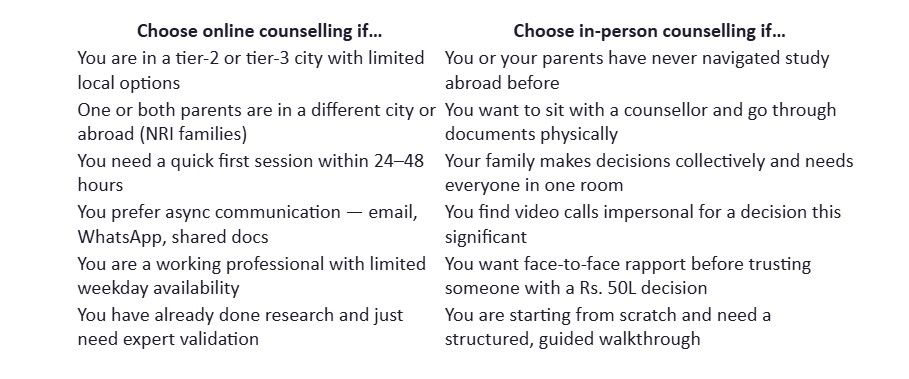
Which format is right for you?
Vidysea's recommendation
If you are in a metro city and this is your first time navigating study abroad: start in-person. If you are in a non-metro city, working professional, or have NRI parents: start online. If your situation is complex — multiple decision-makers, tight deadline, previous rejection — book whichever format gets you into a session fastest. The format matters less than the conversation happening at all — which is the foundation of effective study abroad counselling.
Final Thoughts
The question “online or in-person” matters less than:
Are you getting the right guidance?
Because strong study abroad counselling, effective counselling for study abroad, and expert overseas education counselling work in any format.