Study Abroad Counselling for Working Professionals: A Different Process for a Different Decision
The standard study abroad counselling process is built for an 18-year-old finishing school. It starts with grades, moves to test scores, shortlists universities, and tracks application deadlines. It is a good process — for that person. You are not that person. You are 30, or 36, or 42. You have a salary that would change the loan math entirely. You have an employer who might — if asked correctly — pay for part of your degree. You have a career that has given you a track record that most admissions committees actively want in their cohort. And you have constraints — a partner's job, a school calendar, a visa history, a mortgage — that no standard counselling checklist accounts for. The decision you are making is not 'which university.' It is 'does further education change my career trajectory enough to justify the cost and the disruption — and if so, which type, which country, and at what moment?' That question requires a different kind of counselling. This guide explains what that looks like.

Team Vidysea
May 18, 2026

💡 Who this guide is for
Working professionals in India with 3–20 years of experience who are considering studying abroad — whether through an online part-time programme, a modular EMBA, or a full-time degree that requires a career break. If you have told yourself 'I'll think about this properly next year' for the last three years, this guide is for the conversation you have been postponing.
Why professional counselling is structurally different from student counselling.
The difference is not just that professionals are older. It is that every variable in the decision has changed:
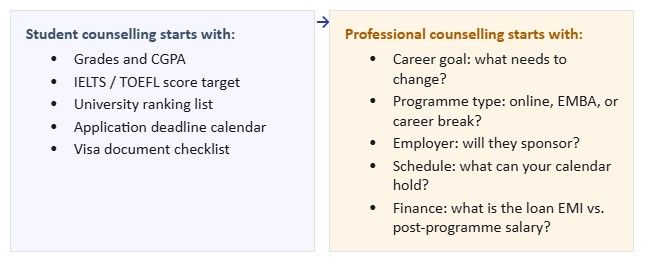
This is not a hierarchy — student counselling is not simpler. It is a different problem. The professional's decision involves more variables, higher financial stakes, and a shorter decision window (the next intake is not the only opportunity, but the cost of each year of delay — in forgone salary premium — is real and calculable).
Four working professionals. Four different counselling needs.
The right programme and the right counselling approach look different depending on where you are in your career. These four profiles represent the working professionals Vidysea most frequently counsels:
1. Deepika R., 31 — Senior Software Engineer, Bengaluru
Profile: 7 years at a product company. Strong STEM background. Feeling the ceiling of the individual contributor track. Wants to move into data science leadership.
The challenge: Wants a credential that justifies a title change without a career break. Unsure whether an online MS, a short course, or a full-time degree is the right call. Employer has no education policy she is aware of.
Counselling outcome: Counsellor identifies: Georgia Tech OMSA (online, Rs. 9L, 2.5 years) as the highest-ROI credential for her goal. Also surfaces IBM India's education assistance policy — Rs. 1.5L/year for approved programmes. First session produces a programme shortlist and an employer conversation script.
2. Vikrant M., 39 — VP Sales, FMCG, Mumbai
Profile: 12 years in brand and commercial management. Plateau at VP level. CMO track requires demonstrated strategic leadership and a peer network at the right tier.
The challenge: Wants EMBA-level credibility without relocating family. Budget consideration: can self-fund up to Rs. 25L; needs employer to cover the balance. GMAT anxiety — hasn't taken a standardised test since graduation.
Counselling outcome: Counsellor identifies: ISB PGP PRO (weekend format, Rs. 37L) as primary option; GMAT waiver possible with work experience documentation. Employer conversation strategy developed for HUL's leadership programme framework. Session 1 output: programme shortlist, GMAT assessment, sponsorship case draft.
3. Arjuna S., 35 — Finance Manager, IT Services, Pune
Profile: 8 years in corporate finance. Target: CFO role in Europe within 10 years. Strong academic record. Partner is open to relocating.
The challenge: Considering a full-time MS in Finance abroad. Unsure whether to target UK, Germany, or Netherlands. Has not mapped loan EMI against European CFO starting salaries. Visa history: one UK rejection in 2020.
Counselling outcome: Counsellor flags: UK visa rejection needs to be disclosed in the application — not hidden. Germany MSc Finance at Frankfurt or Mannheim has no tuition, stronger PR pathway, and better EMI math. Netherlands as second option. Loan analysis done in session: net monthly position positive in both Germany and Netherlands after year 2.
4. Kavitha N., 44 — Director, Consulting, Delhi
Profile: 18 years in strategy consulting. P&L responsibility for a Rs. 200Cr practice. Company discussing succession. Wants global CEO credibility and a C-suite peer network.
The challenge: Considering INSEAD GEMBA but unsure whether the schedule (51–60 days away over 14–17 months) is feasible. Company may sponsor but no one has asked formally. GMAT score from 2009 on file — may need to retake.
Counselling outcome: Counsellor identifies: INSEAD GEMBA Singapore campus option as most schedule-compatible. GMAT from 2009 expired — but GEMBA Flex option allows INSEAD's own assessment as alternative. Employer sponsorship case built around Kavitha's role in company succession plan. Session 1 output: programme fit confirmed, sponsorship meeting agenda drafted, GMAT timeline mapped.
How Vidysea's professional counselling process works — all 6 stages.
The process below is specifically designed for working professionals. The sequencing, the questions, and the outputs are different from student counselling at every stage.
| No | Stage | What it covers for working professionals | Why it's different from student counselling |
|---|---|---|---|
| 1 | Career-first profile assessment | Maps current title, CTC, industry, years of experience, and target role against programme types — online MS, modular EMBA, full-time MS with career break, short executive course. Identifies which programme type serves the goal. | Student counselling starts with grades and test scores. Professional counselling starts with the career question: what needs to change, and does a degree actually change it? |
| 2 | Schedule and format matching | Assesses whether your current work schedule, employer flexibility, and travel capacity can support a modular EMBA, online part-time MS, or only a short programme. Designs a study plan around your calendar. | Students choose a programme and then build their life around it. Professionals need a programme that builds around their life. The sequencing is reversed. |
| 3 | Employer conversation strategy | Identifies whether your employer has an education sponsorship policy. Builds the business case framing — connecting the programme to a company strategic priority. Scripts the conversation for your specific sector and manager type. | Students have no employer to negotiate with. For professionals, this is often the single most financially impactful session in the entire counselling process. |
| 4 | Programme shortlist and ROI modelling | For online/EMBA: tiered list of 4–6 programmes with admission probability, cost, and post-programme salary uplift estimate. For full-time MS with career break: country matching, PR pathway analysis, and loan serviceability modelling. | Student shortlists are built around admission probability and fit. Professional shortlists are built around ROI: what does this programme return, over what time horizon, given your current income baseline? |
| 5 | Application and GMAT strategy | Assesses whether GMAT is required, what score is competitive for target programmes, and whether a GMAT exemption case can be made on the basis of work experience and leadership documentation. | Students are often preparing for GMAT alongside undergraduate exams. Professionals are preparing at 33–42 while managing full-time roles. The preparation strategy, timeline, and exemption pathway are entirely different. |
| 6 | Post-offer integration planning | If relocating abroad: visa, notice period, blocked account, housing, and partner/family logistics. If online: semester scheduling, employer communication about workload, and academic support resources. | A student's transition is: pack, fly, arrive. A professional's transition involves a resignation or leave-of-absence, a financial buffer, a partner's career, children's schooling. All of this is in scope. |
The employer conversation is usually worth more than the counselling fee
In Vidysea's experience, the employer sponsorship conversation — when framed correctly — is the highest-ROI intervention available to most mid-to-senior professionals. A company that contributes Rs. 15–20L toward an EMBA fee is providing more value than any scholarship or loan optimisation. Most professionals never have this conversation because they assume the answer is no. Counsellors who have had 300 versions of this conversation know how to structure it so the answer is yes more often than not.
Which programme type fits you? The working professional's map.
The most common confusion in professional counselling is conflating programme type with quality. An online MS from Georgia Tech is not a lesser credential than an EMBA from a tier-2 business school — it is a different product for a different career stage. Here is the landscape:
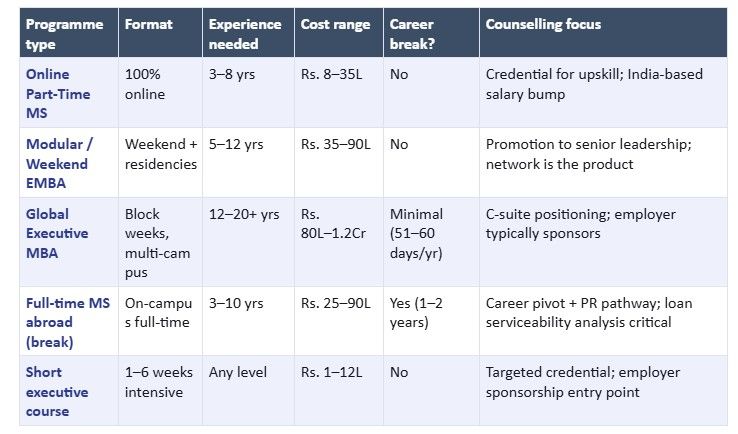
The most underused option: the short executive course as a first step
Many professionals who want an EMBA are not yet ready to make the financial or schedule commitment. A short executive course (2–6 weeks at a reputable institution — INSEAD's Executive Education, LBS Executive Education, IIM programmes) does two things: it produces a credential that justifies a title conversation now, and it builds internal precedent for employer-sponsored education. The short course is often the entry point that makes the full EMBA possible two years later.
Getting your employer to fund it: the sponsorship conversation.
Employer sponsorship for professional education is not a perk reserved for a lucky few. Most large Indian employers — MNCs, IT majors, consulting firms, BFSI institutions — have formal education assistance policies. The reason most professionals never access them is not ineligibility. It is not asking, or asking in the wrong frame.
The frame that fails: "I want to do an MBA abroad and would like the company to help."
The frame that succeeds: 201cThere is a specific capability gap in my team2019s ability to address a strategic priority. I have identified a programme that would directly address it. Here is the business case, the programme details, and the ROI analysis over 18 months.201d
Vidysea counsellors help professionals build the second frame — connecting the programme to a company problem the leadership already cares about. Here is the sector-by-sector landscape:
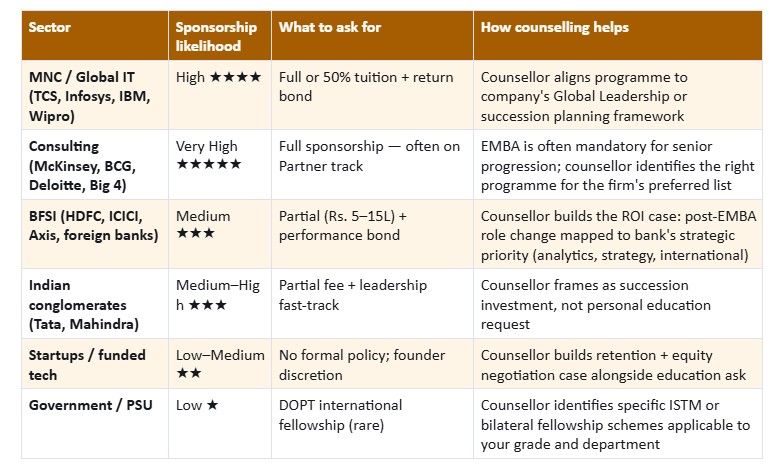
The return bond is normal — negotiate the terms, not the existence
Most employer sponsorship agreements include a 2–3 year return bond. This is standard and reasonable. What is worth negotiating: whether the bond is full-repayment or pro-rata (pro-rata is standard — if you leave after 18 months of a 24-month bond, you repay 25%), and whether the bond applies to salary increments as well as fees (it should not). A counsellor who has seen 200 sponsorship agreements knows which terms are flexible and which are not.
When is the right time? The question every professional postpones.
The most common answer to 'when should I start the counselling process?' is 'next year, when things settle down.' The honest response is that things do not settle down — they restructure. The project that was blocking you in 2023 was replaced by a different project in 2024.
The relevant calculation is not 'do I have time now?' It is 'what is the cost of each additional year of delay?' For a 34-year-old earning Rs. 28 lakh who could be earning Rs. 45 lakh after an online MS, each year of delay is approximately Rs. 17 lakh in forgone salary premium — without accounting for the compounding effect of reaching senior titles earlier.
The counselling session is 30 minutes. It does not commit you to anything. What it does is replace 'I'll think about this properly' with a concrete picture of what the options actually are — which is usually the thing that makes the decision possible.
Questions professionals ask before booking a session.
I haven't studied in 10 years. Will I manage an academic programme?
Yes — with the right support structure. EMBA and online MS programmes are designed for professionals who have been out of full-time study for years. The cohort around you is in exactly the same position. The adjustment period is real but short — most professionals find that work experience makes academic case studies more intuitive, not less. Vidysea's counselling includes a pre-programme academic preparation plan for professionals who want it.
My employer doesn't have a formal education policy. Is sponsorship still possible?
Often yes — particularly in smaller organisations or startups where decisions are made by founders or senior leaders rather than HR policy. The approach is different: instead of citing a policy, you are building a custom case from scratch. Vidysea counsellors have built successful sponsorship cases in organisations with no existing policy, framing it as a retention investment rather than an education expense.
I have a gap year or non-linear career history. Will that hurt my application?
For professional programmes, career narrative matters more than linearity. A gap year that involved building something, caregiving, or a deliberate pivot is explainable and often interesting to admissions committees. What matters is the coherence of the story — why you did what you did, what you learned, and how it connects to what you want to do next. Counsellors help you build that narrative rather than defend against the gap.
Can Vidysea counsellors help with GMAT preparation?
Vidysea's counselling includes GMAT assessment and strategy — identifying your target score for your shortlisted programmes, recommending preparation resources, mapping a preparation timeline around your work schedule, and identifying programmes where GMAT can be waived or replaced with an alternative assessment. Vidysea does not offer GMAT coaching directly, but partners with specialist preparation providers for professionals who need it.
Every working professional's situation is different. The years of experience, the employer, the field, the family, the financial position, the target outcome — all of it changes the answer. That is precisely why generic advice is useless and a counsellor who asks the right questions is not. The session is free. The outcome is a concrete picture of your options — not a brochure, not a ranking list, not a WhatsApp recommendation from a friend who went to a different university with a different profile five years ago.