
Got dreams to achieve? Hop on as we take you on your journey to success!


Services
Contact Info

Noida office
+91 7428715522Bangalore office
+91 8861432223 support [at] vidysea.com
Copyright@Vidysea
Got dreams to achieve? Hop on as we take you on your journey to success!
Noida office
+91 7428715522Bangalore office
+91 8861432223support [at] vidysea.comCopyright@Vidysea
For decades, the "Asian Tiger" has been a magnet for international students, rivaling the US and UK as a top study destination globally. Every year, thousands of students from around the world travel to pursue an MIS in Singapore, seeking its world-class education system, futuristic infrastructure, and incredible post-study work opportunities in the Fintech and Tech sectors. But what makes this island nation such a powerhouse for higher education? Is the investment worth it? In this detailed blog, we’ll explore the top reasons to pursue an MIS in Singapore, the best universities, eligibility requirements, costs, and career benefits — everything you need to know.

Team Vidysea
Published Updated
![Tech Leaders of Tomorrow: The Ultimate Guide to Pursuing MIS in Singapore [2025]](https://cdn.sanity.io/images/5b5wdesf/production/a9d732de07bc3e7920d445ab8f653dcba8748b8b-1024x1536.png?w=1200&fit=max&auto=format)
Singapore is home to some of the world’s most prestigious and modern institutions. Universities like the National University of Singapore (NUS), Nanyang Technological University (NTU), and Singapore Management University (SMU) consistently rank in the global top 20 for technology and business.
When you pursue an MIS in Singapore (Management Information Systems), you are entering an education system that is globally renowned for its rigor. A Singaporean degree is recognized worldwide for its high academic standards and strong industry links, especially in digital transformation and Smart Nation initiatives.
The best part about studying an MIS in Singapore is the direct link to its thriving economy. Singapore is the undisputed "Silicon Valley of Asia," and its course offerings reflect this.
Specializations in MIS in Singapore programs are heavily focused on:
This alignment with industry ensures your MIS in Singapore is future-proof and that you graduate with skills employers like Grab, Shopee, and Google are actively hiring for.
A major reason students choose an MIS in Singapore is the deep integration between universities and global corporations.
Earning an MIS in Singapore significantly enhances your career prospects. The country has a robust economy with a high demand for skilled IT managers and business analysts.
Studying an MIS in Singapore means living in one of the safest and most efficient countries in the world. It is a melting pot of Chinese, Malay, Indian, and Western cultures.
Unlike the automatic 2-year visas in Europe, the pathway after an MIS in Singapore is performance-driven but rewarding.
While pursuing an MIS in Singapore is an investment, scholarships are available to lower the burden.
Vidysea helps students identify these financial aids and apply effectively.
For many, an MIS in Singapore is the first step toward long-term settlement. Singapore’s "PTS Scheme" (Professionals, Technical Personnel and Skilled Workers) allows EP holders to apply for PR.
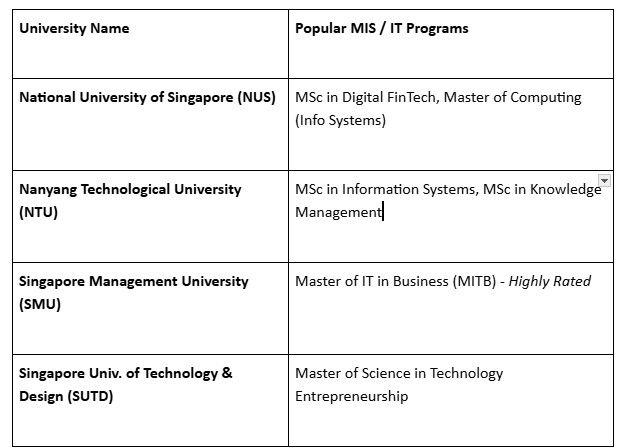
Here are the top-ranked universities offering MIS in Singapore (or equivalent Masters in Information Systems/IT in Business):
To apply for an MIS in Singapore, the criteria are rigorous:
Applying for an MIS in Singapore is a digital-first process:
Navigating the MIS in Singapore process involves understanding the unique "Service Obligation" grants, the SOLAR visa system, and the high entry standards. That’s where Vidysea comes in.
We offer end-to-end guidance — from university shortlisting and GMAT strategy to handling your Student's Pass application. Our experts ensure you choose the right MIS in Singapore course that aligns with the Ministry of Manpower’s skills shortage list.
1. What is the eligibility for MIS in Singapore?
You typically need a good Bachelor’s degree in a relevant field. Top universities (NUS/NTU) often ask for a GMAT/GRE score and some work experience, though freshers can apply to many programs.
2. What is the cost of studying MIS in Singapore?
Tuition fees for an MIS in Singapore typically range from SGD 35,000 to SGD 55,000 for the full program. Living costs are approx SGD 1,500–2,000 per month.
3. How long does an MIS in Singapore take to complete?
Most MIS in Singapore programs are accelerated and take 1 year to 1.5 years to complete.
4. Is GMAT mandatory for MIS in Singapore?
It depends. For NUS, NTU, and SMU, a GMAT or GRE score is often required or gives you a significant advantage. Private institutions usually do not require it.
5. What are the best courses for MIS in Singapore?
The Master of IT in Business (MITB) at SMU and the Master of Computing (Information Systems) at NUS are the most popular choices.
6. Can I work while studying MIS in Singapore?
Yes. International students at approved institutions (like NUS/NTU) can work up to 16 hours per week during term time and full-time during vacations.
7. What are the job opportunities after MIS in Singapore?
Graduates typically move into roles like Business Analyst, IT Consultant, or Product Manager. The MIS in Singapore opens doors to global firms with salaries often starting above SGD 5,000/month.
8. Are scholarships available?
Yes. The "Service Obligation" scheme reduces tuition fees significantly for international students in exchange for a 3-year work bond in Singapore.
Choosing to pursue an MIS in Singapore is one of the most strategic career moves you can make. With top-20 global universities, a fast 1-year degree format, and a gateway to the booming Asian tech market, Singapore offers an unmatched ROI.
Whether you aim for global exposure or a high-paying tech career in Asia, the benefits of studying for your MIS in Singapore are undeniable.
Start your journey today with Vidysea. Let our experts guide you through every step — from securing your offer to your visa success — and help you turn your dream of an MIS in Singapore into reality.