
More reminders

Got dreams to achieve? Hop on as we take you on your journey to success!


Services
Contact Info

Noida office
+91 7428715522Bangalore office
+91 8861432223 support [at] vidysea.com
Copyright@Vidysea
More reminders
Got dreams to achieve? Hop on as we take you on your journey to success!
Noida office
+91 7428715522Bangalore office
+91 8861432223support [at] vidysea.comCopyright@Vidysea
Japan has become one of the most attractive study-abroad destinations for international students seeking world-class education, cutting-edge technology exposure, and global career opportunities. Home to prestigious universities such as the University of Tokyo, Kyoto University, Osaka University, Tohoku University, and Waseda University, Japan offers internationally recognised degrees, strong research opportunities, and access to one of the world's largest economies.

Team Vidysea
Published Updated

Proper financial planning helps students manage expenses effectively and avoid unexpected financial challenges during their stay. While Japan is often perceived as expensive, careful budgeting, scholarships, and part-time work opportunities can make studying in Japan surprisingly affordable.
This comprehensive guide explains the Cost of Study in Japan, including tuition fees, accommodation costs, living expenses, visa-related charges, scholarships, and practical money-saving tips.
The Cost of Study in Japan includes several components beyond tuition fees.
Students should budget for:
The total Cost of Study in Japan varies depending on:
On average, international students spend between ¥80,000 and ¥180,000 per month on living expenses.
Tuition fees form a major portion of the Cost of Study in Japan.
Fortunately, compared to many Western countries, Japanese universities often offer excellent value for money.
Average annual tuition fees:
¥535,800 – ¥600,000 per year
¥500,000 – ¥900,000 per year
¥800,000 – ¥2,000,000+ per year
depending on the course and institution.
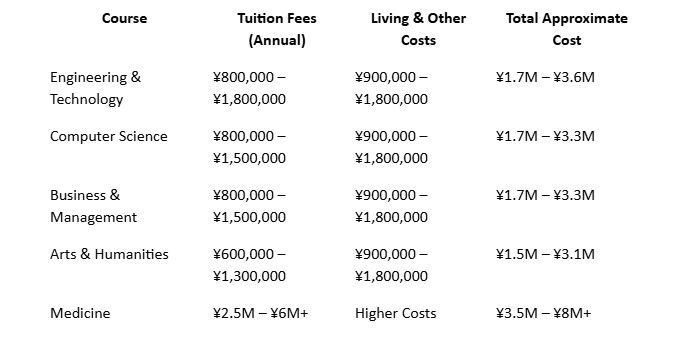
¥600,000 – ¥1,300,000 per year
¥800,000 – ¥1,500,000 per year
¥800,000 – ¥1,800,000 per year
¥2,500,000 – ¥6,000,000+ per year
Medical programmes significantly increase the overall Cost of Study in Japan.
Students pursuing master's degrees generally benefit from affordable tuition compared to other popular study destinations.
¥535,800 – ¥1,500,000 per year
¥1,000,000 – ¥3,500,000+ for the full programme
depending on the institution.
¥535,800 – ¥1,200,000 per year
Research-based scholarships often reduce the overall Cost of Study in Japan for doctoral students.
Many universities require a one-time admission fee.
¥20,000 – ¥35,000
¥200,000 – ¥300,000
These costs should be included when calculating the total Cost of Study in Japan.
Living costs are a significant component of the Cost of Study in Japan.
Expenses vary depending on the city and lifestyle.
Tokyo is generally the most expensive city, while cities such as Fukuoka, Sendai, Hiroshima, and Sapporo are more affordable.
¥20,000 – ¥60,000 per month
¥40,000 – ¥90,000 per month
¥70,000 – ¥150,000+ per month
Tokyo typically has the highest rental costs.
Choosing university housing can significantly reduce the Cost of Study in Japan.
Students generally spend:
¥25,000 – ¥50,000
Cooking at home is one of the most effective ways to manage the Cost of Study in Japan.
Japan has one of the world's most efficient public transportation systems.
¥5,000 – ¥15,000
Student discounts are available on many transport services.
Students should budget approximately:
¥8,000 – ¥15,000
¥3,000 – ¥8,000
Health insurance is mandatory for international students.
Approximately:
¥20,000 – ¥30,000 per year
The Japanese healthcare system offers excellent coverage at affordable rates.
Visa-related expenses should also be included in the Cost of Study in Japan.
Varies by country
Typically:
¥3,000 – ¥6,000 equivalent
Issued before visa application approval.
Universities usually assist students with this process.
Japan offers numerous scholarship opportunities for international students.
The Japanese Government (MEXT) Scholarship is one of the most prestigious funding opportunities.
Benefits may include:
The Japan Student Services Organization (JASSO) provides financial support to eligible students.
Many Japanese universities offer:
Several organizations provide funding for international students.
Scholarships can significantly reduce the overall Cost of Study in Japan.
Japan allows international students to work part-time under specific conditions.
Up to 28 hours per week during academic sessions.
¥1,000 – ¥1,500+
Popular student jobs include:
Part-time employment can help offset the Cost of Study in Japan.
Here are practical ways to manage expenses effectively.
Scholarships can substantially lower tuition and living costs.
Studying outside Tokyo can significantly reduce the Cost of Study in Japan.
Affordable cities include:
Many businesses offer discounts on:
Dormitories are often the most affordable accommodation option.
Part-time jobs can help cover daily expenses.
The average annual Cost of Study in Japan typically ranges between ¥1.5 million and ¥3.5 million, including tuition and living expenses.
Yes. Compared to many Western countries, Japan offers excellent educational quality at a relatively affordable cost.
Yes. Scholarships such as MEXT and JASSO can significantly reduce expenses.
Yes. Students can work up to 28 hours per week with appropriate permission.
Yes. International students must enroll in Japan's National Health Insurance system.
Vidysea helps students plan and manage the Cost of Study in Japan through:
Find universities aligned with your academic profile and budget.
Identify funding opportunities.
Understand tuition and living costs before applying.
Navigate the Japanese student visa process smoothly.
From university selection to arrival in Japan.
Understanding the Cost of Study in Japan is one of the most important steps in planning a successful study-abroad journey. While tuition fees, accommodation, transportation, and daily expenses vary depending on the city and university, Japan remains a highly attractive destination due to its academic excellence, strong career opportunities, safety, and quality of life.
With proper budgeting, scholarships, part-time work opportunities, and expert guidance from Vidysea, international students can manage the Cost of Study in Japan effectively while enjoying a world-class educational experience in one of the world's most technologically advanced nations.


