
More reminders

Got dreams to achieve? Hop on as we take you on your journey to success!


Services
Contact Info

Noida office
+91 7428715522Bangalore office
+91 8861432223 support [at] vidysea.com
Copyright@Vidysea
More reminders
Got dreams to achieve? Hop on as we take you on your journey to success!
Noida office
+91 7428715522Bangalore office
+91 8861432223support [at] vidysea.comCopyright@Vidysea
For many international students, pursuing a Master’s degree in the UK is a dream come true. The country offers world-class education, global exposure, and numerous professional opportunities. But what happens after completing your master’s? Understanding the range of career paths available after MS jobs in UK helps you plan strategically and make informed decisions about your future. This comprehensive guide explores the top industries, job roles, salary expectations, visa options, and FAQs about after MS jobs in UK — so you can take the right steps toward building a successful career.

Team Vidysea
Published Updated
Top Career Opportunities After MS in UK for International Students
For many international students, pursuing a Master’s degree in the UK is a dream come true. The country offers world-class education, global exposure, and numerous professional opportunities. But what happens after completing your master’s? Understanding the range of career paths available after MS jobs in UK helps you plan strategically and make informed decisions about your future.
This comprehensive guide explores the top industries, job roles, salary expectations, visa options, and FAQs about after MS jobs in UK — so you can take the right steps toward building a successful career.
The UK attracts students from around the world each year for postgraduate study. Known for academic excellence and research-intensive learning, it also presents promising employment outcomes after graduation.
Key reasons why after MS jobs in UK appeal to international students include:
These advantages make the UK a compelling choice for those seeking strong career outcomes following their master’s studies.
Upon completing your MS, you can explore a wide range of sectors depending on your specialisation. From Computer Science to Mechanical Engineering and Business Analytics, many fields offer rewarding after MS jobs in UK with competitive salaries and growth prospects.
Computer Science remains one of the most in-demand fields. Graduates often secure positions in tech firms, startups, and research centres.
With businesses increasingly data-driven, the demand for skilled analysts and scientists continues to rise. Top job roles:
Graduates can explore roles in electronics, communications, automation, and power. Top job roles:
Mechanical engineers are valuable across sectors such as automotive, aerospace, and robotics. Top job roles:
Civil and environmental engineers contribute significantly to sustainable infrastructure and urban development. Top job roles:
An MS in Business, Finance, or Analytics prepares you for leadership roles across industries. Top job roles:
To secure after MS jobs in UK, international students must understand the main visa and work permit arrangements.
The UK’s Graduate Route allows international graduates to stay and work (or look for work) for up to two years after completing an eligible course (or three years for doctoral graduates). Notably, employer sponsorship is not required during this period, giving graduates time to secure full-time employment.
After (or during) that period, international graduates may transition to a Skilled Worker Visa (formerly Tier 2). Under this route, you need a job offer from a UK employer who holds a sponsorship licence and you must meet salary and skill thresholds. Having work experience during your Graduate Route period can significantly improve your chances of securing a sponsored role.
Understanding these pathways allows students to strategically plan their transition from study to full-time employment.
Salary levels vary significantly by field, employer, location, and experience. Here are indicative figures and trends (UK equivalents):
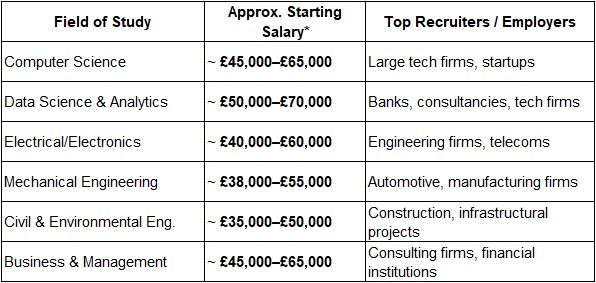
* These are approximate ranges for UK graduates in typical roles; actual salaries will depend on company, location (London vs. elsewhere), and experience.
Choosing the right location can be as important as choosing your field of study. Here are some of the best UK job markets for international graduates:
Landing the right job involves strategy, preparation, and persistence. Here’s how to boost your chances:
While opportunities are plenty, international students should be aware of potential hurdles:
Many institutions and agencies go beyond admission counselling. They help with career mapping, job preparation, and visa guidance to ensure a smooth transition into the UK job market. Services often include:
The UK job market is evolving rapidly. Industries expected to drive future job growth for MS graduates include:
1. What are the most in-demand jobs after MS in UK?Jobs such as Data Scientist, Software Engineer, AI Engineer and Business Analyst are in high demand across technology, finance and engineering sectors.
2. What salary can I expect after MS in UK?Salaries vary by field, company, and location, but many graduates earn in the region of £40,000–£70,000 per annum in UK entry-to-mid-level roles.
3. Can I stay in the UK after completing my MS?Yes. With the Graduate Route visa you can stay and work (or look for work) for up to two years (three years for doctoral graduates) without employer sponsorship.After this period you can move to a Skilled Worker Visa if you have a job offer from a sponsoring employer.
4. How do I find a job in the UK after my MS?Start your job search early: attend career events, network, use your university’s career services, tailor your CV, and apply actively via job portals and LinkedIn.
5. Which UK cities offer the best jobs after MS?Cities like London, Manchester, Bristol, Edinburgh and Cambridge are among the strongest for job growth, especially in tech, finance and engineering.
6. What visa options exist for working after MS in UK?Key routes are the Graduate Route (up to 2 or 3 years) followed by the Skilled Worker Visa if you secure a sponsored job.
7. Is it difficult to find a job after MS in UK?Competition is significant, especially for international students requiring sponsorship, but those who have strong technical skills, internships, and networking experience do have excellent chances.
8. Does every UK university provide job placement help?Most universities offer career support services such as resume workshops, interview practice and job listings, but securing employment also depends on your own performance and effort.
9. Are internships or part-time roles helpful for full-time employment? Absolutely. Internships provide valuable experience, help you build a professional network, and often pave the way to full-time positions after graduation.
Conclusion
Pursuing an MS degree in the UK opens a world of global career opportunities. Whether you’re in engineering, data science, tech or business, the future is bright. Knowing how to navigate the job market, visa process, and growth trends will help you plan effectively.
With the right skill set, determination, and expert support, you can secure one of the many promising after MS jobs in UK and build a successful international career.