More reminders

Got dreams to achieve? Hop on as we take you on your journey to success!


Services
Contact Info

Noida office
+91 7428715522Bangalore office
+91 8861432223 support [at] vidysea.com
Copyright@Vidysea
More reminders
Got dreams to achieve? Hop on as we take you on your journey to success!
Noida office
+91 7428715522Bangalore office
+91 8861432223support [at] vidysea.comCopyright@Vidysea
As businesses worldwide continue to embrace digital transformation, the demand for professionals who can bridge the gap between technology and business strategy is growing rapidly. This is where a Master’s in Information Systems (MIS) becomes highly valuable. For international students seeking advanced education in technology management, business analytics, enterprise systems, and digital innovation, pursuing an MIS in Japan is an increasingly attractive option.

Team Vidysea
Published Updated

Japan is globally recognised for its technological leadership, innovation-driven economy, and strong industrial ecosystem. Home to global companies such as Toyota, Sony, Fujitsu, Hitachi, Panasonic, Rakuten, SoftBank, and NEC, Japan offers students a unique opportunity to study cutting-edge information systems while gaining exposure to real-world business applications.
An combines advanced technical knowledge with business management skills, preparing graduates for leadership roles in today's digital economy. With world-class universities, affordable tuition fees, scholarship opportunities, and growing demand for technology professionals, Japan has become a preferred destination for students interested in information systems and technology management.
This comprehensive guide covers everything you need to know about pursuing an MIS in Japan, including universities, specialisations, admission requirements, costs, scholarships, student visas, and career prospects.
Choosing an MIS in Japan offers students a powerful combination of technology education, industry exposure, and international career opportunities.
Japan remains one of the world's most technologically advanced countries. The nation continues to invest heavily in:
Students pursuing an MIS in Japan gain direct exposure to these rapidly evolving sectors.
Japanese universities place strong emphasis on practical learning, industry collaboration, and applied research.
Many MIS-related programmes include:
This practical approach helps students develop job-ready skills before graduation.
Compared to countries such as the United States, United Kingdom, and Australia, pursuing an MIS in Japan is relatively affordable.
Students benefit from:
This makes Japan an excellent choice for students seeking quality education with a strong return on investment.
As organisations modernise their operations, the demand for information systems professionals continues to increase.
Graduates of an MIS in Japan are highly valued in industries such as:
Many Japanese universities now offer English-taught MIS and technology management programmes designed specifically for international students.
Students enjoy:
MIS stands for Management Information Systems, a discipline that combines business management and information technology.
An MIS in Japan helps students understand how organisations use technology to improve operations, decision-making, customer experience, and business performance.
Students learn both technical and managerial skills, making them ideal candidates for leadership roles in technology-driven organisations.
One of the major advantages of pursuing an MIS in Japan is access to specialised areas aligned with global technology trends.
Learn how organisations use data to make strategic decisions.
Key topics include:
Focuses on managing enterprise technology systems and digital infrastructure.
Explore how businesses adopt modern technologies to remain competitive.
Protect digital assets and manage organisational security risks.
Learn how organisations deploy and manage large-scale technology solutions.
Prepare for advisory and leadership roles in technology-driven organisations.
Several leading universities offer programmes related to MIS, Information Systems, Technology Management, and Business Analytics.
The University of Tokyo is Japan's most prestigious institution and a global leader in technology and management education.
Known for research excellence and interdisciplinary learning.
A premier institution for technology-focused education.
One of Japan's leading universities for business and technology studies.
A top private university offering globally focused programmes.
Highly respected for technology and management education.
To apply for an MIS in Japan, students generally need:
Most universities prefer:
For English-medium programmes:
Overall score of 6.0–7.0
80–100+
Many universities now offer fully English-taught MIS programmes.
Applicants may also need:
Some universities may request:
Applications for an MIS in Japan generally require:
Students with internships, projects, or professional experience in IT or business systems often have stronger applications.
One of the biggest advantages of pursuing an MIS in Japan is affordability.
¥535,800 – ¥800,000 per year
¥600,000 – ¥1,000,000 per year
¥1,000,000 – ¥2,000,000 per year
depending on programme and university.
Students should budget approximately:
¥80,000 – ¥180,000 per month
including:
Tokyo generally has higher living costs than cities such as Osaka, Kyoto, Fukuoka, and Sendai.
International students can access several scholarship opportunities.
The Japanese Government Scholarship covers:
Provides financial support to eligible international students.
Many universities offer:
Graduate students may also receive assistantships and project-based funding.
International students must obtain a Japanese Student Visa.
Required documents typically include:
After arriving in Japan, students receive a Residence Card and can legally study and work part-time.
Students pursuing an MIS in Japan can work part-time.
Up to 28 hours per week during academic sessions.
Full-time work may be allowed during approved vacation periods.
This provides valuable work experience and additional income.
Graduates of an MIS in Japan are highly employable across multiple industries.
Popular job roles include:
Analyse organisational performance and recommend technology solutions.
Help businesses improve operations through technology.
Design and manage information systems.
Lead digital product development initiatives.
Convert business data into strategic insights.
Manage enterprise technology projects and digital transformation initiatives.
Oversee organisational IT infrastructure and digital operations.
Average annual salary ranges include:
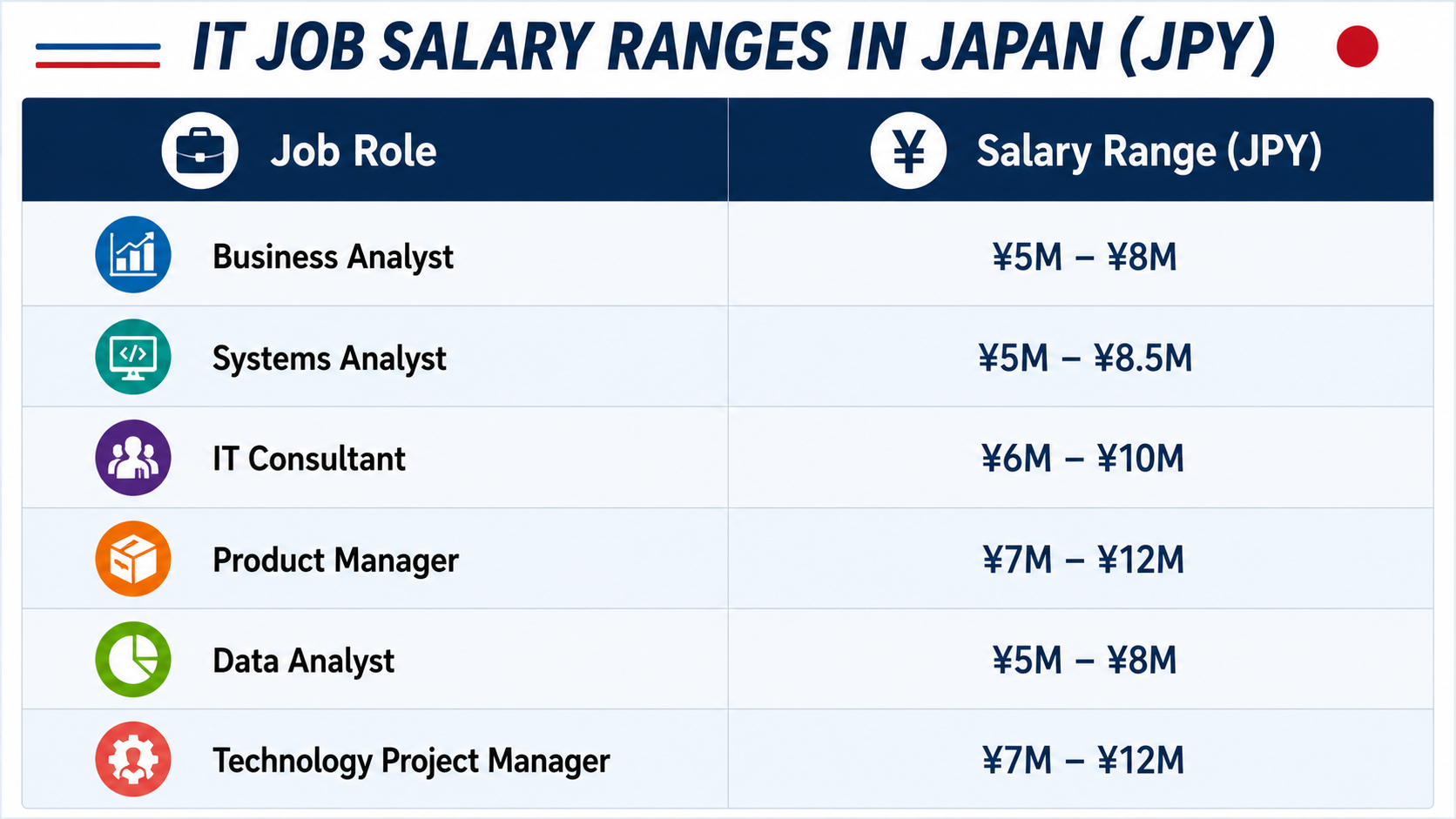
Professionals with Japanese language proficiency and industry experience can earn significantly higher salaries.
Applying for an MIS in Japan involves multiple stages, from university selection to visa processing.
Vidysea helps students through:
Find universities that fit your academic profile and career goals.
Guidance for SOPs, LORs, and documentation.
Identify suitable scholarships and financial aid opportunities.
Complete support for student visa applications.
Prepare confidently for life and studies in Japan.
Yes. An MIS in Japan offers strong career prospects, global exposure, and access to one of the world's most advanced technology ecosystems.
Yes. Many universities offer English-taught programmes in Information Systems, Technology Management, and Business Analytics.
Most universities do not require GMAT or GRE, though they may strengthen certain applications.
Yes. Students can work up to 28 hours per week during their studies.
Not mandatory for admission to many programmes, but learning Japanese significantly improves internship and employment opportunities.
Pursuing an MIS in Japan is an excellent choice for students seeking a combination of technology expertise and business leadership skills. With world-class universities, affordable tuition fees, scholarship opportunities, strong industry connections, and growing demand for digital professionals, Japan provides an outstanding environment for academic and career success.
Whether your goal is to become a Business Analyst, IT Consultant, Product Manager, or Technology Leader, an MIS in Japan can provide the knowledge, experience, and global exposure needed to succeed in today's digital economy. With Vidysea's expert guidance and AI-powered support, your journey from application to career success becomes smooth, structured, and rewarding.