Master Business in Asia: A Guide to the Top Universities for MBA in Singapore
Pursuing an MBA in Singapore is a strategic move for students from India and across the world. As the undisputed financial and technology hub of Asia, Singapore offers a dynamic, English-speaking environment that bridges the East and West. With globally ranked business schools and a highly paid workforce, it is one of the most preferred destinations for ambitious MBA aspirants. However, the competition is fierce, and choosing the right university can feel overwhelming. This comprehensive guide will help you understand how to select the Top Universities for MBA in Singapore, review eligibility criteria, evaluate costs in Singapore Dollars (SGD), and explore high-return career opportunities—all while using Vidysea, your AI-powered study abroad platform.

Team Vidysea
March 23, 2026

Why Choosing the Right MBA University in Singapore Matters
Selecting the right university is more than just picking a famous name—it directly affects your:
- Career prospects: The Top Universities for MBA in Singapore have direct recruitment pathways with the world's largest Tech (Google APAC, Grab, Sea Group), Finance (DBS, Standard Chartered), and Consulting firms (McKinsey, BCG), all of which have regional HQs in the city.
- Learning experience: Curriculum quality differs widely. Schools like NUS and INSEAD offer specific "Asian Business" modules that you won't find elsewhere.
- Networking opportunities: A Singaporean alumni network opens doors to career growth across Southeast Asia, China, and India.
- Return on Investment (ROI): Singapore offers some of the highest post-MBA salaries in the world, often with lower income tax rates compared to the West.
The Top Universities for MBA in Singapore offer a mix of prestige, global exposure, and career outcomes. Your choice should depend on personal goals, budget, and future career plans.
Step 1: Identify Your Career Goals
Before shortlisting the Top Universities for MBA in Singapore, define your career aspirations:
- Finance & Fintech: Consider the National University of Singapore (NUS) or Singapore Management University (SMU), both located in the heart of the financial district.
- Tech & Innovation: Nanyang Technological University (NTU) is world-renowned for its integration of business with technology and sustainability.
- Global Consulting: INSEAD (Singapore Campus) is a global heavyweight for placing graduates into top-tier strategy consulting.
Step 2: Consider Program Specializations
Different universities in Singapore offer distinct MBA specializations such as:
- Digital Business & Transformation
- Finance & Wealth Management
- Supply Chain & Logistics (Singapore is a global logistics hub)
- Asian Management & Strategy
- Innovation & Entrepreneurship
Choosing the right specialization ensures your MBA aligns with the dynamic Asian market.
Step 3: Evaluate University Rankings
Rankings help you identify leading business schools. Singaporean universities consistently dominate global lists:
- QS Global MBA Rankings (NUS and NTU frequently appear in the global top 25).
- Financial Times (FT) Global MBA Rankings.
While rankings are useful, also assess placement rates and the school’s connection to the ASEAN multinational landscape before deciding on the Top Universities for MBA in Singapore.
Step 4: Check Eligibility Requirements
Understanding eligibility is crucial. Common requirements for the Top Universities for MBA in Singapore include:
- Academic Qualifications: A bachelor’s degree from a recognized institution with a good GPA.
- Work Experience: Most top MBA programs (like NUS or NTU) require a minimum of 2–3 years of full-time professional work experience.
- GMAT/GRE Scores: These are highly recommended. Top-tier schools usually expect a GMAT score of 600–660+.
- English Proficiency: IELTS or TOEFL scores are mandatory if your undergraduate degree was not taught in English.
- SOP and References: A strong Statement of Purpose and professional references are key for admission.
Vidysea helps students analyze their profiles using AI insights to identify admission chances at the Top Universities for MBA in Singapore.
Step 5: Consider Location and Cost of Study
Unlike larger countries, Singapore is a city-state, meaning all universities offer access to the central business districts. However, costs vary:
- Tuition Fees: At the Top Universities for MBA in Singapore, fees generally range from SGD $65,000 to SGD $95,000+ (approx. ₹40L - ₹60L) for the full program. Private providers may be cheaper, but the ROI is highest at top-tier public universities.
- Living Costs: Singapore is a premium destination. Budget approx SGD $1,500 – $2,500 per month for rent and living.
Step 6: Research Career Opportunities and Visa Rules
The right MBA program should offer strong placement support. Key things to know:
- Post-Study Work Options: Graduates from valid institutions can apply for a Long-Term Visit Pass (LTVP) (typically 1 year) to stay and look for jobs.
- Employment Pass (EP): Once you secure a job with a qualifying salary (often SGD $5,000+), your employer will sponsor an Employment Pass, allowing you to work long-term.
- Salaries: The average post-MBA salary for graduates from the Top Universities for MBA in Singapore often exceeds SGD $100,000 – $120,000 per annum.
Step 7: Compare Curriculum and Teaching Methods
The Top Universities for MBA in Singapore are known for dynamic learning models such as:
- "The Asian Century" Focus: Case studies focused on the rise of Asian economies.
- Consulting Projects: Real-world projects with companies like Shopee, Lazada, or Dyson.
- Accelerated Format: Many Singaporean MBAs are 12 to 18 months long, offering a faster ROI than traditional 2-year US programs.
Step 8: Explore Scholarships and Financial Aid
Studying in Singapore is an investment, but scholarships make it manageable. Many Top Universities for MBA in Singapore offer:
- University Specific Scholarships: E.g., The "NUS MBA Study Awards" or "Nanyang Scholarship" (can cover 15% to 100% of tuition).
- ASEAN Scholarships: For students from the region.
- Merit-based Awards: For candidates with high GMAT scores and leadership potential.
Vidysea helps students discover scholarships and funding options suited to their profiles.
Step 9: Use AI-Powered Platforms Like Vidysea
Choosing the right MBA university becomes easier with AI-based assistance. Vidysea offers:
- AI Profile Evaluation: Understand your admission chances instantly.
- Smart University Matching: Discover the best-fit Top Universities for MBA in Singapore for your goals.
- Application Tracking: Monitor your progress and deadlines.
- Visa & Scholarship Guidance: Comprehensive support for your study abroad journey.
With Vidysea, you can make confident decisions and simplify the entire application process.
Step 10: Make Your Final Decision
After researching, shortlist 3–5 schools. Consider:
- Career goals (Finance vs Tech).
- ROI and available scholarships.
- Visa pathways (LTVP eligibility).
- Alumni network strength in Asia.
Apply strategically to increase your chances of success at one of the Top Universities for MBA in Singapore.
Top Universities for MBA in Singapore to Consider
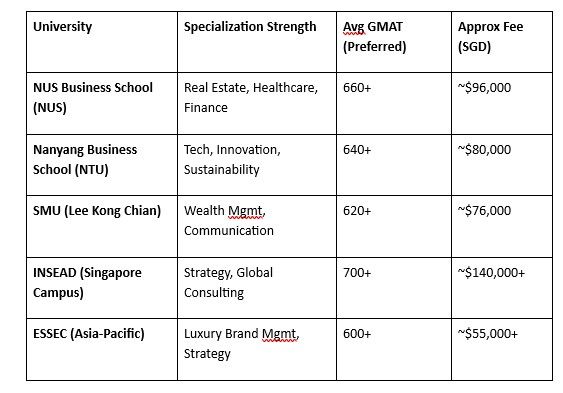
Note: Fees are approximate and subject to change. Always check the official university website.
These universities combine academic excellence, industry exposure, and global networking, making them the Top Universities for MBA in Singapore.
Popular FAQs About Top Universities for MBA in Singapore
1. What are the Top Universities for MBA in Singapore?
NUS (National University of Singapore), NTU (Nanyang Technological University), and SMU (Singapore Management University) are the "big three" local giants. INSEAD is a top global choice with a major Singapore campus.
2. What is the eligibility to apply for an MBA in Singapore?
You typically need a recognized bachelor’s degree, 2+ years of work experience, and English proficiency (IELTS/TOEFL). A competitive GMAT score is highly recommended for the top public universities.
3. How much does it cost to study at the Top Universities for MBA in Singapore?
Tuition fees generally range from SGD $65,000 to SGD $98,000 for the full program at top-tier schools.
4. Is GMAT required for an MBA in Singapore?
For the Top Universities for MBA in Singapore like NUS and NTU, a good GMAT score significantly boosts your chances. Some private institutions may waive it based on experience.
5. Are scholarships available?
Yes. Merit-based scholarships and diversity awards are available at NUS, NTU, and SMU. Vidysea helps students find suitable options.
6. How long is an MBA program in Singapore?
Most programs are 12 months (1 year), though some offer extensions to 18 months for internships.
7. Can I work while studying in Singapore?
Yes, full-time matriculated students at approved universities (like NUS/NTU) can work up to 16 hours per week during term time and unlimited hours during vacation.
8. How does Vidysea help students applying to the Top Universities for MBA in Singapore?
Vidysea provides AI-driven guidance, university matching, scholarship help, and student visa (Student's Pass) assistance to streamline your entire journey.
Conclusion
Choosing the right MBA university in Singapore requires careful planning. From eligibility and cost to specialization and career goals, every factor matters. The Top Universities for MBA in Singapore offer exceptional education, deep industry connections in Asia, and a direct pathway to a high-earning career via the Employment Pass route.
With Vidysea, Indian and international students can simplify their study abroad journey—from university selection to scholarship search and visa support.
Start your MBA journey today with Vidysea—your trusted study abroad partner