Why Study MS in UK? Top Reasons, Universities, and Career Benefits
For decades, the United Kingdom has been one of the most sought-after destinations for higher studies. Every year, thousands of students from around the world travel to pursue an MS in UK, looking for world-class education, international exposure, and excellent career options. But what makes the UK such a popular destination? Is it really worth the investment? In this detailed blog, we’ll explore the top reasons to study in the UK, the best universities, eligibility requirements, costs, and career benefits — everything you need to know before planning your MS in UK.

Team Vidysea
November 24, 2025

1. Global Reputation for Academic Excellence
The UK is home to some of the world’s top institutions — like University of Oxford, University of Cambridge, Imperial College London and London School of Economics and Political Science — which are globally recognised for cutting-edge research, innovative programmes and experienced faculty.
When you pursue an MS in UK, you enter an academic world that values creativity, research, and real-world problem-solving. UK universities are known for their rigorous standards, strong research emphasis, and internationally recognised credentials.
2. Wide Range of Specialisations
One of the strong appeals of doing an MS in UK is the wide array of specialisations available. Whether you’re interested in Computer Science, Mechanical Engineering, Biotechnology, Data Analytics or other emerging fields, there’s a programme for you.
The UK’s educational system also allows you to tailor your degree with electives or special focus areas, aligning your coursework with your career goals. This flexibility ensures your degree matches your ambitions.
3. Research and Innovation Opportunities
The UK is known for significant investment in research and innovation. By studying an MS in UK you get access to advanced labs, experienced professors and industry collaborations.
Whether it’s renewable energy, AI, biotechnology or engineering, you’ll find opportunities to engage in meaningful projects and gain hands-on experience — which sets you apart in a competitive global job market.
4. Career Opportunities and Global Recognition
Earning an MS in UK can significantly enhance your career prospects. UK credentials are respected globally, and the country’s industries—from finance and technology to engineering and life-sciences—offer strong employment networks.
In terms of “after MS jobs in UK”, many roles are available for graduates. Entry-level salaries for MS graduates can range around £30,000–38,000 per year depending on discipline and location.
High-demand fields (software engineering, data science, renewable energy) can command higher salaries, sometimes £45,000–£90,000 or more depending on role and experience.
The UK also offers a post-study work route (the Graduate Route), which allows international students to stay and work in the UK for up to two years after the MS, building valuable practical experience.
5. Multicultural Learning Environment
Studying an MS in UK means you’ll be part of a diverse, multicultural student body. You’ll meet peers from across the globe, working alongside them in classes, labs and group projects. This exposure enhances communication skills, teamwork and adaptability — all of which are valuable in global careers.
6. Shorter Duration & Flexible Learning
Many MS programmes in the UK are designed to be compact and efficient. Typically, they last one year full-time (for taught Master’s programmes) — which means you can enter the workforce sooner.
This shorter duration helps reduce living costs and time out of the workforce compared with longer programmes elsewhere. The UK system also often allows part-time, distance or flexible learning options.
7. Scholarships and Financial Support
While studying in the UK can be expensive, there are many scholarships, bursaries and assistantship programmes available to international students. Many universities also offer research or teaching assistant roles which can support your living costs and tuition fees.
It’s worth exploring university-specific scholarships as well as governmental or third-party funding options.
8. Post-Study Work and Career Benefits
After completing your MS in UK, you can take advantage of the UK’s post-study work opportunities: the Graduate Route allows you to stay up to two years to work or look for work.
This experience gives you real-world exposure, enhances your employability, and helps build a professional network in the UK or internationally. Over time, this can lead to better career growth, higher salaries and broader global mobility.
9. Top Universities for MS in UK
Here are some of the top-ranked UK universities for MS programmes:
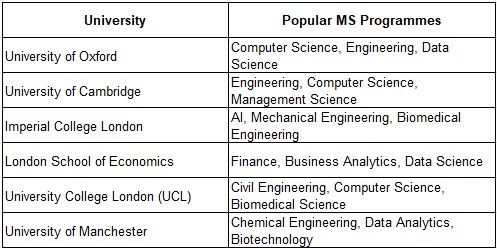
Each of these universities has its unique strengths — your choice should depend on your subject interest, budget, and career goals.
10. Admission Requirements and Eligibility
To apply for an MS in UK, you generally need to meet the following:
- A Bachelor’s degree (typically 3-4 years) from a recognised institution.
- A strong academic record.
- English language proficiency (IELTS/TOEFL or equivalent).
- A Statement of Purpose (SOP), Letters of Recommendation (LORs), and CV.
- Some programmes may require GRE/GMAT or subject-specific tests (depending on the university & course).
- Proof of funds to cover tuition and living expenses.
- Visa application (for international students) and acceptance of offer from university.
11. Application Process for MS in UK
Here’s a typical step-by-step process:
- Research and shortlist universities and MS programmes that match your interest and budget.
- Prepare for English language test (and any other required tests like GRE/GMAT).
- Gather academic transcripts, LORs and prepare your SOP.
- Submit applications before deadlines (UK universities often have multiple intakes but many MS programmes begin in Autumn/Fall).
- Once you receive offers, choose your university, accept the offer and obtain your confirmation of acceptance (CAS) or equivalent.
- Apply for the Student Visa (Tier 4 or Student Route visa) to the UK.
- Make arrangements for travel, accommodation and pre-departure preparation.
- Arrive in the UK, attend orientation and begin your MS programme.
12. How Vidysea Can Help You
Pursuing an MS in UK is a significant decision — and the process can be complex, from selecting universities to managing applications and visas. A good education consultancy offers end-to-end guidance: from counselling and test preparation to university shortlisting, application management, scholarship advice and visa assistance.
With expert support, your journey toward studying an MS in UK becomes simpler, smoother and less stressful.
Frequently Asked Questions (FAQs) About MS in UK
1. What is the eligibility for MS in UK? You generally need a recognised bachelor’s degree, relevant tests (if required), English language proficiency and a strong academic background.
2. What is the cost of studying MS in UK? Fees vary widely based on university and course, but many international students pay between £15,000 to £35,000 (or higher) for taught programmes.
3. How long does an MS in UK take to complete? Most taught MS programmes in the UK are one year full-time. Research-based ones may take longer.
4. Is GRE mandatory for MS in UK? Some universities may require GRE/GMAT, but many UK programmes do not require them — it depends on the field and institution. Always check specific course requirements.
5. What are the best courses for MS in UK? Popular choices include Computer Science, Data Science, Engineering (Mechanical, Civil, Electrical), Finance, Business Analytics, Biotechnology, Renewable Energy.
6. Can I work while studying MS in UK? Yes — international students typically have permission to work part-time (e.g., up to 20 hours/week) during term time and full-time during vacations (depending on visa conditions).
7. What are the “after MS jobs in UK”? After completing your MS, many graduates go into roles such as Software Engineer, Data Scientist, Mechanical or Civil Engineer, Business Analyst, Research Scientist, Environmental Consultant, etc. Entry-level salaries often start at around £30,000–38,000, with higher pay for in-demand fields.
8. Are scholarships available for MS in UK? Yes — there are scholarships, bursaries and assistantships. These vary by university, subject and student profile.
9. Which intake is best for MS in UK? The Autumn (Fall) intake (September/October) is typically the main and most popular session, with the widest range of courses and scholarship opportunities.
10. Why choose [Your Consultancy/Service] for MS in UK guidance? We provide personalised counselling, help you select the right university, assist with applications, SOPs, visa process, and scholarship strategy — making your journey to an MS in UK smooth and successful.
Conclusion
Choosing to pursue an MS in UK is a life-changing decision. From world-class education and international exposure to strong career prospects and post-study work opportunities, the UK continues to stand out as a top destination for global students.
Whether it’s innovation, specialised learning, or high employability — the advantages of studying in the UK are compelling.
Start your journey today with [Your Consultancy/Service], your trusted partner. Let us guide you through every step — from university applications to visa success — and help you turn your dream of an MS in UK and the opportunities of after MS jobs in UK into reality.